
The World's Most Future-Ready Universities: What Global Rankings Don't Tell You in 2026

The best universities in global rankings 2026 occupy a peculiar position: they are simultaneously the most trusted signal in international higher education and the least reliable guide to the question prospective students and institutional partners most urgently need answered. Which universities are genuinely prepared for the world as it is becoming — not as it was when the current ranking methodologies were designed?
That question matters more than it ever has. The higher education landscape is being reshaped by forces that no current league table adequately captures: the integration of artificial intelligence into research and pedagogy, the re-alignment of graduate labour markets around capabilities rather than credentials, the emergence of new academic powerhouses outside the traditional Anglo-American axis, and the growing demand from governments and employers alike for universities that produce demonstrable societal value, not merely citation counts.
What Global University Rankings Actually Measure and What They Miss
The three dominant global ranking systems — QS World University Rankings, Times Higher Education World University Rankings, and the Academic Ranking of World Universities (Shanghai Ranking) — measure a consistent set of proxies: academic reputation surveys, faculty-to-student ratios, citations per faculty, employer reputation, and international diversity. These are not trivial indicators. They correlate meaningfully with research output quality, resource availability, and the density of high-performing peer networks.
What they do not measure is adaptive capacity. A university's ability to redesign curriculum at speed, to integrate emerging fields before they appear in citation databases, to build industry partnerships that generate employable graduates rather than merely employable graduates from prestigious institutions — none of this surfaces in a ranking column. The result is a system that is excellent at measuring the past and structurally blind to the future.
The distinction is consequential. MIT has appeared in the QS top three for over a decade — and also happens to be radically rethinking its undergraduate curriculum around computational thinking and human-machine collaboration. But the ranking cannot tell you which of those facts is more relevant to a prospective student choosing where to spend four years and $300,000.
"The ranking tells you what a university was. The question you actually need answered is what it is becoming — and those are very different investigations."
The Three Dimensions of Future-Readiness That Rankings Ignore
1. Curriculum velocity
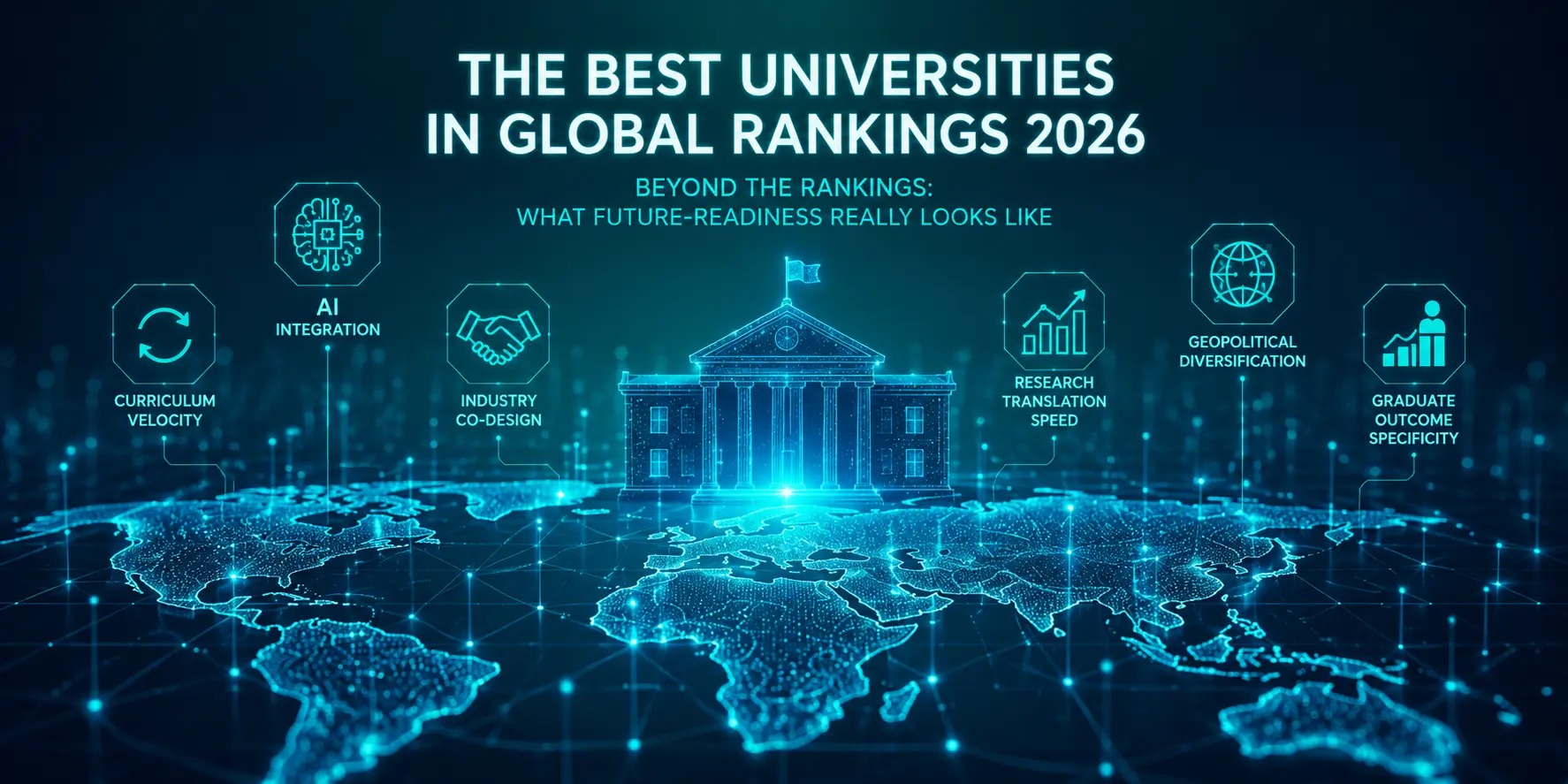
The most revealing indicator of institutional future-readiness is not what a university currently teaches but how quickly it can change what it teaches. When a new field — computational biology, climate finance, AI governance — moves from frontier research to workforce demand, the gap between first-mover universities and the rest is measured in years, not months. That gap has direct consequences for graduate outcomes.
Institutions demonstrating exceptional curriculum velocity in 2026 include KAIST (Korea Advanced Institute of Science and Technology), which has redesigned 40% of its undergraduate programme around AI-integrated learning since 2022, and the African Leadership University, whose competency-based curriculum is rebuilt annually in partnership with employer cohorts across twelve African markets. Neither ranks in the global top 100. Both are producing graduates whose capabilities align more precisely with 2026 labour market demands than many institutions ranked fifty places above them.
2. Research translation speed
Citation counts measure how often academic work is read by other academics. They do not measure how quickly that work reaches the policy tables, clinical settings, corporate R&D programmes, and public systems where it generates real-world value. Research translation speed — the institutional capacity to move from discovery to deployment — is one of the most economically significant dimensions of university performance and one that existing global rankings are structurally unequipped to assess.
The University of Waterloo's deep integration with Canada's technology sector, ETH Zurich's systematic commercialisation infrastructure, and the National University of Singapore's cluster-based research model linking laboratories directly to government and industry partners represent three distinct approaches to translation speed that have produced measurable economic outcomes. Each institution ranks well by conventional metrics; but the translation architecture is the actual competitive asset, and it does not appear in the league table.
3. Geopolitical portfolio diversification
The concentration of global university rankings at Anglo-American institutions reflects historical investment patterns, English-language publication dominance, and network effects that compound over decades. It does not reflect the current distribution of intellectual activity, research investment, or graduate talent production.
China's investment in its Double First-Class universities has produced institutions — Tsinghua, Peking University, Fudan, USTC — whose research output in STEM fields now rivals or exceeds comparable Western peers by volume. Saudi Arabia's KAUST has attracted a faculty roster that would be competitive with any top-20 global institution. India's IIT system produces engineering graduates whose global placement rates challenge the implicit hierarchy of the ranking tables.
For institutional partners, recruiters, and prospective graduate students making decisions in 2026, a working knowledge of the best universities across global rankings requires active engagement with this diversification — not passive reliance on a methodology that still weights English-language citation databases more heavily than research conducted in Mandarin, Arabic, or Hindi.
_1784698654.png)
The Institutions Are Redefining What a University Can Be
The most genuinely future-ready institutions in 2026 are not necessarily the highest-ranked. They are the ones that have made deliberate, structurally committed decisions to operate differently — in how they admit students, how they design learning, how they measure their own success, and how they relate to the societies they serve.
Minerva University has no campus, teaches entirely through active learning seminars conducted across seven global cities, and admits students on demonstrated cognitive potential rather than standardised test scores. Its graduate outcomes in creative problem-solving and cross-cultural leadership consistently outperform institutions ranked several hundred places above it by conventional metrics. It does not appear in the QS top 500. That omission is more revealing about the ranking than about Minerva.
Arizona State University — ranked outside the global top 100 — has become the world's largest university by enrolment while simultaneously achieving the highest rates of social mobility of any research university in the United States. Its publicly stated mission is to measure success by the breadth of its societal impact rather than the exclusivity of its admissions. That mission is incompatible with climbing a ranking system that rewards selectivity as a proxy for quality.
“Future-readiness is not a ranking position. It is an institutional posture — a set of choices about what matters, made visible through structure, investment, and the courage to be measured differently."
What the Best Global University Rankings in 2026 Should Be Asking
The ranking systems are not unaware of these limitations. QS introduced its Sustainability Ranking in 2023. THE's Impact Rankings measure performance against the UN Sustainable Development Goals. The U-Multirank system, developed with European Commission support, attempts a multi-dimensional profile that resists single-number reduction. These are genuine improvements — but they remain marginal to the dominant conversation, and they still do not capture the dimensions that will determine which universities lead in 2036.
A genuinely useful ranking for institutional decision-makers in 2026 would assess: the speed at which curriculum responds to labour market signal; the ratio of research output that reaches non-academic application within five years; the diversity of geographic and disciplinary influence (not merely the diversity of student nationalities); the quality of industry and government partnerships as measured by co-investment and graduate placement; and the institution's own stated theory of societal impact, assessed against evidence.
No such ranking currently exists at scale. Until it does, the most important skill for anyone navigating global higher education — as a student, an administrator, an employer, or a policy maker — is the ability to look past the number and interrogate the institution directly.
How to Evaluate University Future-Readiness: A Framework for Institutional Audiences
For university administrators benchmarking their own institutions, and for prospective students and partners evaluating the field, the following indicators are more predictive of future performance than any current ranking position:
01
Curriculum revision cycle: How frequently is the core curriculum formally reviewed and restructured? Annual cycles indicate adaptability; decade-long cycles do not.
02
AI integration depth: Is artificial intelligence embedded as a cross-disciplinary competency in core programmes, or siloed in a computer science department?
03
Industry co-design: Are employer partners involved in curriculum design, or merely consulted at graduation fairs?
04
Research-to-application pipeline: What proportion of research outputs are licensed, commercialised, or adopted by public sector partners within five years of publication?
05
Graduate outcome specificity: Does the institution publish granular graduate outcome data — by programme, by year, by sector — or only aggregate employability statistics designed for ranking submission?
_1784698704.png)
Frequently Asked Questions
Q: Which universities top the global rankings in 2026?
A: The leading institutions in the major global university rankings in 2026 include MIT, University of Oxford, Harvard University, University of Cambridge, and Imperial College London across the QS and Times Higher Education systems. However, ranking position in 2026 is an increasingly incomplete guide to institutional quality. Future-readiness indicators — curriculum velocity, research translation speed, AI integration, and industry co-design — are not captured by conventional rankings and frequently identify high-performing institutions outside the top 50.
Q: Are global university rankings a reliable guide for choosing a university in 2026?
A: Rankings provide a useful but partial signal. They reliably indicate research output concentration, resource availability, and peer network quality. They do not measure curriculum relevance to current labour markets, institutional adaptability, research-to-application speed, or social mobility outcomes. For prospective students in 2026, ranking position should be one input in a broader evaluation that includes programme-specific outcomes, industry partnership quality, and the institution's demonstrated capacity to evolve.
Q: Which universities outside the traditional top 10 are most future-ready in 2026?
A: Several institutions outside the conventional global top 10 demonstrate exceptional future-readiness by non-ranking criteria. KAIST (South Korea) leads in AI-integrated curriculum redesign. The National University of Singapore combines research translation infrastructure with deep regional industry networks. ETH Zurich maintains systematic commercialisation pathways. Arizona State University leads on social mobility and access at scale. African Leadership University is pioneering competency-based employer co-design. Minerva University's active learning model produces measurable cognitive outcomes that consistently outperform higher-ranked peers.
The Universities That Will Lead in 2036 Are Making Choices Today That Rankings Cannot See
The best universities in global rankings 2026 deserve their reputations. What they do not deserve is the analytical monopoly they currently hold over how the world evaluates higher education quality. The institutions that will define the next decade of global academic leadership are making structural choices right now — about curriculum architecture, research translation, AI integration, and societal accountability — that no current league table is equipped to reward.
For prospective students, the implication is clear: the ranking is a starting point, not a conclusion. For institutional leaders, it is more urgent still: the metrics you are being ranked against are measuring the past, and the future is already being built by institutions willing to be judged by harder questions.