
Beyond Test Scores: Better Ways to Evaluate Teacher Effectiveness and Student Learning Outcomes

For decades, test scores have been the default measure of teacher performance. But what if the most meaningful learning never appears on a standardised exam? Teacher effectiveness evaluation has long relied on a single, imperfect instrument: the standardised test score. A student scores 95% on every written assessment yet when faced with a real-world problem, they cannot apply the same concepts. Another student, who consistently earns average grades, shows genuine curiosity, asks probing questions, and improves steadily over time. Which of these reflects truly effective teaching? This conflict sits at the heart of modern education. For decades, schools have used standardised test scores as the primary method of evaluating teacher performance within the classroom environment specially in schools — scores that offer a basis for comparison and accountability, but present an incomplete picture. They consistently prioritise short-term performance over long-term student learning outcomes. As the world increasingly demands critical thinking, adaptability, collaboration, and innovation, we must rethink how we assess what happens in classrooms.
It is no longer enough for students to recall information; they must be able to apply it meaningfully. The time has come to move beyond test scores and adopt smarter, more holistic assessment methods that genuinely reflect the impact of teaching on student growth.
Why Test-Based Teacher Performance Evaluation Falls Short
Standardised tests are not inherently flawed; they serve a purpose in system-wide benchmarking. The problem arises when they become the primary, or sole, method of evaluating teacher performance. Research by education scholar John Hattie, whose Visible Learning meta-analysis synthesised findings from over 50,000 studies, consistently shows that the quality of teacher feedback and the depth of student engagement are far stronger predictors of learning gains than any single test result.
First, test-based evaluation enforces a narrow definition of academic success. It predominantly measures recall and procedural accuracy, leaving little room for assessing deeper conceptual understanding or real-world application. Students may excel at reproducing textbook content yet struggle to transfer that knowledge to unfamiliar situations.
Second, it encourages teaching to the test. When teachers face pressure to raise scores, they often prioritise test-taking strategies over meaningful learning experiences. The result is shallow engagement — a shift in focus from understanding to performance on paper.
Third, standardised assessments largely ignore 21st-century skills: creativity, collaboration, communication, and emotional intelligence. These competencies are critical for future success, yet rarely captured through conventional testing.
Finally, test scores offer no insight into individual learning trajectories. They do not reflect where a student began, what obstacles they navigated, or how significantly they progressed. In doing so, they risk misrepresenting both student potential and teaching quality — making them a poor standalone tool for teacher performance evaluation.
Case Study: What Student Learning Portfolios Reveal That Tests Cannot
Three students in an eighth-grade science class — Riya, Arjun, and Meera — offer a striking illustration of this gap in student assessment methods. Riya and Arjun consistently scored above 90% on written tests. They reproduced diagrams with precision and followed problem-solving procedures exactly. On paper, they were model students — and, by extension, apparent evidence of effective teaching.
Their limitations surfaced during a project-based learning unit on Sustainable Energy Solutions. Asked to build a simple working model demonstrating the application of renewable energy, both students faltered. They struggled to bridge the gap between theory and practice, and hesitated when asked to articulate their reasoning. Meera, whose test scores hovered around 70%, took a different approach. She constructed a functioning solar-powered prototype using locally available materials, explained her thinking with clarity, connected scientific concepts to real-world contexts, and answered her peers' questions with confidence. This experience prompted the school to overhaul its student assessment framework. Teachers introduced performance-based assessments, student learning portfolios documenting progress over time, and application-focused tasks that cut across disciplines.
Within one academic year, classrooms became more dynamic, student engagement deepened, and knowledge retention improved measurably. The takeaway was clear: what students can do with knowledge is a far more meaningful indicator of teacher effectiveness than what they can reproduce on a test.
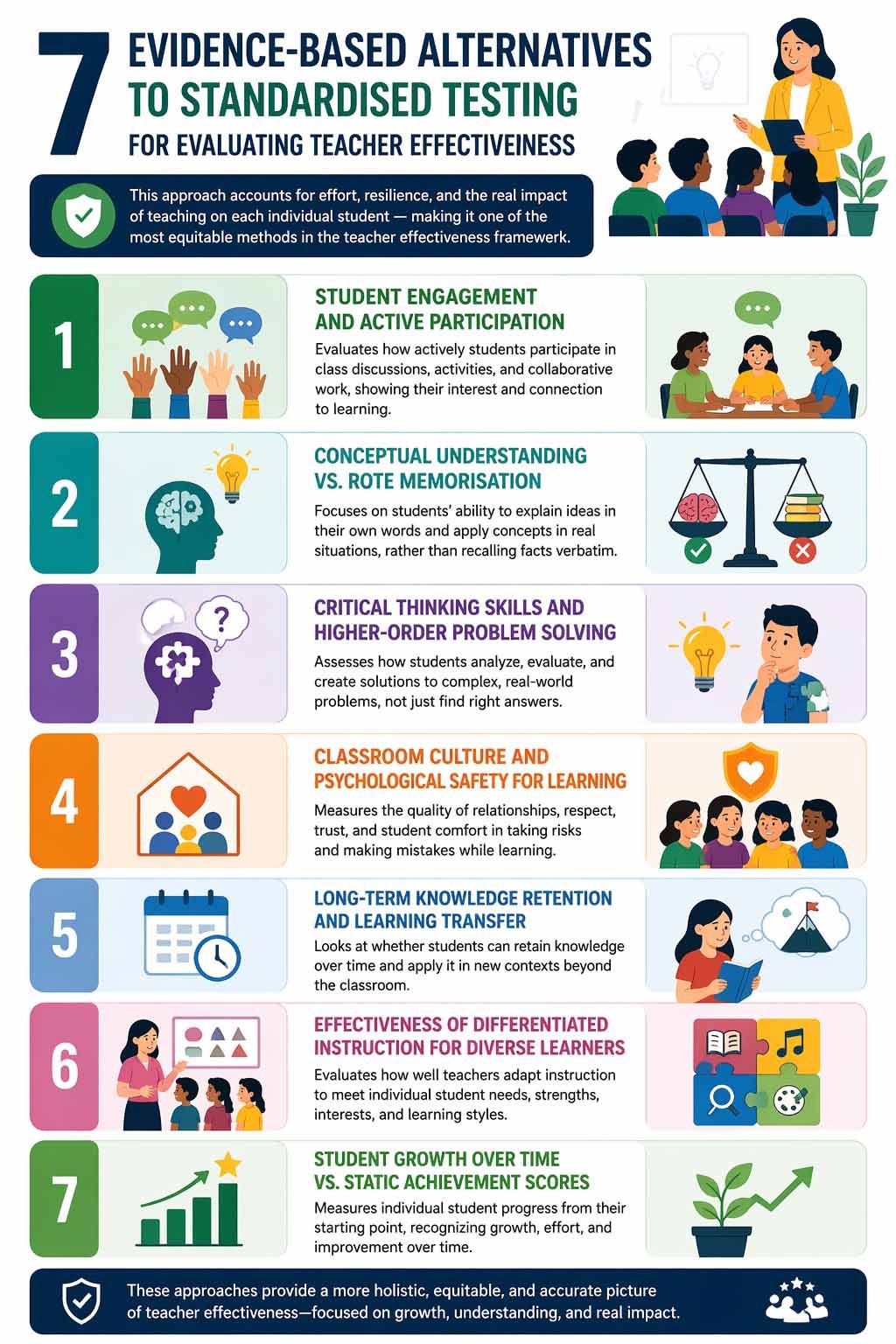
7 Evidence-Based Alternatives to Standardised Testing for Evaluating Teacher Effectiveness
Moving toward meaningful holistic assessment requires a broader framework — one built around indicators that genuinely reflect learning impact. The following seven measures form a practical, evidence-based approach to teacher effectiveness evaluation.
1. Student Engagement and Active Participation
Student Engagement goes well beyond attendance and compliance. It shows up in the quality of student participation, the questions they raise, and their openness to intellectual challenge.
In a truly engaged classroom, students interrogate assumptions, seek answers independently, and are intrinsically motivated to learn. Teachers who cultivate these environments are creating conditions for deep, lasting learning — one of the most telling signs of teaching quality.
2. Conceptual Understanding vs. Rote Memorisation
Effective teaching builds conceptual clarity — the ability to understand ideas well enough to apply them across different contexts and problems. Key indicators include:
- The ability to explain concepts in their own words
- Applying prior knowledge to solve unfamiliar problems
- Making connections across subject areas
Conceptual understanding, unlike rote memorisation, ensures that learning translates into capability.
3. Critical Thinking Skills and Higher-Order Problem Solving
Developing higher-order thinking skills is a hallmark of effective teaching in modern education. Strong teachers move students beyond recall — encouraging them to analyse, evaluate, and create. This shows up in:
- Open-ended responses that demonstrate reasoning, not just answers
- Justification of conclusions
- Active participation in tasks requiring inquiry and debate
These critical thinking skills are essential for navigating complex real-world challenges.
4. Classroom Culture and Psychological Safety for Learning
A positive classroom culture is a foundational condition for effective teaching. Research consistently links psychological safety — the belief that one can speak up without fear of ridicule to deeper learning, intellectual risk-taking, and sustained curiosity. Key indicators include:
- Students feel safe to share ideas without fear of ridicule
- Mistakes are treated as valuable learning opportunities
- Diverse perspectives are actively welcomed
Psychological safety in the classroom directly enables risk-taking, intellectual curiosity, and deeper engagement with learning.
5. Long-Term Knowledge Retention and Learning Transfer
Strong short-term performance does not guarantee lasting learning. Effective teaching ensures that students retain knowledge over time and can transfer it to new situations. Reliable ways to measure this include spiral evaluations that revisit earlier concepts, application tasks assigned weeks or months after initial instruction, and evidence of students making connections across learning cycles. Knowledge retention is a function of teaching depth — not merely content volume.
. Reliable ways to measure this include:
- Spiral evaluations that revisit earlier concepts
- Application tasks assigned weeks or months after initial instruction
- Evidence of students making connections across learning cycles
Knowledge retention is a function of depth of teaching — not merely the volume of content covered.
6. Effectiveness of Differentiated Instruction for Diverse Learners
Every classroom contains students with different needs, learning styles, and starting points. A teacher's ability to adapt to this diversity is a core dimension of teaching effectiveness. Strong indicators include multiple instructional modes, flexible student groupings, and personalised, specific feedback. When differentiated instruction works well, all students make meaningful progress not just the highest performers. Strong indicators include:
- Multiple instructional modes and approaches
- Flexible student groupings
- Personalised, specific feedback
When differentiated instruction works well, all students make meaningful progress — not just the highest performers.
7. Student Growth Over Time vs. Static Achievement Scores
Growth-based evaluation shifts the lens from static scores to measurable progress over time. Rather than asking only "How did the student perform?", it asks: Has the student demonstrably improved? Are learning gaps being addressed? Is there evidence of growing independence and confidence? This approach accounts for effort, resilience, and the real impact of teaching on each individual student — making it one of the most equitable methods in any teacher effectiveness framework. Rather than asking only "How did the student perform?", it asks:
- Has the student demonstrably improved?
- Are learning gaps being addressed?
- Is there evidence of growing independence and confidence?
This approach accounts for effort, resilience, and the real impact of teaching on each individual student — making it one of the most equitable methods in the teacher effectiveness framework.
The Role of Technology and Data Analytics in Modern Student Assessment
Technology offers powerful tools for building a more comprehensive teacher evaluation and formative assessment ecosystem. AI-driven learning analytics can identify patterns in student engagement, flag conceptual gaps, and generate predictive insights enabling teachers to make data-informed decisions rather than relying on intuition alone.
Continuous assessment platforms allow for ongoing evaluation through quizzes, reflections, and interactive tasks. Unlike one-time tests, these systems capture learning as a dynamic process unfolding over time. Real-time feedback mechanisms enable teachers to adjust their instructional approach immediately students receive support at the moment of need; teachers gain clear visibility into what is and is not working.
Crucially, technology should augment teacher judgment, not replace it. When aligned with genuine learning goals, these tools can make classrooms more responsive, adaptive, and equitable.
AI-driven learning analytics can identify patterns in student engagement, flag conceptual gaps, and generate predictive insights — enabling teachers to make data-informed decisions rather than relying on intuition alone.
Continuous assessment platforms allow for ongoing evaluation through quizzes, reflections, and interactive tasks. Unlike one-time tests, these systems capture learning as a dynamic process unfolding over time.
Real-time feedback mechanisms enable teachers to adjust their instructional approach immediately. Students receive support at the moment of need; teachers gain clear visibility into what is working and what needs to change.
Crucially, technology should augment teacher judgment — not replace it. When aligned with genuine learning goals, these tools can make classrooms more responsive, adaptive, and equitable.
What School Leaders and Policymakers Must Do to Reform Teacher Evaluation Methods
Shifting toward meaningful, holistic teacher evaluation requires deliberate action across every level of the education system.
Redesign evaluation frameworks — Schools must move away from single-score reporting and adopt multi-dimensional teacher evaluation methods. This means combining quantitative data with qualitative evidence: classroom observations, student portfolios, and structured feedback.
Invest in professional development — Teachers need well-structured support to transition from traditional instruction to approaches that prioritise formative assessment, differentiated learning, and effective use of data.
Build a culture of reflective practice — Schools should foster environments where teachers regularly examine their own practice, share what works, and collaborate on continuous improvement.
Advocate for policy reform — Policymakers play a decisive role in enabling this shift. Flexible assessment guidelines, reduced dependence on high-stakes standardised tests, and genuine support for innovation can create the conditions for real learning to flourish.
Redefining Teacher Effectiveness: Measuring What Students Can Actually Do
To shape the future of K–12 education, we must be willing to measure what truly matters. Test scores have their place — but they capture only a fraction of the learning process. They cannot quantify curiosity, resilience, creativity, or the capacity to apply knowledge in unfamiliar contexts. Meaningful teacher effectiveness evaluation means recognising teaching for what it genuinely is: the capacity to make a lasting difference. Students who think critically, adapt with confidence, and engage meaningfully with the world around them are the truest measure of that impact. The conversation must shift from performance metrics to student learning outcomes, from one-time scores to evidence of genuine growth. The question is no longer simply "How well did the students perform?" It is: How well are they prepared for life? That is the only measure that will ever be enough.
Frequently Asked Questions
What are the most effective alternatives to standardised testing for evaluating teachers?
Evidence-based alternatives include performance-based assessments, student learning portfolios, growth-based metrics, classroom observation, and formative assessment data collected over time. The strongest frameworks combine multiple methods to capture a fuller picture of teaching impact — no single measure can substitute for a multi-dimensional approach.
How does student growth measurement differ from standardised test scores?
Standardised scores reflect a student's performance at a single point in time. Student growth measurement tracks progress from a student's individual starting point, accounting for prior knowledge, learning challenges, and the trajectory of improvement making it a more equitable and accurate indicator of teacher effectiveness.
What role does classroom observation play in teacher effectiveness evaluation?
Classroom observation allows school leaders and peers to assess teaching quality in real time — examining instructional strategies, student engagement, differentiated instruction, and the overall learning environment. When paired with student outcome data and reflective dialogue, it forms a core pillar of any comprehensive teacher evaluation framework.