

Teaching Excellence in K-12 Education

Teaching excellence in K–12 education is no longer a classroom-only conversation—it is a leadership and system discipline. In an era of learning gaps, teacher workload pressure, and generative AI risk, improving teaching quality depends on instructional leadership that can build, support, and scale high-impact practice.
Why Teaching Excellence Matters More Than Ever
Finally, the conversation is shifting from “excellent teachers” to “excellent systems.” Increasingly, instructional leadership in K–12 is recognised as the lever that determines whether excellent teaching is isolated or embedded across schools. For most education leaders, “teaching excellence” is not a slogan—it’s the difference between a school system that merely covers content and one that reliably produces learning. What has changed in recent years is the level of pressure on that difference. We are operating in a world where the learning crisis is no longer abstract: systems are contending with stalled achievement, widening gaps between learners, and a growing expectation that schools must develop not only literacy and numeracy, but also durable skills like critical thinking, collaboration, and socio-emotional competence. Global conversations about “learning poverty” have helped sharpen the uncomfortable truth: access to schooling is not the same as access to learning, and the quality of everyday instruction remains the strongest lever leaders can influence at scale.
At the same time, teaching excellence is being tested by capacity constraints. Many jurisdictions are facing teacher shortages, retention issues, and a profession carrying an expanding workload that stretches far beyond instruction—data reporting, parent communication, safeguarding responsibilities, and constant system-level change. When stress and burnout become normalised, “quality teaching” quietly shifts from being a shared standard to an individual act of heroism, and that is not a sustainable operating model for any school network. Recent large-scale survey work continues to show that wellbeing and workload pressures are not marginal issues; they shape whether teachers stay, how they teach, and what they have the bandwidth to improve.
Then there is the new frontier education leaders are actively navigating: generative AI. The opportunity is real—planning support, differentiation, feedback loops, and productivity gains—but so is the risk of what some researchers and policymakers are beginning to describe as “false mastery,” where polished outputs mask shallow understanding. In that environment, teaching excellence becomes less about delivering information and more about designing learning that makes thinking visible: strengthening metacognition, improving assessment design, and building students’ ability to evaluate, synthesise, and apply knowledge without outsourcing the cognitive work.
Finally, the conversation is shifting from “excellent teachers” to “excellent systems.” Evidence increasingly points to the role of instructional leadership—how principals and leadership teams create the conditions for high-quality teaching through feedback, professional learning, and coherent school-wide practice. In other words, teaching excellence is becoming a leadership discipline: the craft of building environments where great teaching is expected, supported, measured intelligently, and continuously improved—not left to chance or charisma.
What Is Teaching Excellence in K–12 Education?
When education leaders speak about teaching excellence, they are rarely referring to a single technique, lesson style, or personality trait. Teaching excellence in K–12 education is best understood as a deliberate, sustained practice that consistently enables meaningful learning for all students, across contexts, subjects, and abilities. At its core, it is the capacity of a teacher to design and facilitate learning experiences that are intellectually rigorous, inclusive, engaging, and responsive—while continually refining their practice based on evidence and reflection.
A concise way to frame this is: teaching excellence sits at the intersection of strong pedagogy, deep learner engagement, demonstrable learning outcomes, and reflective professional practice. None of these elements functions in isolation. Pedagogical knowledge without engagement produces compliance, not learning. Engagement without clarity of outcomes risks activity without progress. Outcomes without reflection often lead to short-term gains that are difficult to sustain. Excellence emerges only when these dimensions are intentionally aligned.
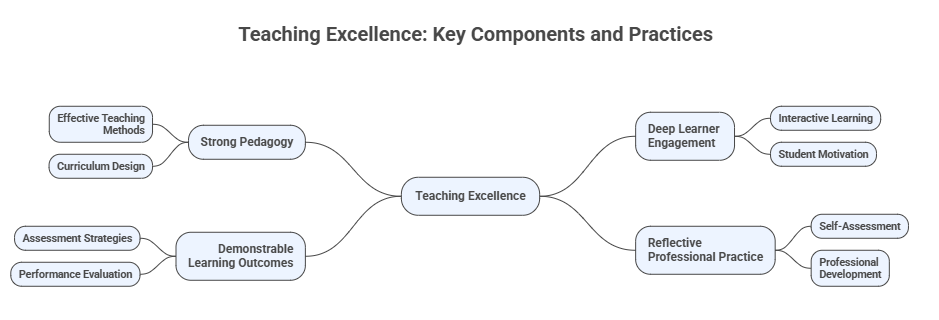
It is also important to distinguish between good teaching and excellent teaching, a distinction that is often blurred in everyday discourse. Good teaching is competent, reliable, and meets expected standards. Lessons are structured, curriculum objectives are addressed, and students generally perform at acceptable levels. Excellent teaching goes further. It adapts instruction in real time, anticipates misconceptions, responds to diverse learner needs, and creates conditions where students are active participants in their own learning. While good teaching ensures coverage, excellent teaching ensures understanding, transfer, and growth.
Equally critical is separating teaching excellence from academic performance alone. High test scores can sometimes reflect effective teaching, but they can also be influenced by factors such as student intake, external tutoring, or narrow test preparation. Teaching excellence is therefore not defined solely by results, but by the quality of learning processes that lead to those results. This includes how students think, how they apply knowledge, how they collaborate, and how they develop confidence and independence as learners. From a leadership perspective, this distinction matters because systems that reward only outcomes may unintentionally discourage innovation, risk-taking, and reflective practice. This distinction is essential for understanding teacher effectiveness—not as a function of test preparation, but as the sustained ability to enable deep, transferable learning.
In K–12 settings, teaching excellence is ultimately a professional mindset rather than a static status. It recognises that learners, curricula, technologies, and societal expectations evolve, and that high-quality teaching must evolve with them. For education leaders, this definition shifts the conversation from identifying “excellent teachers” to creating the conditions in which excellence becomes the norm rather than the exception—embedded in daily practice, supported by professional learning, and sustained over time.
Core Pillars of Teaching Excellence
Teaching excellence in K–12 education is most effectively understood not as a checklist of skills, but as a coherent framework of interconnected pillars that guide everyday practice. Education leaders increasingly recognise that excellence is rarely the result of isolated brilliance; it is the outcome of alignment—between how teachers understand learners, how they design instruction, how they grow professionally, and how they exercise ethical and relational leadership in classrooms. When these pillars reinforce one another, teaching quality becomes both visible and sustainable.
_1769696940.png)
At the foundation of this framework lies student-centred learning. Teaching excellence begins with a deep understanding that learners are not uniform recipients of instruction, but individuals with varying backgrounds, abilities, motivations, and needs. Differentiated instruction is therefore not an optional enhancement; it is a core condition of quality teaching. Excellent teachers deliberately adapt content, process, and assessment to ensure that all learners can access and extend their learning. This approach is closely linked to inclusive classroom practices, where diversity—cognitive, cultural, linguistic, or social—is treated as a strength rather than a challenge to be managed. Learner voice and agency further strengthen this pillar by positioning students as active contributors to their learning journey. When students are encouraged to ask questions, make choices, and reflect on their progress, engagement becomes intrinsic rather than imposed.
The second pillar, effective teaching strategies, translates learner understanding into purposeful instructional design. Teaching excellence is grounded in evidence-based practice: strategies informed by research on how students learn, rather than habit or tradition alone. This includes the intentional use of active learning approaches that require students to think, discuss, apply, and create, rather than passively receive information. Formative assessment plays a central role here, enabling teachers to gather real-time evidence of learning and adjust instruction accordingly. Classroom engagement techniques—questioning, feedback, discussion structures—are not performative tools, but mechanisms for making learning visible and responsive. When implemented with clarity and consistency, these approaches contribute directly to improving student learning outcomes—both in measurable performance and in long-term capability.
Sustaining excellence over time depends on the third pillar: professional competence and continuous development. Excellent teaching is inherently reflective. Teachers who demonstrate high levels of effectiveness routinely analyse their practice, examine student evidence, and question their assumptions. This reflective orientation is strengthened through structured professional development that is relevant, collaborative, and embedded in practice. A lifelong learning mindset ensures that teachers remain adaptive in the face of evolving curricula, technologies, and learner expectations, rather than relying on static expertise.
The fourth pillar, ethical practice and classroom leadership, anchors teaching excellence in values. Emotional intelligence enables teachers to build trust, manage relationships, and respond constructively to behaviour and wellbeing needs. A positive classroom climate—psychologically safe, respectful, and purposeful—creates the conditions in which learning can flourish. Professional integrity, fairness, and ethical judgement guide decision-making, particularly in complex or high-pressure situations.
Together, these four pillars form a Teaching Excellence Framework in which pedagogy, engagement, outcomes, and reflection operate as an integrated system. For education leaders, this framework offers a shared language for evaluating, developing, and sustaining excellence—moving the conversation beyond individual performance toward collective instructional quality across schools and systems.
Teaching Strategies That Drive Excellence in Learning
When education leaders ask what the best high-impact teaching practices for improving student outcomes look like in practice, the answer is rarely about novelty. The most effective strategies are those that consistently deepen understanding, surface thinking, and help teachers respond intelligently to learners in real time. What distinguishes these strategies in excellent classrooms is not their presence, but the precision and intentionality with which they are used.
Inquiry-based learning is one such strategy when applied with clarity of purpose. At its best, inquiry does not mean leaving students to “discover” content without guidance. Instead, it involves carefully designed questions and problems that require learners to investigate, hypothesise, test ideas, and draw conclusions. For example, in a middle-school science classroom, rather than explaining a concept upfront, a teacher might present a phenomenon and guide students through structured inquiry prompts that lead them to uncover underlying principles. The strength of this approach lies in how it builds conceptual understanding while strengthening critical thinking and curiosity.
Collaborative learning models further extend this depth by recognising learning as a social process. Excellence emerges when collaboration is structured rather than incidental. Effective teachers design tasks where interdependence is necessary—students must rely on one another’s contributions to succeed. In a language arts classroom, this might involve small groups analysing different perspectives of a text and synthesising their insights into a shared interpretation. When collaboration is purposeful, it improves not only academic outcomes but also communication, reasoning, and learner confidence.
Feedback-driven instruction is another hallmark of excellent teaching. High-quality feedback is timely, specific, and focused on improvement rather than judgement. Instead of simply marking answers as correct or incorrect, excellent teachers provide guidance that helps students understand why an error occurred and how to improve. A mathematics teacher, for instance, might identify a misconception in problem-solving and use targeted feedback to redirect student thinking before misunderstandings become embedded.
Closely linked to feedback is the intelligent use of formative assessment. In classrooms characterised by teaching excellence, assessment is not confined to tests at the end of a unit. Teachers regularly gather evidence of learning through questioning, exit prompts, short reflections, or discussion. This evidence informs immediate instructional decisions, such as revisiting a concept or adjusting pacing. Formative assessment transforms teaching from a fixed plan into a responsive process.
Technology-enhanced teaching, when used thoughtfully, can further support excellence. Digital tools can help visualise concepts, personalise practice, or streamline feedback, but they are most effective when they serve clear pedagogical goals. For example, a simple interactive simulation may deepen understanding of abstract ideas far more effectively than an elaborate digital platform used without purpose. In excellent classrooms, technology amplifies learning rather than distracting from it.
Together, these strategies demonstrate that teaching excellence is not about doing more, but about doing what matters—intentionally, responsively, and in service of meaningful student learning.
Teaching Excellence in K–12 Classrooms: What It Looks Like in Practice
For education leaders, the question is no longer whether teaching excellence matters, but how it actually shows up in day-to-day classroom life. In practice, excellence is rarely dramatic or performative. It is visible in the quiet precision of lesson design, the quality of student thinking, the climate of the classroom, and the teacher’s ability to adapt instruction in response to learners as they are—not as the plan assumed they would be.
High-quality lesson design is one of the clearest indicators. In excellent classrooms, lessons are intentionally structured around clear learning goals rather than activities alone. The sequence of tasks builds understanding step by step, anticipating misconceptions and making cognitive demand explicit. Transitions are purposeful, time is used efficiently, and learning activities are aligned with what students are expected to understand or demonstrate by the end of the lesson. Importantly, flexibility is built into the design, allowing teachers to pause, extend, or revisit concepts based on student responses.
Student engagement provides another powerful signal. In classrooms characterised by teaching excellence, engagement is not measured by silence or compliance, but by visible thinking. Students ask questions, explain their reasoning, challenge ideas respectfully, and take intellectual risks. Participation is distributed rather than dominated by a few confident voices, and students show ownership of their learning. Engagement is sustained because learners understand why they are doing what they are doing, not merely what they are doing.
Classroom management in excellent practice is similarly distinctive. It is proactive rather than reactive, grounded in clear expectations and consistent routines. Teachers establish a climate of mutual respect where behaviour is addressed calmly and proportionately, without interrupting learning flow. Emotional intelligence plays a critical role here; teachers read the room, respond to cues, and maintain authority without relying on control or coercion. As a result, classrooms feel orderly yet warm, structured yet human.
Adaptability to diverse learning needs ties all these elements together. Teaching excellence is evident when teachers adjust instruction in real time—rephrasing explanations, offering alternative examples, or providing additional scaffolding where needed. In a mixed-ability classroom, this might involve offering extension challenges to some students while supporting others through guided questioning or targeted prompts. The goal is not uniformity of instruction, but equity of access to learning.
Consider a simple scenario: during a mathematics lesson, a teacher notices through questioning that several students are applying a formula mechanically without understanding its logic. Rather than pushing ahead, the teacher pauses, introduces a visual model, invites students to explain their thinking, and reshapes the lesson trajectory. This moment of responsiveness captures teaching excellence in action—where professional judgement, learner awareness, and instructional agility converge to serve learning.
In real classrooms, teaching excellence is not an abstract ideal. It is a daily practice, expressed through thoughtful design, engaged learners, supportive environments, and adaptive teaching that keeps learning at the centre.
Teacher Excellence Programs: Building Capacity at Scale
As education systems grow in complexity, teaching excellence can no longer rely on individual effort or isolated professional development sessions. This is where a teacher excellence program becomes a strategic instrument for leaders—designed not to “fix” teaching, but to build collective instructional capacity over time. At scale, excellence is less about identifying standout teachers and more about creating structures that enable consistently high-quality practice across classrooms, schools, and networks.
The primary purpose of a structured teacher excellence program is alignment. It brings together shared expectations about what excellent teaching looks like, how it is developed, and how it is sustained. Rather than fragmented workshops or compliance-driven training, these programs establish a coherent pathway for professional growth, grounded in classroom realities and student learning needs. For leaders, this coherence is critical: it ensures that professional learning investments translate into instructional improvement rather than remaining disconnected initiatives.
Mentoring and coaching sit at the heart of effective programs. High-impact mentoring goes beyond informal advice; it is intentional, relationship-based, and focused on practice. Coaches observe classrooms, engage teachers in reflective dialogue, and support the transfer of theory into action. Over time, this builds professional confidence and instructional judgement, particularly for early-career teachers and those navigating new pedagogical expectations. Importantly, coaching normalises growth, reinforcing the idea that excellence is developed, not bestowed.
Peer learning communities further strengthen this ecosystem. When teachers collaborate around shared problems of practice—examining student work, planning lessons, or reflecting on assessment evidence—professional learning becomes embedded rather than episodic. These communities foster collective responsibility for student outcomes and reduce the isolation that often undermines improvement efforts. From a leadership perspective, peer learning also surfaces internal expertise, enabling schools to grow their own instructional leaders.
Performance feedback systems provide the connective tissue between development and accountability. In high-functioning teacher excellence programs, feedback is developmental rather than punitive. Classroom observations, student evidence, and professional reflections are used to inform growth conversations, not rankings. This balanced approach ensures that standards remain high while trust is preserved—a critical condition for sustained improvement.
Crucially, teacher excellence programs must be understood as long-term capacity-building models, not one-time interventions. This is where advanced academic pathways, such as Master’s and Doctorate programs in education, play a complementary role. When aligned with school improvement priorities, these programs deepen pedagogical expertise, research literacy, and leadership capacity. They prepare educators not only to refine their own practice, but to contribute to system-level improvement through inquiry, innovation, and evidence-informed decision-making.
Measuring and Evaluating Teaching Excellence
For education leaders, measuring teaching excellence—and strengthening teaching quality in schools—is one of the most sensitive and consequential responsibilities within governance and quality assurance. The challenge lies in doing this rigorously without reducing teaching to narrow metrics that distort practice. Teaching excellence is not an abstract quality, but neither is it something that can be captured through a single data point. Effective evaluation therefore depends on multiple sources of evidence, interpreted professionally and used to support continuous improvement.
Classroom observation remains a foundational element in understanding teaching quality, but its value depends entirely on how it is conducted. In systems that take excellence seriously, observations are structured, purposeful, and grounded in shared instructional standards. Observers look beyond surface features such as pacing or classroom control to examine the quality of questioning, the depth of student thinking, and the alignment between learning intentions and instructional strategies. When observations are followed by reflective dialogue rather than judgement, they become a powerful tool for professional growth rather than compliance.
Student learning outcomes also play a role, but only when viewed through a balanced lens. Outcomes should be interpreted as signals, not verdicts. Patterns in student progress, conceptual understanding, and skill development can offer valuable insights into instructional effectiveness, particularly when considered alongside contextual factors such as learner diversity and starting points. Over-reliance on standardised test scores risks oversimplifying a complex process and can inadvertently encourage teaching to the test rather than teaching for understanding. Excellence is better indicated by consistent growth over time and evidence of transferable learning.
Professional portfolios add another important dimension to evaluation. By documenting lesson plans, assessment designs, reflective commentary, and examples of student work, portfolios make teaching practice visible. They allow teachers to articulate the rationale behind their decisions and demonstrate how they respond to evidence of learning. For leaders, portfolios provide a richer picture of practice than observation snapshots alone, particularly when used as part of appraisal or professional review processes.
Peer and leadership feedback further strengthen evaluation systems. When colleagues engage in structured feedback—through lesson study, peer observation, or collaborative inquiry—evaluation becomes a shared professional responsibility rather than a top-down exercise. Leadership feedback, when aligned with the same standards, reinforces coherence and trust. This multi-perspective approach reduces bias and encourages collective ownership of teaching quality.
Underlying all effective evaluation systems is a commitment to continuous improvement cycles. Evidence is gathered, analysed, acted upon, and revisited. Teaching excellence is therefore measured not as a fixed state, but as a trajectory of growth. For governance and quality assurance frameworks, this shift is critical: it positions evaluation as a mechanism for learning within the system, ensuring that high standards are maintained without constraining professional judgement or innovation.
The Role of School Leadership in Sustaining Excellence
Teaching excellence does not sustain itself through individual effort alone. While classroom practice is where excellence becomes visible, it is school leadership that determines whether such practice is isolated or embedded across the system. From a system-level perspective, leadership acts as the enabling force that shapes priorities, allocates resources, and sets the cultural conditions under which high-quality teaching can flourish consistently over time.
One of the most critical roles leaders play is providing explicit and sustained support for teachers. This goes beyond encouragement or recognition. It involves instructional leadership that is present, informed, and engaged with the realities of teaching. Leaders who understand pedagogy are better positioned to have meaningful conversations about practice, offer relevant feedback, and make informed decisions about professional learning. When teachers perceive leadership as knowledgeable and supportive rather than distant or purely administrative, trust deepens and improvement efforts gain credibility.
Closely linked to this is the creation of a culture of trust and innovation. Teaching excellence thrives in environments where teachers feel safe to experiment, reflect, and refine their practice without fear of punitive consequences. Innovation in instruction often involves risk—trying new approaches, rethinking assessment, or adapting curriculum delivery. Leaders who model learning, invite dialogue, and treat setbacks as opportunities for growth send a powerful signal that excellence is a shared pursuit rather than a compliance exercise. Over time, this culture encourages collaboration, professional honesty, and collective responsibility for student learning.
Time and space for professional growth represent another decisive leadership lever. Excellence cannot be sustained in systems where teachers are perpetually overloaded and professional learning is treated as an add-on. Effective leaders protect time for reflection, collaboration, mentoring, and inquiry, recognising that instructional improvement requires cognitive and emotional bandwidth. This includes aligning schedules, reducing unnecessary administrative burden, and ensuring that professional development is purposeful and connected to classroom practice rather than generic or episodic.
Alignment between teaching excellence and the school’s vision is equally important. When excellence is explicitly articulated within the institution’s mission and strategic priorities, it moves from rhetoric to expectation. Teachers understand how their daily practice contributes to broader educational goals, and leaders can make coherent decisions about curriculum, assessment, staffing, and professional learning. This alignment ensures that teaching excellence is not dependent on individual champions, but embedded within the organisational identity.
In this context, formal preparation in education management and leadership becomes increasingly significant. Advanced degrees in education management or educational leadership equip school leaders with the theoretical grounding and practical tools to navigate complex systems, manage change, and lead instructional improvement at scale. Such programs deepen understanding of organisational culture, governance, quality assurance, and human capital development—capabilities that are essential for sustaining excellence beyond short-term initiatives.
Ultimately, teaching excellence is sustained when leadership treats it as a system-wide responsibility. By supporting teachers, cultivating trust, prioritising professional growth, and aligning practice with vision—supported by strong educational leadership preparation—schools move closer to making excellence a stable feature of everyday learning rather than an exception.
Challenges to Achieving Teaching Excellence (and How to Address Them)
Even in systems where teaching excellence is clearly articulated and widely valued, sustaining it remains a complex challenge. For education leaders, the obstacles are rarely theoretical; they are practical, systemic, and deeply human. Understanding these challenges—and responding to them strategically—is essential if excellence is to move beyond aspiration into everyday reality.
One of the most pressing challenges is workload and burnout. Teachers are increasingly asked to do more with less time: deliver high-quality instruction, personalise learning, manage wellbeing needs, engage with parents, and meet accountability requirements. When cognitive and emotional overload becomes the norm, reflective practice and instructional innovation are often the first casualties. Addressing this requires leadership choices, not individual resilience narratives. Practical responses include streamlining administrative demands, prioritising instructional work over peripheral tasks, and protecting time for planning and collaboration. Leaders who explicitly signal what matters most create the conditions in which teachers can focus their energy where it has the greatest impact on learning.
_1769697926.png)
A second barrier is limited access to meaningful professional development. In many contexts, professional learning remains fragmented, generic, or disconnected from classroom realities. One-off workshops may raise awareness, but they rarely change practice. A strategic response involves rethinking professional development as a continuum rather than an event. This means embedding learning into the school year through coaching, peer inquiry, and practice-based reflection, and aligning opportunities with both individual growth needs and institutional priorities. Access to advanced study, including postgraduate pathways in education, can further deepen expertise when thoughtfully integrated with school improvement goals.
Resistance to pedagogical change presents another common challenge. Such resistance is often misinterpreted as unwillingness, when it may instead reflect uncertainty, past experience, or lack of support. Teachers are more likely to embrace new approaches when they understand the rationale, see evidence of impact, and feel supported during implementation. Leaders play a critical role here by pacing change sensibly, modelling learning themselves, and creating forums for professional dialogue where concerns can be surfaced and addressed constructively.
Finally, policy–practice gaps can undermine even the strongest commitments to teaching excellence. Well-intentioned policies may emphasise innovation, inclusion, or learner-centred approaches, while accountability systems reward narrow outcomes or compliance. Bridging this gap requires leaders to act as translators—aligning policy expectations with realistic classroom practices and advocating for coherence where misalignment exists. Internally, this means ensuring that evaluation, professional learning, and resource allocation reinforce, rather than contradict, the vision for excellence.
Taken together, these challenges highlight a central truth: teaching excellence is not constrained by teacher capability alone, but by the systems within which teachers operate. Strategic, practical leadership responses—focused on conditions, coherence, and capacity—are what enable excellence to be sustained even in demanding educational environments.
Teaching Excellence and the Future of K–12 Education
As K–12 education moves deeper into an era defined by rapid technological, social, and economic change, teaching excellence is no longer just a marker of current quality—it is a future-ready competency. The classrooms of the future will not be shaped solely by new tools or curricula, but by the professional judgement of teachers who can navigate complexity, uncertainty, and diversity while keeping learning deeply human.
One of the most significant forces reshaping teaching practice is the rise of artificial intelligence and adaptive learning technologies. Used responsibly, these tools hold promise for supporting differentiated instruction, identifying learning gaps, and reducing administrative load. Adaptive platforms can help teachers personalise practice, while AI-assisted tools can support lesson planning, formative feedback, and data-informed decision-making. However, the future of teaching excellence does not lie in replacing professional expertise with automation. The risk of over-reliance is real: when technology begins to drive pedagogy rather than serve it, learning can become shallow, fragmented, or overly transactional. Excellence in the future will therefore depend on teachers’ ability to critically integrate technology—using it to enhance thinking, not outsource it.
This brings renewed focus to the irreplaceable role of human-centred teaching. As content becomes increasingly accessible, the value of the teacher shifts toward what technology cannot replicate: relational trust, ethical judgement, emotional intelligence, and the capacity to design meaningful learning experiences. Excellent teachers help students make sense of knowledge, question assumptions, collaborate with others, and develop resilience. In an age of information abundance, teaching excellence is defined less by delivery and more by sense-making—helping learners navigate complexity with confidence and integrity.
From a system perspective, teaching excellence must also be understood as a dynamic capability. Future-ready educators will need to continuously adapt their practice in response to emerging research, evolving learner needs, and changing societal expectations. This places a premium on reflective practice, research literacy, and professional learning pathways that extend beyond initial training. Advanced study, practitioner inquiry, and leadership development increasingly become part of the excellence equation, equipping teachers to contribute not only to classrooms, but to school and system improvement.
For education leaders, the implication is clear. Preparing for the future of K–12 education is not primarily about predicting the next innovation; it is about investing in teaching excellence as a strategic asset. Systems that cultivate adaptive, ethical, and learner-centred teaching will be best positioned to respond to whatever changes lie ahead. In this sense, teaching excellence is not just about meeting today’s standards—it is about ensuring that learning remains meaningful, equitable, and human in an uncertain future.
Frequently Asked Questions (FAQ)
Q1. What is teaching excellence in K–12 education?
Teaching excellence in K–12 education refers to the consistent ability of teachers to design and facilitate learning experiences that lead to deep understanding, engagement, and meaningful progress for all learners. It goes beyond delivering curriculum content and focuses on how students think, apply knowledge, and grow academically and personally. Teaching excellence integrates strong pedagogy, inclusive practices, clear learning goals, and reflective professional judgement. Importantly, it is not a fixed label attached to individuals, but a dynamic practice that evolves with learners, contexts, and evidence of impact.
Q2. How can teachers improve excellence in teaching and learning?
Teachers improve excellence by treating their practice as a continual learning process rather than a finished skill set. This involves reflecting on lessons, analysing student responses, and adjusting instruction accordingly. Engaging in professional dialogue with peers, seeking feedback, and participating in relevant professional development strengthens instructional decision-making. Excellence grows when teachers remain curious about how students learn, experiment thoughtfully with new approaches, and use evidence—rather than habit—to guide improvement.
Q3. What teaching strategies are most effective in K–12 classrooms?
The most effective strategies are those that actively involve students in learning and make thinking visible. Inquiry-based approaches encourage curiosity and conceptual understanding, while collaborative learning supports reasoning and communication. Formative assessment and feedback help teachers respond to learning needs in real time, preventing misconceptions from becoming entrenched. Technology can enhance these strategies when used purposefully, but effectiveness ultimately depends on alignment with clear learning goals rather than the tools themselves.
Q4. What is a teacher excellence program?
A teacher excellence program is a structured, long-term approach to developing instructional quality across a school or system. Rather than isolated training sessions, it combines mentoring, coaching, peer learning, and reflective practice within a shared framework of teaching standards. Effective programs focus on growth, coherence, and sustainability, supporting teachers at different career stages while aligning professional learning with student learning priorities.
Q5. How can schools sustain teaching excellence long term?
Sustaining teaching excellence requires leadership commitment and system-level coherence. Schools do this by creating cultures of trust, protecting time for professional growth, and aligning evaluation, professional learning, and school vision around instructional quality. Long-term sustainability depends on seeing teaching excellence not as an initiative, but as an organisational norm—supported by leadership capability, continuous improvement cycles, and investment in teacher development pathways.
Conclusion: Reframing Teaching Excellence as a Continuous Journey
Teaching excellence is often spoken about as though it were a fixed state to be achieved—a badge earned, a benchmark crossed, a standard met. Yet the reality of K–12 education makes this framing increasingly inadequate. Learners change, curricula evolve, societal expectations shift, and new tools reshape how knowledge is accessed and applied. In this context, teaching excellence cannot be a destination. It must be understood as a continuous journey of professional growth and system development.
At its heart, teaching excellence begins as a mindset. It reflects a commitment to learning—not only for students, but for educators themselves. Excellent teachers and leaders approach practice with curiosity, humility, and a willingness to adapt. They ask not only “Did this work?” but “Why did it work?” and “How can it work better for more learners?” This mindset resists complacency and keeps professional judgement alive, even in stable or high-performing environments.
Teaching excellence is also a practice, refined daily through intentional design, responsive instruction, and reflective decision-making. It shows up in how lessons are planned, how students are engaged, how feedback is given, and how classrooms are managed with care and purpose. These practices are strengthened when teachers are supported by meaningful professional learning, coaching, and collaboration, allowing excellence to be developed rather than demanded.
Critically, teaching excellence functions within a system. It is shaped by leadership, culture, policy, and professional pathways. Schools and education systems that sustain excellence recognise that individual effort alone is insufficient. They invest in structures that align vision, evaluation, professional development, and leadership capability around instructional quality. When excellence is embedded at the system level, it becomes resilient—able to withstand change, turnover, and external pressure.
Ultimately, excellence in teaching leads to excellence in learning. When teaching is thoughtful, inclusive, and adaptive, students experience learning that is deeper, more engaging, and more enduring. They develop not only academic knowledge, but the skills, confidence, and agency required to navigate an uncertain future. For education leaders, reframing teaching excellence as a continuous journey is both a responsibility and an opportunity—one that places learning, in its fullest sense, at the centre of educational purpose.