

Blockchain in Higher Education: The Future of Digital Credentials and Academic Verification

As universities embrace digital transformation, blockchain is emerging as a powerful solution for secure academic credentials, instant verification, and globally trusted education records.

Blockchain in Higher Education: The Future of Digital Credentials and Academic Verification

Author

Editorial Team

What if the university degree hanging on someone’s wall was completely fabricated, yet no employer or institution detected it for years?

That concern is becoming increasingly real in today’s globally connected education landscape. As higher education becomes more digital, cross-border, and decentralised, traditional academic credential verification systems are struggling to keep pace. Fake degrees continue to circulate online. Verification processes still take days or weeks. Academic records often remain fragmented across institutions and countries.

This is where blockchain in higher education is rapidly emerging as a transformative solution.

Universities, governments, and education technology leaders are now exploring blockchain-based academic verification systems to create secure, tamper-proof, and globally trusted digital credentials. The shift is no longer theoretical. It is already happening.
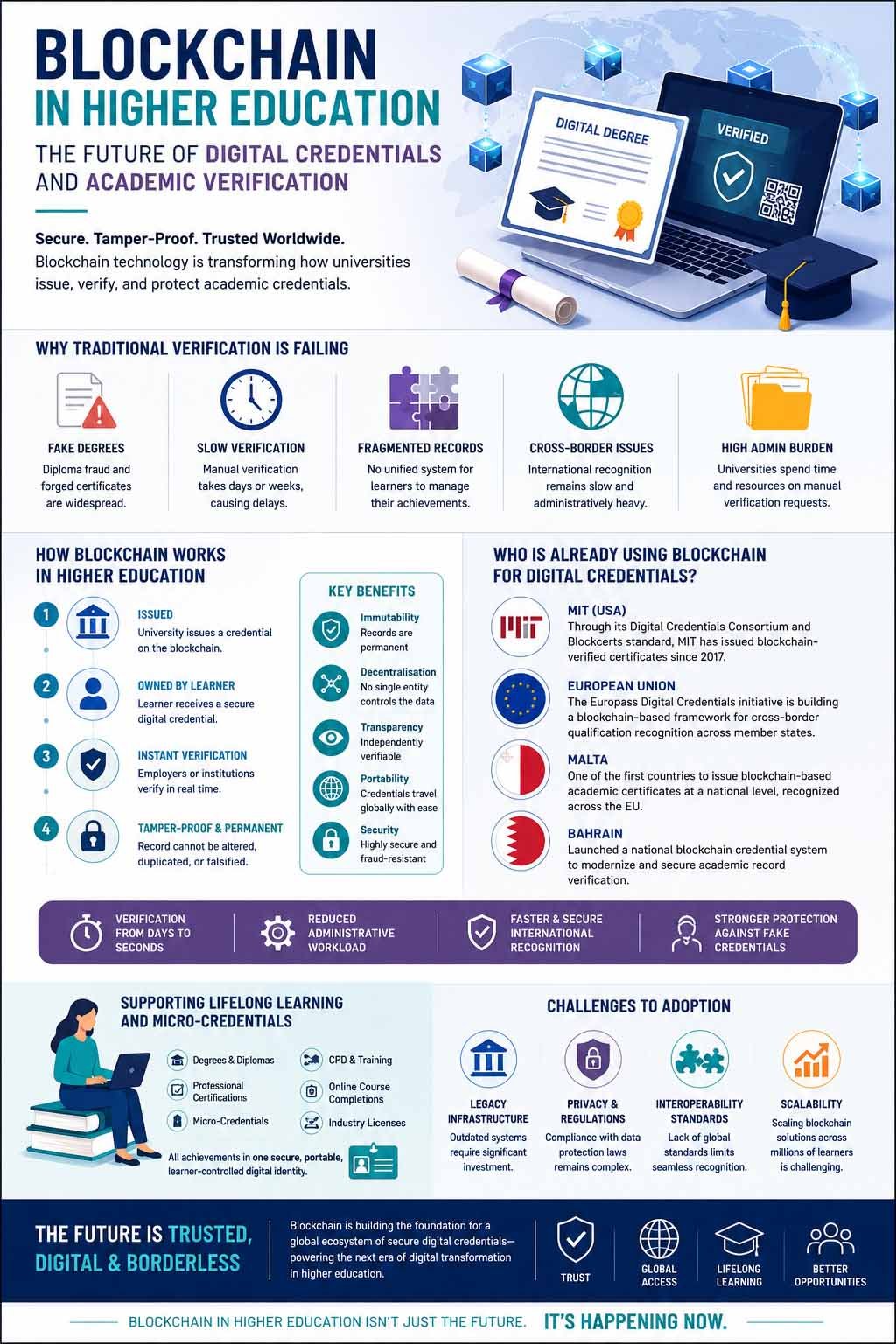

Why Traditional Academic Credential Verification Is Failing

Traditional academic verification systems were built for a much simpler education model: one institution, one qualification, and one country. That model no longer reflects how modern higher education works. Today, learners earn qualifications through online universities, international collaborations, professional certification platforms, and lifelong learning programmes spread across multiple regions and institutions.

Yet the infrastructure used to verify these credentials remains largely manual and outdated.

Several major challenges continue to affect academic credential verification globally:

  • Fake degree fraud through sophisticated diploma mills and forged certificates
  • Manual verification processes that delay admissions and recruitment decisions
  • Fragmented academic records with no unified learner-controlled system
  • Cross-border recognition issues affecting internationally qualified professionals
  • Administrative burden on universities handling verification requests manually

As digital transformation accelerates across higher education, institutions are actively searching for secure and scalable alternatives.

Blockchain technology is emerging as one of the most credible solutions currently being implemented.

How Blockchain Technology Works in Higher Education

Blockchain is a decentralised digital ledger that securely records information across a distributed network rather than storing it in one central location.

Each record is cryptographically connected to the previous one, creating a permanent and tamper-proof chain of information.

In higher education, blockchain-based academic verification typically works like this:

  • A university issues a graduate’s credential on a blockchain network
  • The learner receives a secure digital credential or certificate
  • Employers, universities, or licensing bodies can instantly verify the credential online
  • The credential cannot be altered, duplicated, or falsified after issuance

This creates a trusted ecosystem for digital academic credentials.

What Makes Blockchain-Based Credentials Reliable?

Several features make blockchain technology highly suitable for academic credential verification:

  • Immutability: Academic records cannot be changed once issued
  • Decentralisation: No single institution controls the entire system
  • Transparency: Credentials can be independently verified in real time
  • Security: Blockchain-based certificates are extremely difficult to forge
  • Portability: Digital credentials can move seamlessly across borders and institutions

For universities navigating digital transformation, blockchain offers a more efficient and globally scalable verification infrastructure than paper-based systems.

Universities and Governments Already Using Blockchain for Digital Credentials

Blockchain in higher education is no longer experimental. Multiple institutions and governments are already deploying blockchain credential systems at scale.

MIT and Blockchain Academic Credentials

Massachusetts Institute of Technology developed the Blockcerts open standard through its Digital Credentials Consortium and has issued blockchain-verified certificates since 2017.

Graduates can securely share digital credentials with employers without requiring manual university verification.

European Union Digital Credential Framework

European Commission is actively implementing Europass Digital Credentials Infrastructure, a blockchain-enabled system designed to support cross-border qualification recognition across EU member states.

This initiative aims to create interoperable digital academic credentials across Europe.

Malta’s National Blockchain Credential System

Malta became one of the first countries to deploy blockchain-based academic verification nationally through partnerships focused on secure digital diploma issuance.

Bahrain’s Blockchain Education Initiative

Bahrain launched a national blockchain credential system through collaboration with its eGovernment Authority to modernise academic record verification.

These initiatives consistently report major improvements:

  • Verification reduced from weeks to seconds
  • Reduced administrative workload for universities
  • Faster international recognition of qualifications
  • Stronger protection against fake academic credentials

How Blockchain Supports Lifelong Learning and Micro-Credentials

Modern careers are increasingly built through continuous learning rather than a single university degree.

Professionals now accumulate:

  • Micro-credentials
  • Online certifications
  • CPD programmes
  • Industry licences
  • Skills-based workshops
  • Modular academic qualifications

The challenge is that these achievements are often scattered across disconnected systems.

Blockchain in higher education offers a powerful solution through portable learner-controlled digital identities.

The Rise of Portable Learning Records

Blockchain-enabled digital credential systems can securely store:

  • Degrees
  • Professional certifications
  • CPD achievements
  • Online course completions
  • Skills assessments
  • Industry licences

in one unified and verifiable academic profile.

This supports:

  • Lifelong learning
  • International career mobility
  • Faster recruitment verification
  • Cross-border professional recognition
  • Flexible stackable qualifications

As the global workforce increasingly prioritises reskilling and upskilling, blockchain-based digital credentials could become central to future education ecosystems.

Challenges of Blockchain Adoption in Higher Education

Despite its potential, blockchain adoption in education still faces important barriers.

Legacy University Infrastructure

Many universities continue operating on outdated administrative systems that were never designed to integrate with blockchain networks.

Implementation often requires significant technical investment and institutional restructuring.

Data Privacy and Regulatory Concerns

Critical legal and regulatory questions remain unresolved in many countries:

  • How does blockchain comply with GDPR and data protection laws?
  • What legal standing do blockchain credentials hold internationally?
  • Who corrects inaccurate records on decentralised systems?

Lack of Global Interoperability Standards

Several blockchain credential platforms currently operate independently using different protocols and standards.

Without interoperability, a credential issued on one network may not be universally recognised.

Scalability Challenges

A blockchain verification system functioning for one university may face significant performance and operational challenges when expanded globally across millions of learners.

These challenges must be addressed carefully to ensure sustainable adoption.

The Future of Blockchain in Academic Verification

The direction of global education is becoming increasingly clear.

As online learning expands and international student mobility continues to rise, the demand for instant, secure, and globally trusted academic credential verification will intensify.

Major international organisations are already supporting this transition:

  • UNESCO has advocated interoperable digital credential systems within its global education frameworks
  • World Economic Forum continues promoting verifiable lifelong learning ecosystems
  • European Commission is scaling cross-border blockchain credential infrastructure
  • African Union has included digital credential recognition within continental education strategies

Blockchain technology could ultimately become the foundation of a global trust infrastructure for higher education.

In such a system, any recognised qualification from any accredited institution could be verified instantly, securely, and internationally without delays or intermediaries.

Universities adopting blockchain-based digital credentials today are not simply upgrading administrative systems. They are helping define the future of academic credibility itself.

The Bottom Line

Blockchain in higher education is ultimately about trust.

Secure digital credentials, instant academic verification, and tamper-proof academic records address long-standing weaknesses in global education systems.

The initiatives already operating at institutions like MIT and across regions such as the European Union, Malta, and Bahrain demonstrate that blockchain-based academic verification is no longer just a future concept.

It is becoming a practical foundation for the next era of digital transformation in higher education.

The real challenge now is not whether blockchain can reshape academic credential verification.

The challenge is how universities, governments, and global education stakeholders implement it responsibly, collaboratively, and at scale.


Frequently Asked Questions (FAQs)

What Is Blockchain in Higher Education?

Blockchain in higher education refers to the use of decentralised digital ledger technology to securely issue, store, and verify academic credentials, degrees, and certifications.

How Does Blockchain Improve Academic Credential Verification?

Blockchain enables instant and tamper-proof verification of digital academic credentials without requiring manual confirmation from universities.

Can Blockchain Prevent Fake Academic Degrees?

Yes. Blockchain-based credentials are extremely difficult to alter or falsify, significantly reducing fake degree fraud.

Which Universities Are Using Blockchain for Digital Credentials?

Institutions and governments including MIT, the European Union, Malta, and Bahrain have implemented blockchain-based academic credential systems.

How Does Blockchain Support Lifelong Learning?

Blockchain can securely store micro-credentials, professional certifications, CPD achievements, and degrees in one learner-controlled digital identity.

What Are the Challenges of Blockchain Adoption in Education?

Major challenges include legacy infrastructure, data privacy concerns, lack of interoperability standards, scalability issues, and implementation costs.

Will Blockchain Replace Paper Certificates?

While paper certificates may continue to exist, blockchain-based digital credentials are likely to become a trusted global standard for academic verification in the future.

Editorial Team

Editorial Team