Beyond Steel and Storms: The Changing Reality of Life at Sea in a Technology‑Driven Era

When I began my career as a mariner, navigation relied on handwritten logs, mental arithmetic, and the occasional weather fax curling as it printed. You trusted your eyes, leaned on experience, and hoped the weather held.
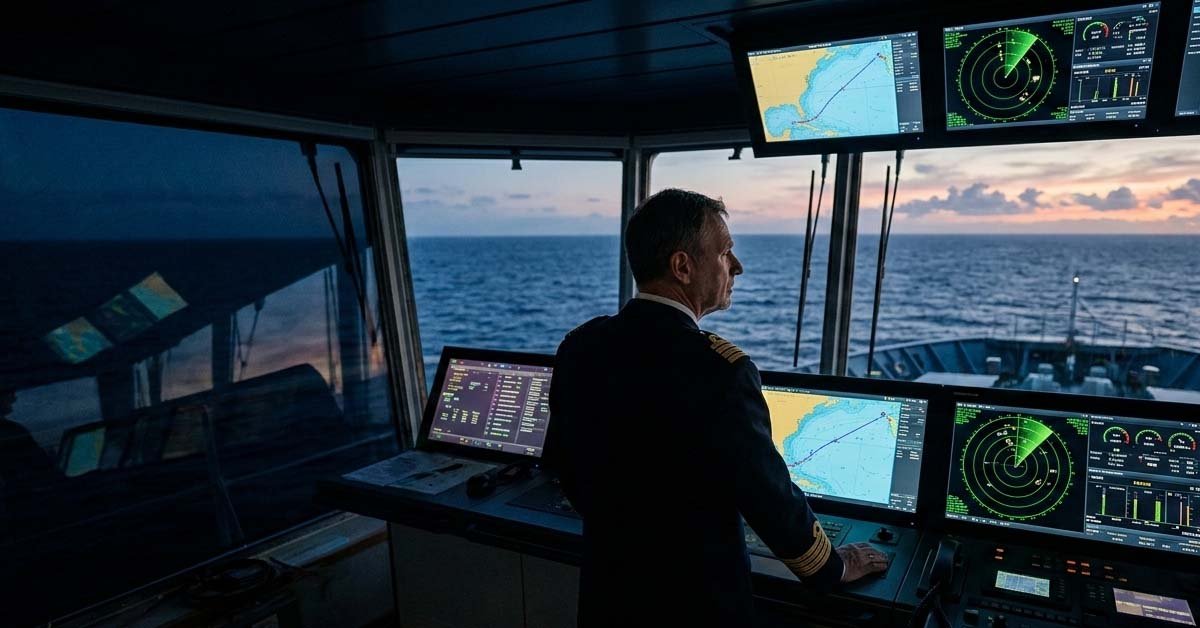
Now, in 2026, the bridge resembles a mission-control centre.
Screens are everywhere—position keeping, weather, traffic, machinery health, and fuel monitoring—each updating constantly as the vessel moves through the swell. It is tempting to dismiss this as merely an accumulation of technological “bells and whistles.” In reality, the transformation runs far deeper.
The way ships operate today reveals something fundamental about the industry itself: how decisions are made, how risks are managed, and how seriously organisations treat both crew welfare and environmental responsibility.
From Guesswork to Real-Time Intelligence
Not long ago, checking the weather meant waiting for a crackling radio bulletin or watching a fax machine slowly produce a blurry chart. Engine diagnostics relied on a flashlight and the quiet hope that nothing critical would fail before the next port. Fuel consumption was recorded in a logbook at the end of each watch and manually tallied later.
Today, everything is presented on screen.
Modern vessels operate through integrated systems fed by dozens of sensors distributed across the ship. A single glance provides precise positioning, multi-day weather forecasts, nearby traffic information, and real-time fuel consumption.
The transformation is not merely about convenience—it is about the speed and confidence with which decisions can now be made.
During one ocean crossing, our voyage planner proposed a route that appeared longer on the chart. The initial reaction was predictable: a waste of time and bunker fuel. Yet when the system modelled the scenario, the reasoning became clear.
Avoiding the developing weather system ultimately reduced fuel consumption and kept us closer to schedule than forcing our way through would have.
A generation ago, the data required to make such a decision with confidence simply did not exist onboard.
The Engine Room: From Reactive to Predictive
Below deck, the engine room has undergone a similar transformation.
Condition-based monitoring now allows engineers to detect mechanical stress signatures in real time. Instead of waiting—and hoping—that a pump or system will survive until the next port, maintenance can be scheduled strategically when it aligns with charter schedules.
The ship is no longer a black box.
It becomes an asset that can be actively monitored, analysed, and managed.
Precision That Keeps People Safe
Dynamic Positioning (DP) was once a niche capability used primarily by specialist offshore vessels. Today, it has become standard across many mission-specific ships, particularly in offshore construction and renewable energy operations.
Its evolution highlights an important principle: technology earns trust only when lives depend on it—and it delivers consistently.
DP systems measure wind, waves, and currents while continuously modelling the vessel’s dynamic behaviour. Thrusters adjust automatically with a precision far beyond what manual joystick control could achieve.
I once stood aboard an accommodation vessel positioned beside an offshore wind tower, watching the DP system hold the ship steady within a metre while crews worked only an arm’s length from steel structures.
This is not sophisticated engineering for its own sake.
It is what prevents gangways, tenders, and subsea equipment from ending up where they should not.
Just as important as the operation itself is the data trail it leaves behind. DP systems record environmental inputs, thruster commands, alarms, and system responses. These logs support incident reviews, operational debriefs, and procedural improvements.
Technology therefore serves not only as a safety tool—but also as a learning system for organisations.
Smart Ships—But Who Is in Charge?
Autonomous vessels often dominate industry headlines—sleek renderings of crewless ships gliding across open oceans.
The reality onboard working ships is far more incremental—mirroring the wider shift toward human-technology collaboration in modern industries.
Remote operations centres now assist bridge teams in analysing complex traffic situations. Automated mooring systems, advanced lookout technologies, and collision-avoidance tools are increasingly deployed as decision-support systems, not replacements for human officers.
Imagine navigating a congested harbour approach in thick fog. An intelligent lookout system highlights a small fishing vessel that a fatigued officer might otherwise miss.
The value is obvious.
Yet one question remains unchanged.
When something goes wrong, regulators and courts still ask the same question:
Who was in charge?
No algorithm can answer that question.
Responsible operators therefore treat every autonomous function as both a technical decision and a governance decision. Responsibilities, training requirements, and accountability must be clearly defined before such systems are activated—not after an incident occurs.
Technology may assist, advise, and warn.
But accountability remains human.
Greener Seas, One Voyage at a Time
Decarbonisation has placed maritime technology under increasing environmental scrutiny.
Hull sensors now track fouling-related drag throughout a voyage. Emissions monitoring systems report actual stack output rather than relying on estimates or assumptions. Digital twins allow shore teams to simulate retrofits, fuel changes, and route adjustments before committing to costly physical modifications.
The impact often appears modest.
A one- or two-percent fuel saving on a single voyage may seem insignificant.
But across an entire fleet—and sustained over years—those incremental improvements remove thousands of tonnes of fuel consumption and emissions.
In an industry operating on thin margins and facing rising environmental regulation, the ability to demonstrate environmental performance with credible data has become just as important as achieving the improvement itself.
For charterers, regulators, and investors alike, the ability to prove progress is now a competitive advantage.
What This Means for Operators and Leaders
Technology at sea is not about replacing people.
It is about equipping professionals with better tools to make high-stakes decisions in real time—often while fatigued and operating in environments that most people would find intolerable.
In many ways, the bridge has become a mirror of leadership. The way a ship is equipped—and how technology is used during demanding operations—reflects the same principles explored in discussions around leadership in high-stakes operational environments.
The way a ship is equipped—and how technology is used during demanding operations—reveals how seriously an organisation treats safety, sustainability, and duty of care.
An operator that invests heavily in decision-support systems while neglecting training budgets sends a clear message.
So does one that celebrates fuel savings while ignoring crew fatigue.
The organisations that succeed are those that align technology, people, and purpose so that safety, sustainability, and commercial performance reinforce one another.
This alignment requires more than purchasing sophisticated systems. It demands rigorous selection, thorough training, disciplined procedures, and clear governance frameworks.
The Human Element Remains Central
For regulators and classification societies, these changes reinforce the need to address questions of competence, responsibility, and fatigue as advanced technologies become more widespread.
Sensors, algorithms, and automation will continue to evolve.
But the future of maritime work will not be determined by technology alone.
It will ultimately be shaped by how we choose to use these tools—and whether human judgement, experience, and accountability remain firmly at the centre of decision-making.