Bridging the Digital Divide: Making Experiential Learning Accessible to Every Student

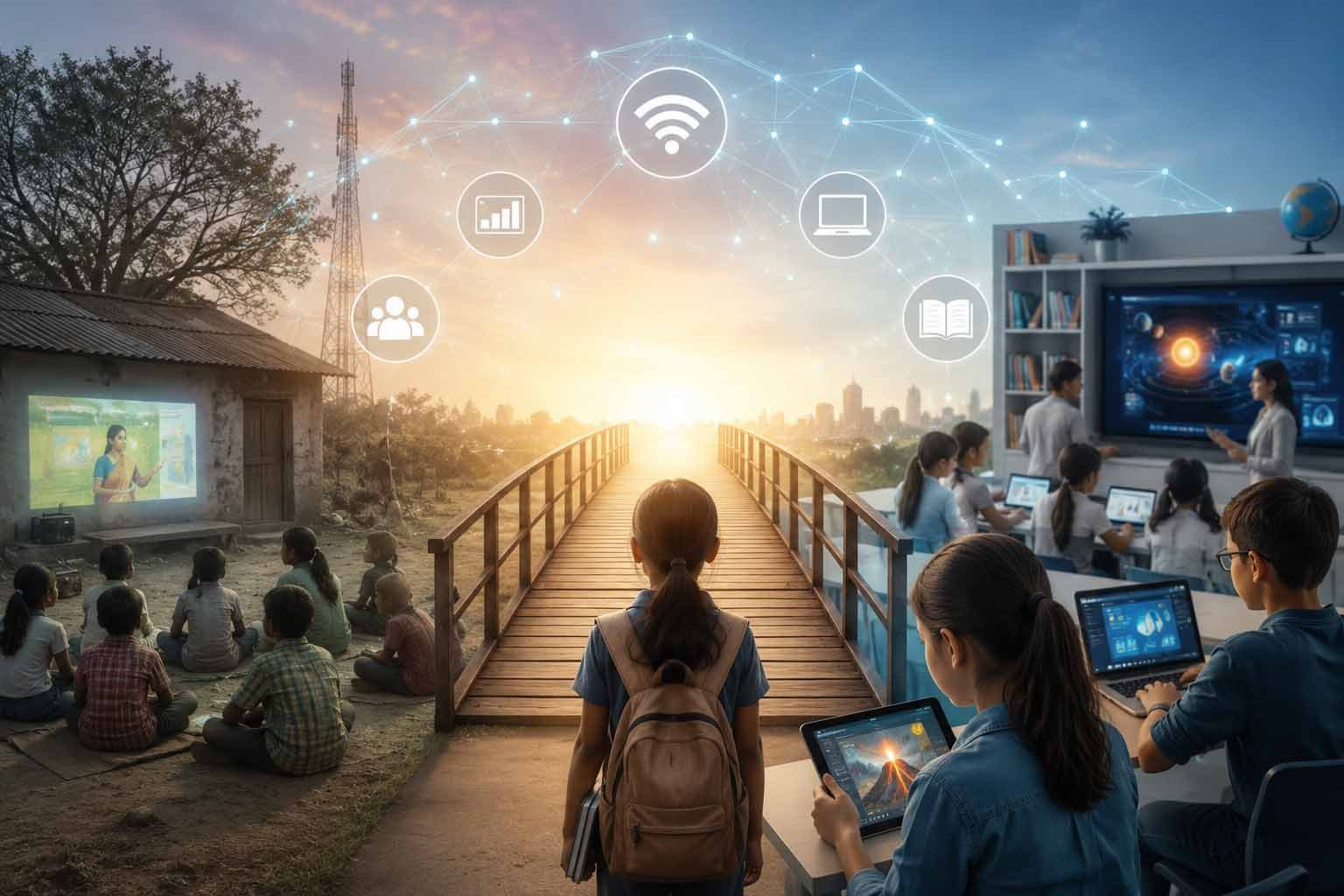
Bridging the digital divide in education is one of the defining equity challenges of the 21st century. While edtech promises to democratise access to experiential learning, deep disparities in devices, connectivity, and digital literacy continue to produce unequal outcomes for K–12 students worldwide. The challenge is not merely technological — it is fundamentally pedagogical: how can educators leverage digital tools to deliver meaningful, hands-on learning for every student, regardless of socio-economic background?
According to UNESCO (2023), nearly one-third of school-age children globally still lack reliable internet access — a stark reminder that digital transformation in education is far from complete. Closing this gap demands systemic action across infrastructure, pedagogy, and policy. The digital divide is not only a connectivity problem it is a skills, pedagogy, and equity problem that technology alone cannot solve.
Understanding the Digital Divide: Beyond Access and Connectivity
The digital divide in education is commonly framed as a lack of internet access or devices. In reality, it encompasses at least three overlapping layers:
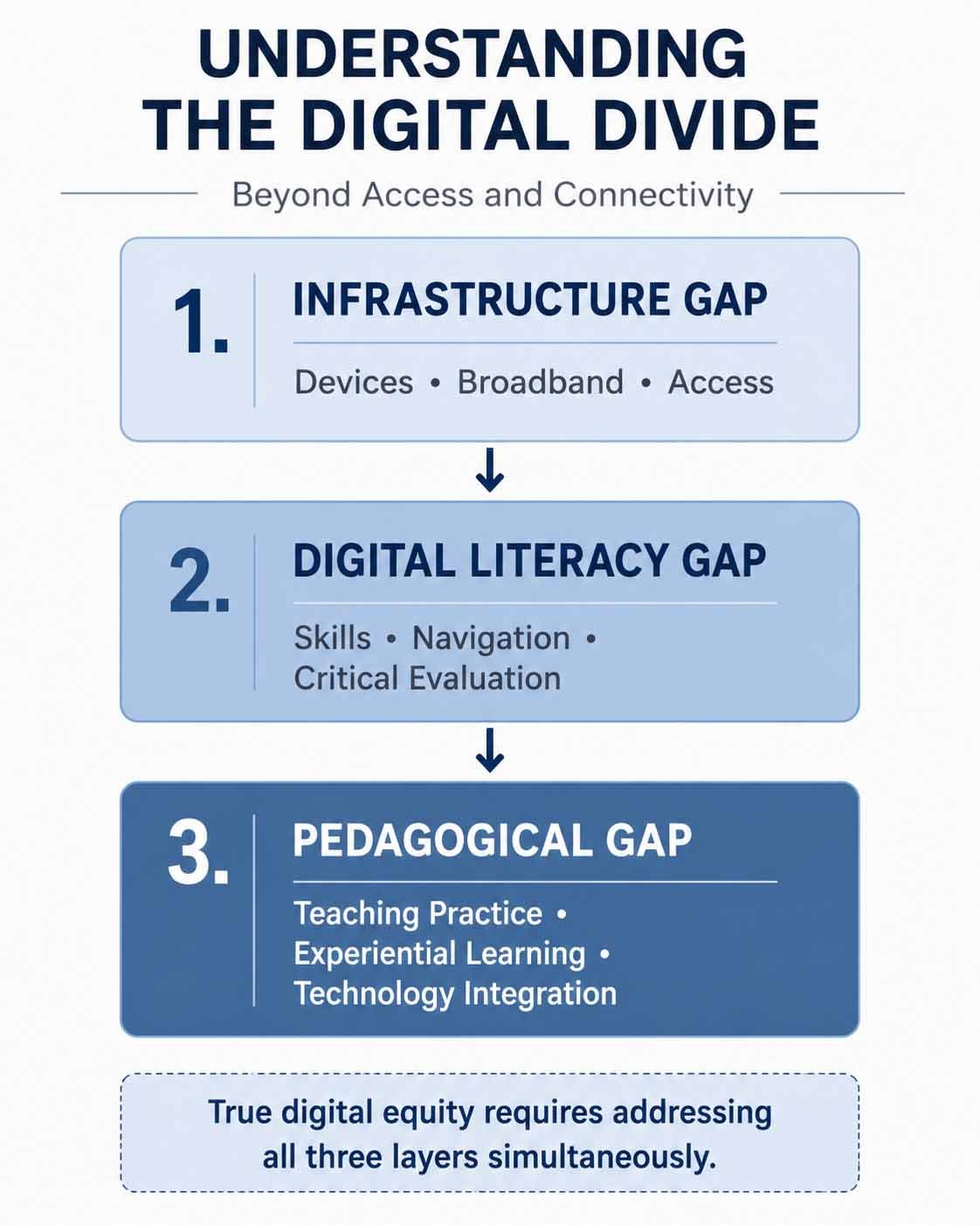
The Infrastructure Gap: Where Bridging the Digital Divide Begins
Millions of students — particularly in rural and low-income communities — lack reliable broadband or personal devices. Without these basics, participation in any digital learning ecosystem is impossible.
Digital Literacy: The Missing Link in Educational Equity
A student may own a smartphone yet lack the skills to navigate complex educational platforms, evaluate online sources, or use productivity tools effectively. Access without literacy produces limited learning gains.
The Pedagogical Gap: Inclusive Teaching in an Unequal Digital Landscape
Educators may be equipped with devices and software but receive little training in integrating them into student-centred, experiential pedagogies. As Selwyn (2016) argues, technology in education is not inherently transformative — its impact depends entirely on how it is embedded within existing social and institutional structures.
How Edtech Expands Experiential Learning Opportunities in K–12 Education
Experiential learning — rooted in Kolb’s cycle of experience, reflection, conceptualisation, and application — has found powerful new expressions in the digital classroom. Edtech now enables:
• Virtual Reality (VR) and Augmented Reality (AR) for immersive historical, scientific, and vocational simulations
• Gamified learning platforms that build critical thinking and engagement
• AI-driven adaptive tools that personalise learning pathways in real time
• Project-based collaboration platforms that mirror real-world workflows
However, these innovations frequently remain out of reach for marginalised learners. To address this, low-bandwidth and offline-first solutions have emerged as critical alternatives — including SMS-based learning modules, radio and television broadcasts, and apps designed to function without a live internet connection.
Case Study: India's PM eVIDYA and Inclusive Digital Learning
One of the most compelling examples of large-scale digital inclusion in education is India's PM eVIDYA initiative. Launched in 2020 as part of the country's response to widespread learning disruptions, the programme recognised a critical reality: millions of students could not participate in online learning simply because they lacked reliable internet access or digital devices.
Rather than relying exclusively on high-speed connectivity, PM eVIDYA adopted a multi-channel approach to reach learners wherever they were. Dedicated educational television channels under the "One Class, One Channel" model delivered curriculum-aligned lessons across grade levels, while community radio broadcasts and podcasts extended educational access to remote and underserved communities. The programme was further supported by a comprehensive digital content portal, ensuring that students, teachers, and parents could access learning resources through multiple formats and platforms.
What makes PM eVIDYA particularly significant is its recognition that educational equity requires flexibility. A student in a metropolitan city with broadband access and a student in a rural village with only a television set were both provided pathways to continue learning. The initiative demonstrated that meaningful educational experiences do not always depend on cutting-edge technology; they depend on thoughtful design that meets learners where they are.
By 2022, PM eVIDYA had reached more than 240 million learners, making it one of the world's largest educational outreach programmes. Beyond its scale, the initiative highlighted an important lesson for policymakers and educators globally: bridging the digital divide is not solely about providing devices or internet connections. It is about creating inclusive ecosystems that accommodate diverse realities, learning environments, and levels of digital readiness.
The success of PM eVIDYA illustrates that experiential and multimedia learning can be delivered effectively even in low-connectivity settings. When technology is combined with inclusive planning, adaptive delivery models, and a commitment to equity, digital education can extend far beyond the boundaries of traditional classrooms and reach learners who might otherwise be left behind.
Teacher Training: The Critical Role in Closing the Digital Divide in Education
Teachers are the most decisive variable in whether edtech narrows or widens the digital divide. Professional development programmes must move beyond basic digital skills to encompass:
• Instructional design for student-centred, experiential pedagogy
• TPACK (Technological Pedagogical Content Knowledge) frameworks that integrate technology with subject matter and teaching method
• Co-creation of digital content, giving teachers ownership and ensuring contextual relevance
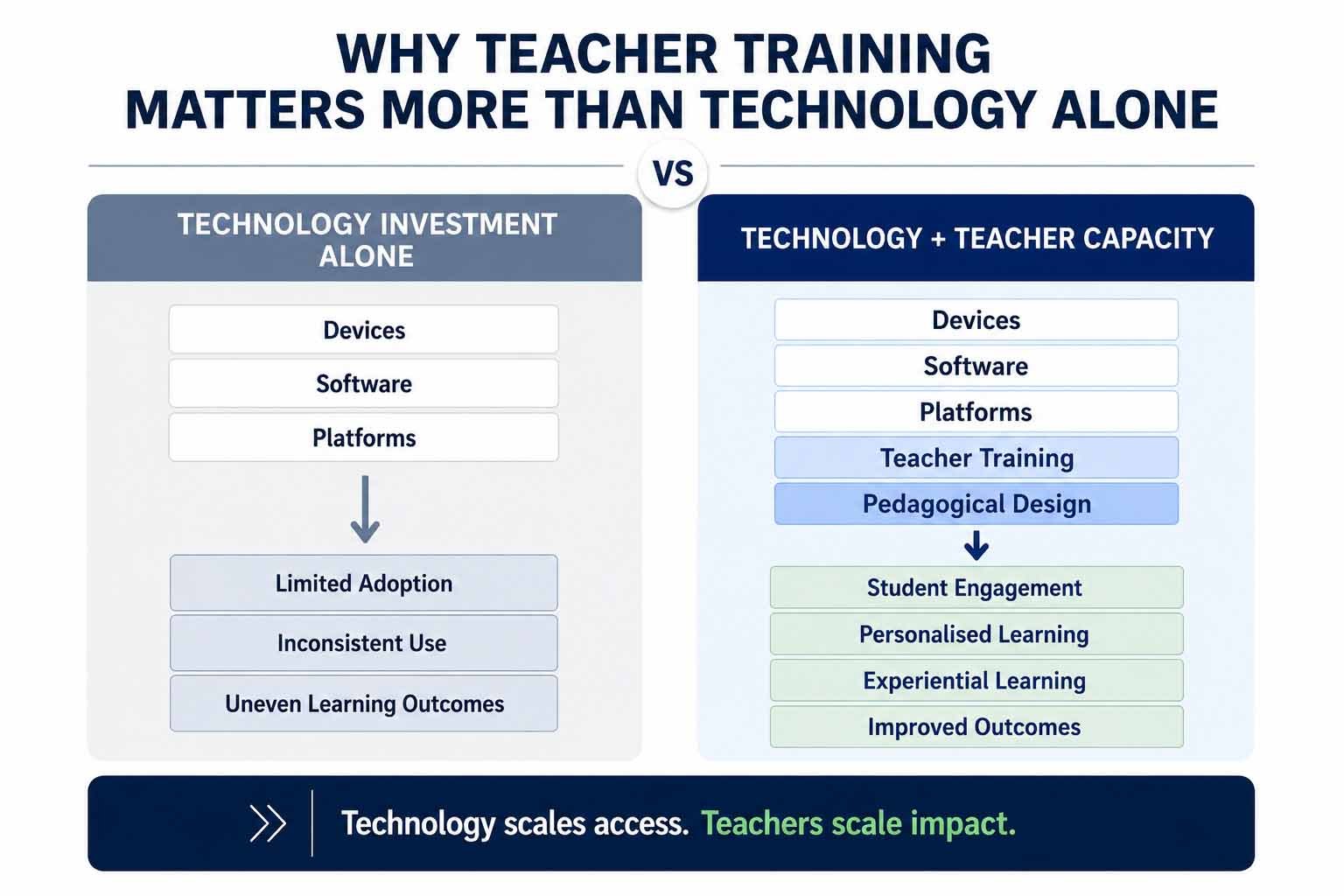
Evidence from multiple education systems suggests that investments in teacher professional development often generate greater long-term learning gains than investments in hardware alone. When educators are confident in designing technology-enabled learning experiences, even modest digital resources can have significant impact. Conversely, classrooms equipped with advanced technologies frequently underperform when teachers lack the support needed to integrate those tools meaningfully.
As Darling-Hammond et al. (2020) note, effective teacher education integrates technology with pedagogy and content, enabling educators to design meaningful learning experiences rather than simply deploying new tools.
Inclusive Policy and Public-Private Partnerships for Equitable Edtech Deployment
Research consistently demonstrates that learners engage more deeply when educational content reflects their language, culture, and lived experiences. Digital platforms designed primarily for urban or Western audiences may inadvertently exclude learners from different socio-cultural contexts. Ensuring that educational technologies are culturally responsive is therefore not merely a question of representation, but a prerequisite for meaningful participation and learning. Bridging the digital divide in education cannot be achieved by schools alone. It requires coordinated investment across government, industry, and civil society:
• Public investment in broadband infrastructure and device distribution programmes
• Open Educational Resources (OER) policies that reduce cost barriers to quality content
• Data privacy regulations that protect student information in edtech ecosystems
• Inclusive design mandates that require edtech products to meet accessibility and multilingual standards
Public-private partnerships (PPPs) have scaled digital classroom deployments and teacher training programmes effectively in several contexts. However, equity-focused governance frameworks are essential to ensure that commercial interests do not overshadow educational goals.
Designing Inclusive and Culturally Responsive Digital Learning
Experiential learning must be culturally responsive to be effective. Much digital content reflects dominant narratives and languages, marginalising indigenous knowledge systems and local contexts. Truly equitable edtech must incorporate:
• Multilingual content and interfaces
• Indigenous knowledge integration into curriculum design
• Context-specific pedagogy that reflects local realities
Gender disparities compound these challenges. In many regions, girls are statistically less likely to have access to digital devices or the internet. Targeted community engagement programmes and gender-sensitive policies are essential components of any equity-first digital strategy.
Measuring Edtech Impact: Scaling What Works for K–12 Learners
Robust monitoring and evaluation are essential to ensure that edtech-driven experiential learning actually improves outcomes. Effective frameworks should measure:
• Learning outcomes and skill development — not just access and usage metrics
• Student engagement levels and dropout indicators
• Teacher adoption rates and confidence scores
For example, a school may report high platform usage rates, yet still experience low student engagement or limited improvement in learning outcomes. Measuring success therefore requires examining not only access and participation, but also evidence of critical thinking, collaboration, problem-solving, and knowledge application.
Scalability remains the sector’s central challenge. Pilot programmes frequently demonstrate success but fail to translate into large-scale implementation. Adaptable, modular models — designed from the outset to be customised across diverse educational contexts — offer the most promising path to systemic change.
Frequently Asked Questions
What is the digital divide in education and why does it matter?
The digital divide in education refers to the gap between students who have reliable access to digital devices, internet connectivity, and the skills to use them effectively — and those who do not. It matters because access to digital tools increasingly determines access to quality, experiential, and future-ready learning.
How can schools provide experiential learning without high-speed internet?
Schools can use offline-first apps, pre-loaded tablets, SMS-based platforms, and broadcast media such as radio and television to deliver experiential and multimedia learning independently of live internet access. India’s PM eVIDYA programme and Kenya’s Eneza Education platform are proven examples.
What role do teachers play in bridging the digital divide?
Teachers are central. Without training in how to integrate technology into student-centred, experiential pedagogies — using frameworks like TPACK — even well-resourced classrooms fail to convert devices into learning gains. Teacher professional development is the most high-leverage investment any school or system can make.
Closing the Digital Divide: A Mission Beyond Technology
Bridging the digital divide in education is not a problem that more bandwidth or more devices can solve alone. It demands a holistic commitment — to teacher empowerment, culturally responsive content, equitable policy, and rigorous measurement. When those elements align, edtech becomes what it has always promised to be: a genuine equaliser, enabling every learner — regardless of geography, language, or income — to engage in meaningful, experience-driven education.
The systems and students most in need of transformation cannot wait for perfect conditions. The tools, models, and evidence already exist. What remains is the will to deploy them equitably — and the sustained investment to make that equity last.