

Burnout Is Not a Personal Problem — It’s a Leadership Design Flaw

Workplace burnout and occupational burnout are no longer isolated HR concerns—they are systemic organisational risks. Workplace burnout is a leadership design flaw embedded in how work is structured, measured, and rewarded, while occupational burnout reflects the cumulative psychological, emotional, and physical exhaustion caused by prolonged exposure to poorly designed work systems. When burnout becomes widespread, it signals not individual weakness but systemic failure.
This article explores how leaders can understand, diagnose, and redesign organisational systems to prevent burnout at scale. It examines the role of leadership, planning, and organisational design in creating or preventing burnout, supported by real-world data, including findings from Deloitte.
What Is Workplace Burnout and Occupational Burnout?
Workplace burnout is a state of chronic physical, emotional, and mental exhaustion caused by prolonged workplace stress that is not effectively managed. Occupational burnout, a broader concept, reflects long-term exposure to these stressors across a profession or role, often leading to disengagement, reduced performance, and mental health deterioration. The World Health Organization defines burnout as a syndrome resulting from chronic workplace stress that has not been successfully managed. It is characterised by three dimensions: exhaustion, cynicism or detachment, and reduced professional efficacy. Traditionally, burnout was framed as an individual issue requiring resilience or stress management. Today, it is understood as a systemic outcome—a predictable result of leadership decisions, organisational culture, and work design.
Key Burnout Symptoms at Work: Early Warning Signs of Workplace Burnout
Burnout rarely appears suddenly; it develops gradually through compounding stressors. Recognising symptoms early is critical for both individuals and organisations.
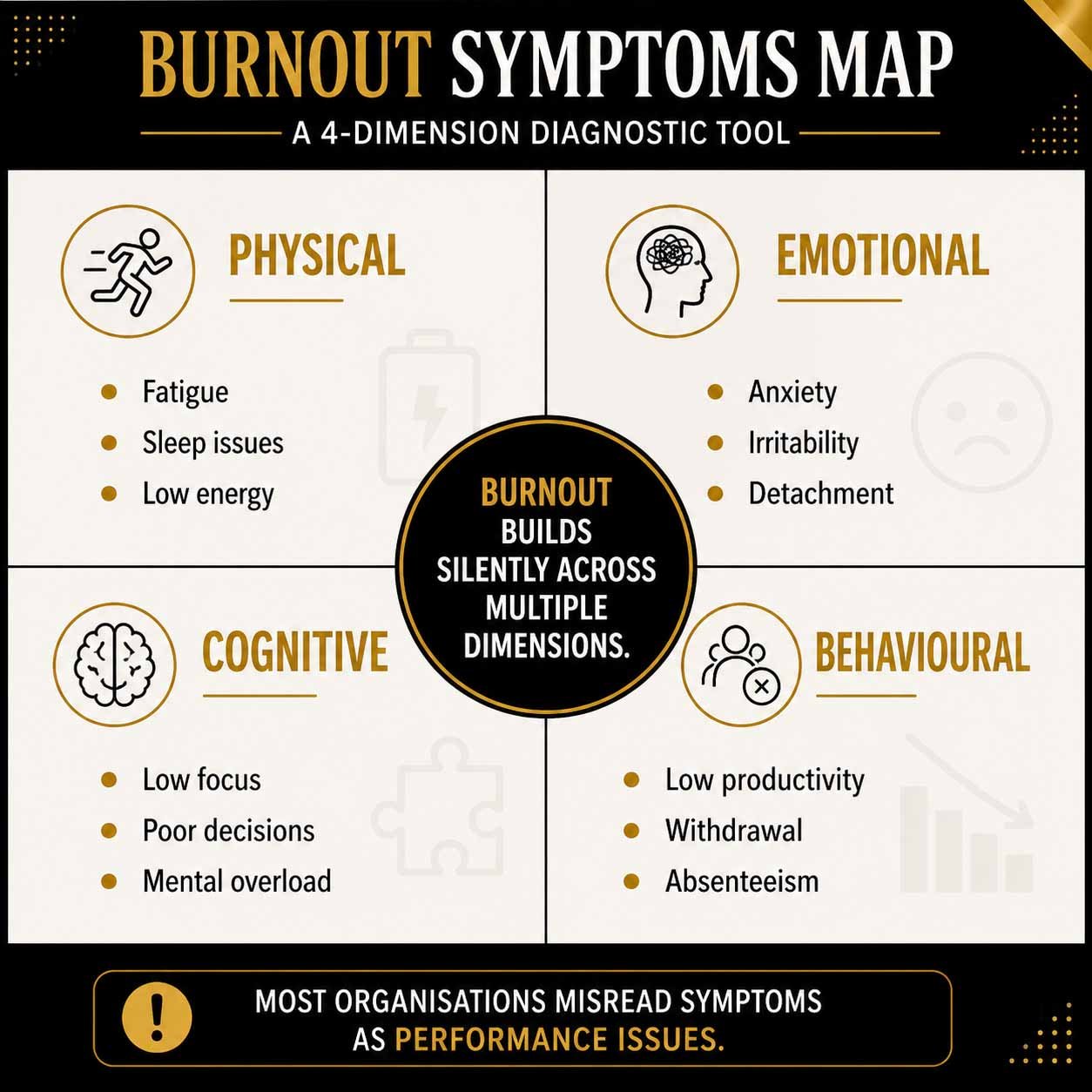
Physical Symptoms of Workplace Burnout and Chronic Stress
Chronic fatigue, sleep disturbances, headaches, and weakened immunity are among the most visible signs. These symptoms often emerge when recovery cycles are insufficient to offset sustained workload pressure.
Emotional and Psychological Burnout Symptoms in Employees
Employees experiencing burnout often report anxiety, irritability, emotional detachment, and a sense of helplessness. Over time, motivation declines and engagement erodes, even among high performers.
Cognitive Effects of Occupational Burnout on Performance
Burnout reduces focus, decision-making ability, and creativity. Employees struggle with prioritisation and experience mental overload, particularly in environments with constant interruptions and shifting expectations.
Behavioural Signs of Workplace Burnout in Organisations
Increased absenteeism, reduced productivity, withdrawal from collaboration, and higher turnover intentions are common behavioural indicators of burnout. These symptoms are often misinterpreted as performance issues rather than systemic signals.
Top Causes of Workplace Burnout and Occupational Burnout in Organisations
Burnout does not originate in individuals—it is produced by systems. The most common causes include:
- Excessive workload and unrealistic deadlines
- Unclear priorities and constant task switching
- Lack of autonomy and decision-making control
- Always-on culture and expectation of constant availability
- Misaligned incentives that reward overwork
- Poor leadership communication and feedback loops
The main causes of burnout are excessive workload, lack of control, unclear expectations, and poor leadership systems.
WHO Definition of Workplace Burnout: Global Perspective on Occupational Burnout
The global understanding of workplace burnout and occupational burnout has been significantly shaped by the World Health Organization, which formally classified burnout as an occupational phenomenon in the International Classification of Diseases (ICD-11). This classification marked a critical shift: burnout is no longer viewed as a vague psychological state, but as a measurable, work-related syndrome with systemic origins. According to WHO, burnout is defined by three dimensions:
- Persistent physical and emotional exhaustion
- Increased mental distance from one’s job or feelings of negativity
- Reduced professional efficacy
This definition reinforces a crucial insight: burnout is not caused by personal fragility, but by chronic workplace stress that has not been successfully managed at the organisational level. WHO’s research consistently highlights that burnout is most prevalent in environments characterised by high demand, low control, and insufficient support systems. These conditions are not accidental; they are direct outcomes of leadership decisions, organisational structures, and planning failures. The implication for leaders is significant. If burnout is formally recognised as an occupational phenomenon, then its prevention must also be treated as an organisational responsibility. This shifts the burden from employee coping mechanisms to leadership accountability, system design, and workplace architecture.
The Role of Leadership in Workplace Burnout and Employee Stress
Leadership is the single most influential factor in determining whether burnout emerges or is prevented. Leaders shape workload distribution, define priorities, and set behavioural norms across the organisation. When leaders reward responsiveness over effectiveness, employees learn that being constantly available matters more than producing meaningful outcomes. When leaders celebrate overachievement without questioning sustainability, they normalise overwork as a success metric. Leadership styles also play a structural role. Transactional leadership can create pressure through rigid performance metrics, while charismatic leadership can drive unsustainable intensity. In both cases, without balance, leadership amplifies stress rather than managing it.
Burnout persists not because leaders intend harm, but because leadership systems are rarely evaluated for their human impact. Over time, these systems create invisible rules: rest is risky, boundaries are negotiable, and endurance is rewarded.
How Poor Planning Contributes to Workplace Burnout
Poor planning is one of the most underestimated drivers of burnout. While leadership sets direction, planning determines how work is executed. Ineffective planning manifests in several ways:
- Overloaded project timelines with unrealistic delivery expectations
- Lack of prioritisation, leading to competing demands
- Excessive meetings that fragment attention and reduce productivity
- Absence of buffer time for recovery or unexpected challenges
When planning fails, employees compensate by extending their working hours, increasing cognitive load, and sacrificing recovery. Over time, this creates sustained pressure that leads directly to occupational burnout. Effective planning, by contrast, aligns workload with capacity, ensures clarity of priorities, and protects time for focused work. It transforms work from reactive to structured, reducing unnecessary stress.
Why Leadership and Planning Are Essential for Burnout Prevention
Burnout prevention requires the integration of leadership and planning into a coherent system. Leadership defines expectations; planning operationalises them. When both are aligned, organisations can create sustainable performance environments.
Alignment of Priorities and Capacity to Prevent Burnout
Leaders must ensure that organisational goals are matched with realistic resource allocation. Planning systems should reflect actual capacity rather than aspirational targets.
Structured Work Design to Reduce Workplace Stre
Clear workflows, defined decision rights, and predictable processes reduce ambiguity and cognitive overload. This creates stability in execution and reduces stress.
Sustainable Performance Metrics Beyond Overwork
Organisations must shift from output-based metrics to sustainability-based metrics, including employee engagement, retention, and energy levels.
Built-in Recovery Mechanisms
High performance requires recovery. Leaders and planners must design systems that allow for rest, reflection, and recalibration. Burnout prevention is not achieved through isolated initiatives—it is the outcome of integrated leadership and planning systems working together.
Building Recovery Systems to Prevent Occupational Burnout
Modern organisations invest heavily in wellness programs yet burnout continues to rise. This paradox reveals a fundamental misalignment between solutions and root causes. Wellness initiatives operate at the individual level, offering tools for stress management. However, burnout originates at the system level. When employees are encouraged to practice self-care within environments that make recovery impossible, the result is superficial change without structural impact. This explains why burnout persists: organisations treat symptoms while ignoring causes. Without redesigning leadership systems and planning processes, wellness programs remain cosmetic interventions.
Workplace Burnout in India: Insights from Deloitte Research
According to a 2022 Deloitte study on employee mental health, 80% of India's workforce reported experiencing symptoms of poor mental health in the past year, with 47% identifying workplace stress as the biggest factor. Other surveys have shown rates of burnout reaching as high as 70-77% in various studies, often driven by the "always-on" culture.
This statistic reflects deeper structural issues:
- Rapid economic growth combined with high performance pressure
- Cultural norms that equate long hours with dedication
- Competitive work environments with limited boundaries
- Leadership models that prioritise output over sustainability
The data underscores a critical insight: burnout at scale is not an anomaly—it is a systemic pattern driven by organisational design.
Workplace Burnout as a Leadership Design Failure
Burnout is best understood as a failure of leadership design. Organisations that consistently demand more than they restore create systems that extract energy without replenishment. This failure manifests in:
- Misaligned incentives that reward overwork
- Lack of clarity in roles and responsibilities
- Continuous escalation of expectations without recalibration
- Absence of feedback mechanisms to detect stress early
These systems function exactly as designed. Burnout is not a breakdown—it is an output. Recognising this shifts the conversation from individual coping to organisational accountability. It forces leaders to redesign systems rather than expect employees to adapt indefinitely.
Human-Centric Leadership: A Sustainable Approach to Prevent Burnout
Human-centric leadership is often misunderstood as reduced standards. In reality, it demands greater discipline. Leaders must design systems that optimise both performance and sustainability. This involves:
- Clarifying priorities to reduce unnecessary workload
- Protecting focus by minimising interruptions
- Encouraging autonomy in execution
- Normalising recovery as part of performance
Human-centric leadership does not eliminate pressure—it manages it intelligently. It ensures that performance is sustained over time rather than achieved through short-term overexertion.
Leadership Redesign vs Leadership Development in Burnout Prevention
Traditional leadership development focuses on individual capability. However, burnout prevention requires system-level redesign. Leaders must be equipped not only to perform within systems but to reshape them. This includes:
- Redesigning workflows to reduce friction
- Aligning incentives with sustainable outcomes
- Simplifying decision-making structures
- Eliminating unnecessary complexity
Organisations that focus solely on leadership development without addressing design will perpetuate burnout with more skilled leaders operating within flawed systems.
Business Impact of Workplace Burnout: Insights from Gallup Data
While WHO provides the clinical definition, workplace impact is best understood through workforce data. Research by Gallup reveals that burnout is deeply intertwined with employee engagement, productivity, and organisational performance. Gallup’s global workplace studies show that: Only ~23% of employees worldwide are actively engaged at work.
- Actively disengaged employees are significantly more likely to experience burnout
- Burned-out employees are 2.6x more likely to be actively seeking another job
- High burnout teams report 63% more sick days and significantly lower productivity
More importantly, Gallup identifies five key drivers of burnout, all of which are directly influenced by leadership and planning:
- Unfair treatment at work
- Unmanageable workload
- Lack of role clarity
- Lack of communication and support from managers
- Unreasonable time pressure
Each of these drivers maps directly to organisational design decisions. This reinforces a critical pattern: burnout is not random; it is predictable, measurable, and preventable when leadership systems are aligned correctly. From a business perspective, burnout is not just a people issue—it is a performance risk. Disengagement, attrition, and productivity loss compound into measurable financial impact, making burnout prevention a strategic priority rather than an HR initiative.
How to Prevent Workplace Burnout: The Future of Leadership
Burnout is no longer an HR issue, it is a strategic risk. As work becomes more complex and cognitively demanding, organisations that fail to address burnout will face declining productivity, higher attrition, and reduced innovation. The future of leadership will be defined by the ability to create environments where high performance is sustainable. Leaders who redesign work systems to balance demand and recovery will outperform those who rely on intensity alone. Burnout is feedback. It signals that systems are misaligned with human capacity. Leaders who act on this feedback will shape the future of work.
Practical Strategies to Prevent Workplace Burnout and Occupational Burnout: A Leadership and Planning Playbook
Understanding burnout is not enough, leaders need clear, actionable frameworks to prevent it. Burnout prevention requires deliberate system design across leadership, planning, and organisational operations.
1. Capacity-Based Workload Planning to Reduce Burnout
Most organisations plan based on desired outcomes rather than realistic capacity. Leaders must shift toward capacity-based planning, where workload is aligned with available time, resources, and cognitive bandwidth. This includes limiting work-in-progress, reducing parallel priorities, and eliminating unnecessary tasks.
2. Priority Clarity to Eliminate Workplace Stress
Burnout thrives in ambiguity. When everything feels urgent, employees default to overwork. Leaders must define clear priority hierarchies, ensuring teams understand what matters most—and what can be deprioritised without penalty.
3. Designing Recovery Systems for Sustainable Performance
High performance is only sustainable when paired with recovery. This requires structural interventions such as meeting-free focus blocks, realistic deadlines with buffer time and encouraging time off without implicit penalties. Recovery should be designed into workflows not treated as optional.
4. Outcome-Based Metrics to Prevent Employee Burnout
Many organisations unintentionally reward burnout by measuring visible effort (hours worked, responsiveness) instead of outcomes. Leaders must redesign performance systems to prioritise impact, efficiency, and sustainability over intensity.
5. Reducing Cognitive Load Through Better Work Planning
Poor planning increases mental strain. Leaders should minimise unnecessary complexity by:
- Streamlining meetings and communication channels
- Clarifying decision ownership
- Reducing context switching
- Cognitive simplicity is a critical but often overlooked burnout prevention lever.
6. Feedback Systems to Detect Burnout Early
Burnout becomes dangerous when it goes unnoticed. Organisations must implement continuous feedback systems, including pulse surveys, one-on-one check-ins, and workload reviews. Early detection allows leaders to intervene before burnout escalates.
7. Training Leaders to Design Burnout-Free Work Systems
Traditional leadership training focuses on interpersonal skills. Modern organisations must go further—training leaders to design workflows, align incentives, and structure sustainable systems.
Frequently Asked Questions
What is the difference between workplace burnout and occupational burnout?
Workplace burnout refers to stress caused by specific organisational conditions, while occupational burnout reflects long-term exposure to these conditions within a role or profession. Both are systemic rather than purely individual issues.
What are the main symptoms of burnout?
Burnout symptoms include chronic fatigue, emotional detachment, reduced productivity, anxiety, and cognitive overload. These symptoms develop gradually and signal sustained stress.
How does leadership contribute to burnout?
Leadership contributes to burnout through workload design, performance expectations, and cultural norms. Systems that prioritise output over sustainability create environments where burnout becomes inevitable.
Can planning reduce burnout?
Yes. Effective planning aligns workload with capacity, clarifies priorities, and reduces unnecessary stress. Poor planning is a major driver of burnout.
Why don’t wellness programs solve burnout?
Wellness programs address individual coping mechanisms but not systemic causes. Burnout prevention requires organisational redesign, not just personal resilience strategies.
Burnout as a Systemic Signal
Understanding workplace burnout and occupational burnout is no longer optional for leaders. Burnout is not a personal failure it is a systemic signal that organisational design is misaligned with human capacity. The organisations that will succeed in the future are those that treat burnout not as an exception but as feedback. By redesigning leadership systems, improving planning processes, and aligning performance with sustainability, they will create environments where people can thrive without exhaustion. Because ultimately, burnout is not a weakness to be managed it is a design flaw to be fixed.