
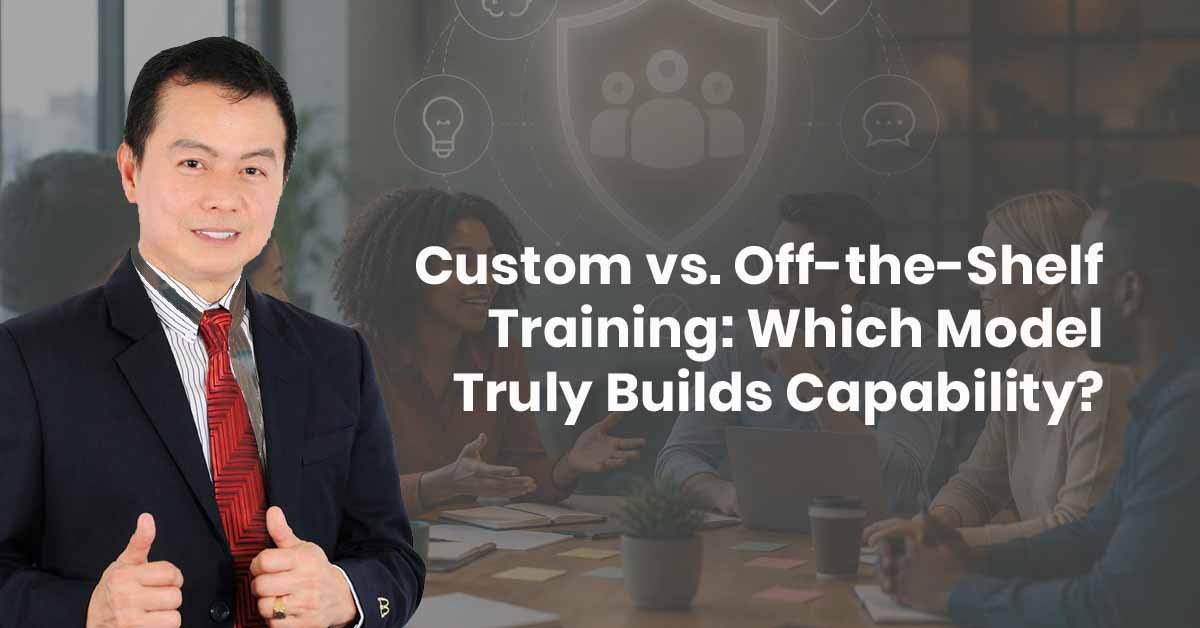
Custom vs. Off-the-Shelf Training: Which Model Truly Builds Capability?

In today’s rapidly evolving workplace, organizations are under constant pressure to upskill employees, strengthen leadership pipelines, and improve performance at every level. Training has become more than an HR initiative; it is now deeply tied to business growth, customer experience, and long-term sustainability. Yet despite the billions spent globally on corporate learning and development, many leaders still struggle with a critical challenge: are employees truly building capability, or are they simply consuming information?
According to Edwin S. De Leon, a seasoned training professional who has worked across cultures, industries, and performance environments, the answer often lies in the kind of training organizations choose to implement. While both off-the-shelf and custom-designed programs have their place, the difference between the two becomes strikingly clear when the goal shifts from knowledge sfer to meaningful behavioral change.Off-the-shelf training programs continue to remain popular for good reason. They are accessible, structured, cost-effective, and easy to deploy across large teams. Many organizations use them successfully for onboarding, compliance training, foundational concepts, and standardization initiatives. These programs provide a practical starting point for learners and help establish a common understanding of universal frameworks and practices.
informed, but information alone does not automatically lead to improved performance. True capability requires application, reinforcement, and contextual understanding. Without those elements, training risks becoming an isolated event rather than a business enabler.
“Training should be measured by business impact, not by completion rates.” Dr. Edwin S. De Leon
However, their biggest strength is also their biggest limitation. Because they are designed for broad audiences, they often fail to reflect the unique culture, challenges, leadership dynamics, and operational realities of a specific organization. Employees may understand the concepts being taught, but when they return to the workplace, many struggle to apply those ideas effectively in real-world situations. The learning remains theoretical rather than transformational.
As Edwin explains, this is where organizations begin to confuse awareness with capability. Employees may leave a training session feeling informed, but information alone does not automatically lead to improved performance. True capability requires application, reinforcement, and contextual understanding. Without those elements, training risks becoming an isolated event rather than a business enabler.
Custom-designed training, on the other hand, begins from an entirely different perspective. Instead of starting with generic content, it starts with the organization itself. The process focuses on identifying real performance gaps, operational pain points, leadership expectations, and the actual situations employees face daily. Training is then built around the organization’s language, values, customer expectations, and desired behaviors.
This shift dramatically changes the learning experience. Employees are no longer trying to force generic ideas into unfamiliar contexts. Instead, they see their own environment reflected in the training itself. The discussions feel relevant. The scenarios feel authentic. The challenges mirror what they encounter every day in the workplace.
That relevance drives engagement, but more importantly, it drives action.
From Edwin’s experience, custom training consistently develops stronger decision-making, greater execution consistency, improved leadership behaviors, and more measurable business outcomes. It moves beyond simply “teaching” employees and istead equips them to perform with greater confidence and accountability.
One of the most important insights highlighted in the discussion is that organizations often ask the wrong questions when evaluating learning solutions. Too many decisions revolve around cost, speed, or convenience. Off-the-shelf programs are undeniably faster to deploy, while custom training requires more time, collaboration, and strategic planning upfront.
But the more meaningful question, Edwin suggests, is far simpler and far more powerful: “Do we want people who know, or people who can do?”
That distinction changes everything. In an increasingly competitive business environment, organizations can no longer afford training that merely checks boxes or satisfies attendance requirements. Leaders need employees who can think critically, adapt quickly, communicate effectively, and execute consistently under pressure. Capability has become a strategic differentiator, and building it requires more than downloadable modules or standardized presentations.
At the same time, Edwin does not dismiss off-the-shelf learning entirely. In fact, he advocates for a purposeful blended approach, one that combines the efficiency of standardized learning with the impact of customized capability-building initiatives. Foundational knowledge can be delivered effectively through ready-made solutions, while mission-critical skills, leadership development, customer engagement, and operational excellence are better supported through tailored training interventions.
This balanced strategy allows organizations to maximize both scalability and effectiveness. It recognizes that not every learning need requires customization, but also acknowledges that the most important performance capabilities cannot be developed through generic content alone.
Ultimately, the article reframes training as something far more strategic than a calendar activity or compliance requirement. It challenges organizations to evaluate learning not through completion rates or attendance numbers, but through visible behavioral change and measurable business impact.
For Edwin, the message is clear: training only creates value when it works. And in a world where business success increasingly depends on people at every level — from the boardroom to the crew room — organizations must rethink how they define effective learning. Capability is not built through information alone. It is built through relevance, practice, feedback, accountability, and real-world application.
That is where custom training continues to stand apart. As Edwin powerfully concludes, “The goal of training is not just knowledge, but action.”