
Decision-Making Under Uncertainty: A Guide for Modern Leaders

There is a peculiar silence that descends on a boardroom the moment the last data point runs dry. No dashboard to refresh. No analyst to summon. No historical precedent to lean on. Just a room full of exceptionally intelligent people, a deadline, and an organisation holding its breath. In these moments, leadership stops being a science and becomes something far older, an art form practised under pressure. The question, then, is not whether ambiguity will find you. It will. The question is whether you have the frameworks to find your way through it.
Is Ambiguity the New Normal?
Ambiguity in business decision-making is not a bug in the system. It is a permanent condition of operating in a world that refuses to be fully quantified. Markets mutate overnight. Geopolitical fault lines shift without warning. Consumer behaviour pirouettes around every prediction model. The leaders who thrive are not those with the best data — they are those with the best relationship with the absence of data.
The most dangerous leader is not the one who acts without data. It is the one who waits for certainty in a world that has stopped offering it.
Why Traditional Frameworks Fail in the Fog
Most decision-making frameworks are designed for a world with sufficient signal. SWOT analyses require known variables. Risk matrices demand quantifiable probabilities. Even agile methodologies presuppose a backlog of defined requirements. Strip away the data, and these tools become elaborate rituals — comforting, structured, and ultimately useless.
Leading through ambiguity demands something different: a set of mental frameworks built not for clarity, but for navigation through the absence of it. These are not shortcuts. They are sophisticated cognitive instruments that allow leaders to make high-quality decisions with low-quality information — and to do so repeatedly, consistently, and without burning out their teams in the process.
Four Frameworks That Work When the Data Doesn't
The Reversibility Test
Ask one question before any ambiguous decision: is this reversible? Amazon's Jeff Bezos codified this as "two-way doors" vs "one-way doors." Reversible decisions deserve speed; irreversible ones deserve rigour. Most decisions under ambiguity are far more reversible than they feel in the moment — identifying this unlocks your ability to act.
Pre-Mortem Thinking
Before committing, project six months forward and imagine the decision has catastrophically failed. Then ask your team: what went wrong? This is not pessimism — it is structured imagination. Pre-mortem thinking surfaces hidden assumptions, stress-tests logic, and dramatically improves decisions made in data-scarce environments.
The Regret Minimisation Frame
Project yourself to age 80 and ask which regret sits heavier — acting boldly and failing, or never acting at all? This reframes decision-making from an analytical exercise into a values-alignment exercise. When data is absent, values become the load-bearing structure. Leaders who know their organisational values deeply make faster, better decisions in fog.
Sensemaking Over Analysis
Karl Weick's concept of sensemaking argues that in true ambiguity, the goal is not to find the right answer — it is to construct a plausible story that the organisation can act on. Gather weak signals. Talk to people at the edges of your ecosystem. Build narrative coherence, then act. Plausibility beats perfection when certainty is off the table.
The Inner Work Nobody Talks About
Decision-making frameworks for ambiguity are only as powerful as the psychological stability of the person wielding them. The hidden variable in every ambiguous leadership moment is the leader's own nervous system. Anxiety narrows cognitive bandwidth. Fear of being wrong — in cultures where being wrong carries severe social cost — produces paralysis dressed up as prudence.
The most effective leaders practising ambiguous decision-making share a common trait that rarely appears on MBA curricula: what psychologists call high tolerance for epistemic discomfort. They have trained themselves to sit with not-knowing without either grasping for false certainty or retreating into inaction.
This is a learnable skill, not a personality trait. It is built through deliberate exposure to ambiguity at lower stakes, through reflective practice, and through organisational cultures that celebrate adaptive action over performative confidence.
Clarity is a luxury. Direction is a necessity. The job of a leader is not to eliminate the fog — it is to keep moving through it with enough conviction that others follow.
Building a Culture That Moves in the Dark
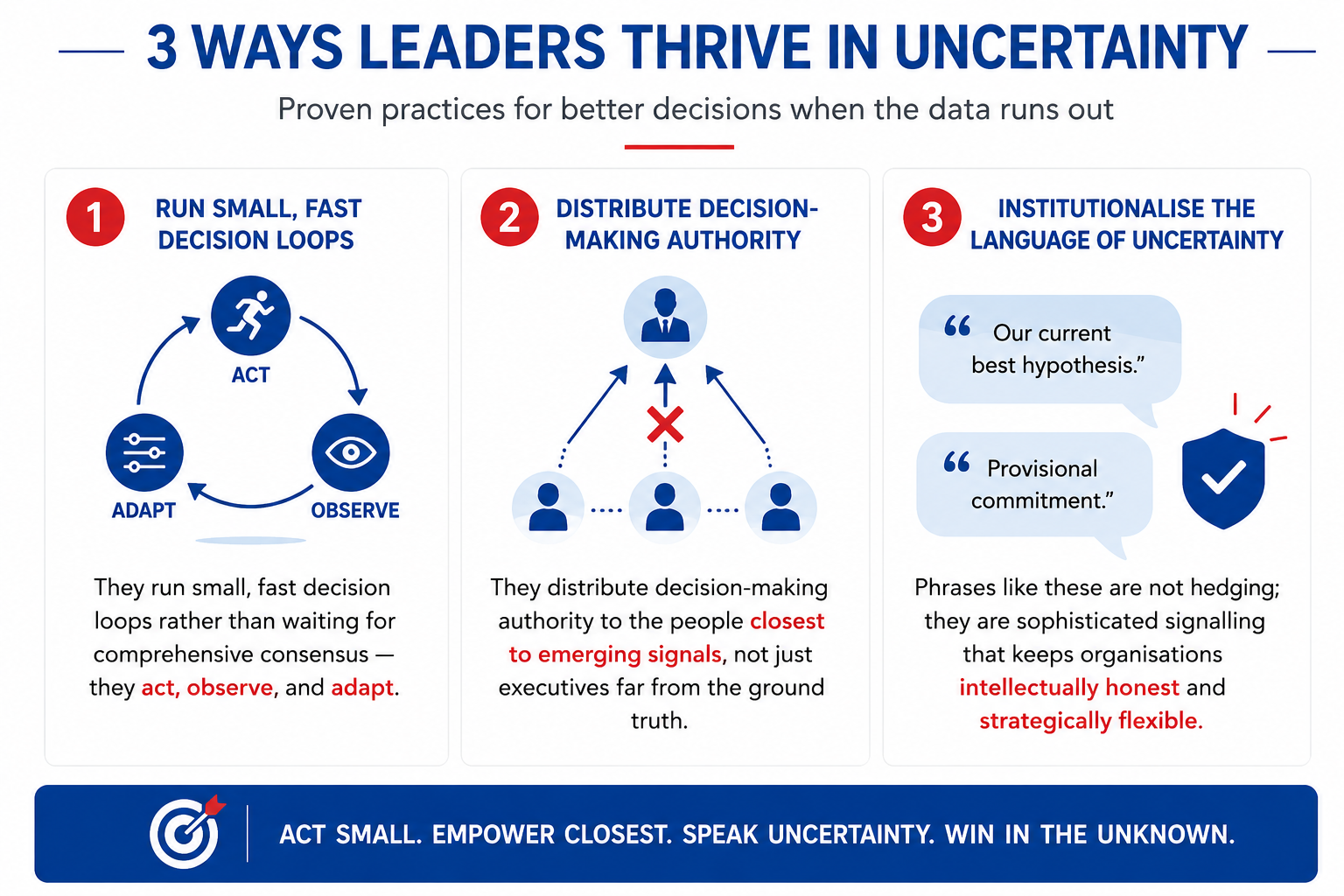
Individual frameworks matter. Organisational culture matters more. A single leader armed with pre-mortem thinking and reversibility tests will consistently be overruled by a culture that punishes wrong calls and rewards the appearance of certainty. Strategic leadership in ambiguity is therefore not just a personal competency — it is an institutional design problem. The organisations that navigate ambiguity best share three structural features.
First, they run small, fast decision loops rather than waiting for comprehensive consensus — they act, observe, and adapt.
Second, they distribute decision-making authority to the people closest to emerging signals, rather than compressing every uncertain call upward toward executives who are further from the ground truth.
Third, and most critically — they have institutionalised the language of uncertainty. Phrases like "our current best hypothesis" and "provisional commitment" are not hedging; they are sophisticated signalling that keeps organisations intellectually honest and strategically flexible.
The Competitive Edge Hidden in Plain Sight
Here is the quiet, slightly counterintuitive truth that sits at the heart of ambiguous leadership: your competitors are suffering the same fog. Every industry, in every cycle, presents the same information desert to everyone simultaneously. The competitive advantage does not belong to the organisation with superior data — it belongs to the one with superior decision-making processes when data is scarce.
Master the frameworks. Build the culture. Train the tolerance for discomfort.
When the next period of profound uncertainty arrives — and it will, because it always does — you will not be the leader staring at a blank dashboard, frozen. You will be the one already moving, already adapting, already three decisions ahead of the paralysis. That is not luck. That is craft. And like all craft, it is built long before the moment it is needed.
Frequently Asked Questions
What is decision-making under uncertainty?
Decision-making under uncertainty is the process of choosing a course of action when reliable data, historical precedent, or clear probabilities are unavailable. Rather than relying on quantitative analysis, leaders use structured judgment frameworks — such as reversibility testing, pre-mortem analysis, and sensemaking — to act with confidence despite incomplete information.
Why do traditional decision-making frameworks fail under ambiguity?
Frameworks like SWOT analysis, risk matrices, and agile backlogs assume a baseline of known variables and quantifiable probabilities. When that signal disappears, these tools lose their function — they become procedural comfort rather than genuine guidance. Ambiguity calls for frameworks designed specifically for navigation without clarity, not adapted versions of data-dependent tools.
What is the "two-way door" decision framework?
The two-way door framework, popularised by Amazon founder Jeff Bezos, asks whether a decision is reversible (a "two-way door") or irreversible (a "one-way door"). Reversible decisions can be made quickly, since mistakes are correctable. Irreversible decisions warrant slower, more rigorous deliberation. Most ambiguous decisions are more reversible than they initially feel, which is what makes this test so effective at unlocking speed.
What is pre-mortem thinking and how does it help with uncertainty?
Pre-mortem thinking is a technique where a team imagines, before committing to a decision, that it has already failed — then works backward to identify why. This structured imagination surfaces hidden assumptions and blind spots that standard planning misses, making it especially valuable when data is too thin to stress-test a decision through analysis alone.