

From Authority to Influence: Why Modern Leadership Is Being Redefined

Influence-based leadership is the model in which leaders drive organisational performance through trust, demonstrated competence, and the ability to inspire purposeful action — rather than through positional authority, hierarchy, or formal control. It is the leadership response to a fundamental shift in how organisations create value: one where competitive advantage depends on the discretionary effort of people who cannot be directed into excellence.
The leadership power shift from positional authority to genuine influence is the most significant structural change in organisational leadership of the past two decades. Command-and-control hierarchies along the dominant model for large-scale organisational management are giving way to a fundamentally different leadership architecture, one where power flows not from title or tenure but from trust, expertise, and the ability to inspire purposeful action. Understanding this shift, and mastering the modern leadership models it demands, is now the defining competency of executive effectiveness.
This shift is not cosmetic. It is structural, cultural, and strategic. Organisations that have embedded influence-based leadership report measurably stronger performance, talent retention, employee engagement, leadership agility, and adaptive capacity precisely the capabilities most needed in today's volatile global economy.
The rise of servant leadership, transformational leadership, and distributed leadership models all reflect the same underlying reality: organisations now succeed not through rigid control systems, but through cultures that unlock creativity, accountability, and strategic responsiveness.
Why Traditional Authority-Based Leadership Is Losing Effectiveness
Positional authority thrived in stable, hierarchical environments where information flowed downward, decisions were centralised, and competitive advantage derived from operational consistency rather than adaptive innovation. In these conditions, the leader's role was to direct, control, and enforce — and the organisation's role was to execute within defined parameters.
The conditions that made this model effective have largely dissolved. Organisations today operate in environments of rapid change, distributed expertise, and workforce expectations that simply do not accommodate authoritarian management styles.
72% of employees globally cite purpose and autonomy as more influential on commitment than compensation. (Deloitte, 2024)
This shift explains why influence-based management has become central to modern leadership transformation strategy. In knowledge-intensive industries especially, talent mobility and transparent information flows mean employees increasingly expect participation, meaning, and psychological safety rather than pure top-down instruction. In this landscape, authority without genuine influence is not a leadership style — it is a liability. The transition toward influence-based leadership is not optional for organisations that intend to compete for high-calibre talent in knowledge-intensive industries.
What Influence-Based Leadership Looks Like in Practice
Building Leadership Credibility Through Competence and Trust
The first pillar of influence-based leadership is credibility — not the credibility conferred by a job title, but the kind earned through demonstrated competence, intellectual honesty, and consistent follow-through. Influential leaders are trusted because they know what they are talking about, acknowledge what they do not know, and do what they say they will do.
Leadership credibility has become the primary currency of executive effectiveness in flat organisation leadership structures, where reporting lines are compressed and information travels laterally as much as vertically. Leaders who cannot earn trust through performance and character cannot compensate for its absence through hierarchy.
Research on transformational leadership consistently demonstrates that employees commit more deeply to leaders they perceive as competent, authentic, and aligned with organisational purpose. In influence-based leadership cultures, credibility does not simply improve morale it directly shapes organisational execution capacity.
Creating Psychological Safety Across the Organisation
Influence in digital era leadership depends critically on psychological safety the organisational condition where people feel secure to speak up, challenge ideas, and take reasonable risks without fear of punishment or embarrassment. Leaders who create psychological safety do not simply have more engaged teams; they have faster-learning organisations that surface problems earlier, generate more innovative solutions, and execute more cohesively.
Harvard Business School professor Amy Edmondson's research on psychological safety demonstrates conclusively that teams with high psychological safety outperform on complex tasks because their members contribute their full cognitive and creative capacity rather than managing their behaviour to avoid social risk. Her landmark study of hospital teams found that teams with greater psychological safety reported errors more frequently not because they made more mistakes, but because they felt safe acknowledging them.
Psychological safety is also one of the strongest predictors of employee engagement and leadership agility in modern organisations. Teams that trust their leaders contribute more original thinking, identify operational risks faster, and adapt more effectively during periods of uncertainty.
The Distributed Leadership Model: Sharing Power to Increase Impact
One of the most consequential expressions of the leadership power shift is the move toward distributed leadership organisations deliberately spreading leadership capacity across multiple levels and functions rather than concentrating it at the top. Distributed leadership models do not eliminate hierarchy; they supplement it with domain-specific leadership that operates with genuine autonomy within defined strategic boundaries.
The commercial logic is clear: in knowledge-intensive industries, the people closest to the work often have the most relevant insight for solving problems and seizing opportunities. Leaders who systematically block this intelligence from influencing decisions are not protecting strategic control; they are sacrificing competitive responsiveness for the illusion of certainty.
34% higher voluntary turnover occurs in organisations led primarily through positional authority versus influence-based leadership models. (Gallup, 2024) Distributed leadership is also a leadership transformation strategy — not just an HR initiative. Organisations that consciously develop leadership capacity at every level create the organisational resilience, stakeholder management capability, and strategic agility that no top-down command structure can replicate.
One of the clearest real-world examples is Microsoft under CEO Satya Nadella. When Nadella took over leadership in 2014, Microsoft shifted away from internal competition and authority-heavy management cultures toward collaboration, empathy, learning, and shared accountability. Nadella consistently emphasised curiosity over certainty and encouraged cross-functional leadership across the organisation. The transformation not only reshaped Microsoft's internal culture but also coincided with dramatic gains in innovation, market relevance, and financial performance. Microsoft's transformation illustrates a core principle of influence-based leadership: sustainable performance improvements occur when leadership capacity is distributed, psychological safety is strengthened, and employees feel empowered to contribute ideas rather than simply execute instructions.
Four Essential Skills for Leading Without Authority
The ability to drive outcomes across functional boundaries without direct reporting authority is the most practical and most testable expression of the leadership power shift. The following four skills form the operational toolkit for any leader navigating this new landscape:
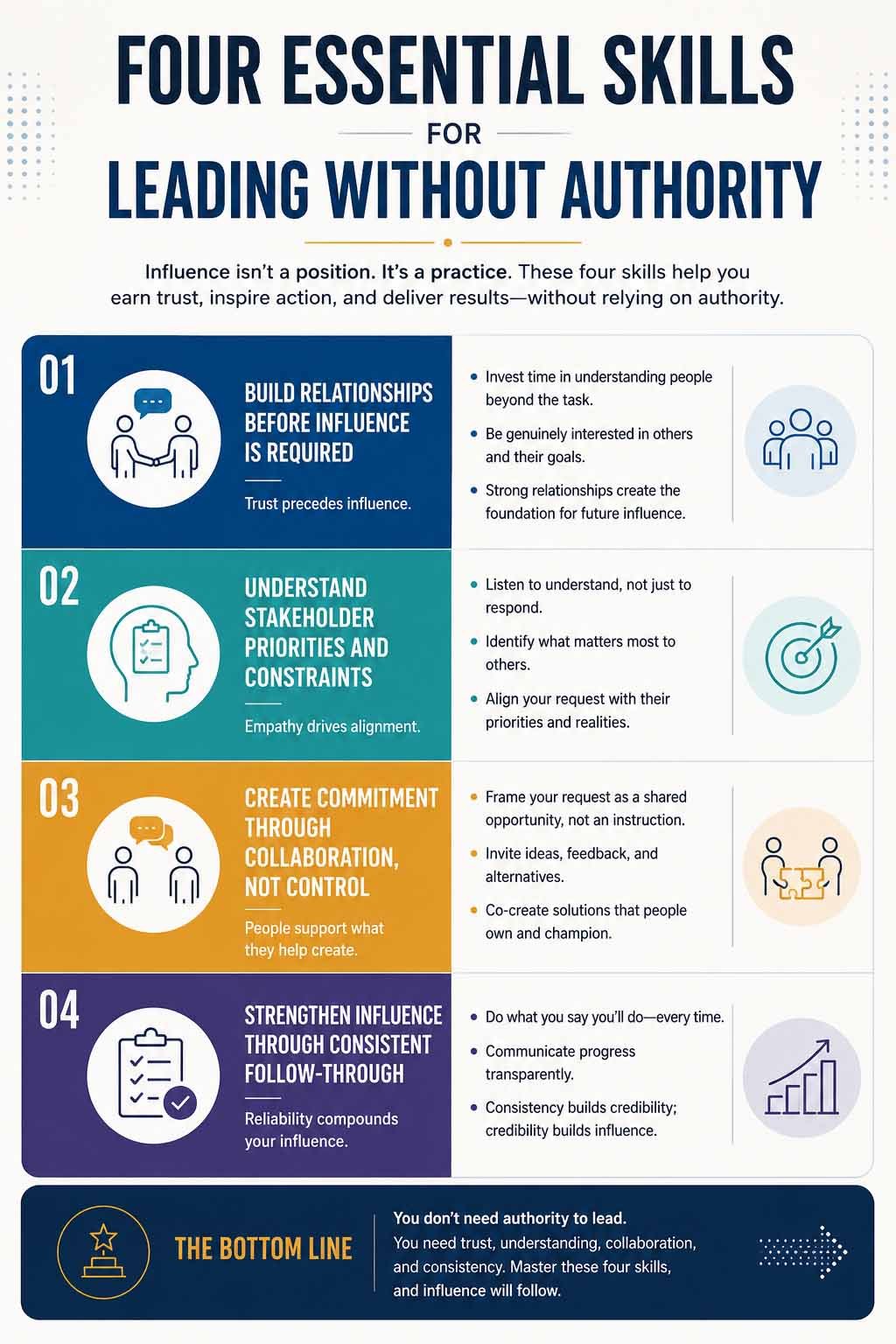
Build Relationships Before You Need Them
Influence is a long-term investment. Leaders who wait until they need cross-functional cooperation to begin building relationships find the account empty when they most need to draw on it. Strong relationship networks improve collaboration speed, stakeholder management effectiveness, and organisational trust.
Understand Stakeholder Priorities and Constraints
Effective influence requires genuine understanding of what matters to the people you are trying to move — not just what matters to you. Leaders who take time to understand their colleagues' KPIs, pressures, and decision criteria consistently achieve faster alignment and stronger cross-functional cooperation.
Create Commitment Through Collaboration, Not Control
The language of authority ('you need to...') closes down collaboration; the language of influence ('I'd value your perspective on...') opens it. The shift is subtle but the organisational impact is significant. Influence-based leadership depends on creating voluntary commitment rather than minimum compliance.
Strengthen Influence Through Consistent Follow-Through
Trust is built in small increments and destroyed in large ones. Leaders who follow through on every commitment regardless of scale — accumulate the credibility that makes influence possible at scale. Consistency remains one of the strongest foundations of leadership credibility.
Why Communication Is the Primary Mechanism of Influence-Based Leadership
In influence-based leadership, communication is not a secondary management skill — it is the mechanism of power itself. The ability to articulate a compelling vision, listen with discipline, give clear and constructive feedback, and create meaning in the face of uncertainty is what allows influential leaders to mobilise others without relying on directive authority.
Leaders who invest in communication mastery consistently outperform on employee engagement, talent retention, organisational trust, and change execution. This is particularly important in digital era leadership contexts, where leaders must influence across geographies, cultures, and communication channels without the interpersonal immediacy that traditionally reinforced authority. In hybrid and remote work environments especially, influence increasingly depends on clarity, consistency, emotional intelligence, and the ability to sustain trust without constant physical visibility.
Research on transformational leadership repeatedly demonstrates that communication quality strongly shapes whether employees perceive leaders as trustworthy, competent, and strategically credible. Leaders who communicate with transparency during uncertainty are significantly more likely to maintain organisational stability and employee confidence during periods of disruption.
Communication also functions as the foundation of stakeholder management in modern organisations. Cross-functional leadership increasingly requires persuading individuals who may not share the same incentives, priorities, or reporting structures. In these environments, influence emerges not from formal authority but from a leader’s ability to align competing interests around a shared strategic objective.
This is why influence-based leadership places extraordinary emphasis on listening as much as speaking. Leaders who dominate conversations often reduce collaboration quality by unintentionally suppressing dissenting perspectives and limiting psychological safety. By contrast, leaders who create space for contribution increase both trust and organisational intelligence. Employees are far more likely to share emerging risks, innovative ideas, and operational concerns when they believe their perspectives will be genuinely considered rather than dismissed.
The most effective communicators in modern leadership are therefore not necessarily the most charismatic. They are the leaders capable of translating complexity into clarity, uncertainty into direction, and organisational purpose into language that employees can meaningfully connect to their own work. In influence-based leadership systems, communication is ultimately the mechanism through which trust, alignment, credibility, and organisational culture are continuously constructed.