

Deep Work for Executives: Executive Productivity Frameworks for Better Focus and Leadership Effectiveness

The most urgent productivity crisis in business today is not operational — it is cognitive. Senior leaders are losing the ability to think deeply, not because they lack discipline, but because the structural conditions of modern executive life make sustained focus almost impossible to achieve. This guide sets out the deep work frameworks, time-blocking practices, and organisational habits that allow executives to reclaim the uninterrupted cognitive time their roles genuinely demand.
What Is Deep Work for Executives and Why Does It Improve Leadership Effectiveness?
Cal Newport defines deep work as professional activity performed in a state of distraction-free concentration that pushes cognitive capabilities to their limit. For business leaders, this is not a personal productivity preference — it is the cognitive state in which strategic thinking, complex judgment, and high-quality decision-making actually occur.
The scale of the problem is substantial. Research from the University of California, Irvine found that it takes an average of 23 minutes to return to full cognitive capacity after an interruption. For executives whose value to their organisations lies in the quality of their thinking rather than the volume of their activity, the cumulative cost of a typical day's interruptions is not an inconvenience — it is a measurable erosion of leadership effectiveness.
The modern executive operates in an environment of structural distraction: perpetual notification streams, back-to-back meetings, ambient pressure to respond instantly to every message, and an always-on culture that conflates visibility with productivity. Deep work for executives is, above all, a structural challenge that requires structural solutions.
Why Executive Distraction Hurts Cognitive Performance and Organisational Results
The standard framing of executive distraction presents it as a self-management problem — something leaders can solve with stronger willpower or better time management habits. This framing is both empirically insufficient and strategically misleading.
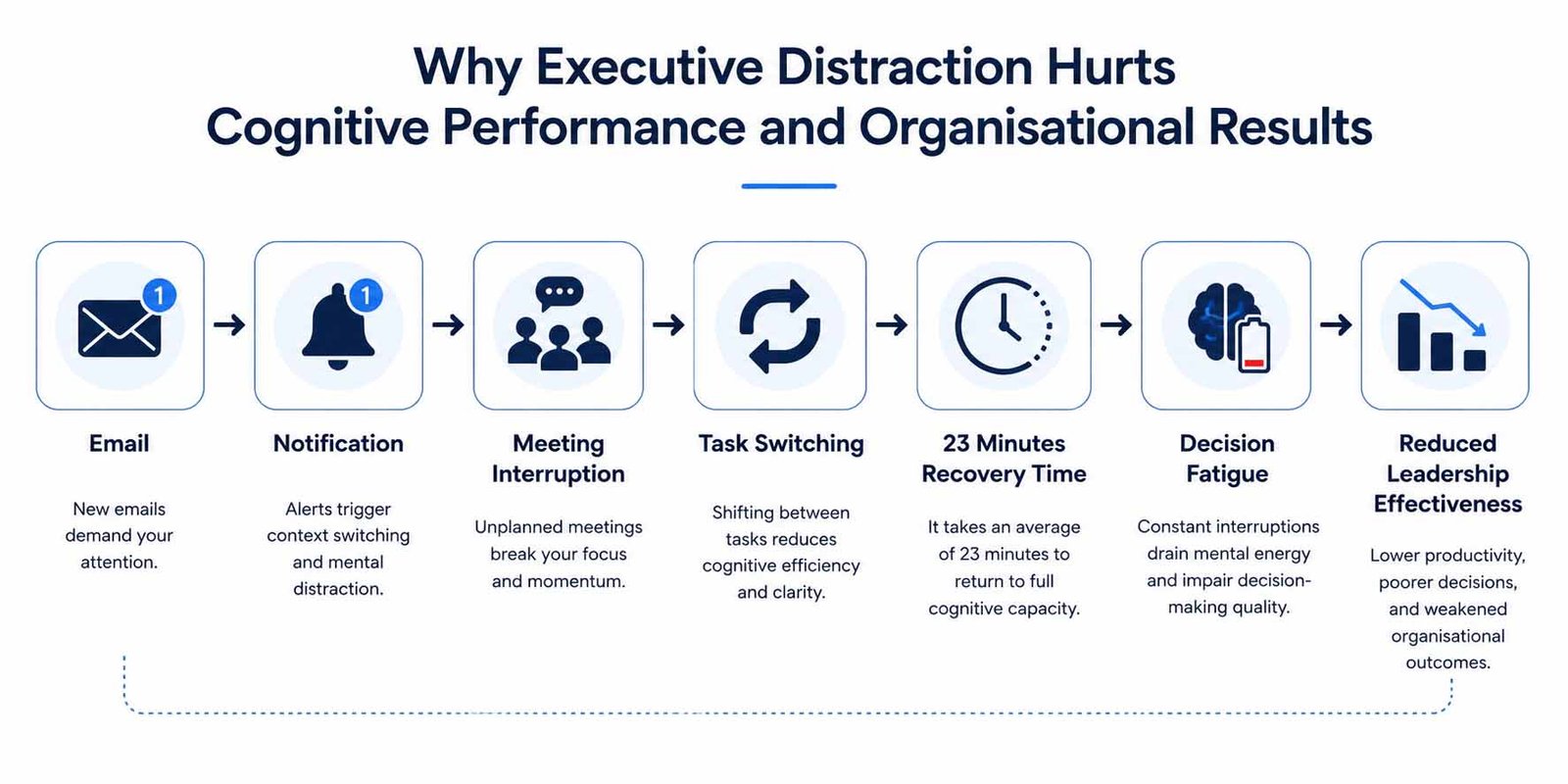
Distraction at the leadership level creates cascading effects across the organisation. Leaders who cannot protect their cognitive time make slower, lower-quality decisions. They mistake responsiveness for productivity. They model an always-on culture that their teams replicate, multiplying the cognitive cost throughout the organisation. Executive burnout, which research links directly to chronic cognitive overload and insufficient recovery, frequently begins with a failure to protect deep work time before the warning signs become visible.
The reframe that changes everything: executive cognitive capacity is a finite organisational resource. Managing it with the same rigour applied to financial capital is not a lifestyle choice it is a strategic imperative.
The Deep Work Framework for Executives: 4 Proven Executive Productivity Strategies
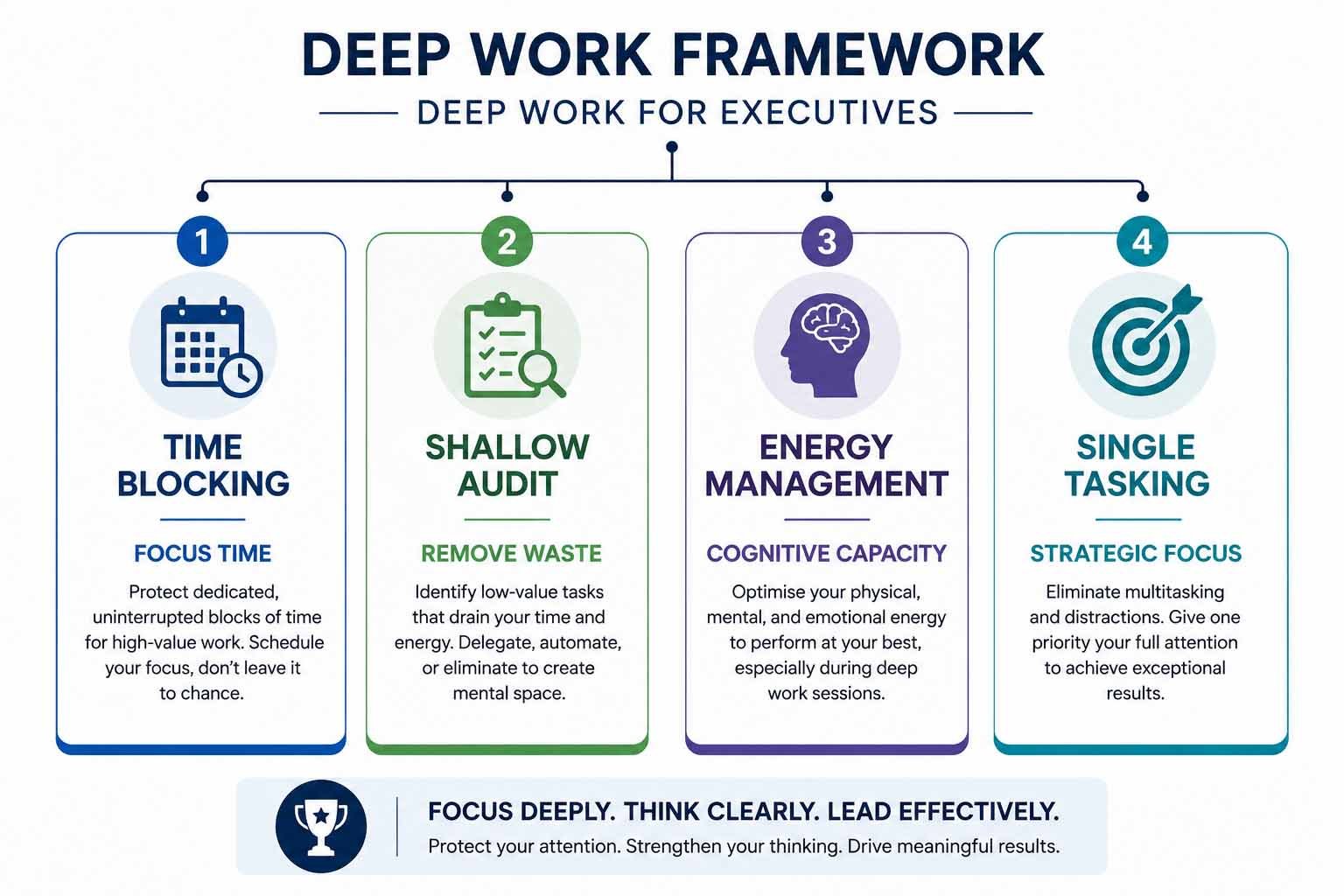
1. Time Blocking for Executives: Protecting High-Value Cognitive Work
The highest-leverage shift available to any executive is moving from scheduling tasks to scheduling cognitive states. Time blocking — the practice of reserving fixed, inviolable calendar windows for uninterrupted deep work is the structural foundation of executive productivity.
Effective time blocking for executives means protecting two to four hours of focused cognitive time each day, treated with the same inviolability as a board meeting or a major client commitment. The specific time of day matters less than the consistency with which the blocks are protected. Many executives find that early morning hours before the organisation activates and before the inbox fills offer the most reliable deep work conditions. Others protect a post-lunch window. The critical variable is permanence: deep work time must be a recurring, non-negotiable fixture rather than something you attempt to fit in when everything else is done. A practical starting point: block the first 90 minutes of each working day as a no-meeting, no-email zone. Protect it for six weeks without exception. The cognitive improvement in output quality will be self-evident.
2. The Shallow Work Audit: Eliminate Low-Value Tasks and Improve Executive Productivity
Before executives can protect time for deep work, they must honestly assess how much of their current working week is consumed by what Newport calls shallow work logistical tasks, routine communications, and administrative activities that consume time without demanding significant cognitive engagement.
For most executives, this audit produces uncomfortable results. Between 40 and 60 percent of a typical leadership week is spent on activities that could be delegated, automated, or eliminated entirely without meaningful impact on organisational outcomes.
Conduct the audit by logging every activity across a representative week and categorising each as: Deep (requires your unique cognitive judgment), Delegable (could be handled by a direct report), or Eliminable (produces no meaningful outcome). The goal is not to remove all shallow work, some genuinely necessary but to make conscious, deliberate decisions about which activities truly require the executive's direct involvement.
3. Energy Management and Cognitive Performance for Executive Leaders
Time management without energy management is insufficient. An executive who protects four hours for deep work but schedules them at the wrong point in their biological energy cycle, after inadequate sleep, or following a string of high-stress meetings will produce mediocre output regardless of how much time is allocated.
Research from Stanford Medical School demonstrates that leadership decision quality declines measurably after fewer than seven hours of sleep, a finding that applies regardless of how much the executive believes they have adapted to sleep restriction. Regular aerobic exercise produces sustained, documented improvements in executive function and creative cognition. Deliberate recovery, genuine rest built into the weekly schedule rather than treated as a reward for completed work is not a luxury; it is cognitive maintenance.
The framework: cognitive output = time availability × cognitive state quality. Both variables must be actively managed.
4. Single-Tasking: One of the Most Effective Focus Strategies for Leaders
The mythology of executive multitasking, the idea that great leaders can effectively manage several complex demands simultaneously, is not merely false; it actively degrades performance. Neuroscience research from MIT and Stanford conclusively demonstrates that what humans experience as multitasking is actually rapid task-switching, and each switch carries a cognitive cost that compounds with every additional switch.
Single-tasking working on one complex problem to completion before moving to the next consistently produces superior output quality, and counter-intuitively often completes work faster than multitasking approaches. Focus strategies for business leaders that prioritise single-tasking are among the most immediately actionable and measurably impactful changes available.
Executive Burnout Prevention: Why Deep Work Reduces Cognitive Overload
Executive burnout is often misunderstood as the result of excessive working hours. In reality, research increasingly suggests that burnout stems less from the quantity of work and more from the quality of cognitive demands placed upon individuals. Constant interruptions, decision fatigue, context switching, and perpetual responsiveness create a state of cognitive overload that gradually erodes performance, motivation, and wellbeing.
For senior leaders, the risks are particularly acute. Executives make hundreds of decisions every day, many of which carry significant organisational consequences. When attention is fragmented across emails, meetings, messages, and operational issues, the brain rarely receives the uninterrupted time required to process information effectively. Over time, this creates mental exhaustion even when working hours remain relatively stable.
Deep work acts as a protective mechanism against executive burnout by reducing cognitive fragmentation. Rather than forcing the brain to repeatedly switch between competing priorities, deep work creates structured periods of sustained focus where complex problems can be addressed efficiently and with less mental strain.
The relationship between deep work and executive burnout prevention is straightforward: fewer interruptions lead to lower cognitive load, better decision quality, and greater psychological control over the workday. Leaders who consistently protect deep work time often report reduced stress, improved concentration, and a stronger sense of accomplishment compared with those who spend entire days reacting to incoming demands.
A useful principle for executives is to treat cognitive recovery with the same seriousness as strategic planning. Deep work should be complemented by adequate sleep, physical activity, and periods of deliberate recovery. Together, these practices create a sustainable system for maintaining high performance without sacrificing long-term wellbeing.
Time Management for Executives: Deep Work vs Reactive Work
Most executives believe they have a time management problem when, in reality, they have an attention management problem. The challenge is not a lack of hours in the day but the disproportionate amount of time consumed by reactive work.
Reactive work includes responding to emails, attending status meetings, answering messages, resolving routine issues, and handling unexpected requests. While some reactive work is unavoidable, many executives find that it gradually expands to fill the entire working day, leaving little time for strategic thinking, innovation, or long-term planning.
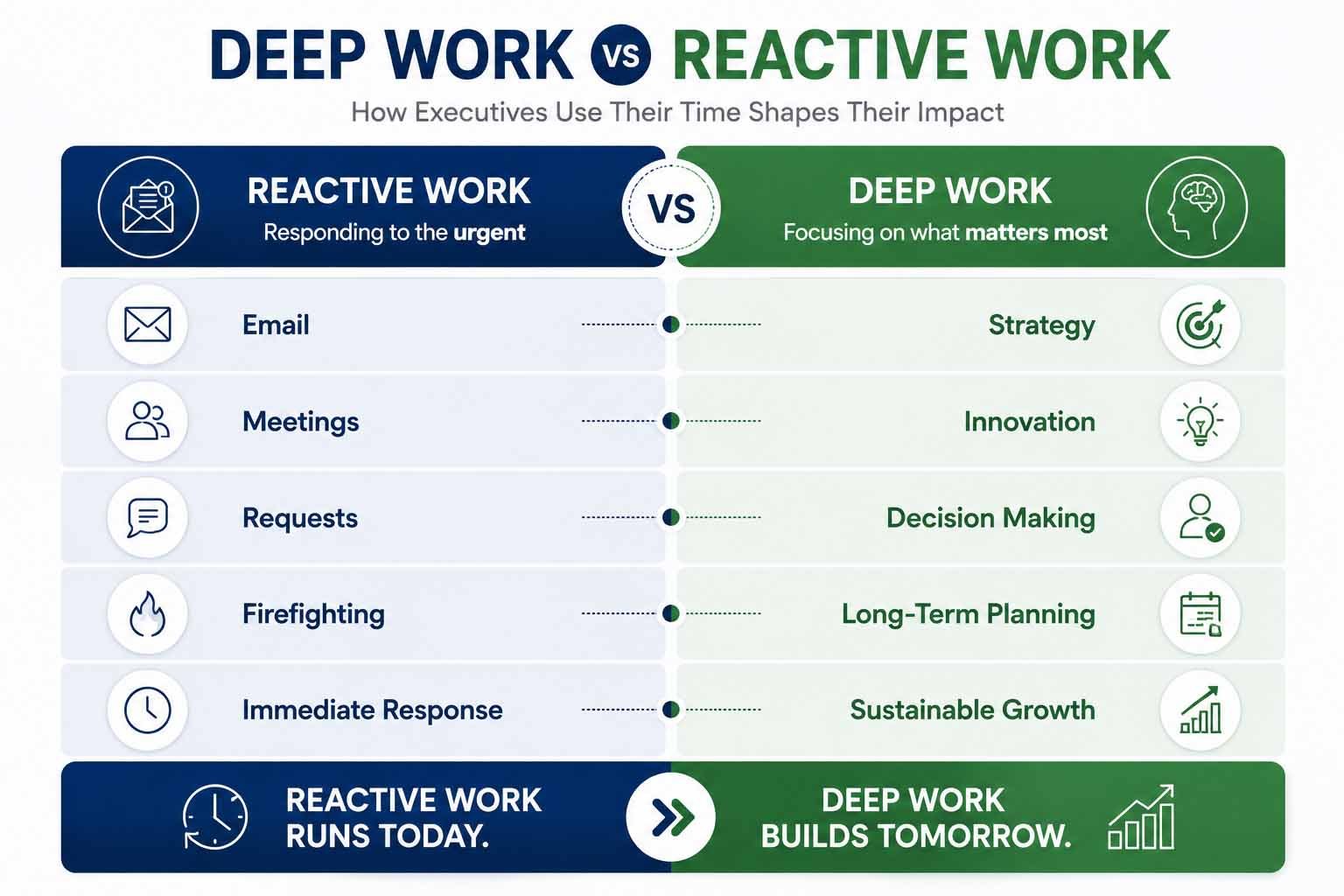
Deep work represents the opposite approach. It prioritises proactive value creation over constant responsiveness. Instead of allowing external demands to dictate the agenda, executives intentionally allocate protected time to activities that generate the highest strategic impact. These activities may include business planning, market analysis, decision-making, leadership development, organisational design, or solving complex challenges.
The distinction between deep work and reactive work can be viewed through a simple question:
Does this activity create long-term value, or does it merely respond to short-term demands?
High-performing executives recognise that leadership effectiveness depends on maintaining an appropriate balance between the two. Reactive work keeps the organisation functioning today, while deep work ensures the organisation succeeds tomorrow.
One practical framework is the 60-30-10 model:
- 60% Strategic and Deep Work – planning, decision-making, innovation, and leadership activities.
- 30% Operational Management – team leadership, reviews, stakeholder communication, and oversight.
- 10% Reactive Response Time – urgent issues, unexpected challenges, and immediate requests.
While the exact ratio varies by role, the principle remains constant: executives who dedicate a greater proportion of their time to deep work consistently generate better long-term outcomes than those trapped in perpetual reaction mode.
Effective time management for executives is therefore not about fitting more tasks into the calendar. It is about deliberately protecting the cognitive space required to perform the highest-value work that leadership demands.
How Deep Work Improves Leadership Effectiveness Across the Organisation
Individual executive productivity strategies are necessary but insufficient if the organisation's culture systematically undermines them. The leader's approach to their own calendar is never purely personal; it is always a signal to the organisation about what is valued.
Leaders who visibly protect cognitive time, who do not send emails at midnight, who decline unnecessary meetings, and who explicitly explain why they do these things give everyone in their organisation permission to do the same. Conversely, leaders who project an always-on, perpetually responsive persona regardless of their stated policies implicitly demand the same from their teams, embedding structural distraction into the organisation's operating culture.
Time management for C-suite leaders carries an organisational multiplier. When a CEO restructures their calendar to protect deep work time, they are not simply improving their own output, they are rewriting the cultural norms that govern how every leader in the organisation allocates their cognitive capacity.
The highest-leverage starting point for most executive teams: reduce standing meeting load by 30 percent and replace synchronous meetings with structured asynchronous communication wherever genuine real-time dialogue is not required.
Frequently Asked Questions
What is deep work, and why does it matter specifically for executives?
Deep work is professional activity performed in a state of sustained, distraction-free concentration — the cognitive state in which complex thinking, creative problem-solving, and high-quality strategic judgment actually occur. For executives, whose organisational value lies in the quality of their decisions rather than the volume of their activity, the ability to enter and sustain deep work states is the single most important determinant of leadership effectiveness.
How many hours of deep work should an executive aim for each day?
Research on executive performance and knowledge worker productivity converges on two to four hours of genuine deep work as the daily optimum. Beyond this threshold, cognitive fatigue typically diminishes output quality. The goal is not to maximise deep work hours but to protect consistent, high-quality focused time every day — even 90 minutes of genuinely uninterrupted deep work will outperform a full day of fragmented, distracted effort.
What is time blocking, and how do executives use it effectively?
Time blocking is the practice of scheduling fixed, protected calendar windows for deep, uninterrupted work — treating them as non-negotiable as any external commitment. For executives, the most effective implementation is to block 90–120 minutes each morning as a no-meeting, no-email period dedicated to the highest-priority cognitive work. The block is protected by default and requires an explicit, deliberate decision to override.
How can executives prevent burnout while maintaining high performance?
Executive burnout is most effectively prevented not through reactive recovery — taking time off after depletion but through proactive cognitive maintenance built into the baseline routine. This means enforcing a consistent sleep floor of at least seven hours, scheduling daily physical movement, and building weekly reflection practices that create the psychological distance needed to process complex decisions. Leaders who treat recovery as a strategic practice rather than a reward for completion sustain high performance through organisational intensity peaks.
How do focus strategies for leaders improve organisational culture?
When senior leaders visibly model deep work protecting cognitive time, reducing unnecessary meetings, and avoiding after-hours communication they signal to the entire organisation what is valued. This creates structural permission for leaders at every level to adopt the same focus strategies, amplifying the productivity benefit beyond the individual and reducing the ambient always-on pressure that drives collective cognitive overload.
The Leaders Who Think Most Clearly Will Lead Most Effectively
In a world of infinite distraction and finite cognitive capacity, the ability to think deeply and act with strategic clarity has become the rarest and most valuable resource in any organisation. Productivity strategies for executives that focus only on doing more faster are missing the point entirely.
The goal is not a longer to-do list completed at higher velocity. It is better thinking, sharper decisions, and more consequential leadership executed with the sustained focus that genuinely complex challenges demand and that deep work for executives, properly structured, consistently delivers.
The leaders who protect their cognitive capacity with the same discipline they bring to their financial capital will not simply be more productive. They will be more effective, more innovative, and more resilient, the defining qualities of leadership in an era where the quality of thinking determines the quality of outcomes.