
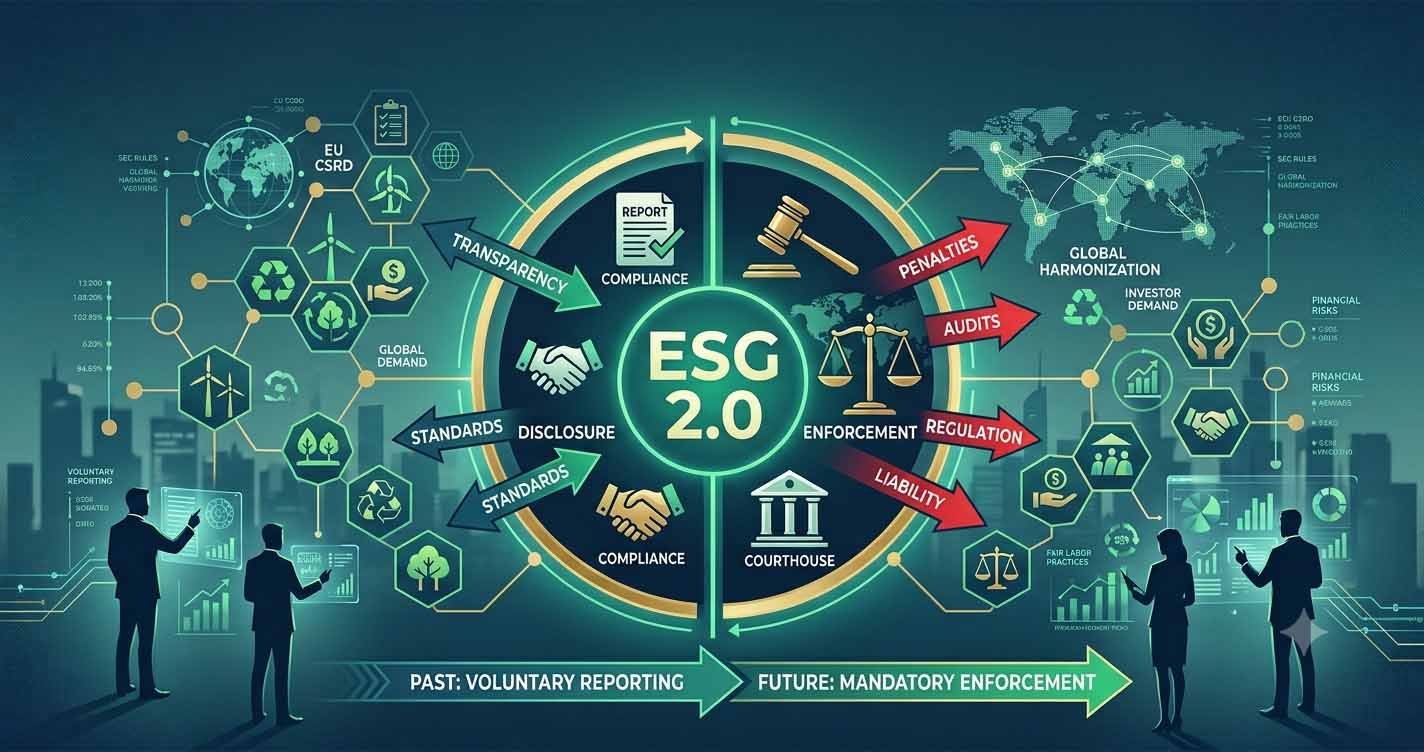
ESG 2.0: From Disclosure to Enforcement Across Global Markets

For years, ESG reporting functioned largely as narrative positioning. Sustainability reports expanded. Frameworks multiplied. Commitments were announced.
In 2026, that era is ending.
Across the European Union, the Gulf, and parts of Asia, ESG requirements are transitioning from voluntary disclosure to enforceable regulation. Carbon reporting, supply chain transparency, governance standards, and social impact metrics are now entering formal compliance regimes.
This marks the shift to ESG 2.0.
Regulators are introducing penalties for greenwashing, mandatory climate-risk disclosure standards, and stricter governance accountability. Boards are increasingly expected to demonstrate measurable sustainability performance, not aspirational targets.
The implications are significant. ESG is no longer a branding function — it is a risk management and strategic imperative. Investors are recalibrating portfolios based on regulatory exposure, while executive teams must now treat sustainability metrics with the same seriousness as financial audits.
For leadership, this represents a recalibration of power. Transparency is no longer optional. The gap between stated values and operational practice is narrowing rapidly.
Institutions that integrate ESG into core strategy — rather than peripheral reporting — are emerging stronger. Those that resist face not reputational risk alone, but regulatory consequence.