
ESG Beyond Compliance: Why Sustainable Business Practices Are a Competitive Advantage

Forward-looking enterprises are no longer treating ESG as a regulatory burden; they're weaponising it for growth, resilience, and brand authority in markets that increasingly reward purpose with profit. For too long, ESG Environmental, Social, and Governance was filed under compliance. A box to tick. A report to produce annually and promptly shelved. But the business landscape of 2026 looks very different from the one in which that attitude took root. Today, ESG as a competitive advantage is not a slogan; it is a measurable, strategically documented reality reshaping how companies attract capital, recruit talent, win customers, and build lasting resilience. The organisations that understood this shift early are now pulling ahead and the distance between them and their peers is growing.
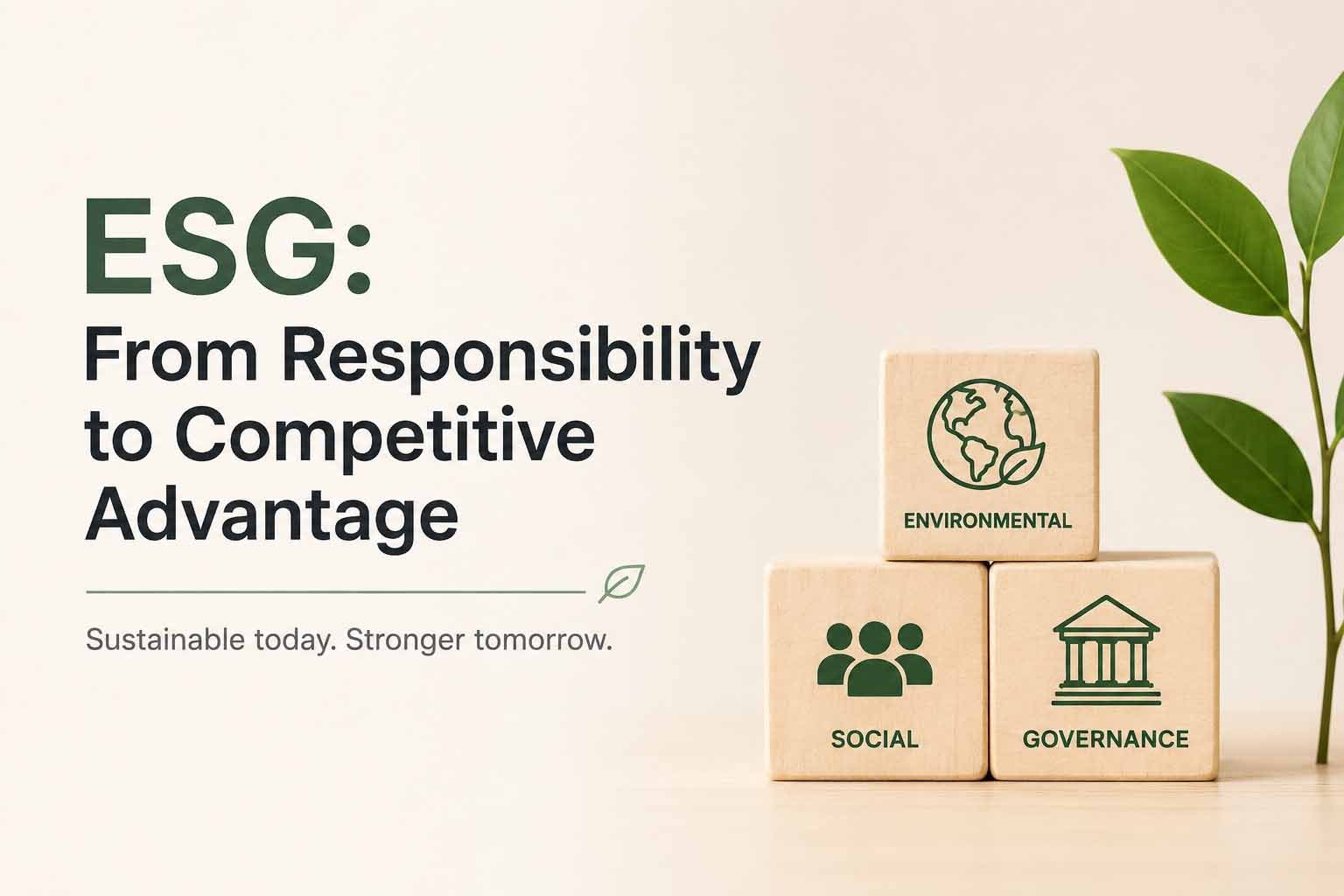
ESG — Environmental, Social, and Governance — refers to the three pillars through which organisations are increasingly assessed not only for financial performance, but also for their environmental stewardship, social responsibility, and quality of corporate governance. Once viewed primarily as a compliance obligation, ESG has evolved into a strategic lens through which investors, regulators, customers, and employees evaluate long-term business viability.
This article examines why sustainable business practices have crossed the line from obligation to opportunity, what the core ESG pillars mean for competitive positioning, and why executives who still treat ESG as a cost centre are misreading the most consequential strategic trend of the decade.
The organisations that will define their industries in the next decade are not simply those with the best products or the lowest costs. They are those with the strongest institutional legitimacy built through transparent governance, genuine environmental stewardship, and authentic social commitment. ESG is not the future of responsible business. It is the present architecture of durable competitive advantage.
The roots of ESG trace back to the 1970s and 1980s, when corporations introduced concepts like Corporate Social Responsibility (CSR) and Socially Responsible Investing (SRI) to enhance public perception. But as a term, ESG was only floated and introduced in 2004 when the United Nations (UN) Global Compact and the Swiss government issued a report called "Who Cares Wins" and made it mainstream.
-Singapore Management University
From Regulatory Burden to Strategic Asset: ESG as a Competitive Advantage
The conventional framing of ESG has always been defensive: avoid fines, satisfy regulators, mollify activist shareholders. This framing is not just outdated, it is actively costly. Companies that position ESG purely as a compliance exercise spend resources without capturing returns. They build infrastructure without building advantage.
The paradigm shift began when a confluence of forces accelerating climate risk, post-pandemic stakeholder expectations, and the rise of ESG-linked capital markets — converged to make sustainable business models financially superior, not just ethically preferable. ESG and corporate resilience are now deeply intertwined: companies with robust governance structures, low carbon exposure, and strong social frameworks demonstrably weather downturns more effectively than those without.
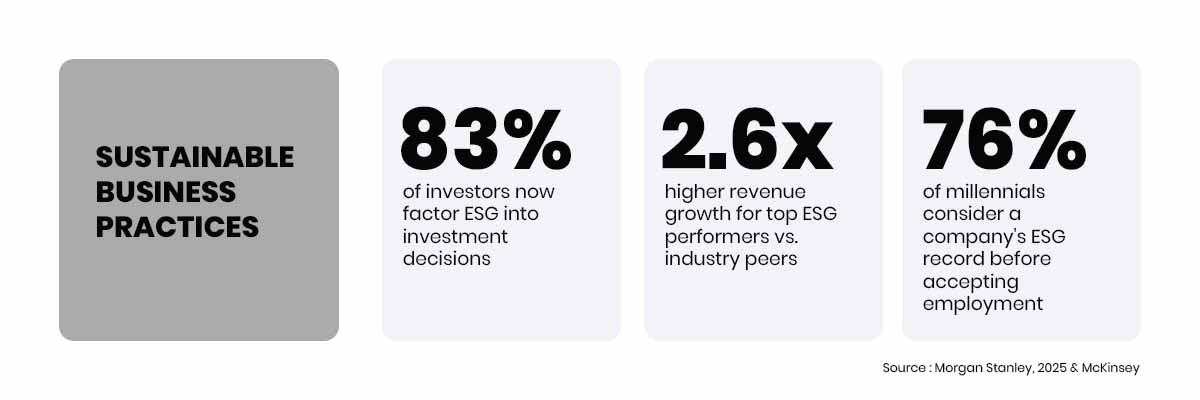
Consider the evidence from global capital markets. BlackRock's annual survey of institutional investors consistently finds that ESG-integrated portfolios outperformed conventional ones over a five-year horizon. The causal logic is straightforward: companies that manage environmental risks reduce operational disruption; those with strong governance structures have fewer costly governance failures; those that invest in their workforce and communities build brand loyalty that outlasts economic cycles.
"Sustainability is no longer a trade-off with performance. In most advanced markets, it is the precondition for it."
The Three ESG Pillars That Drive Competitive Advantage
To understand why ESG drives business growth, it is necessary to examine each pillar on its own commercial terms — not as abstract values, but as engines of competitive differentiation.
Environmental : Carbon efficiency, resource optimisation, supply chain resilience, and climate-risk mitigation. Directly affects operational costs, regulatory exposure, and investor valuation.
Social : Labour standards, DEI frameworks, community investment, and supply chain ethics. Shapes talent attraction, brand equity, consumer loyalty, and market access.
Governance : Board accountability, executive compensation transparency, anti-corruption frameworks, and risk oversight. Directly correlated with investor confidence and long-term valuation multiples.
Environmental: Efficiency Is the New Margin
The environmental pillar is the one most visible to the public, but its internal commercial value is often underestimated. Companies that have invested seriously in energy transition, waste reduction, and sustainable supply chains have discovered that the transition pays for itself — often faster than expected. The Unilever Sustainable Living Brands, for instance, consistently grew 69% faster than the rest of the Unilever portfolio and delivered the majority of the company's growth over a decade. This is not greenwashing metrics — it is P&L performance driven by operational efficiency and brand premium.
Social: The Human Capital Premium
The social dimension of ESG has the most direct link to talent strategy — one of the defining competitive battlegrounds of the current decade. A sustainable business model built on fair wages, psychological safety, diversity, and genuine community investment produces measurable advantages in recruitment, retention, and productivity. In sectors where talent is scarce, companies with strong social credentials command access to the best candidates and spend significantly less on turnover.
The social pillar also extends to the customer relationship: consumers in every major market are demonstrably willing to pay a premium for, and show significantly greater loyalty to, brands with credible social commitments.
Governance: Trust Is a Balance Sheet Item
Of the three pillars, governance is the least romantic but the most directly legible to investors and boards. Strong governance — characterised by transparent reporting, independent oversight, and accountable leadership — is strongly correlated with lower cost of capital, higher valuation multiples, and faster recovery from market disruptions.
Building competitive advantage through sustainability requires, above all, the kind of institutional credibility that only sound governance can provide.
In an era of rapidly evolving regulation and heightened stakeholder scrutiny, companies with weak governance structures are one disclosure away from catastrophic reputational damage.
Seven Ways ESG Creates Competitive Advantage
The following dimensions represent the clearest, most empirically grounded channels through which ESG improves brand value, accelerates growth, and builds long-term resilience:
Access to ESG-linked capital and lower cost of financing
Green bonds, sustainability-linked loans, and ESG-screened institutional investment now represent a multi-trillion-dollar capital pool. Companies with credible ESG credentials access this capital at lower rates and with fewer covenants — a structural financing advantage over peers and credible ESG credentials access this capital at lower rates.
Brand differentiation and premium pricing power
In category after category — consumer goods, financial services, B2B professional services — ESG credentials are becoming a brand differentiator that commands measurable price premiums. How ESG improves brand value is no longer theoretical; it is trackable in Net Promoter Scores, customer lifetime value, and brand equity indices.
Talent acquisition and retention in competitive markets
With the majority of high-skilled talent evaluating potential employers on ESG criteria, sustainable business practices are now a direct input into human capital strategy. Companies that lead on social and governance dimensions attract better talent, retain it longer, and build the organisational culture that compounds into durable competitive advantage.
Operational efficiency and risk-adjusted cost savings
Environmental investments — in energy, water, waste, and supply chain resilience consistently generate long-term cost advantages. The benefits of sustainable business practices extend beyond optics: they reduce exposure to resource price volatility, regulatory fines, and physical climate risk.
Market expansion and regulatory positioning
As ESG regulation tightens globally from the EU's Corporate Sustainability Reporting Directive to mandatory climate disclosures in the UK and US companies with mature ESG frameworks gain access to markets and procurement opportunities that are increasingly closed to non-compliant competitors.
Investor confidence and valuation resilience
Institutional investors representing over $100 trillion in assets under management have signed the UN Principles for Responsible Investment. ESG performance is now a direct input into how these investors price risk and allocate capital. Companies that score poorly on ESG metrics face higher discount rates and lower valuation multiples — a structural disadvantage that compounds over time.
Innovation and future-ready business models
ESG commitment frequently drives innovation — in product design, supply chain engineering, and business model architecture.
Sustainable business models for the future tend to be more circular, more technology-enabled, and more aligned with evolving consumer and regulatory expectations. This creates first-mover advantages that are difficult for late adopters to replicate.
ESG Strategies for Long-Term Growth: What Leaders Are Doing Differently
The organisations that are translating ESG commitment into genuine competitive advantage share several strategic characteristics. First, they treat ESG as a board-level priority, not a sustainability team project. Second, they integrate ESG KPIs into executive compensation and operational scorecards ensuring that sustainability targets carry the same organisational weight as revenue and margin goals. Third, they invest in robust, auditable ESG reporting that goes beyond narrative disclosure to provide the granular, comparable data that sophisticated investors and regulators require.
Leading companies also understand that why sustainability matters in modern business is increasingly about ecosystem positioning: the suppliers, partners, and distribution channels that define competitive moats are themselves under ESG scrutiny. A company's scope 3 emissions, supply chain labour standards, and governance practices at subsidiaries are visible to the same analysts, activists, and regulators who evaluate the parent company. ESG excellence must therefore be end-to-end and those who achieve it create supply chain relationships and partnership opportunities that rivals simply cannot access.
The Cost of ESG Inaction: Why Sustainable Business Practices Are No Longer Optional
It is worth stating plainly: the competitive disadvantage of ESG inaction is now quantifiable. Companies that rank in the bottom quartile of ESG performance in their sector face, on average, a 2–3% higher cost of debt, a significant talent recruitment penalty, and growing exposure to stranded asset risk as physical climate events and policy transitions accelerate. The argument that ESG investment is a discretionary luxury is empirically untenable. The question for leadership teams is not whether to build ESG-led competitive advantage, but how fast and how comprehensively.
The Future Belongs to ESG-Driven Organisations
The organisations that will define the next decade will not be distinguished solely by the products they create or the markets they serve. They will be recognised for how responsibly they operate, how transparently they govern, and how effectively they create value for all stakeholders. ESG has evolved beyond sustainability reporting to become a strategic lens through which resilience, innovation, and long-term competitiveness are measured.
Businesses that embrace ESG as a core leadership principle are building stronger brands, attracting smarter capital, and creating operating models that are better equipped to withstand disruption. Those that delay risk finding themselves increasingly out of step with investors, customers, employees, and regulators alike.
Ultimately, ESG is not a trend, nor is it a temporary response to stakeholder pressure. It is a reflection of how modern organisations are expected to create and sustain value. For leaders looking beyond the next quarter and toward the next decade, ESG is not merely part of the strategy—it is becoming the strategy itself.
Frequently Asked Questions
How does ESG create a competitive advantage for businesses?
ESG creates competitive advantage through multiple channels: lower cost of capital via ESG-linked financing, improved talent attraction and retention, brand differentiation that commands premium pricing, operational cost savings through efficiency investments, and stronger regulatory positioning as ESG requirements tighten globally.
What are the benefits of sustainable business practices beyond compliance?
Beyond compliance, sustainable business practices drive revenue growth through brand equity, reduce operational costs through resource efficiency, expand market access as regulatory bars rise, and build investor confidence that lowers the cost of capital — all of which translate directly into long-term financial outperformance.
Why does ESG matter for business growth in 2026?
In 2026, ESG matters for growth because institutional capital, consumer spending, talent pools, and regulatory access are all increasingly conditional on ESG performance. Companies that excel on ESG criteria access more capital at lower cost, attract better talent, command customer loyalty, and operate with greater resilience — compounding advantages over peers.
How can companies build sustainable business models for the future?
Building a sustainable business model requires embedding ESG into corporate strategy at the board level, integrating ESG metrics into executive performance frameworks, investing in transparent and auditable reporting, and extending ESG standards across the supply chain and partner ecosystem — not merely within the parent company's own operations.