
Leading Educational Transformation: Building Future-Ready Schools Through Leadership, Culture & Innovation

We spoke to Dr. Mari Eunice Simpson is the Founder of Built for Capacity Consultancy and an international education leader with 21+ years of experience across Asia and the Middle East on Leading Educational Transformation.
Q: Your career has given you the unique perspective of both leading schools through transformation and evaluating schools as an inspector. From these dual viewpoints, what distinguishes schools that achieve sustainable improvement from those that struggle to maintain momentum?
A: The clearest pattern I have seen, from both sides of the table, is that struggling schools are rarely short on effort. They are often working extremely hard. What separates the schools that sustain improvement is not how much they do but the order in which they build.
When I inspect, I can usually tell within a day whether a school is genuinely strong or simply busy. A busy school has initiatives, displays, and activities. A strong school has coherence. Practice looks similar from one classroom to the next, staff can explain why they do what they do, and the systems hold steady whether or not the principal is in the building. That last point matters more than any single program. If improvement collapses the moment a leader steps out of the room, it was never really embedded.
Schools that struggle usually start with what is most visible. They launch the attractive initiative before the conditions exist to carry it. They ask for collaboration before trust is built, or innovation before staff feel safe enough to try and fail. Movement can be generated through effort. Transformation requires structure.
Schools that sustain improvement do something less glamorous first. They strengthen the adult culture, build clear systems, and sequence change so each step rests on solid ground beneath it. It is slower at the start and far more durable in the end.
So the real distinguishing question is not what a school is doing. It is whether the school is strong enough to hold what it is doing.
Q: During your tenure as Principal at KPIS International School, you led significant growth in enrolment, staff retention, and overall school performance. What were the most important leadership decisions that enabled this transformation?
A: The most important decision was also the least visible. Before we launched anything, we designed a three-year roadmap. Not a wish list dressed up as strategy, but a sequence that asked what the school needed to become each year, and what leaders, staff, students, and parents would each need at every stage for the change to last.
The second decision was to begin with the adults rather than the program. The school is often remembered now for its shift to project-based learning, but that was never the starting point. It was a later expression of a culture that had already been strengthened. When I arrived, staff turnover was high and belonging was low, so we built there first. We invested in trust, collaboration, and a sense that people were part of the school rather than simply employed by it.
The third decision was patience with sequence. Everything felt urgent at once, and the temptation was to fix it all at the same time. We resisted that. We strengthened communication and staff culture before asking teachers to take real instructional risks, and we built parent trust deliberately rather than assuming families would simply follow.
The results followed the order of the work, not the other way around. Enrolment grew by 76.8%. Staff retention rose from 69% to 92%. And when we did make the school-wide shift to project-based learning, 98.5% of parents approved of it, because by then they trusted what we were building.
None of that came from a single bold move. It came from refusing to skip the steps that make bold moves survivable. It is the same sequence I now help other leaders design from the beginning, so they do not have to learn it the hard way.
Q: Many schools invest heavily in strategic plans but often fail to translate them into meaningful change. In your experience, what are the critical systems and leadership practices required to turn vision into measurable outcomes?
A: Most of the leaders I work with arrive with a strong plan and a stalled reality, and the two are rarely as connected as they assume. Strategic plans fail not because they are wrong but because they stay abstract. It rarely builds the conditions that allow people to travel there together. The gap between vision and outcome is almost always a gap in systems.
The first practice is translation. Leaders assume clarity exists because the thinking is clear in their own mind. But clarity does not transfer through explanation alone. Words like collaboration, high expectations, or student-centered sound precise to the leader and remain open to interpretation for everyone else. Vision becomes real only when it is embedded into systems, modeled in practice, reinforced through feedback, and supported over time.
The second is alignment. A vision held by leadership but not lived in daily classrooms is decoration. The work is to align what the school says it values with what it actually rewards, measures, and makes time for.
The third is measurement that tracks impact rather than activity. Many schools measure how much they are doing, the number of training delivered or meetings held, and mistake that for progress. The more honest question is whether practice has actually changed and whether students are experiencing something different.
Underneath all of this is a shift in the leader’s role, from carrying the work to building the systems that carry it. When a leader becomes the connector, reminder, and problem-solver for everything, the plan depends on their stamina. When systems hold the work, the plan can survive a difficult week, a staffing change, or the leader’s absence. That is when a strategy stops being a document and starts being a reality.
Q: Staff wellbeing has become a strategic priority for schools worldwide. How can school leaders move beyond wellbeing initiatives as standalone activities and instead embed wellbeing into the culture and operations of the institution?
A: Wellbeing initiatives often fail because they sit on top of the problem rather than inside it. A wellness day does little for a teacher who returns to unclear expectations, constant reactivity, and a culture where it does not feel safe to struggle. You cannot decorate your way out of a structural problem.
Embedding wellbeing means treating it as a condition of how the school operates, not an event on the calendar. Much of what exhausts staff is not workload alone but ambiguity. People are drained by unclear priorities, shifting expectations, and the sense that they must guess what good looks like. Clarity is a wellbeing strategy. So is coherent communication, because noise is tiring in a way that is easy to underestimate.
It also lives in how people are treated in ordinary moments. In my own school, we celebrated staff across every role, not just teaching staff. Office and operations staff were included in events, sent for training, and recognised publicly when they earned new qualifications. Belonging is not sentimental. It is infrastructural. People do not only leave workloads. They leave cultures where they feel unseen.
And wellbeing requires space. If we ask teachers to grow, take risks, and try new approaches, we have to protect the room for them to do that imperfectly at first. I call it flex space. Not unstructured time, but protected professional space where becoming is allowed.
When wellbeing is built into clarity, belonging, and the daily dignity of how people are treated, it stops being a program. It becomes part of why people stay.
Q : As Deputy Head of School and K-12 Pastoral Lead, you have overseen initiatives that contributed to inspection improvements across key pastoral standards. What lessons can educational leaders learn about building wellbeing systems that create genuine impact?
A: The biggest lesson is that pastoral care, like instruction, only becomes reliable when it is built into systems rather than left to individual goodwill. Most schools have caring adults. What they often lack is consistency, so a child’s experience of support depends on which teacher they happen to have rather than on what the school guarantees.
When I led pastoral work across the school, the shift that mattered most was moving from provision to impact. It is easy to point to the existence of a counsellor, an anti-bullying policy, or a wellbeing curriculum and assume the standard is met. Inspection frameworks, used well, push past that. They ask whether students actually feel safe, known, and able to speak up, not simply whether a service exists on paper.
That reframing changed how we worked. We built shared structures so that pastoral expectations were understood and enacted consistently, not interpreted differently in every corner of the school. We listened to students directly, because they are the most honest evidence of whether a system is working. And we treated belonging as the foundation rather than the reward, since students cannot develop genuine agency or voice until they first feel they belong.
The pastoral standards improved, but the deeper outcome was cultural. Care became something the institution provided dependably, not something that rose or fell with individual relationships.
If there is one lesson for leaders, it is this. A wellbeing system is only real when a child experiences it the same way on a difficult day as on an easy one.
Q: School inspections are often viewed as accountability exercises. How can leaders use inspection frameworks as catalysts for school improvement, innovation, & organisational learning?
A: Inspection becomes a catalyst the moment a school stops preparing for the visit and starts building for the standard. The schools that dread inspection are usually the ones performing readiness, scrambling to assemble evidence for a few intense weeks. The schools that benefit from it have built systems that make them ready most of the time, so the inspection simply confirms and sharpens what already exists.
Used well, an inspection framework is one of the most useful mirrors a school has. It describes what strong practice looks like across every area, which gives leaders a shared language for honest self-evaluation. The point is not to chase a judgment. It is to ask where the school’s own evidence is thin, where practice is inconsistent, and where the gap between intention and reality is widest.
The mindset shift is from accountability to learning. Accountability asks, did we pass. Learning asks, what did this reveal that we did not see clearly before. When leaders treat findings as information rather than verdicts, inspection becomes a structured form of organisational reflection that most schools rarely make time for otherwise.
I have seen this from both sides. As an inspector, I can tell when a school is genuinely strong rather than well rehearsed. As a leader, I learned to use the framework not as a hurdle but as a design tool, a way of checking whether our systems were coherent enough to hold our ambitions.
Readiness should come from systems, not stress. A school built well is always, in a quiet sense, already being inspected by itself.
If improvement collapses the moment a leader steps out of the room, it was never truly embedded. - Dr. Mari Eunice Simpson
Q: Future-ready schools require future-ready leaders. What leadership capabilities will be most critical for educational leaders over the next decade?
A: The next decade will reward leaders who can build capacity in others rather than simply carry the work themselves. Schools are facing more change, more complexity, and more pressure, and no individual leader, however capable, can absorb all of that personally. The most important capability is the ability to design conditions in which other people can succeed.
That begins with systems thinking. Future-ready leaders will need to see the school as an interconnected whole, understanding that a weakness in staff culture eventually surfaces as a problem with parents, and that nothing improves in isolation. They will need to think in sequence, knowing what must be built first so that everything else can hold.
Cultural fluency will only grow in importance. Schools, especially international ones, are increasingly diverse in staff and students, and differences in communication, hierarchy, and expectation can quietly become a misunderstanding. Leaders who can build genuine belonging across differences will have a real advantage.
There is also a human steadiness that matters more than ever. In times of rapid change, people look to leaders for a sense of stability and clear identity. A leader who reacts situationally creates anxiety. A leader anchored in clear principles creates trust, even when the answers are hard.
And finally, the discipline to resist the shortcut. Technology and innovation will keep offering tempting quick fixes. The strongest leaders will adopt new tools while protecting the slower, relational, structural work that actually makes change last.
The future does not need leaders who do more. It needs leaders who build better.
Q: You are the author of Built for Capacity. What does “capacity building” mean in the context of modern education, and why is it becoming increasingly important for schools seeking long-term success?
A: Capacity building is the work of making a school strong enough to carry the future it says it wants. It is the difference between a school that can launch an initiative and a school that can sustain one.
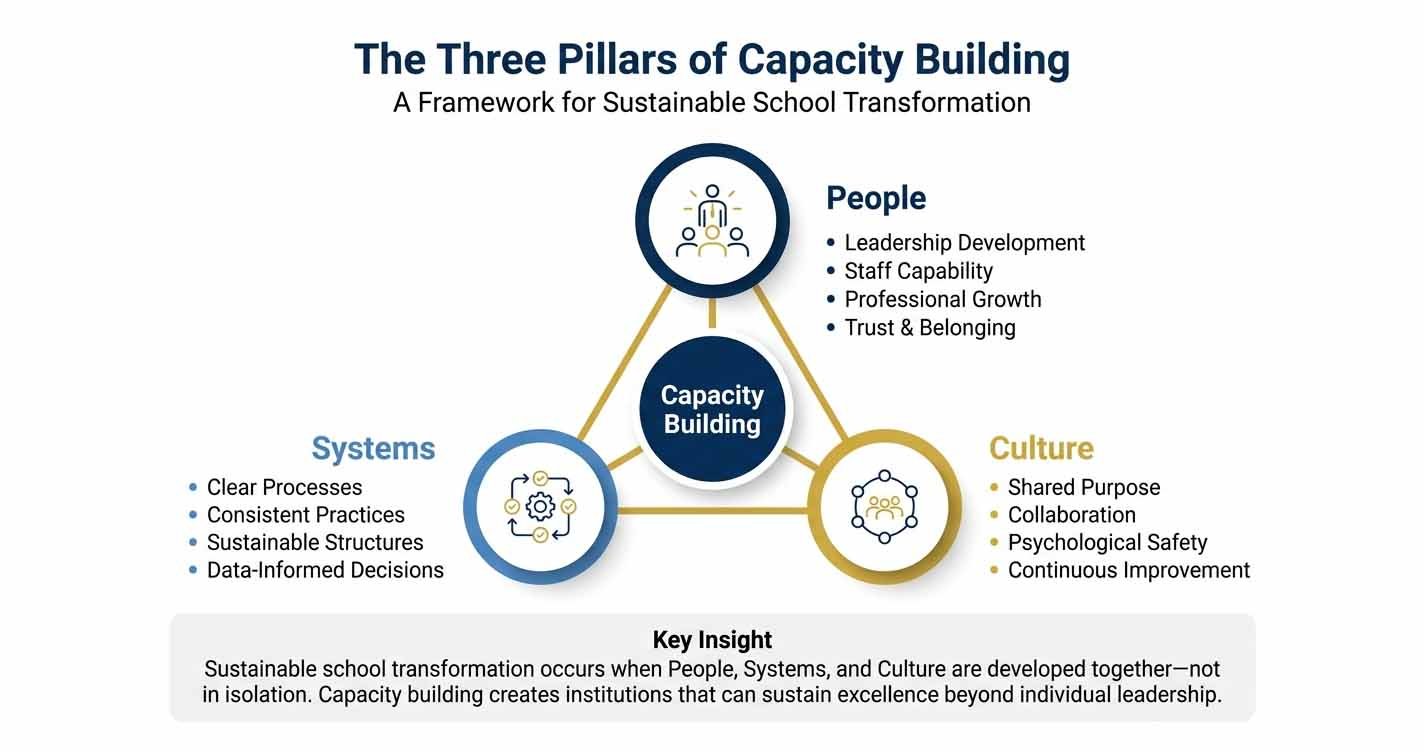
In Built for Capacity, I describe capacity as living in three places: people, systems, and culture. People’s capacity is the strength, growth, and stability of adults, because a school cannot become more collaborative than its staff or more reflective than its teachers. Systems capacity is the structure that makes good practice consistent and repeatable rather than dependent on a few strong individuals. Culture capacity is the trust, belonging, and shared identity that determine whether people move together when the work becomes difficult.
This matters more now because schools are being asked to change faster than ever, and most improvement still fails for the same reason. Schools adopt impressive ideas before they are strong enough to hold them. Capacity is what allows ambition to survive contact with reality.
It is increasingly important for a second reason too. The pace of change means leaders cannot personally hold every system together. A school that runs on one leader’s energy is fragile by design. Capacity building moves improvement out of individual stamina and into institutional strength, so progress does not collapse when a leader leaves or a difficult year arrives.
In simple terms, capacity is the strategy underneath every other strategy. A school can have a brilliant plan, but if it has not built the people, systems, and culture to carry it, the plan will not hold. Build the capacity first, and almost everything else becomes possible.
"Build the capacity first, and almost everything else becomes possible." — Dr. Mari Eunice Simpson
Q : Across the Middle East and Asia, educational institutions face rapid technological, social, and workforce changes. How can schools balance innovation with the need to maintain strong educational foundations and values?
A: Innovation and strong foundations are often presented as opposites. In my experience, they depend on each other. Innovation without foundations is fragile, and foundations without innovation eventually stagnate. The skill is sequencing, knowing that the most ambitious change usually has to rest on something solid that was built first.
I learned this directly. The most innovative work my school became known for was only possible because we had first strengthened the less glamorous foundations, trust among staff, clarity in communication, and the confidence of parents. Had we led with the innovation, it would have arrived into a system too weak to hold it and a community not yet ready to trust it.
Across the Middle East and Asia, this balance carries an added dimension, because schools here serve communities with deep cultural and family values. Innovation that ignores those values feels like a risk to families rather than progress. Real change has to honour what a community cares about while still moving it forward. That is not a compromise. It is respect, and it is also what makes the change durable.
Values, in this sense, are not a brake on innovation. They are the anchor that allows a school to take risks without losing itself. A school that knows clearly who it is and what it stands for can adopt new tools, new pedagogies, and new technologies with confidence, because it has a stable identity to integrate them into.
Move too fast without foundations and you create anxiety. Build the foundations first, and innovation becomes something a community will trust you to lead.
Q: Looking ahead, what is your vision for the future of educational leadership, and what advice would you offer to school leaders aspiring to drive meaningful transformation in their institutions?
A: My vision is for a model of educational leadership that measures strength by what a leader builds in others rather than by how much they can hold alone. For too long, we have admired the heroic leader, the one who carries everything, solves every problem, and holds the school together through sheer will. That image is inspiring and quietly unsustainable. When the school depends on one person, the leader’s limits become the school’s limits.
The future I hope for belongs to leaders who think like architects. They build the people, systems, and culture so that clarity, trust, and momentum do not collapse the moment they step out of the room. Their success is visible not in their indispensability but in how well the school runs because of what they have built.
To aspiring leaders, my advice is simple to say and hard to practice. Begin with people. No system, strategy, or innovation will outperform the trust and capacity of the adults carrying it. Resist the pressure to prove yourself through visible activity, and invest instead in the conditions that make activity meaningful.
Think in sequence. Ask not only what needs to change, but what needs to be built first so that everything else can follow. And be patient with the parts of the work that do not photograph well, because that is usually where transformation actually lives.
Finally, lead from a clear sense of who you are. Much of my work with leaders now begins here, because a leader unclear about their own identity leads reactively, while one who knows who they are and where they are heading leads with consistency. That same clarity lets you see your own path to the next role rather than waiting to be chosen for it. People follow the patterns you create, so become consistent, and you give your school, and your own future, something to build on.
Q: If you could change one thing about how schools approach improvement today, what ld it be, and why?
A: I would change the instinct to start with the initiative instead of the conditions.
When a school wants to improve, the almost universal reflex is to add something. A new program, a new framework, a new strategy. It feels like progress because it is visible, and it gives everyone something concrete to point to. But adding more to a system that is not yet strong enough to carry it rarely produces lasting change. It produces busyness, fatigue, and the quiet disappointment of effort that does not hold.
If I could change one thing, schools would begin every improvement effort with a different question. Not what should we launch, but what must we strengthen first so that what we launch can actually survive. That single shift would save an enormous amount of wasted energy, because so much of what schools experience as failure is really just good ideas introduced before the conditions existed to hold them.
The reason this matters so much is human. Behind every stalled initiative are teachers who tried, leaders who cared, and communities who hoped. When change does not last, people do not only lose a program. They lose a little faith that change is possible at all. Over time, that erosion of belief is far more damaging than any single failed initiative.
Building capacity first protects people from that cycle. It is slower at the start, but it honours the effort of everyone involved by making sure that effort finally leads somewhere. That, to me, is worth changing everything for.
Q: Beyond the book, you now work directly with school leaders through your consultancy, Built for Capacity. What are you really trying to change in the leaders you partner with, and what does that work look like in practice?
A: The honest answer is that I am trying to change how leaders see their own role. Most of the leaders I work with are capable and hardworking, but they are carrying their schools through personal effort rather than building schools that can carry themselves. The shift I care about is from being the engine of improvement to becoming the architect of it.
A great deal of that work begins with identity. Before a leader can build people, systems, and culture, they have to be clear about who they are as a leader, what they stand for, and the kind of school they are actually trying to build. Leadership becomes reactive when that clarity is missing. So much of what I do is helping leaders find that anchor first, because a leader who knows who they are leads with far more consistency, and consistency is what builds trust.
From there, the work becomes practical. I help leaders sequence their improvement so they build the right conditions in the right order, and I help aspiring and middle leaders map a clear pathway toward the role they want next rather than waiting to be chosen for it. Through advisory partnerships and master classes on people, systems, and culture, the aim is always the same. Not to hand leaders another framework to implement, but to build their capacity to lead well long after our work together ends.
That is the real measure for me. Not whether a leader leaves a session feeling inspired, but whether, months later, their school is stronger because of what they were able to build.