

Remote Work Best Practices: Building High-Performing Distributed Teams in 2026

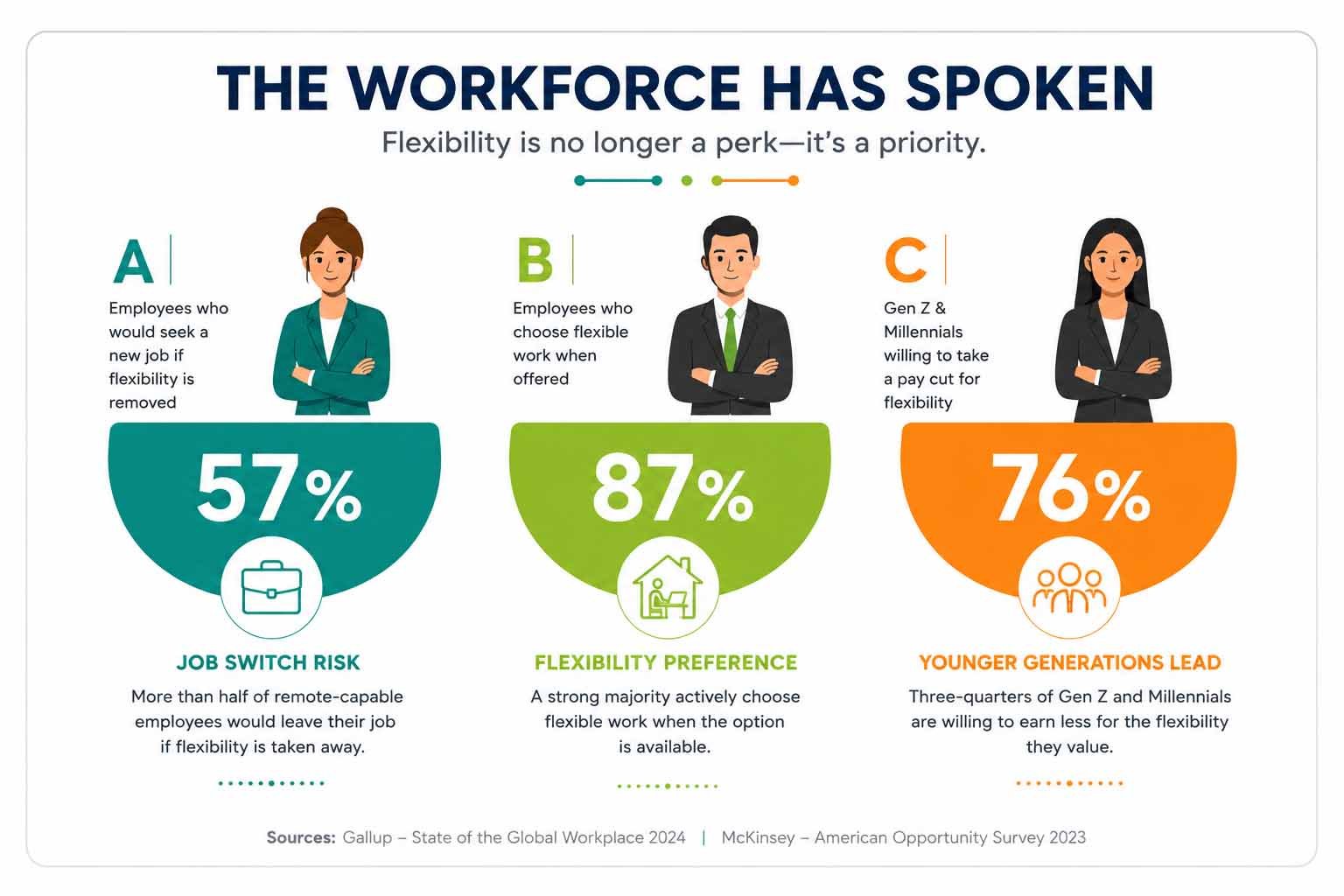
The executives who predicted remote work would fade once the pandemic subsided were wrong — and the data makes clear why. According to Gallup's 2024 State of the Global Workplace report, 57% of remote-capable employees now say they would actively seek a new job if their employer eliminated flexible work options. The remote work best practices that once seemed like emergency adaptations have become the defining competitive differentiators of the world's most effective organisations.
Microsoft, Spotify, Atlassian, and Airbnb haven't simply maintained flexible work policies — they've invested more aggressively in them. This isn't sentiment. It's strategy. In an era where talent is globally mobile and digitally enabled, the organisations that master distributed work are building structural advantages their office-first competitors may struggle to close.
This is no longer a conversation about where people work. It is a conversation about how organisations are built to attract talent, sustain high performance, nurture culture, and compete across borders — and the companies winning that competition are those that have codified the strongest remote work best practices into the fabric of how they operate.
Workplace Flexibility: The Foundation of Modern Remote Work
The Pre-Pandemic Problems That Flexible Work Exposed
Remote work did not create workforce dissatisfaction. It revealed it. Long before 2020, employees across industries were already questioning rigid workplace structures defined by punishing commutes, limited autonomy, geographic restrictions on career opportunity, and management cultures that equated presence with performance. The pandemic compressed years of slow-building frustration into a single, irreversible moment of clarity.
For millions of professionals, the shift to remote work didn't just change location — it changed expectations permanently. According to McKinsey's 2023 American Opportunity Survey, 87% of workers offered flexible work arrangements choose to take them. For organisations competing for skilled talent, this is not a preference to manage around. It is a structural reality to design for.
Flexible Work Is Now Workforce Infrastructure, Not a Perk
The most important reframe in modern workforce strategy is this: flexibility is no longer a perk. It is infrastructure.
Just as organisations invest in technology, office space, and compensation systems to make work possible, they must now invest in flexibility systems to make competitive talent attraction possible. Deloitte's 2024 Global Human Capital Trends report found that organisations with formally designed flexible work policies experience 31% lower voluntary turnover than those relying on ad hoc arrangements — a finding consistent across industries from technology and financial services to healthcare and professional services. Organisations ignoring this shift are not holding the line. They are ceding ground.
Essential Remote Work Best Practices for High-Performing Teams
Flexible work does not succeed by default. The most effective remote and hybrid organisations don't simply permit distributed work — they redesign their systems around it. Here are the core remote work best practices that consistently separate high-performing distributed teams from struggling ones.
Intentional Communication for Distributed Teams
In traditional offices, communication happened incidentally. Employees absorbed context through proximity — overhearing conversations, observing dynamics, catching colleagues at their desks. Distributed workplaces remove these ambient information channels entirely.
High-performing remote organisations replace accidental communication with intentional communication architecture. This includes:
- Asynchronous-first workflows that reduce dependency on real-time availability and respect time zones across globally distributed teams
- Centralised documentation systems (Notion, Confluence, or equivalent) where decisions, processes, and project context are recorded and accessible to all
- Structured meeting discipline — defined agendas, recorded outputs, and a strong default bias toward written communication over unnecessary video calls
- Transparent decision-making processes that keep distributed team members informed without requiring synchronous participation
Teams that build communication clarity into their operating systems outperform because employees gain greater autonomy and greater alignment simultaneously — a combination that is genuinely rare in poorly designed office environments.
Outcome-Based Performance: Remote Work Best Practice for Distributed Team Productivity
Traditional office cultures systematically confused visibility with value. Employees who arrived earliest, stayed latest, and appeared busiest were often perceived as the most committed — regardless of what they actually produced. Remote work makes this performance theatre impossible to sustain — and that is, for most organisations, a significant improvement.
In distributed environments, the best remote work best practices shift evaluation from presence to outcomes: measurable goals, defined deliverables, and demonstrable impact. According to a 2023 Stanford study by Professor Nicholas Bloom, remote workers show 13% higher productivity on average compared to office counterparts — but only in organisations that have made the management transition from surveillance to accountability.
High-performing distributed teams typically share these performance management characteristics:
- Goals are specific, measurable, and reviewed regularly (quarterly OKRs or equivalent)
- Managers are trained to evaluate outputs rather than monitor activity
- Unnecessary meetings are actively eliminated, protecting deep work time
- Trust is treated as a management tool, not a risk to be managed
The best remote leaders understand that trust is a productivity multiplier — and that micromanagement doesn't become more effective simply because it's conducted through screen-monitoring software.
Building Digital Collaboration Culture for Remote Employee Engagement
Technology enables remote work. Culture determines whether it succeeds. Many organisations make the mistake of investing heavily in collaboration tools — Slack, Teams, Zoom, Miro — while underinvesting in the behavioural norms that make those tools effective. The result is digital noise rather than digital collaboration.
Strong remote employee engagement and digital collaboration cultures share several deliberate design features:
- Psychological safety in digital spaces — explicit norms around how feedback is given, how disagreement is handled, and how new voices are included in asynchronous discussions
- Structured virtual onboarding that invests in relationship-building, not just process training, during the first 90 days of a new hire's tenure
- Periodic in-person touchpoints — retreats, project kickoffs, or team summits that create relational capital teams draw on for months of distributed work
- Inclusive meeting design that ensures remote participants in hybrid meetings receive equal airtime, visibility, and decision-making access to those in the room
Without deliberate culture investment, distributed teams drift toward isolation, disengagement, and attrition — often invisibly, until the damage is already done.
What Today's Workforce Demands: Autonomy, Flexible Work, and Trust
The rise of flexible work reflects a fundamental shift in what employees consider non-negotiable. Deloitte's 2024 Millennial and Gen Z Survey found that 76% of respondents from both generations would take a pay cut to work for an employer with better flexible work policies. This is not a marginal preference — it is a revealed willingness to accept material trade-offs in exchange for autonomy and work-life integration.
What Employees Want From Hybrid Work and Modern Employers
Today's workforce isn't uniformly asking to work from home full-time. The dominant demand is more nuanced: choice. Employees want the ability to decide where they work based on the nature of the work itself — and they want employers to trust them to make that decision well.
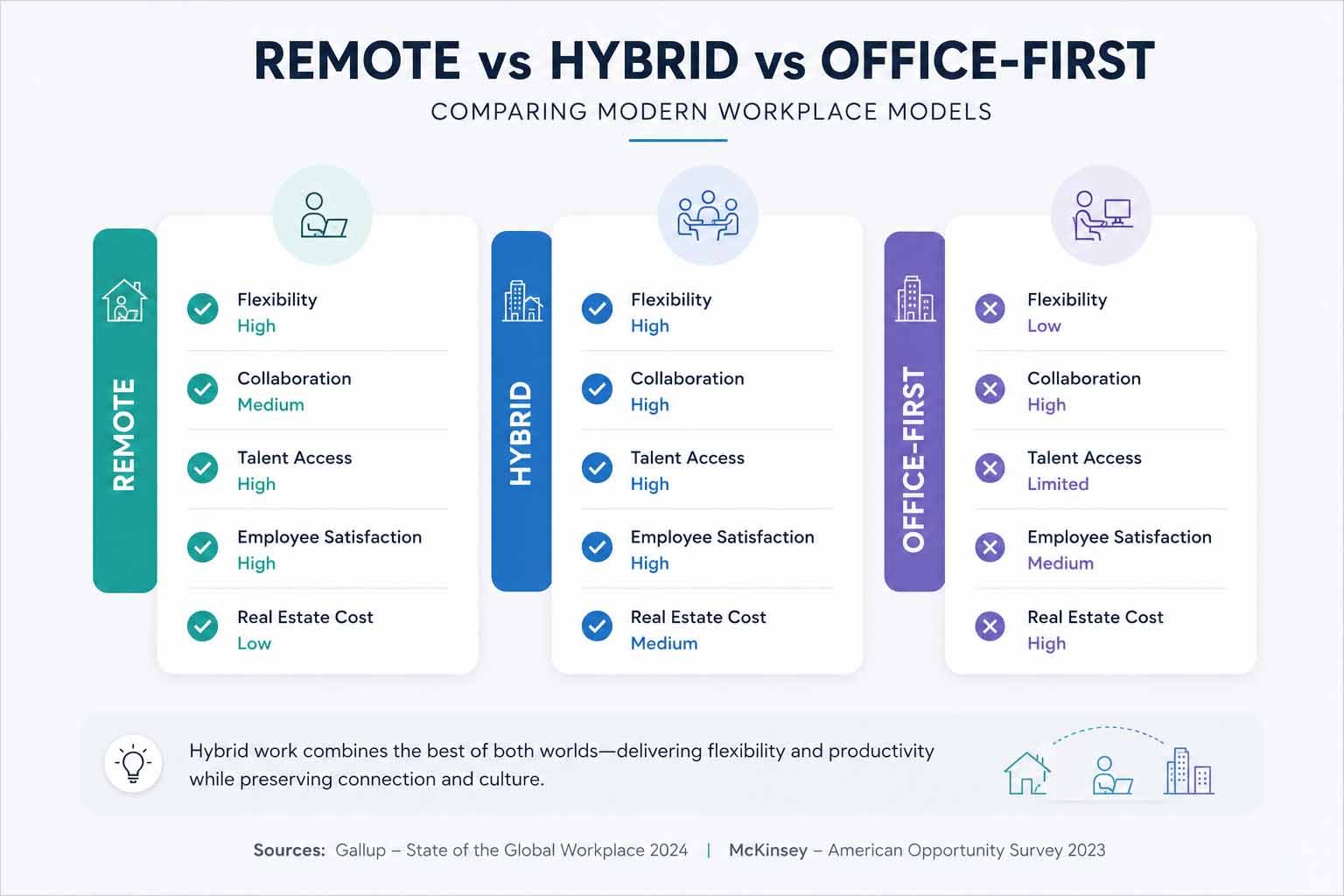
This is precisely why hybrid work models have emerged as the dominant global pattern. Hybrid systems give employees the flexibility they require while preserving the in-person collaboration, mentorship, and social connection that many still value — and that some roles genuinely require.
Equally important: remote and hybrid work has dramatically expanded global talent access for employers. Organisations are now recruiting across geographic boundaries far more effectively than at any previous point in history, building globally distributed teams with highly specialised skills. For businesses, this creates both unprecedented opportunity and unprecedented competition — because the same access that allows you to recruit globally allows every competitor to recruit your best people.
Does Remote Work Actually Improve Productivity? Evidence From Distributed Teams
Few questions in modern workforce management generate more ideological heat and less analytical clarity than remote productivity. The honest answer is that remote work neither automatically improves nor automatically diminishes productivity — outcomes are almost entirely determined by the quality of the systems and leadership surrounding the work.
The evidence is instructive. Stanford's Professor Nicholas Bloom, one of the leading researchers on distributed work, has found in multiple studies that:
- Well-managed remote workers are 13–20% more productive than equivalent office workers on individual, focused tasks
- Hybrid models show the strongest overall performance outcomes, combining the focus advantages of remote work with the collaboration benefits of periodic in-person contact
- Poorly managed remote environments, particularly those characterised by isolation, unclear expectations, and absent leadership, can produce measurable declines in engagement and output
The lesson is consistent: flexibility itself is not the strategy. Organisational adaptability is. The employers winning the flexibility debate are not those who simply permit remote work — they are those who have built management systems, communication structures, and performance frameworks specifically designed for distributed teams.
Why Hybrid Work Is Becoming the Global Standard
Fully remote companies continue to operate successfully — GitLab, Automattic, and Basecamp among them. But across global industries, hybrid work has emerged as the most common and most sustainable long-term model precisely because it avoids the most significant limitations of both extremes.
The Strategic Advantages of Hybrid Work for Distributed Teams
- Hybrid models offer organisations several compounding advantages:
Greater flexibility without the cultural isolation risks of fully remote environments - In-person collaboration opportunities for complex problem-solving and relationship-building
- Stronger new employee onboarding experiences when combined with structured virtual components
- Reduced commuting burden, improving employee satisfaction and reducing attrition
- Flexibility to adapt office space requirements and reduce real estate costs over time
Proximity Bias: The Equity Problem Hybrid Work Must Solve
Hybrid environments also introduce a structural risk that organisations frequently underestimate: proximity bias. Without intentional design, hybrid workplaces create invisible inequalities between employees who are regularly in-office and those who work primarily remotely — particularly in areas of meeting participation, leadership visibility, performance evaluation, and promotion decisions.
According to Microsoft's 2023 Work Trend Index, 43% of remote workers feel that in-office colleagues receive more recognition from management. For hybrid models to deliver on their promise, organisations must actively design against this bias — through inclusive meeting protocols, rotation-based in-person requirements, and explicit guidance for managers on equitable evaluation of remote and in-office team members.
The future of work will not belong to organisations enforcing the strictest return-to-office mandates. It will belong to those building the most adaptable, equitable, and intentionally designed hybrid systems.
Flexible Work as a Strategic Advantage: How Remote-First Thinking Reshapes Talent Competition
The remote work conversation is increasingly an economic and competitive one. Flexibility now directly influences the metrics that determine long-term organisational performance: talent acquisition costs, employee retention rates, workforce productivity, operational resilience, and global hiring reach.
In highly competitive industries — technology, financial services, consulting, media — these factors compound into meaningful strategic differentiation. An organisation with a 31% lower voluntary turnover rate, driven in part by well-designed flexible work policy, is not simply a nicer place to work. It is a structurally more efficient business, spending less on recruitment, onboarding, and institutional knowledge replacement than its more rigid competitors.
The companies that continue to invest in remote work best practices are not doing so because remote work is perfect. They are doing so because workforce expectations, digital infrastructure, and global labour market dynamics have fundamentally and permanently changed.
The workplace is no longer defined by buildings. It is defined by systems, communication architectures, trust cultures, and organisational adaptability. In that environment, the organisations that master the remote work best practices outlined here — intentional communication, outcome-based performance, genuine digital culture, equitable hybrid design — will not simply attract better talent. They will build better organisations.
Frequently Asked Questions
What are the most important remote work best practices for leaders?
The most critical remote work best practices for leaders are: building intentional communication systems (asynchronous-first, documented decisions), shifting to outcome-based performance management, investing in digital collaboration culture beyond tools, and designing hybrid policies that actively counteract proximity bias. Leadership trust is the foundation — without it, no system works.
Does remote work improve productivity?
Remote work improves productivity when organisations invest in effective communication structures, clear goal-setting, and trust-based management. Stanford research by Professor Nicholas Bloom shows well-managed remote workers are 13–20% more productive on focused tasks. Outcomes depend almost entirely on the quality of leadership and organisational systems, not location itself.
Why are companies adopting hybrid work models?
Hybrid work has become the dominant model because it combines the autonomy and focus benefits of remote work with the collaboration, mentorship, and relationship-building advantages of in-person contact. Deloitte and McKinsey data consistently show hybrid models produce higher employee satisfaction and lower turnover than either fully remote or fully office-based arrangements.
What is the biggest risk of poorly managed remote work?
The greatest risk is invisible disengagement — distributed employees gradually disconnecting from team culture, leadership visibility, and career development opportunities without either party noticing until attrition occurs. This is why remote employee engagement systems, structured check-ins, and deliberate culture-building are not optional add-ons but core operational requirements.
What is the most effective remote work policy for a global organisation?
The most effective global remote work policy combines flexible location options with structured expectations: defined core collaboration hours that respect time zones, documented communication protocols, outcome-based performance frameworks, and periodic in-person investment. Policies that prioritise clarity, equity, and employee autonomy consistently outperform those built primarily around location control.
How do you maintain company culture with a remote or hybrid team?
Culture in distributed teams is maintained through intentional design rather than physical proximity. This includes structured virtual onboarding, regular team rituals (weekly check-ins, async updates, virtual socials), periodic in-person retreats, and leadership behaviour that models the values the organisation claims to hold. Culture doesn't emerge from office presence — it emerges from consistent, deliberate reinforcement of shared norms and expectations.