
What Students Really Want from Higher Education — And Why Most Universities Are Missing It

A generation ago, the value proposition of a university degree was largely self-evident. You enrolled, you studied, you graduated — and the credential alone opened doors. Today, that contract between student and institution has fundamentally broken down. Higher education student expectations have shifted at a pace that most universities have been structurally unable to match, and the consequences are playing out in enrolment pressures, rising dropout rates, and a growing crisis of institutional trust.
The question facing every university leader, policymaker, and academic today is no longer simply "are we delivering quality education?" It is: "Are we delivering what students actually need — and if not, why not?"
What Do Students Actually Expect from Higher Education Today?
Understanding modern higher education student expectations requires setting aside what institutions assume students want and paying close attention to what the evidence actually shows.
A 2024 Gallup–Lumina Foundation study of over 14,000 students in the United States found that fewer than 40% felt their education was preparing them well for the job market. A separate survey by Pearson found that 72% of students globally ranked career relevance as their top priority when choosing or evaluating their degree programme. Yet university curricula — shaped by decades of academic tradition and slow-moving governance structures — frequently lag three to five years behind the skills the labour market demands.
The gap is not about academic rigour. Students are not asking for easier degrees. They are asking for degrees that mean something when they graduate.
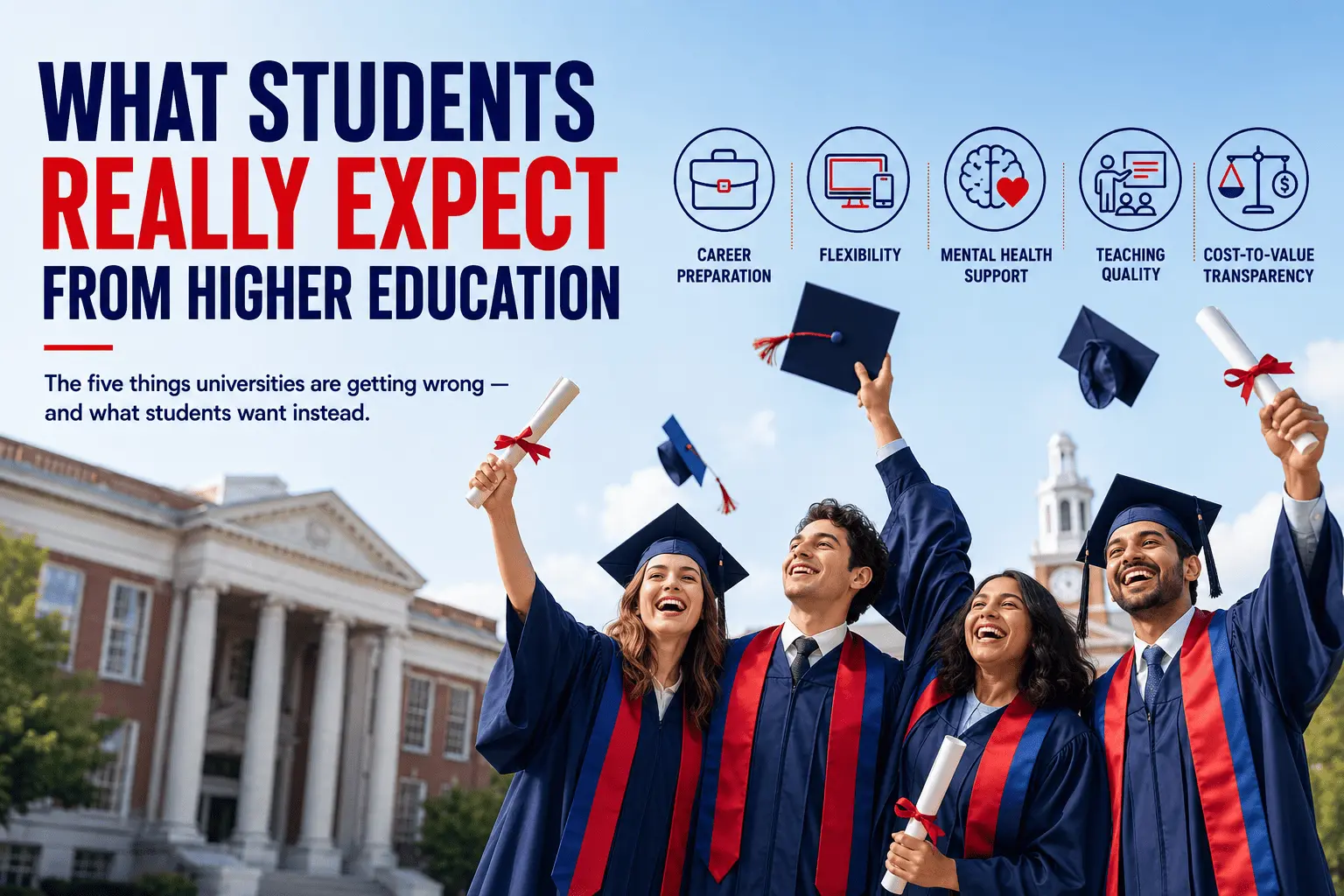
The Five Things Students Say Universities Are Getting Wrong
1. Career Preparation Is Treated as an Afterthought
The most consistent finding across student satisfaction research is a perceived disconnect between academic content and professional reality. Students want work-integrated learning — placements, live briefs, industry partnerships, mentorship — embedded throughout their degree, not bolted on as an optional module in the final year.
Universities that have restructured programmes around this model, such as Northeastern University in the United States with its co-operative education model, consistently report higher graduate employment rates and significantly stronger alumni loyalty. The lesson is transferable; the will to implement it is what most institutions lack.
2. Flexibility Is Still Treated as a Concession, Not a Design Principle
The pandemic demonstrated, irrefutably, that higher education could be delivered in radically different formats without collapsing academic standards. Students absorbed that lesson. Many now expect modular study, asynchronous options, and the ability to pause and re-enter education around life's realities — caregiving, part-time work, mental health needs.
Most universities responded to post-pandemic enrolment by reverting to pre-pandemic rigidity. Students noticed. Flexible learning pathways are not a concession to declining standards; they are a response to the reality of who today's students actually are.
3. Mental Health and Wellbeing Support Remains Structurally Underfunded
Student mental health has reached a genuine crisis point across most developed economies. According to the American College Health Association, more than 60% of university students reported significant anxiety in 2023, with depression and burnout close behind. Yet counselling services at most institutions operate on wait times of four to six weeks — a structural mismatch that signals, loudly, where students sit in institutional priorities.
For prospective students navigating increasingly anxious decision-making processes, the perceived quality of wellbeing infrastructure is now a material factor in university selection — and a growing driver of early withdrawal when that infrastructure fails to deliver.
4. Teaching Quality Is Inconsistently Recognised and Rewarded
Students are acutely aware of the institutional prestige economy in which research output is rewarded and teaching quality is frequently treated as secondary. The most common complaint in student satisfaction surveys — persistent across institutions, geographies, and disciplines — is not about facilities or administration. It is about the quality and accessibility of teaching.
Closing this gap requires universities to genuinely restructure how teaching excellence is recognised, promoted, and incentivised. Cosmetic interventions — teaching awards, satisfaction surveys without consequence — signal to students that the institution is performing concern rather than acting on it.
5. The Cost-to-Value Equation Is Under Sustained Scrutiny
With tuition fees at historic highs in markets like the UK, US, and Australia, students are applying a consumer lens to higher education with unprecedented rigour. This is not crass commercialism — it is a rational response to carrying significant financial risk. When students ask whether their degree is "worth it," they are asking a legitimate question that most universities still struggle to answer with confidence.
The institutions navigating this challenge most effectively are those that articulate their value proposition with specificity: graduate outcomes data, industry partnership depth, the tangible return on the educational investment. Vague appeals to the intrinsic value of learning no longer close the credibility gap.
_1785559157.png)
What Students Do Want — And Where Universities Can Lead
It would be a mistake to read this as a straightforwardly negative verdict on higher education. Students remain deeply invested in the university experience — socially, intellectually, and professionally. What they are withdrawing is not their desire to learn but their patience with institutions that treat their expectations as unreasonable.
The students entering higher education today want four things above all else: relevance, respect, flexibility, and genuine support. They want to be treated as intelligent adults navigating a genuinely difficult world, not as passive recipients of a traditional model designed for a different era.
The universities that are winning student confidence — and sustaining enrolment in a contracting demographic market — share a common characteristic. They have stopped defending their existing model and started genuinely asking: what do the people we exist to serve actually need from us right now?
Exploring the future of higher education requires grappling honestly with that question. The institutions prepared to do so will not merely survive the current disruption — they will define what comes next.
FAQ: People Also Ask
What are the main expectations of students in higher education today?
Students primarily expect career-relevant curricula, flexible learning options, strong mental health support, high-quality teaching, and a clear return on their financial investment. Institutional responsiveness and genuine communication are also increasingly cited as baseline expectations.
Why are students dissatisfied with universities?
The most common drivers of dissatisfaction include poor career preparation, inflexible course structures, underfunded wellbeing services, and a perceived gap between tuition costs and the value delivered. Students consistently report that their expectations were not met at the point of enrolment.
How can universities better meet student expectations?
Universities can close the expectations gap by embedding work-integrated learning throughout degree programmes, investing structurally in mental health services, rewarding teaching quality, publishing transparent graduate outcomes data, and building genuine flexibility into how programmes are designed and delivered. Discover more in our university student success strategies hub.
The Cost of Continuing to Miss the Mark
Higher education's social contract with students is not broken beyond repair — but it is under genuine strain. The institutions that acknowledge this honestly, and act on it structurally rather than rhetorically, have an extraordinary opportunity to rebuild the trust and relevance that the sector urgently needs.
Higher education student expectations have not become unreasonable. They have become a clear signal of what a genuinely student-centred university looks like. The question is which institutions have the courage and the governance agility to follow that signal where it leads.