

The Science of Speaking Up Why Psychological Safety Is the Hidden Engine of High-Performing Teams

Psychological safety in the workplace is the single most powerful and most misunderstood driver of team performance in the modern knowledge economy. Defined by Harvard Business School professor Dr. Amy Edmondson as "a shared belief held by members of a team that the team is safe for interpersonal risk-taking," it is neither a corporate trend nor a license for mediocrity. It is a biologically and statistically verifiable catalyst for innovation, accountability, and sustained commercial success.
When employees feel safe to voice concerns, admit mistakes, and challenge assumptions without fear of punishment or humiliation, their cognitive capacity shifts from self-preservation to collaborative problem-solving. That shift is the hidden differentiator between stagnant organizations and elite, high-performing teams.
This article examines the neuroscience behind psychological safety, the definitive data from Google's Project Aristotle, real-world case studies showing what happens when it fails and a practical blueprint for how leaders can engineer it deliberately.
When Fear Takes the Wheel
To understand why psychological safety in the workplace dictates team performance, leaders must first understand what happens inside the human brain when it perceives a social threat.
From an evolutionary standpoint, the brain is optimized for survival, not productivity. When an employee receives a harsh public reprimand, faces a dismissive manager, or operates inside a culture of blame and politics, the brain does not register that as a professional disagreement. It registers it as a direct threat to survival.
The Amygdala Hijack: The Neuroscience of Workplace Fear
When an individual perceives an interpersonal threat, the amygdala, the brain's threat-detection system triggers an immediate fight-or-flight response. Cortisol and adrenaline flood the body. The prefrontal cortex, the seat of strategic thinking, creative problem-solving, and nuanced collaboration effectively shuts down. This response is useful when fleeing a physical predator. Inside a corporate boardroom or product sprint, it is catastrophic.
An organization that operates on fear, blame, or hyper-criticism is systematically suppressing its collective cognitive capacity. Employees under chronic threat cannot innovate, identify market trends, or propose creative solutions because every available mental resource is consumed by a single, exhausting objective: self-preservation.
The performance cost is real. A 2017 Gallup study found that only 3 in 10 employees feel their opinions matter at work. Closing that gap to 6 in 10 would result in a 27% reduction in employee turnover, a 40% reduction in safety incidents, and a 12% increase in productivity.
The Neurochemistry of Trust in the Workplace and High-Performing Teams
Conversely, when psychological safety in the workplace is high, brain chemistry shifts entirely. Environments characterized by mutual trust and open vulnerability generate elevated levels of oxytocin (the social bonding hormone) and dopamine (the reward and motivation neurotransmitter).
Oxytocin actively dampens amygdala reactivity, allowing the prefrontal cortex to operate at full capacity.
Dopamine sharpens memory, enhances engagement, and reinforces creative risk-taking.
Psychological safety doesn't just make employees feel better — it creates the precise neurochemical environment required for intellectual breakthrough and collaborative agility.
Psychological Safety vs. Comfort Culture: What Leaders Get Wrong About Workplace Culture
A major barrier to building genuine psychological safety is a fundamental misreading of what it actually means. Most organizations either dismiss it as "soft" HR language or overcorrect into a culture of comfortable avoidance. Both responses are equally damaging.
What Psychological Safety Is NOT What It Actually Is
- A culture of niceness and polite hesitation
- An arena for candid debate and hard truths
- A lowering of performance standards
- A foundation that accelerates accountability
- Unconditional praise for every idea
- A system where mistakes become collective learning data
- Protection from discomfort
- Permission to take calculated interpersonal risks
The critical distinction is this: psychological safety coexists with high standards — it does not replace them.
Organizational culture researchers identify three distinct team environments:
The Comfort Zone — High safety, low standards. People are content but uninspired. Performance plateaus.
The Anxiety Zone — High standards, low safety. The birthplace of burnout, hidden errors, and voluntary turnover.
The Learning Zone — High standards and high safety. The environment where elite teams collaborate intensely, surface problems early, and innovate freely.
The goal for any high-performing organization is to operate consistently within the Learning Zone. Without psychological safety in the workplace, high standards alone produce anxiety, not excellence.
The Five Pillars of Psychological Safety: Framework for Building High-Performing Teams
Understanding what psychological safety is represents the first step. Knowing how to build it is where most organizations stall. The 5 Cs framework — Clarity, Contribution, Confidence, Comfort, and Connection — offers leaders a concrete, actionable model for establishing and sustaining psychological safety across their teams.
Clarity is the foundation. When expectations, roles, and goals are ambiguous, employees default to self-protective behaviour avoiding visible mistakes rather than pursuing bold outcomes. Leaders who communicate objectives transparently and define what success looks like give their teams the cognitive freedom to focus on performance rather than second-guessing their standing. Clarity removes the anxiety of the unknown and replaces it with the confidence to act.
Contribution ensures that every voice has genuine weight. A psychologically safe team is not one where the same three people dominate every meeting while others disengage in silence. Leaders who actively invite quieter team members into discussions, acknowledge all input without immediate dismissal, and create structured space for diverse perspectives send a consistent signal: your ideas are not just tolerated here they are sought. When contribution is valued equitably, engagement rises and groupthink diminishes.
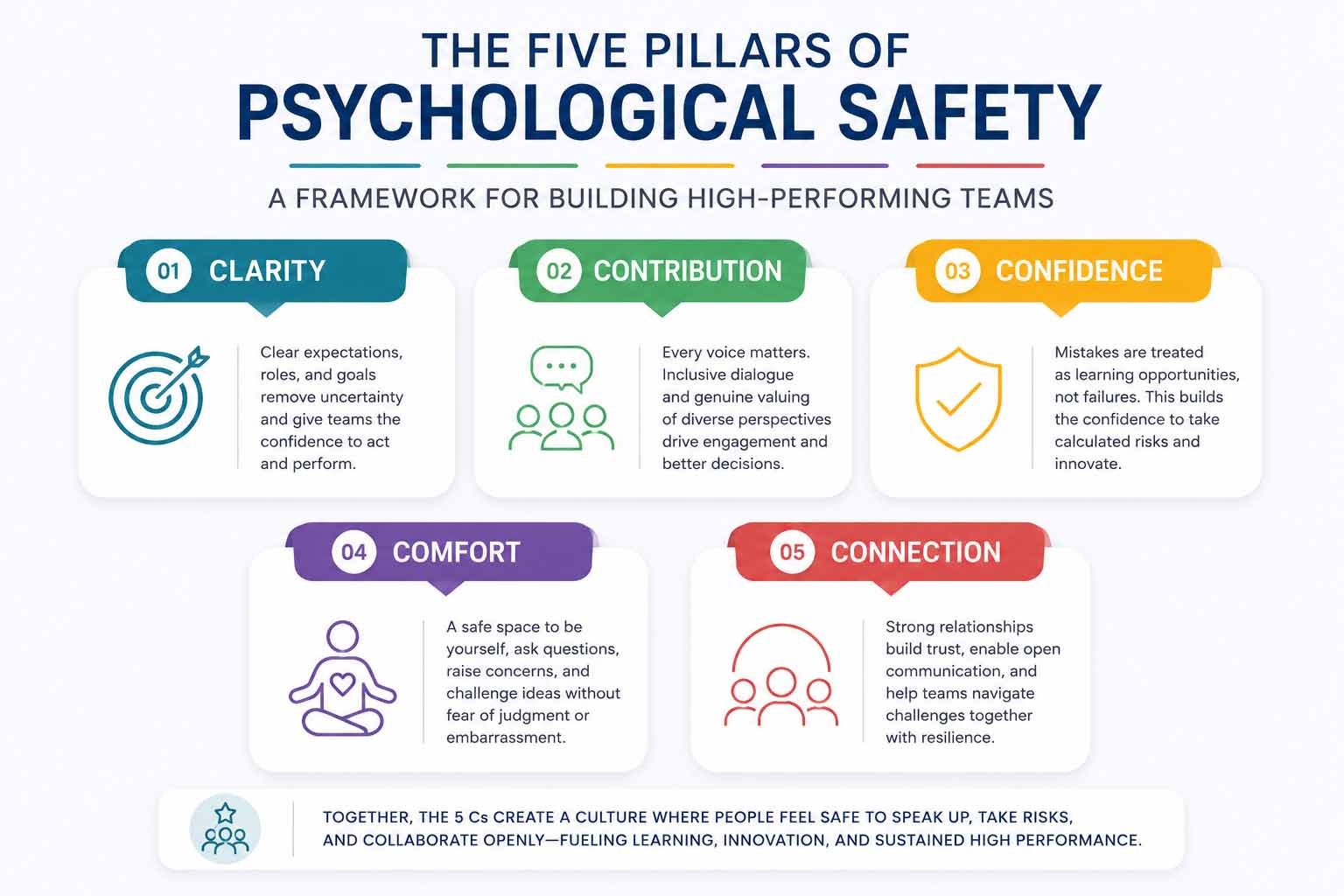
Confidence shifts how mistakes are treated at the organizational level. In low-safety environments, errors are career-defining failures to be concealed. In high-safety environments, they are data points to be examined collectively. When leaders respond to mistakes with curiosity rather than blame asking "what did we learn?" instead of "who is responsible?" — they build the team's collective confidence to take the calculated risks that innovation requires. This is not the absence of accountability; it is accountability designed to produce learning rather than fear.
Comfort addresses the physical and emotional dimensions of safety. It means creating an environment where individuals feel genuinely free to be themselves — to raise an unpopular concern, ask what might feel like a "basic" question, or push back on a senior leader's assumption without bracing for social consequences. Comfort is not passivity; it is the psychological baseline that allows intellectual courage to flourish. Leaders build it through consistency: responding the same way on a difficult Tuesday as they do in an all-hands meeting where impressions are managed.
Connection recognizes that psychological safety does not exist in the abstract — it lives inside relationships. Teams with strong interpersonal trust share information more freely, recover from conflict more quickly, and sustain high performance under pressure more reliably than teams whose members remain professionally distant. Leaders who invest in the relational fabric of their teams through regular one-on-ones, shared context, and genuine human interest in their people are not engaging in soft management. They are building the connective tissue that makes all other dimensions of psychological safety durable.
Together, the 5 Cs form a self-reinforcing system. Clarity reduces anxiety. Contribution broadens engagement. Confidence normalizes risk. Comfort enables authenticity. Connection sustains all four. Organizations that deliberately cultivate each element do not simply improve team morale, they engineer the precise conditions in which high-performing, psychologically safe teams are structurally inevitable.
Project Aristotle: Google's Search for the Perfect Team
The most rigorous validation of psychological safety as a driver of team performance came from inside Google itself.
Launched in 2012, Google's People Analytics division conducted a multi-year internal study codenamed Project Aristotle analyzing hundreds of internal teams to answer one question: Why do some teams succeed where others fail?
The initial hypothesis was straightforward: the best teams would be those with the highest concentration of individual talent, the most experienced engineers, the most credentialed researchers, and the most charismatic leaders. The data consistently rejected this theory.
Individual talent had no statistically significant correlation with team effectiveness. What mattered was not who was on the team, but how team members interacted with one another.
Project Aristotle identified five dynamics that underpinned high-performing teams:
- Psychological safety — Can I take risks without fear of being judged or penalized?
- Dependability — Can I rely on my teammates to deliver?
- Structure and clarity — Are goals, roles, and plans clear?
- Meaning — Is this work personally significant?
- Impact — Do I believe my work matters?
Crucially, the data revealed that psychological safety was not merely one factor among five equals; it was the foundational prerequisite for all the others. Teams without it could not achieve dependability because members concealed mistakes until they were too costly to fix. They lacked clarity because people were too intimidated to ask clarifying questions about vague directives. They found no meaning in work that felt perpetually unsafe.
Project Aristotle didn't just validate psychological safety as a feel-good value. It established it as an organizational framework for maximizing human capital at scale.
Psychological Safety Fails in the Workplace: Silence Becomes Expensive
The absence of psychological safety in the workplace carries consequences that go far beyond employee satisfaction scores. History shows that organizational silence can destroy market value, cost billions, and endanger human lives.
The Volkswagen Emissions Scandal: Organisational Culture and the Cost of Fear
The Volkswagen "Dieselgate" crisis is a textbook study in the organizational cost of fear. Under an authoritarian corporate culture, engineers were given aggressive, seemingly impossible emissions targets with a clear implicit message: failure is not an option.
Because engineers felt psychologically unsafe reporting that the targets could not be achieved with existing technology, they chose instead to install deceptive software to manipulate regulatory test results. The systemic absence of safety blocked accurate technical feedback from reaching leadership until it was too late. The result: over $30 billion in fines, sweeping executive exits, and permanent damage to a brand built over eight decades.
The problem was never the engineers. The problem was a culture in which speaking the truth carried more perceived risk than committing fraud.
Aviation's Safety Turnaround: How Trust in the Workplace Saved Lives
A more instructive case study can be found in commercial aviation. Throughout the 1970s and 1980s, an alarming pattern emerged in accident investigations: subordinate co-pilots and flight engineers had identified fatal piloting errors made by senior captains and chose to remain silent, or offered only timid, indirect hints. Their fear of challenging a senior officer's authority outweighed their survival instincts.
In response, the aviation industry pioneered Crew Resource Management (CRM), a systemic intervention that explicitly flattened the cockpit hierarchy during operational crises. Co-pilots were not just permitted but mandated to voice concerns clearly. This intentional creation of psychological safety transformed aviation from one of the world's most dangerous industries into one of its safest modes of transportation.
The lesson for organizational leaders is unambiguous: when speaking up is dangerous, silence becomes the rational choice regardless of the stakes.
How to Build Psychological Safety in the Workplace: 3 Proven Leadership Actions
Psychological safety in the workplace does not emerge from a values statement or a team-building workshop. It must be deliberately engineered through consistent, visible leadership behaviour. Here are three actions with immediate impact.
Action 1: Frame Work as a Learning Problem to Build Employee Engagement
Most corporate initiatives involve genuine uncertainty. Leaders who pretend otherwise create an environment where admitting difficulty is career-limiting. Instead, explicitly acknowledge the uncertainty upfront.
When launching a new initiative, use framing like: "We are entering uncharted territory. To succeed, we need to discover what works — which means we will encounter unexpected data and missteps. I need everyone's early observations, especially the uncomfortable ones." This single reframe removes the stigma of raising problems and repositions candor as a professional asset rather than a liability.
Action 2: Model Vulnerability to Build Trust in the Workplace
Employees closely observe executive behaviour to calibrate what is genuinely safe. If leadership projects an image of absolute infallibility, the team will conceal their own flaws to match that standard. The antidote is deliberate, public vulnerability. Announce your own mistakes openly: "I misjudged our competitor's response on this product launch that's on me. What can we learn from this data?" Or simply: "I don't know the answer here yet. What do you all think?"
When leaders demonstrate that it is professionally safe to be human, teams feel safe enough to be honest.
Action 3: Replace Passive Questions With Active Inquiry to Strengthen Team Performance
The standard meeting question "Does anyone have any objections?" is structurally designed to produce silence. Dissent feels like personal confrontation, so most people default to compliance.
Replace passive invitations with structured intellectual challenges:
"What is the weakest part of this strategy?"
"If this launch fails six months from now, what caused it?"
"What perspective am I missing entirely?"
This reframe transforms a dissenting opinion from a risky personal challenge into a valued answer to an explicit leadership request. The psychological dynamic shifts completely.
How to Measure Psychological Safety Using Amy Edmondson's Diagnostic Framework
What cannot be measured cannot be managed. Dr. Amy Edmondson's validated 7-question diagnostic framework provides organizations with a reliable, actionable tool for tracking psychological safety across teams. Deploy regular, anonymous pulse surveys asking team members to rate their agreement with the following statements:
If you make a mistake on this team, it is often held against you. (Reverse scored)
Members of this team are able to bring up problems and tough issues.
People on this team sometimes reject others for being different. (Reverse scored)
It is safe to take a risk on this team.
It is difficult to ask other members of this team for help. (Reverse scored)
No one on this team would deliberately act in a way that undermines my efforts.
Working with members of this team, my unique skills and talents are valued and utilized.
A high team score on this diagnostic correlates directly with faster problem resolution, lower voluntary turnover rates, and higher rates of workplace innovation. Organizations that track this metric quarterly create a feedback loop that allows leadership to intervene before disengagement becomes departure.
Psychological Safety in the Workplace Is Your Organisation's Greatest Competitive Advantage
In the modern knowledge economy, your single greatest asset is the collective intelligence of your people. If your team members are quietly editing themselves — holding back critical observations, concealing early-warning signals, or suppressing unconventional ideas out of fear you are paying a premium for talent you are not actually using.
Psychological safety in the workplace is not an administrative luxury or a soft HR preference. It is the key that unlocks latent human potential at scale. Organizations that engineer it deliberately — through leadership modeling, structural redesign, and consistent measurement — do not merely improve team morale. They build the kind of adaptive, high-performing organizational culture that sustains competitive advantage through disruption, uncertainty, and change. The leaders who understand this are not building nicer workplaces. They are building smarter ones.
Key Questions Leaders Ask
What is psychological safety in the workplace?
Psychological safety in the workplace is a shared team belief that individuals can take interpersonal risks voicing concerns, admitting mistakes, asking questions, or challenging assumptions without fear of social penalty, humiliation, or professional retaliation. The concept was formally defined and validated by Harvard Business School professor Dr. Amy Edmondson, whose research established it as the primary predictor of high-performing team behavior.
What did Google's Project Aristotle discover about team performance?
Google's Project Aristotle discovered that team success is determined by how members interact, not who is on the team. After studying hundreds of internal teams, researchers found that individual talent, personality, and background had no statistical correlation with high performance. Instead, five team dynamics drove effectiveness — with psychological safety identified as the foundational prerequisite. Without it, the remaining four dynamics (dependability, structure and clarity, meaning, and impact) could not function effectively.
How does psychological safety improve employee engagement?
Psychological safety improves employee engagement by removing the cognitive burden of self-protection. When employees no longer fear judgment for speaking up, their mental resources shift from threat-monitoring to creative contribution. Research links high psychological safety to measurable increases in problem-solving speed, innovation rates, voluntary knowledge-sharing, and reduced voluntary turnover — all direct indicators of sustained employee engagement and organizational health.
What is the difference between psychological safety and accountability?
Psychological safety and accountability are complementary, not competing, forces. Psychological safety refers to an environment where individuals feel safe to take risks and admit mistakes without social penalty. Accountability refers to holding individuals responsible for clearly defined performance standards and outcomes. High-performing teams require both operating simultaneously in a combination organizational researchers call the "Learning Zone." High safety without high standards produces comfort and stagnation; high standards without safety produce anxiety, burnout, and hidden failures.
How do you measure psychological safety on a team?
Psychological safety is measured through regular, anonymous pulse surveys using the validated 7-question diagnostic framework developed by Dr. Amy Edmondson. Team members rate statements covering how mistakes are treated, whether difficult issues can be raised openly, whether unique skills are valued, and whether calculated risk-taking is supported. Scores are tracked over time to identify teams at risk and measure the impact of leadership interventions on organizational culture.