

University Strategic Management: Balancing Academic Mission and Financial Sustainability

Effective university strategic management has never been more consequential — or more contested. As public funding for higher education declines across OECD nations (dropping an average of 12% as a share of institutional income since 2010, according to the OECD Education at a Glance report), university leaders face a defining tension: how to protect the core academic mission while building the financial sustainability needed to survive a period of profound disruption. In this environment, strategic decision-making has shifted from a periodic planning exercise to a continuous, high-stakes discipline — one where every choice about programme investment, campus footprint, or partnership carries direct consequences for institutional survival.
This is not a theoretical challenge. Across the UK, Australia, and the United States, institutions with strong academic reputations have faced financial collapse — among them, Japan College of Foreign Languages and several UK providers — because leadership failed to reconcile vision with fiscal reality. The institutions that will define the next generation of higher education excellence are those that treat this tension not as a problem to be solved, but as a dynamic to be mastered.
Why Academic Vision and Financial Reality Collide in Higher Education
The Primacy of Academic Mission
Universities are not businesses. Most institutional leaders are rightly resistant to models that reduce them to one. The academic mission — to generate, transmit, and apply knowledge in service of human flourishing — is a commitment that transcends quarterly performance cycles and market signals. Research into low-commercial-value disciplines, the protection of academic freedom, the maintenance of culturally and societally important fields with limited enrolment: these are not inefficiencies. They are the defining features that make universities distinct from any other type of organisation.
The Discipline of Financial Sustainability
And yet, mission without financial sustainability is aspiration without execution. A 2023 KPMG Higher Education Sector report found that more than one-third of UK universities are running operating deficits — a structural trend that, left unaddressed, does not preserve academic mission. It ends it. The universities that have failed in recent decades have almost invariably combined strong academic identity with inadequate strategic planning in higher education. Financial discipline, properly applied, does not betray the academic mission — it protects it.
Strategic Planning Frameworks Every University Leader Needs
Rigorous university leadership strategy requires more than vision statements and budget reviews. It demands frameworks that translate institutional values into structured, defensible decisions about resource allocation, programme development, and partnership investment.
Portfolio Analysis in Higher Education
One of the most powerful tools in academic strategic planning is disciplined portfolio analysis: evaluating the institution's full range of programmes, research centres, and service activities across two dimensions — strategic importance and financial contribution.
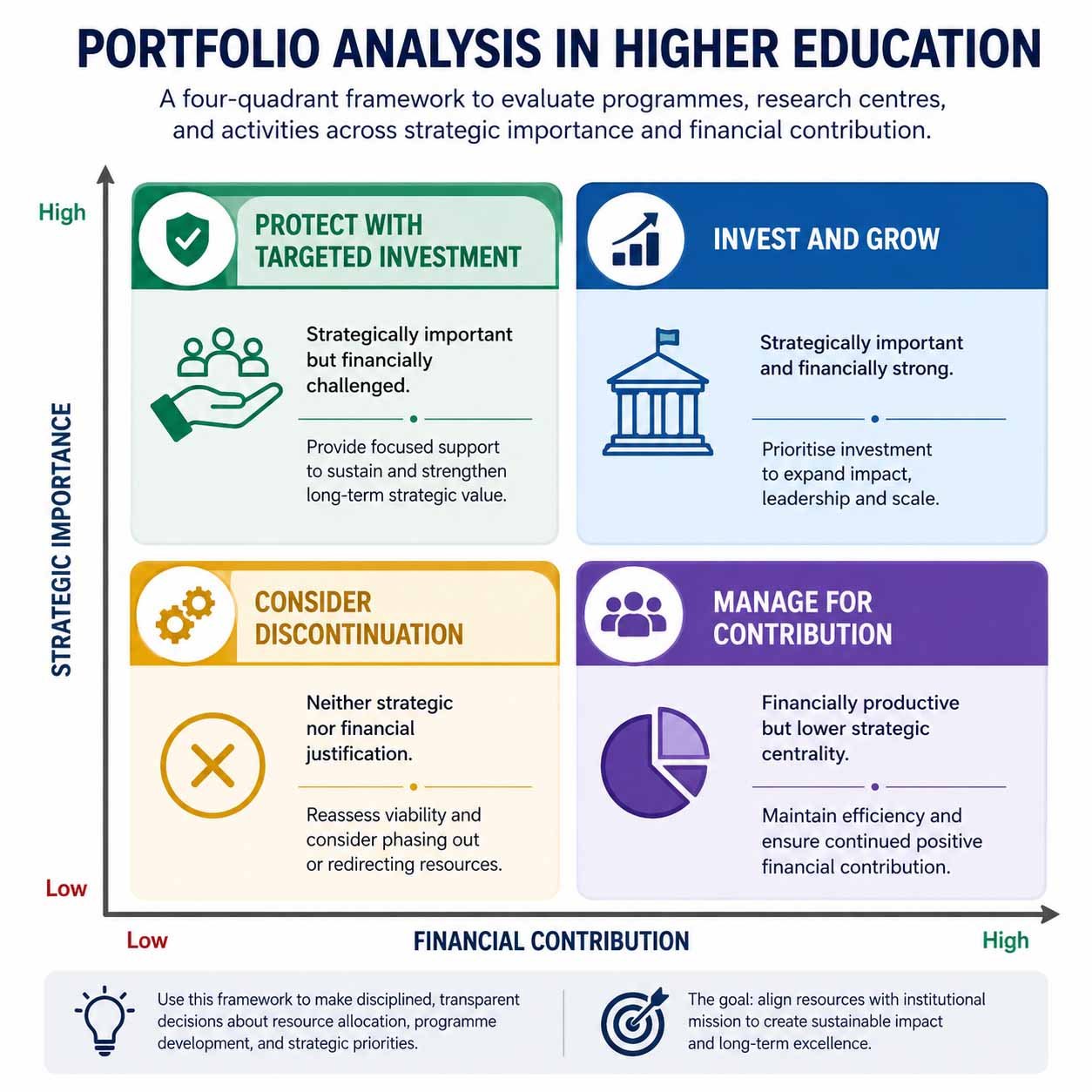
This produces a four-quadrant framework:
Invest and grow: Strategically important and financially strong
Protect with targeted investment: Strategically important but financially challenged
Manage for contribution: Financially productive but lower strategic centrality
Consider discontinuation: Neither strategic nor financial justification
The political difficulty of applying this framework — in academic cultures where every programme has passionate advocates — does not diminish its utility. Enrollment management strategy and resource allocation decisions made without this kind of structured analysis tend to produce drift rather than direction.
Building Strategic Partnerships That Protect Academic Integrity
Higher education governance increasingly relies on partnerships with industry, government, international institutions, and community organisations to extend capability, share costs, and access new revenue streams. Research funding strategy that depends solely on government grants is, in the current environment, structurally fragile.
Effective industry partnerships fund applied research, create employability pipelines, and generate income that subsidises less commercially oriented academic activity. But the strategic question is not whether to pursue partnerships — it is how to structure them so that commercial interest genuinely aligns with research priority, without requiring institutions to subordinate academic judgment to a partner's commercial agenda.
According to Times Higher Education's 2024 University-Industry Collaboration Index, institutions with formally governed partnership frameworks report 34% higher research commercialisation rates than those without — while maintaining equivalent scores on academic independence measures.
University Governance Strategy: Defining Who Holds Decision-Making Authority
University governance strategy is complicated by a structure with no precise parallel in corporate or public sector organisations. Academic governance — through senates, academic boards, and faculty councils — reflects the principle of collegial authority over curriculum, research, and academic standards. Administrative governance — through executive leadership and boards of governors — reflects the accountability requirements of regulated, publicly funded institutions.
When academic vision and financial reality collide most sharply — at programme closures, campus restructuring, or major strategic pivots — these governance structures can produce debilitating conflict and decision paralysis.
Universities that have invested in clear, shared understanding of which decisions reside in academic governance and which in administrative governance are significantly better positioned to make and implement difficult strategic choices. Institutional resilience is built not just through financial reserves, but through governance structures that can move decisively under pressure.
What the Data Tells Us About Strategic Success in Higher Education
The evidence on higher education strategy outcomes is instructive. According to McKinsey's 2023 Global Higher Education Report: Universities with clearly documented strategic plans are 2.4x more likely to achieve revenue growth targets over a five-year horizon Institutions that formally evaluate programme portfolios every three years show 18% higher student retention rates. Leaders who communicate strategic decisions with full transparency report 41% higher staff engagement scores during periods of restructuring. These are not peripheral metrics. They are evidence that the discipline of strategic management, properly applied to academic institutions, produces better academic outcomes — not worse ones.
Frequently Asked Questions
What is strategic management in higher education?
Strategic management in higher education is the process by which university leaders define institutional priorities, allocate resources, manage programme portfolios, and govern partnerships in ways that advance the academic mission while ensuring long-term financial sustainability. It encompasses strategic planning, governance design, and performance management across teaching, research, and operational functions.
How do universities develop a long-term strategic plan?
Effective university strategic plans begin with a rigorous environmental scan analysing demographic trends, funding landscapes, competitor positioning, and student expectation shifts. Institutions then define 3–5 strategic priorities, identify key enablers (financial, technological, human capital), and establish governance mechanisms to monitor implementation and adjust course. The most effective plans are co-developed with academic leadership, not imposed by administration.
What role does university governance play in strategic decision-making?
University governance shapes which decisions can be made, how fast they can be made, and how much legitimacy they carry when implemented. Institutions with clear delineation between academic governance (curriculum, research, standards) and administrative governance (financial, operational, strategic) are better equipped to make difficult decisions closures, restructures, pivots without the kind of internal conflict that delays implementation and erodes institutional trust.
How should university leaders communicate difficult strategic decisions to academic staff?
Transparency, early engagement, and honest acknowledgement of trade-offs are consistently more effective than managed communication strategies. Academic cultures place high value on intellectual honesty. Leaders who demonstrate it — even when the message is difficult generate significantly greater trust and cooperation than those who obscure hard realities through strategic narrative management.
What is the biggest strategic threat facing universities globally?
The convergence of demographic decline in traditional student-age populations, the growing credibility of non-degree learning pathways (particularly micro-credentials and employer-led programmes), and increasing student cost burden creates an existential pressure on the traditional residential higher education model. Universities that cannot articulate a compelling, differentiated value proposition one that justifies cost relative to alternatives face sustained strategic pressure regardless of their academic reputation.
The Leaders Who Navigate This Tension Will Define the Future
The universities that will lead the next generation of higher education excellence are not those that resolve the tension between university strategic management and academic mission by sacrificing one for the other. They are the institutions led by leaders who understand that the tension itself is generative.
Financial sustainability, properly applied, forces clarity about what truly matters academically. Genuine academic excellence, properly communicated and evidenced, is the most powerful generator of financial sustainability a university can possess. The two imperatives are not opposites they are, in the hands of strategic leaders who understand both, the same thing expressed in different registers.
University strategic management at its best is not a compromise. It is a synthesis — and the leaders who can achieve it will shape not just their own institutions, but the trajectory of human knowledge and capability for decades to come.