

University Rankings and Global Reputation: What Really Matters

There has been considerable debate over the past two decades regarding the validity of World University Rankings and their effectiveness in assessing the true quality of higher education institutions. Increasingly, questions have been raised about whether such rankings provide a meaningful and reliable measure of institutional excellence. In recent years, a growing number of universities have opted to pursue international accreditation rather than rely solely on ranking systems. This article examines the relative value of both approaches, critically evaluating the merits and limitations of World University Rankings and international accreditation frameworks.
History of World University Rankings
The first comprehensive global university ranking was introduced in 2003, marking a significant shift toward international benchmarking in higher education. This was rapidly followed by other ranking systems that now exert considerable influence over the sector. While national rankings had existed previously—most notably the U.S. News & World Report rankings established in 1983—the early 2000s signalled the beginning of a globalised approach to institutional comparison.
Major Global Ranking Milestones
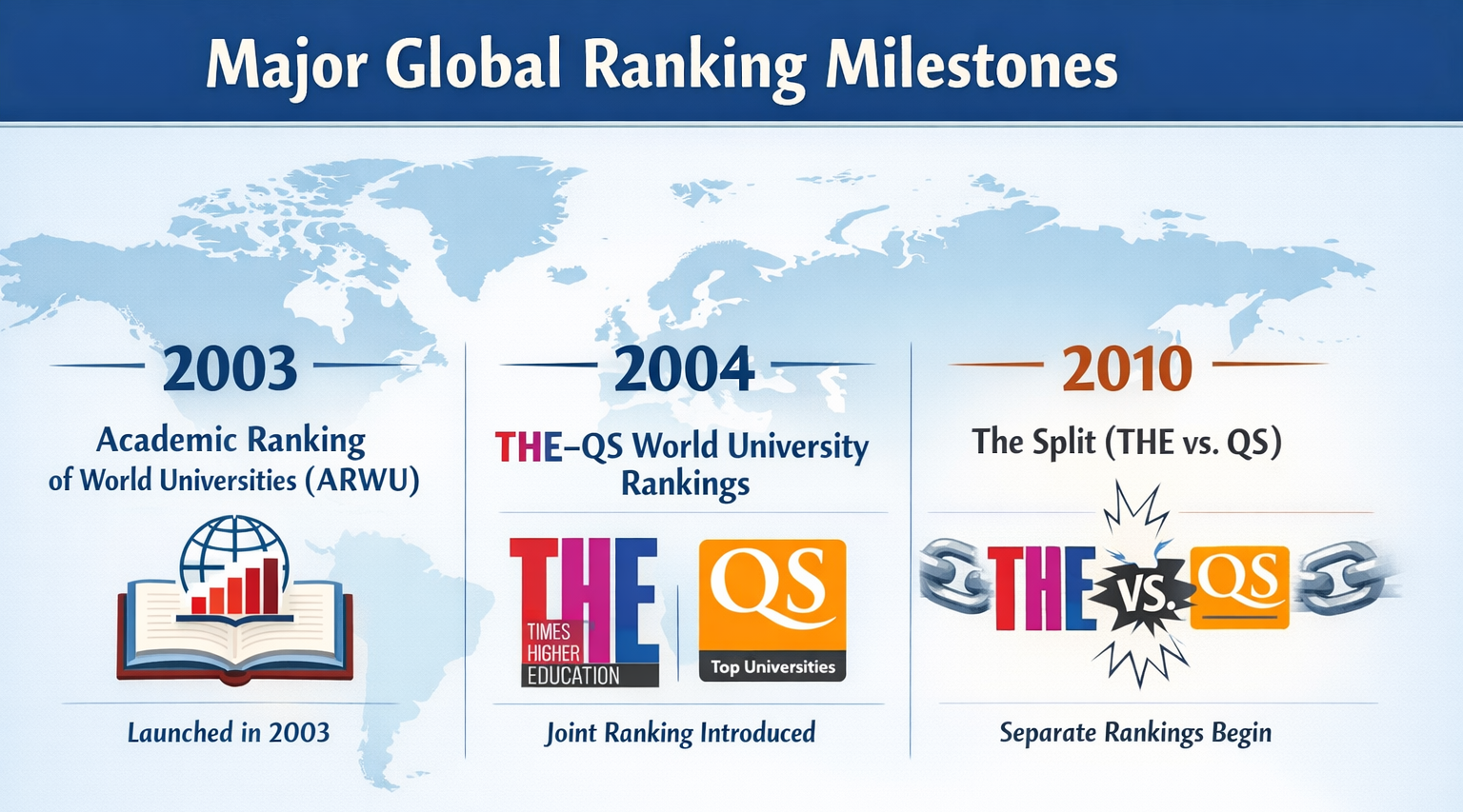
2003: Academic Ranking of World Universities (ARWU)
Commonly referred to as the “Shanghai Ranking,” ARWU was the first global university ranking system. Developed by Shanghai Jiao Tong University, its purpose was to benchmark Chinese institutions against leading international universities. Its methodology is heavily reliant on objective research indicators, including Nobel Prize affiliations and publications in high-impact journals such as Nature and Science.
2004: THE–QS World University Rankings
Times Higher Education (THE) and Quacquarelli Symonds (QS) jointly launched this ranking to provide a more comprehensive and multidimensional alternative to ARWU.
2010: The Split (THE vs. QS)
Following the dissolution of the THE–QS partnership in 2009, both organisations began publishing independent rankings:
• QS World University Rankings: Continued with the original methodology established in 2004.
• Times Higher Education World University Rankings: Introduced a revised methodology in collaboration with Thomson Reuters (and later Elsevier), incorporating broader performance indicators.
What is the biggest failing and criticism of the various World University Rankings?
The principal criticisms of World University Rankings centre on their methodological limitations, which many scholars argue are inherently reductionist and insufficiently robust. Critics contend that these systems attempt to quantify highly complex and multidimensional institutions through overly simplified metrics, often leading to distorted representations of quality. A significant concern is that universities, influenced by the reputational and financial implications of rankings, may prioritise strategies aimed at improving their position rather than fulfilling their broader educational mission. This can result in resource allocation that disproportionately favours research output over teaching quality, student support, and societal engagement.
Primary Criticisms
Overreliance on Subjective Reputation Surveys
Major ranking systems such as QS and Times Higher Education place substantial weight on reputation surveys, which can account for up to 50% of an institution’s total score. These surveys are inherently subjective and prone to bias, often reinforcing established hierarchies and favouring well-known, predominantly Western institutions. This creates a self-perpetuating cycle in which historical prestige continues to influence contemporary rankings.
Research-Heavy Bias
Global rankings tend to prioritise research output and citation metrics over teaching quality and student experience. This emphasis marginalises institutions that excel in teaching and community engagement but lack extensive research funding. In practice, this imbalance is significant, as teaching and applied learning activities constitute the majority of a university’s operational function, yet remain underrepresented in ranking methodologies.
For example, countries such as India, despite having a large number of higher education institutions, often struggle to place universities within the top global tiers. This is partly due to structural differences between teaching-focused and research-intensive institutions, as well as varying levels of research investment.
Additionally, several countries traditionally strong in global rankings—including Australia, Canada, and the Netherlands—have experienced declines in performance due to policy changes affecting international student mobility and funding. Similarly, the United Kingdom has seen a notable number of institutions fall in recent rankings due to increased global competition and financial pressures.
Oversimplification of Quality
It is widely acknowledged that reducing a university’s performance to a single numerical score fails to capture the complexity of its mission. Universities fulfil diverse roles, including vocational training, regional development, community engagement, and the promotion of inclusivity and diversity. These dimensions are rarely reflected in ranking metrics.
Conflicts of Interest.
Concerns have also been raised regarding potential conflicts of interest, as some ranking organisations offer consultancy and marketing services to the same institutions they evaluate. This dual role raises questions about transparency and impartiality.
Critics frequently summarise these issues by noting that rankings tend to measure what is easily quantifiable, rather than what is genuinely meaningful in the educational experience.
This is where international accrediting bodies are increasingly gaining prominence. In contrast to ranking organisations—which primarily function as data aggregators and rarely engage directly with institutions—accrediting bodies adopt a far more comprehensive and evidence-based approach. For example, organisations such as International Education Accreditation Council (IEAC) deploy peer review teams to institutions for extended site visits, during which they observe teaching practices, engage with staff and students, inspect facilities, and evaluate institutional responsibilities, including duty of care, sustainability practices, community engagement, and commitments to inclusivity, equity, and diversity.
An additional distinguishing feature of accreditation is its emphasis on continuous engagement. Responsible accrediting bodies, such as IEAC, maintain an ongoing partnership with institutions beyond the initial accreditation process, supporting continuous quality enhancement and institutional development.
Continual Improvement and Emerging Priorities
Continuous improvement, alongside the evolution of quality assurance systems, should serve as a catalyst for the ongoing refinement of accrediting frameworks. In response to emerging global challenges and trends, the International Education Accreditation Council (IEAC) has identified several strategic priorities:
Deepening AI and Technology Standards
IEAC is advancing from basic AI readiness toward more sophisticated implementation standards. This includes ensuring compliance with ethical frameworks, rigorous bias testing, and maintaining human oversight in AI-driven decision-making processes, alongside promoting equitable access to digital technologies.
Integrating Sustainability and Climate Action
Aligned with global movements such as the United Nations Sustainable Development Goals (SDGs), IEAC is formalising criteria relating to institutional climate action, campus decarbonisation, and the integration of sustainability across curricula.
Enhancing Transparency and Public Accountability
Greater emphasis is being placed on measurable student outcomes, including completion rates, employability, and affordability, thereby demonstrating the tangible value of education to stakeholders.
Promoting Student Welfare and Mental Health
Recognising the importance of holistic well-being, IEAC is developing clearer standards addressing mental health and institutional responsibility for student and staff welfare.
Expanding Global Reach and Partnerships
IEAC continues to strengthen its international presence through strategic partnerships and participation in global educational forums, ensuring relevance and fostering collaboration.
International accrediting bodies such as IEAC are therefore transitioning from compliance-focused models toward a more holistic, people-centred approach. This shift emphasises ethical standards, transparency, and measurable outcomes related to student and staff well-being, reflecting a broader commitment to ensuring education serves societal needs.
Which is more valid when evaluating the Quality of an institution- World Rankings or Accreditation?
Determining whether World University Rankings or international accreditation provides a more valid measure of institutional quality depends largely on the criteria being prioritised. International accreditation is widely regarded as a more reliable indicator of educational quality. It involves a structured evaluation against established standards encompassing governance, faculty qualifications, curriculum design, research processes, ethical practices, and student support systems. Importantly, accreditation also adopts a people-centred approach, assessing how effectively institutions support both staff and students, and how well they prepare graduates for professional environments.
Accrediting bodies do not compare institutions and always undertake on-site evaluations
In contrast, World University Rankings are more effective as indicators of global prestige and research performance. They compare institutions using competitive metrics such as academic reputation and employer perception. World University Ranking bodies do not conduct on-site evaluations as part of their assessment processes.
Which One Should You Trust?
For Career & Licensing:
Accreditation is essential. Many professional disciplines—such as medicine, engineering, and business—require qualifications from accredited institutions for licensure and employment.
For Research & Prestige:
Rankings may carry greater influence. Institutions with high rankings often provide enhanced access to research funding, networks, and global visibility.
The “Gold Standard”:
The most credible institutions typically possess both accreditation and strong ranking positions. Accreditation establishes a foundation of quality, which can subsequently support improved ranking performance.
Why can there be such a gap in Quality between a good World University Ranking and International Accreditation
1. The “Data Presentation” Problem
Ranking systems rely on indirect indicators, such as student-to-staff ratios, to infer teaching quality. However, such metrics do not necessarily reflect actual teaching effectiveness or student experience.
2. Research is “Traceable,” Teaching is “Difficult to Quantify”
Research outputs generate measurable data—such as citations and publications—while teaching quality lacks universally standardised metrics, resulting in its underrepresentation in rankings.
3. The Prestige Feedback Loop
Reputation surveys often reinforce established institutional hierarchies, with respondents favouring well-known universities regardless of direct experience.
4. The “Publish or Perish” Effect
The prioritisation of research outputs incentivises universities to allocate resources toward publication metrics, potentially at the expense of teaching quality and student support.
How to Find the “Real” Quality
To gain a more accurate understanding of institutional quality, it is necessary to consider sources beyond rankings:
• National Student Surveys (NSS): Direct feedback from students regarding their educational experience.
• Graduate Employability Data: Indicators of how effectively institutions prepare students for the workforce.
• Professional Accreditation Reports: Independent evaluations based on on-site inspections, governance reviews, and assessments of institutional practices.
How the Accreditation Process differs in its approach to verifying data compared to Ranking bodies
World Rankings can be likened to remote evaluations based on aggregated data, whereas accreditation resembles a comprehensive audit grounded in direct observation and verification.
1. On-Site Peer Review
Accreditation involves in-person evaluations conducted by experienced academic professionals who assess facilities, teaching practices, and institutional culture.
2. Evidence-Based Assessment
Institutions are required to provide verifiable documentation, including course materials, student work, and faculty credentials.
3. Financial and Ethical Oversight
Accrediting bodies assess governance structures, financial sustainability, and ethical practices.
4. Continuous Improvement Framework
Accreditation operates as an ongoing process, with institutions required to address identified areas for improvement.
Why Employers Prioritise Accreditation
Employers often favour graduates from accredited institutions due to:
• Greater alignment with industry standards
• Verified quality assurance processes
• Higher employability outcomes
Accreditation serves as a credible signal of competence and preparedness, reducing the need for extensive training.
Conclusion
A growing body of academic opinion suggests that World University Rankings, while influential, are often overvalued and methodologically limited. They may inadvertently reinforce global inequalities and divert institutional focus away from core educational objectives.
In contrast, international accreditation provides a more comprehensive and reliable framework for evaluating institutional quality. By emphasising governance, teaching, student support, ethical practices, and societal contribution, accreditation aligns more closely with the fundamental mission of higher education.
Universities serve diverse and critical roles within society, from workforce development to advancing public policy and community well-being. A singular reliance on ranking systems risks overlooking these contributions.
Ultimately, while rankings may offer insights into prestige and research performance, accreditation provides a more meaningful and holistic assessment of institutional quality. The most effective approach is to consider both, with accreditation serving as the foundation upon which genuine educational excellence is built.