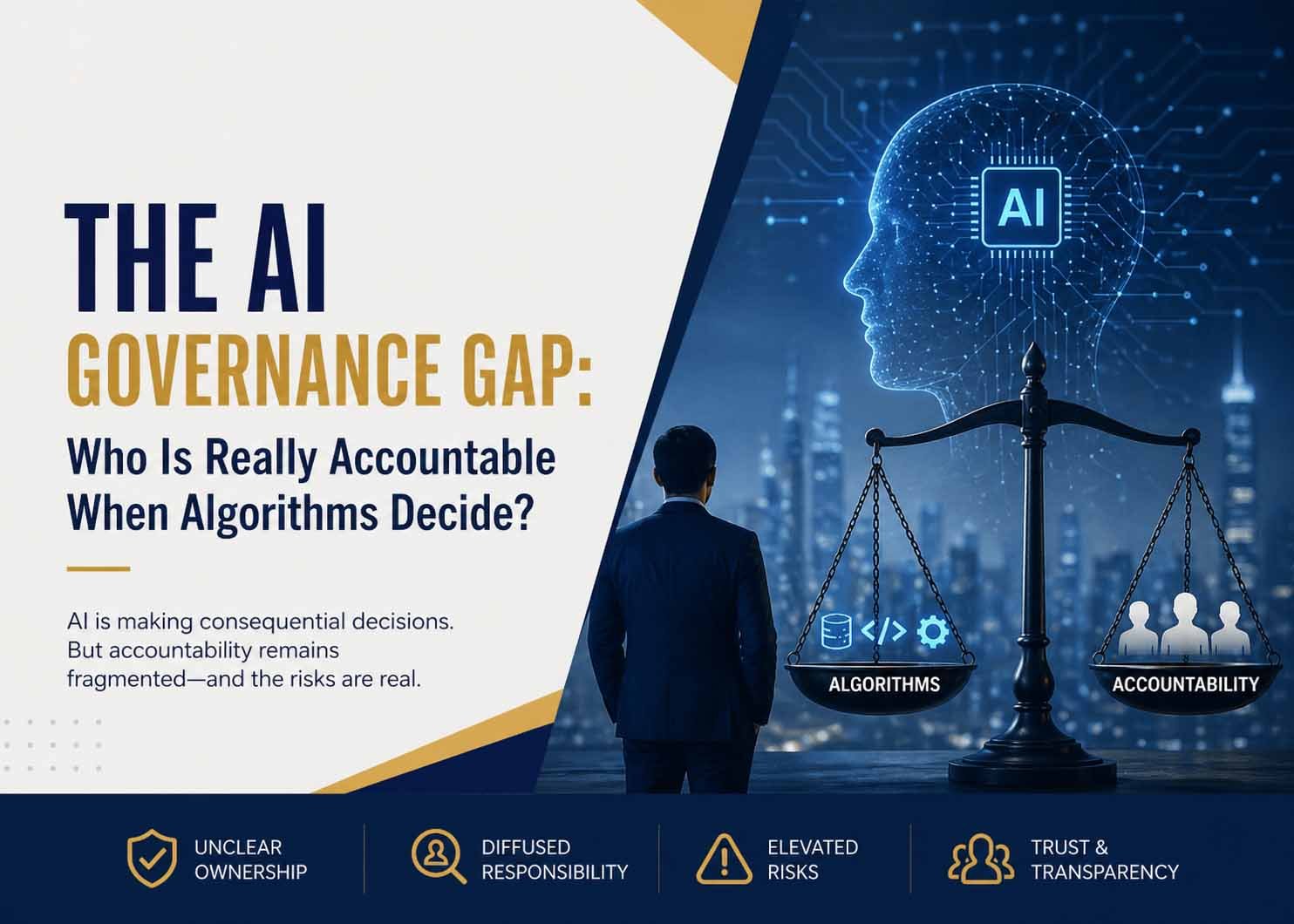

AI as Strategy: Why Leaders Must Treat Artificial Intelligence as a Core Business Capability

Artificial intelligence is no longer an experiment, a side project, or an IT upgrade. In 2026, AI strategy for business is a defining driver of competitive advantage — and the gap between organisations that treat it strategically and those that treat it as a toolset is widening fast. This is not a technology story. It is a leadership and strategy story.
Across industries, AI strategy for business is reshaping how decisions are made, how value is created, and how organisations scale. According to McKinsey & Company, over 55% of companies have adopted AI in at least one business function — yet only a small fraction are capturing full value, largely because AI has not been integrated into strategic decision-making. The question for senior leaders is no longer whether to adopt AI, but how deeply artificial intelligence is embedded into the operating model.
What Is an AI Strategy for Business?
An AI strategy for business is the deliberate integration of artificial intelligence into an organisation's core decision-making, workflows, and value creation systems — designed to drive sustainable competitive advantage. Unlike isolated AI adoption, which focuses on tools and pilots, a true artificial intelligence business strategy aligns data, technology, talent, and governance with long-term business goals. This distinction is critical. Organisations implementing AI without strategy typically see fragmented results: promising pilots that fail to scale, efficiency gains that plateau, and AI investments that cannot be tied to measurable outcomes. Those embedding AI into business strategy achieve consistency, scalability, and demonstrable ROI.
Why Treating Artificial Intelligence in Business as a Tool Is a Competitive Risk
Most organisations still approach AI tactically — deploying chatbots, automating reports, or experimenting with generative AI pilots. While useful, these initiatives rarely transform performance at the system level. The real value of AI in business emerges when it becomes an organisation-wide capability — not a feature, but infrastructure. When AI is treated strategically, it:
- Shapes executive decision-making using predictive insights and real-time data
- Redesigns workflows rather than simply accelerating them
- Enables autonomous and adaptive operations that improve over time
- Builds long-term competitive advantage through proprietary data and learning loops
According to Gartner, organisations that operationalise AI at scale are expected to outperform competitors by up to 25% in key performance metrics by 2027. The implication is clear: treating AI as a tool creates incremental gains. Treating it as a strategy creates structural advantage. This shift defines artificial intelligence strategy in modern organisations. Leaders who succeed do not ask, "What can AI automate?" They ask, "Where should intelligence sit in our value chain?"
Why Leadership Ownership of AI Is Non-Negotiable
One of the most common failure points in AI adoption in business is delegation. When AI is confined to IT or data science teams, its strategic impact remains limited — because AI decisions are, fundamentally, business decisions. High-performing organisations elevate AI ownership to the leadership level. Artificial intelligence directly influences:
Revenue growth — through dynamic pricing, demand forecasting, and customer acquisition
Customer experience — via personalisation engines, recommendation systems, and AI-driven support
Supply chain resilience — using predictive analytics and real-time logistics optimisation
Risk management — through compliance monitoring, fraud detection, and scenario modelling
Workforce productivity — through AI augmentation tools and decision-support systems
Leaders who recognise AI's strategic scope treat artificial intelligence in business with the same rigour as capital allocation or market strategy — setting direction, funding accordingly, and holding their organisations accountable for outcomes.
Enterprise AI: Embedding Intelligence Into the Operating Model
Enterprise AI goes beyond isolated use cases. It integrates AI-driven decision making across an organisation's core systems and processes, creating compounding advantages that isolated tools cannot replicate. Where AI is embedded in high-performing organisations
Core systems: CRM, ERP, and supply chain platforms enhanced with machine learning models that improve over time as more data flows through them.
Decision systems: Forecasting, pricing, procurement, and risk analysis powered by predictive AI moving organisations from reactive to proactive operations.
Customer journeys: Personalisation engines, recommendation systems, and AI-driven support that improve retention and lifetime value.
Internal operations: HR analytics, financial planning, and performance management automation that free leadership bandwidth for higher-order decisions. Companies like JPMorgan Chase deploy AI for fraud detection and risk analysis at extraordinary scale. Unilever applies machine learning in business across marketing optimisation and global supply chain management. These are not pilot programmes — they are operational infrastructure.
AI Transformation and Digital Transformation: A Business Model Shift
AI transformation is not merely about efficiency it fundamentally reshapes business models and competitive positioning. Organisations with mature AI implementation in business:
- Move from reactive to predictive operations
- Replace intuition-led decisions with data-driven insights calibrated against live performance
- Compete on speed, accuracy, and adaptability rather than scale alone
- Build defensible advantages through proprietary data assets that improve AI performance over time
This is where AI intersects with digital transformation. AI amplifies existing systems if those systems are inefficient, AI scales the inefficiency. If they are optimised, AI accelerates performance exponentially. AI readiness, therefore, is not only about technology; it is about the quality of the operational foundation on which AI sits. According to PwC, AI could contribute up to $15.7 trillion to the global economy by 2030 making it one of the most consequential drivers of business transformation in history.
Measuring AI ROI: From Experimentation to Value
A persistent gap in many AI initiatives is the failure to measure AI ROI clearly. Without structured measurement, AI remains a cost centre. With it, AI becomes a demonstrable value driver that justifies continued investment. Key AI ROI metrics for business leaders :
- Revenue uplift attributable to predictive analytics and personalisation
- Cost reduction achieved through automation and process optimisation
- Productivity gains per employee as AI handles routine cognitive tasks
- Customer retention improvement and lifetime value growth
- Speed of decision-making across operational and strategic cycles
Leaders should establish baseline metrics before AI deployment and measure them quarterly. This discipline separates AI strategy from AI experimentation.
7-Step Leadership Framework to Build an AI Strategy for Business
Step 1: Define strategic objectives
Start by aligning AI initiatives with core business priorities — revenue growth, cost optimisation, customer experience, or operational resilience. Avoid starting with tools; start with outcomes. Identify where AI strategy for business can create measurable impact and competitive advantage, ensuring every AI investment is tied directly to a strategic goal rather than isolated experimentation.
Step 2: Assess AI readiness
Evaluate your organisation's readiness across three dimensions: data infrastructure, talent capability, and technology architecture. Assess data quality, accessibility, and integration across systems. Identify talent gaps in AI, analytics, and data literacy. A rigorous AI readiness assessment prevents overinvestment in advanced AI capability before foundational infrastructure is in place.
Step 3: Prioritise high-impact use cases
Identify and prioritise AI use cases that offer the highest business value and fastest ROI. Focus on areas such as pricing optimisation, demand forecasting, customer personalisation, or operational efficiency. Avoid dispersing effort across too many low-impact initiatives — concentrated, high-value use cases accelerate adoption and generate the early wins that build organisational confidence in AI.
Step 4: Build data foundations
AI performance depends entirely on the quality and structure of underlying data. Invest in data governance, integration, and standardisation across systems before scaling AI capability. Without strong data foundations clean, accessible, and consistently structured even the most advanced AI models will fail to deliver reliable or scalable outcomes.
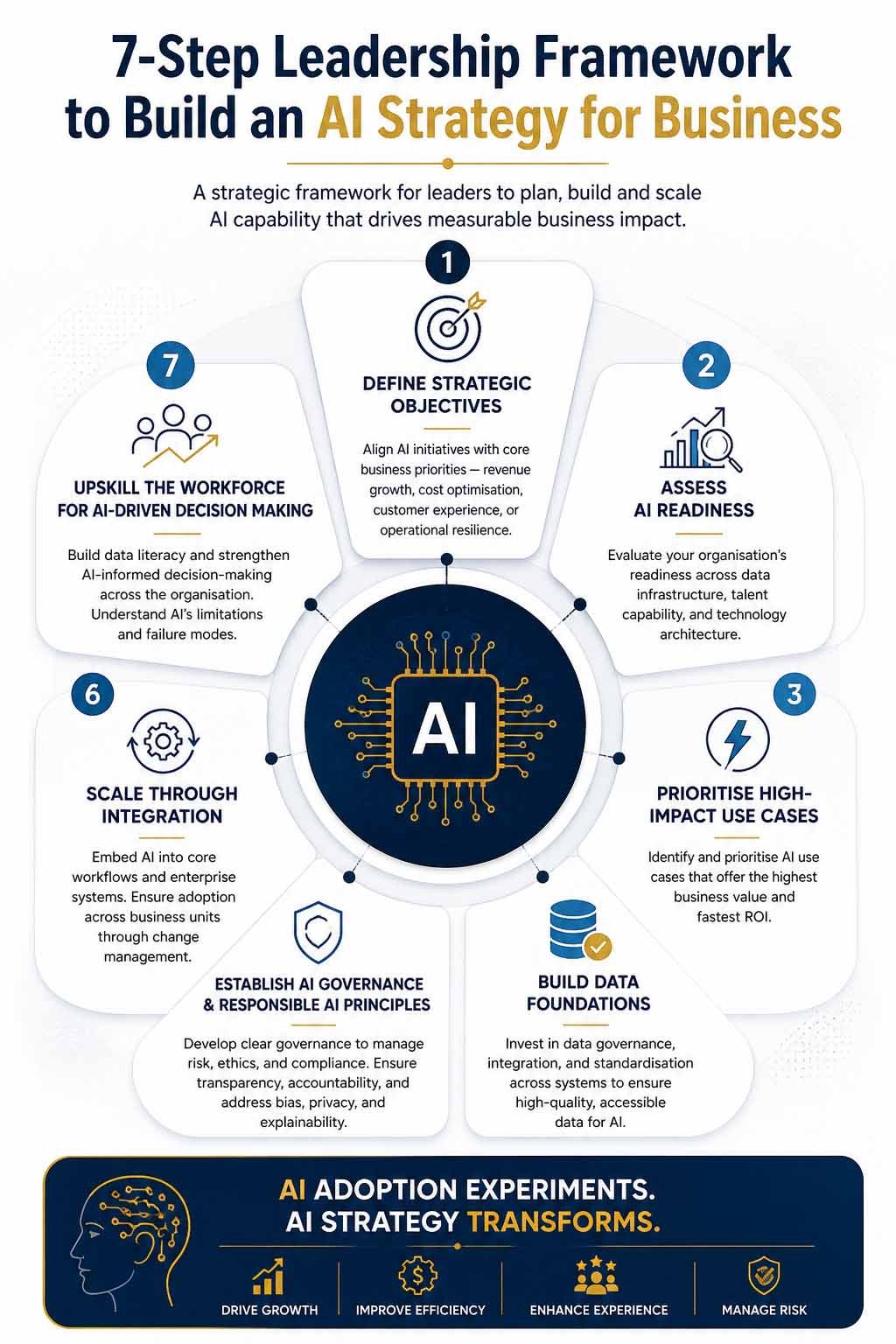
Step 5: Establish AI governance and responsible AI principles
Develop clear governance frameworks to manage risk, ethics, and regulatory compliance. This includes defining accountability for AI decisions, ensuring transparency in AI-driven outputs, and proactively addressing bias, privacy, and explainability concerns. Responsible AI is not a constraint on performance, it is a prerequisite for sustainable, trusted AI adoption at enterprise scale. Strong governance builds internal confidence and external credibility simultaneously.
Step 6: Scale through integration
Move beyond pilot projects by embedding AI into core workflows and enterprise systems. Scaling AI requires cross-functional alignment and structured change management to ensure adoption across business units. AI must become embedded in daily operations, decision systems, customer journeys, and internal processes to function as a consistent and reliable business capability rather than a series of disconnected experiments.
Step 7: Upskill the workforce for AI-driven decision making
AI transformation requires people, not just technology. Invest in upskilling leaders and employees to work effectively alongside AI systems — building data literacy, strengthening AI-informed decision-making, and developing clear understanding of AI's limitations and failure modes. Organisations that build human capability in parallel with AI capability consistently outperform those that treat AI as a purely technical deployment. This is the distinction between AI adoption and AI strategy for business: one experiments, the other transforms.
Managing AI Risk: Governance, Bias, and Ethical AI in Business
While the strategic upside of AI is significant, responsible AI governance is not optional — it is a competitive necessity. Unmanaged AI risk creates regulatory exposure, reputational damage, and operational vulnerability. Key AI risks that leaders must address strategically:
- Algorithmic bias AI systems trained on unrepresentative data can embed and scale discrimination into business decisions
- Data privacy and regulatory compliance GDPR, sector-specific regulation, and evolving AI legislation create a complex governance environment
- Over-reliance on automation including errors introduced by large language models (LLMs) and generative AI systems that can produce plausible but incorrect outputsLack of transparency AI decision-making that cannot be explained to regulators, customers, or employees erodes trust and creates liability
- Talent gaps insufficient AI and data literacy at leadership level leads to poor investment decisions and inadequate oversight
Ethical AI and responsible AI governance frameworks are the architecture through which these risks are managed not as a compliance exercise, but as a strategic capability.
What Business Excellence Looks Like in the Age of AI
In the coming decade, business excellence will be defined by how effectively organisations integrate intelligence into strategy and execution. AI does not replace leadership — it raises the standard of what leadership must deliver.
High-performing organisations in the AI era demonstrate:
- Clear, board-level alignment on AI strategy for business and investment priorities
- Enterprise-wide AI integration embedded in core systems, not siloed in individual functions
- Strong responsible AI governance that earns trust from customers, regulators, and employees
- Continuous learning and adaptation using AI performance data to refine strategy in near real-time
The organisations that will define the next generation of performance are those where artificial intelligence is not a project to be completed it is a permanent, evolving capability embedded in how the organisation thinks and operates.
Why AI Strategy for Business Is Now a Leadership Imperative
The defining insight for senior leaders in 2026 is straightforward: artificial intelligence is not an IT initiative. It is a strategic capability that determines whether an organisation leads its sector or follows it. Organisations that embed AI into leadership thinking, enterprise design, and business strategy will define the next era of competitive performance. Those that treat AI as a tool or delegate it exclusively to technical teams will find themselves operationally capable but strategically exposed. The bridge between ambition and AI-driven competitive advantage is a well-designed, consistently executed AI strategy for business. The question is not whether to build one. The question is how quickly senior leadership can make it real and how deeply it can be embedded before the window for structural advantage closes.
Frequently Asked Questions
What is the difference between AI adoption and an AI strategy for business?
AI adoption refers to the deployment of individual AI tools or pilots within specific functions: a chatbot for customer service, an automation tool for reporting, or a generative AI assistant for content. It is tactical and often fragmented. An AI strategy for business, by contrast, is the deliberate, organisation-wide integration of artificial intelligence into core decision-making, workflows, and value creation systems. Strategy aligns AI investments with long-term business goals, measures outcomes rigorously, and builds compounding advantage over time. Adoption experiments; strategy transforms.
How do you measure ROI from artificial intelligence in business?
AI ROI should be measured across both financial and operational dimensions. Financial metrics include revenue uplift from AI-driven pricing or personalisation, cost reduction from process automation, and improvements in capital efficiency. Operational metrics include productivity gains per employee, speed of decision-making, reduction in error rates, and customer retention improvements. Critically, baseline metrics must be established before deployment — AI ROI cannot be calculated retroactively. Leaders should review AI performance quarterly against pre-agreed targets, adjusting investment priorities based on evidence rather than assumption.
What does responsible AI governance look like for enterprise organisations?
Responsible AI governance is a structured framework that defines accountability, transparency, and risk management across all AI deployments. In practice, it includes: a clear ownership structure for AI decisions (who is accountable when AI produces an incorrect or harmful output); model documentation that explains how AI systems make decisions; bias auditing processes that assess training data and outputs for discriminatory patterns; data privacy protocols aligned with GDPR and relevant sector regulation; and escalation paths when AI outputs are disputed or fail. For enterprise organisations, responsible AI governance is typically overseen at the C-suite or board level, with dedicated AI ethics and risk functions embedded alongside technical teams.
What are the biggest risks of AI adoption for business leaders?
The most significant risks are: (1) strategic misalignment — deploying AI without connecting it to business priorities, producing activity without impact; (2) data quality failure — investing in AI capability before data infrastructure is reliable, resulting in models that produce misleading outputs at scale; (3) governance gaps — particularly around bias, explainability, and regulatory compliance, which create liability as AI legislation matures globally; (4) talent deficit — insufficient AI literacy at leadership level leads to poor oversight and investment decisions; and (5) change management failure — AI systems that employees do not trust or understand will be circumvented, regardless of their technical capability.