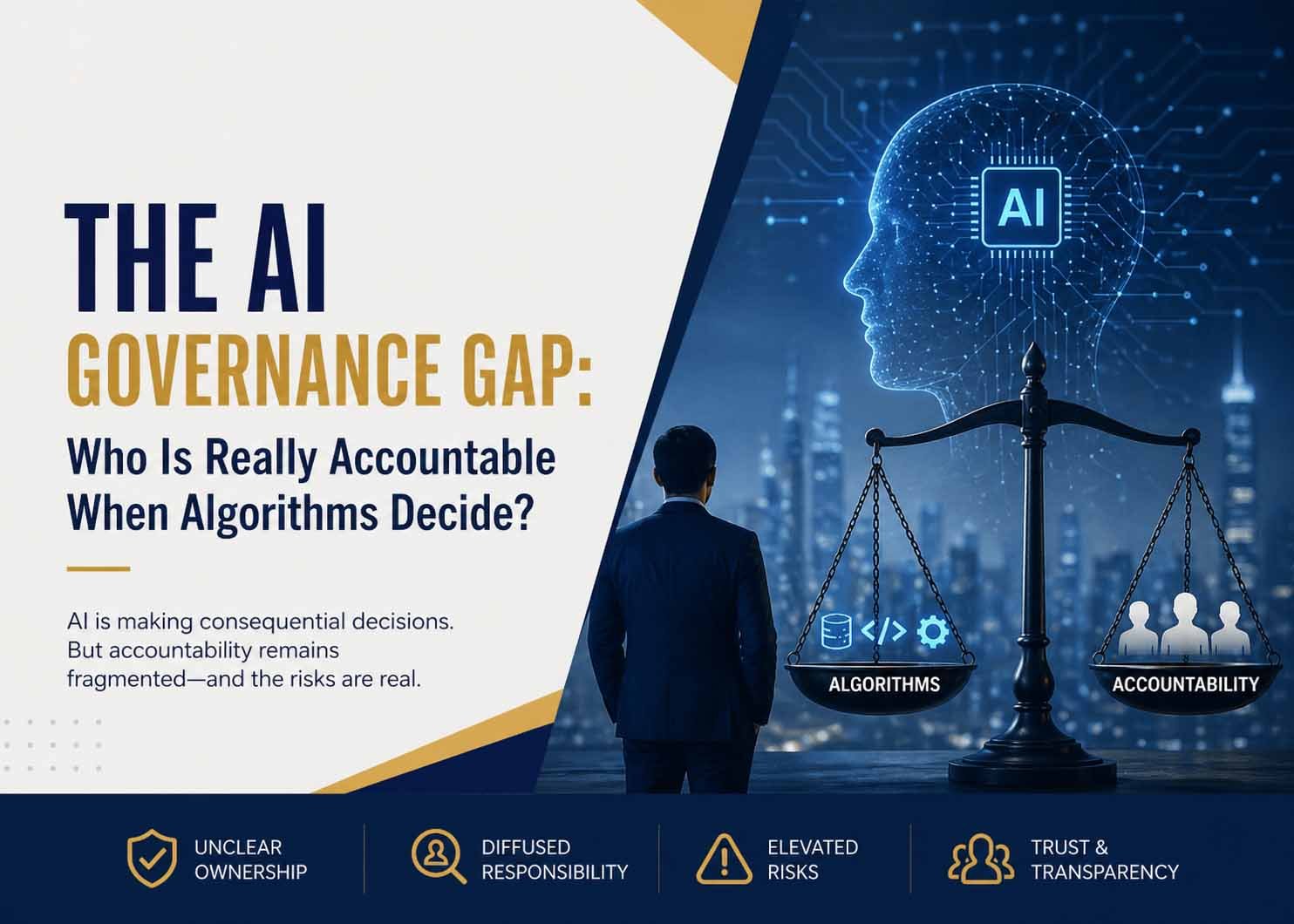

AI Strategy for Business Leaders: A 90-Day Playbook to Outpace Rivals

Most companies don’t fail at AI because of technology. They fail because they treat strategy like experimentation—and experimentation like strategy. The ones pulling ahead are those whose leaders have stopped treating it as a technology question, and started treating it as a strategy question. A coherent AI strategy for business leaders is no longer optional. It has become the foundation of a competitive, scalable, and future-ready enterprise, the price of relevance in every sector from financial services to manufacturing, from healthcare to retail. Yet despite the rhetoric, a striking number of boardrooms still treat artificial intelligence and business strategy as separate conversations. They should not be. According to McKinsey's 2024 State of AI report, organisations that have integrated AI into their core strategy are 2.5 times more likely to report revenue growth exceeding 10% than those that have not. The gap between AI-enabled leaders and AI-reluctant ones is widening, and widening fast.
This article is not about technology. It is about how executives build, execute, and govern a generative AI strategy that creates durable competitive advantage. It is structured as a practical 90-day playbook: three phases, clear milestones, and the decision frameworks that matter most at the boardroom level.
What Is an AI Strategy for Business Leaders?
An AI strategy for business leaders is a structured plan for identifying where artificial intelligence creates the greatest competitive value in a specific business, prioritising use cases, building the data and organisational infrastructure to execute them, and governing their deployment responsibly, all anchored to measurable business outcomes rather than technology trends. It is distinct from a technology roadmap. Where a technology roadmap describes what systems to build or buy, an AI strategy answers a harder question: which decisions, if made faster or more accurately, would generate the greatest return, and how does AI change the economics of making them?
Why Artificial Intelligence and Business Strategy Must Be Inseparable
The most common mistake leaders make is delegating AI to the IT function. They frame it as infrastructure, a cost to manage rather than a capability to leverage. This framing systematically undervalues AI's strategic potential and leaves the decisions that matter most in the wrong hands. Artificial intelligence and business strategy become inseparable when executives understand what AI actually changes: the economics of decision-making. AI compresses the time and cost of processing information, identifying patterns, generating options, and executing at scale. Every business that competes on the quality of its decisions, which is every business, is therefore in AI's direct line of impact.
The competitive cost of AI inaction
Leaders who defer their AI strategy are not simply missing an opportunity. They are allowing rivals to widen capability gaps that become structurally difficult to close. When a competitor deploys AI-driven demand forecasting, they are not just more accurate, they are compounding that accuracy advantage into lower inventory costs, fewer stockouts, and tighter margins month after month. The longer the delay, the steeper the catch-up curve. Research from MIT Sloan Management Review found that companies with a defined AI strategy are significantly more likely to report that AI has meaningfully changed their competitive position within two years of implementation, while those without a strategy most commonly report modest, isolated gains. Critically, AI competitive advantage compounds in a way most other investments do not. Every data point generated by a deployed AI system improves the next model. Every workflow redesigned around AI capabilities makes the next redesign faster. Every team that develops AI literacy raises the organisation's overall speed of adoption. Early movers are not simply ahead today, they are accelerating away.
From pilot purgatory to strategic AI clarity
Many organisations are not short of AI experiments. They are short of strategic clarity about which experiments to scale, and why. This is the defining challenge for leaders in 2025: escaping pilot purgatory, the state of perpetual proof-of-concept with no clear pathway to enterprise-wide value. This is precisely where most enterprise AI transformation efforts stall, unable to bridge the gap between isolated experimentation and system-wide competitive impact. The escape route is not more pilots. It is a disciplined framework that connects each initiative to a strategic priority, defines the criteria for scale, and assigns clear ownership at the executive level. AI change management, the process of shifting people, processes, and culture alongside technology, is as important as the technology itself, and it must be planned from the outset.
The AI Strategy Framework for Business Leaders: Four Pillars
Before launching any 90-day roadmap, leaders need a shared framework. Without it, AI initiatives proliferate in different directions, competing for the same data and talent without producing coherent competitive advantage. The following four-pillar framework is designed specifically as an AI strategy framework for business leaders, strategic rather than technical, and actionable rather than theoretical. An effective framework always begins with the revenue model, not the technology. Ask: which decisions, if made faster or more accurately, would directly improve revenue? Pricing decisions in B2B sales? Customer churn prediction in subscription businesses? Demand sensing in consumer goods? The answers differ by organisation, but the method of asking is universal.
| Pillar | Strategic question | What leaders must define |
|---|---|---|
| Value Diagnosis | Where does AI create the most asymmetric value in our business model? | Top 3 use cases ranked by revenue impact and feasibility |
| Data Readiness | Do we have the data infrastructure to execute the priority use cases? | Data gaps, ownership, and a remediation plan with timeline |
| Talent & Governance | Who owns AI strategy execution, and what guardrails govern deployment? | AI leadership team structure, ethics policy, and escalation protocols |
| Competitive Positioning | How does our AI strategy differentiate us, not just improve us? | AI-driven capabilities that are difficult for rivals to replicate |
Once the value diagnosis identifies the highest-leverage use cases, the framework focuses investment and attention. This prevents the fragmentation that kills most enterprise AI programmes: dozens of low-value pilots consuming resources that should be concentrated on one or two genuinely transformative initiatives.
"The organisations winning with AI are not those with the most experiments. They are those with the clearest answers to the question: what decisions matter most, and how does AI change them?"
The 90-Day AI Strategy Roadmap for Business Leaders
The 90-day structure is not arbitrary. It is the minimum viable timeframe in which a leadership team can move from strategic diagnosis to first measurable results, producing enough evidence to make informed scale decisions before the organisation's attention shifts elsewhere.
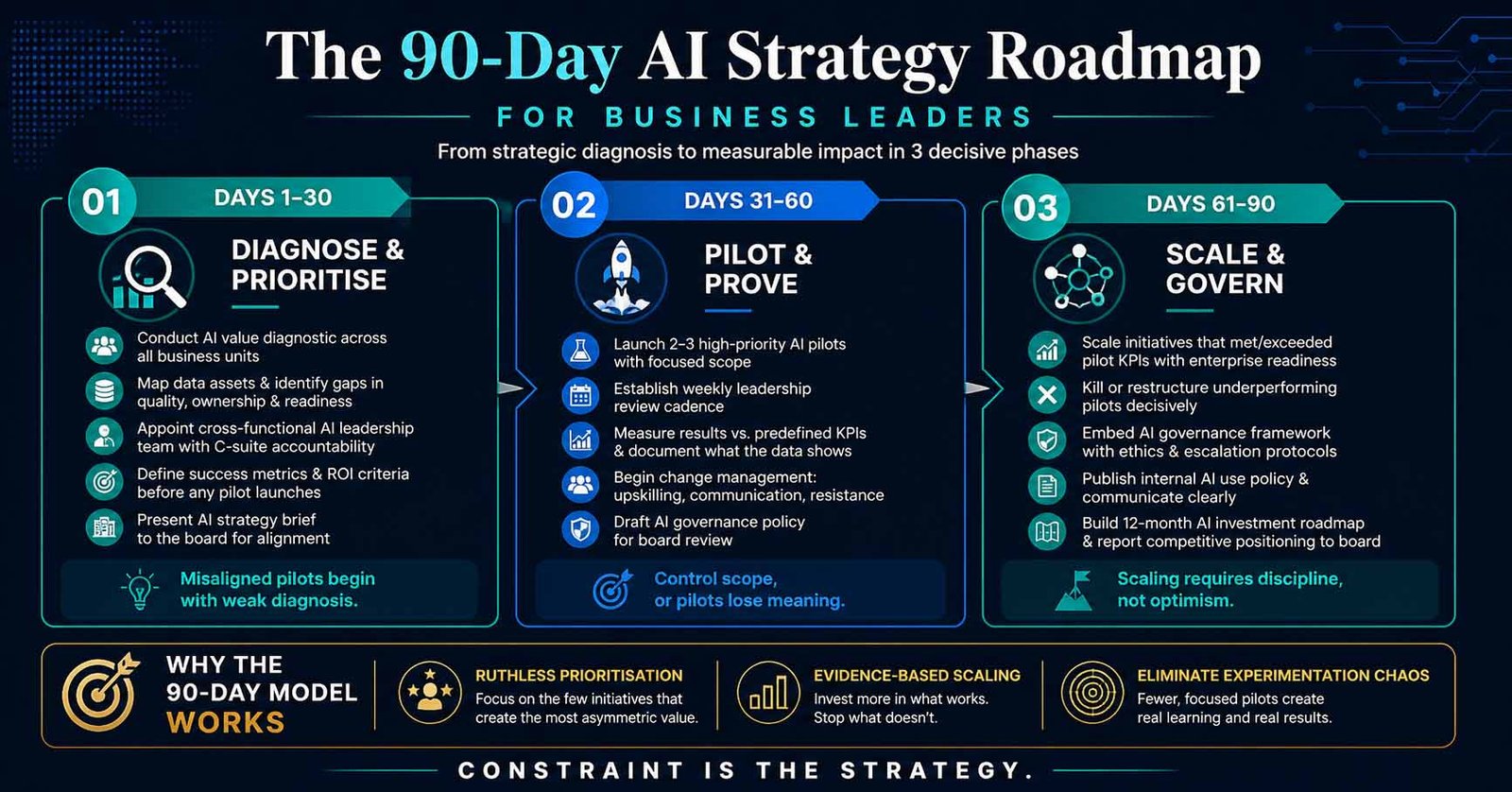
Phase 1 (Days 1–30): Diagnose and prioritise
The strategic foundation phase. Leaders must:
- Conduct an AI value diagnostic across all business units to identify where AI creates the most asymmetric return
- Map data assets against priority use cases and identify gaps in data quality, ownership, and readiness
- Appoint a cross-functional AI leadership team with clear accountability at the C-suite level
- Define success metrics, including AI ROI measurement criteria, for each priority initiative before a single pilot launches
- Present an AI strategy brief to the board for formal alignment
Why this phase matters: Every hour spent on misaligned pilots later traces back to decisions not made here. The diagnostic is not a desk exercise, it requires direct input from business unit leaders, not just data or technology teams.
Phase 2 (Days 31–60): Pilot and prove
Controlled execution against defined parameters. Key actions include:
- Launch 2–3 high-priority AI pilots with tightly defined scope, timelines, and success criteria
- Establish a weekly leadership review cadence, not monthly, not quarterly, to surface blockers early
- Measure results against pre-defined KPIs and document what the data actually shows, not what stakeholders hoped to see
- Begin the AI change management programme: upskilling affected teams, communicating the rationale for AI adoption, and addressing resistance honestly
- Draft the AI governance policy for board review
Why this phase matters: The most common failure in this phase is allowing scope to expand mid-pilot. Define the boundaries at the start and enforce them.
Phase 3 (Days 61–90): Scale and govern
Systematic growth based on evidence, not optimism:
- Scale initiatives that met or exceeded pilot KPIs, with the infrastructure, resourcing, and change management to support enterprise-wide deployment
- Kill or restructure underperforming pilots decisively. This is the hardest discipline in AI strategy and the most important. Leaders who cannot terminate failing pilots cannot build a learning organisation.
- Embed the AI governance framework organisation-wide, including ethics standards, escalation protocols, and responsible AI deployment policies
- Publish an internal AI use policy and communicate it clearly to employees, customers, and regulators
- Build a 12-month AI investment roadmap informed by the pilot learnings, including realistic budget benchmarks
- Report a competitive positioning update to the board
Why the 90-day structure drives AI strategy results
The 90-day structure works because it forces two disciplines most AI programmes lack: ruthless prioritisation in Phase 1 and ruthless termination in Phase 3. Leaders who run eight pilots simultaneously end up with eight inconclusive results and no organisational learning. The playbook's value is not in its content, it is in the constraint it imposes.
Board-Level AI Strategy: Four Responsibilities Directors Cannot Delegate
One of the most consequential shifts in corporate governance over the next decade will be the extent to which boards develop genuine AI literacy. Not technical expertise, boards do not need to understand transformer architectures, but strategic and risk literacy: the ability to ask the right questions, stress-test executive recommendations, and hold management accountable for AI outcomes. An effective AI strategy for boardroom decision-making requires directors to actively own four responsibilities:
1. Strategic intent
The board must formally approve the organisation's AI ambition level, from operational efficiency to product transformation, and ensure it aligns with long-term competitive positioning. This is not a rubber-stamp exercise. Boards that simply endorse management's AI ambition without interrogating it provide no governance value.
2. Risk appetite
Boards must define the organisation's tolerance for AI-related risk: reputational, regulatory, operational, and ethical. Establishing responsible AI deployment boundaries sets the guardrails within which management executes, and protects the organisation when things go wrong.
3. Investment accountability and AI ROI
AI capital allocation requires board-level scrutiny. Directors must be able to evaluate whether AI investment is generating the promised return on investment and challenge management when it is not. Boards that approve AI budgets without a clear ROI measurement framework are funding experimentation, not strategy.
4. Ethics and governance oversight
As AI systems make consequential decisions at scale, boards bear ultimate accountability for ensuring those decisions are fair, transparent, and compliant. This is a governance responsibility, not a technical one, and it cannot be delegated to the CTO.
Board readiness test: If your board cannot answer "What are our top three AI-related risks and who owns them?", your AI governance framework is not yet fit for purpose.
AI Leadership Frameworks for Executives: Roles, Culture, and Capability
The 90-day playbook can only succeed if the leadership structure around it is fit for purpose. AI leadership frameworks for executives are not about creating a new layer of AI specialists above the business, they are about distributing AI accountability throughout the existing leadership team, supported by a small centre of excellence that accelerates capability-building.
The three-layer AI leadership model
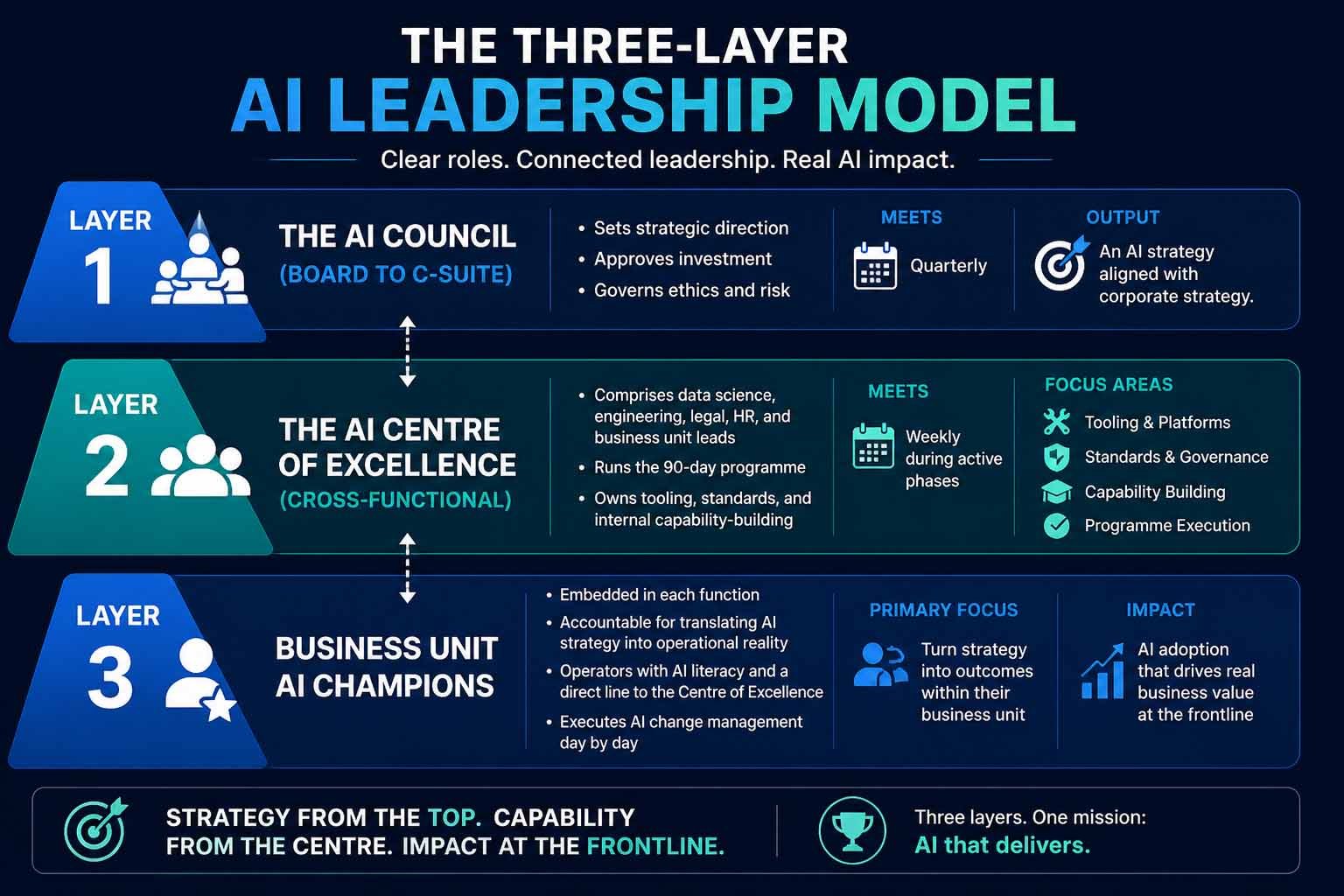
Layer 1, The AI Council (board to C-suite): Sets strategic direction, approves investment, and governs ethics and risk. Meets quarterly. Output: an AI strategy aligned with corporate strategy.
Layer 2, The AI Centre of Excellence (cross-functional): Comprises data science, engineering, legal, HR, and business unit leads. Runs the 90-day programme. Owns tooling, standards, and internal capability-building. Meets weekly during active phases.
Layer 3, Business Unit AI Champions: Embedded in each function, accountable for translating AI strategy into operational reality. These are not AI experts, they are operators with AI literacy and a direct line to the Centre of Excellence. This layer is where AI change management is actually executed, day by day.
Building generative AI capability at the leadership level
A generative AI strategy demands a particular capability that most leadership teams currently lack: the ability to evaluate AI outputs critically. When a large language model produces a market analysis, a legal summary, or a customer communication, leaders need enough literacy to know when the output is reliable, when it requires verification, and when it should not be used at all. This is not a technology skill. It is a judgement skill, and it belongs at the leadership level, not just in the hands of technical teams. Organisations that build this capacity earliest will make better AI-assisted decisions and avoid the costly errors that come from over-trusting model outputs in high-stakes contexts.
AI Governance as a Growth Enabler
One of the most counterintuitive insights in enterprise AI strategy is that robust governance accelerates, rather than constrains, AI adoption. Organisations with clear ethics policies, defined risk frameworks, and transparent AI decision-making processes move faster, because their teams do not spend time relitigating the same governance questions on every new initiative. They also face fewer regulatory and reputational risks that can set AI programmes back by months or years. An AI governance framework is not a brake on innovation. It is the infrastructure that makes responsible AI deployment at scale possible. In this context, digital transformation with AI is not just about automation, it is about redesigning decision-making systems across the entire organisation, with the guardrails to do so sustainably.
Five Actions Every Business Leader Must Take in the Next 30 Days
For leaders ready to begin, these are the five highest-leverage actions to take before launching the full 90-day roadmap:
Commission an AI value diagnostic. Map your top five business processes against AI capability. Identify the three use cases with the highest potential impact on revenue, cost, or competitive advantage. This is the foundation of every subsequent decision.
Audit your data infrastructure. The most sophisticated AI strategy is worthless without data readiness. Identify where your most valuable data lives, who owns it, how clean it is, and what it would take to make it AI-ready. This audit will surface the data gaps that most pilots later stumble over.
Appoint an AI lead at the C-suite or direct-report level. Not an IT lead, a business strategy lead with AI accountability. This person owns the 90-day programme and reports to the CEO or board, not the CTO. The reporting line matters: AI that reports to technology rarely transforms the business.
Schedule an AI strategy session with your board. Present a one-page AI strategic intent document: what you are trying to achieve, what you are explicitly not doing, and what governance principles will guide decisions. Get formal alignment before committing capital.
Define your "AI will not do" policy. The decisions about where AI should not be used are as important as where it should. Establishing these boundaries early prevents governance crises and builds trust with employees, customers, and regulators.
The Leaders Who Move Now Will Define the Next Decade
Building a coherent AI strategy for business leaders is no longer a future priority, it is a present imperative. The organisations that will define their industries over the next decade are not necessarily those with the most advanced technology. They are those whose leaders made the clearest, most disciplined strategic choices about how to deploy it.
The 90-day playbook in this article is designed to give those leaders a starting structure: rigorous enough to produce real results, flexible enough to adapt to every sector and scale. The frameworks, phases, and decision tools here are not theoretical. They are the patterns that separate organisations in motion from those still planning to begin. The question for every leader reading this is not "Is AI right for our business?" It is: How quickly can we build the strategy, the structure, and the capability to make AI work for ours?
For organisations seeking to position themselves at the forefront of global leadership and innovation, aligning AI strategy with broader excellence frameworks becomes a natural next step — connecting execution with recognition, visibility, and long-term positioning.
Frequently Asked Questions About AI Strategy for Business Leaders
How can business leaders build an effective AI strategy from scratch?
Business leaders can build an effective AI strategy by starting with a clear diagnosis of where AI creates the most value in their specific business model, assigning a cross-functional AI leadership team, and committing to a phased 90-day roadmap that moves from pilot to scale. The key is not to chase technology trends but to anchor every AI investment to a measurable business outcome, revenue growth, cost reduction, or competitive differentiation, and to define AI ROI measurement criteria before the first pilot launches.
What is an AI strategy framework for business leaders?
An AI strategy framework for business leaders is a structured approach to identifying where AI creates competitive value, prioritising use cases, building the data and talent infrastructure to execute them, and measuring ROI. Strong frameworks combine a business excellence lens with governance guardrails, ensuring AI decisions are ethical, scalable, and aligned with long-term growth rather than short-term efficiency gains alone. The four-pillar model outlined in this article, value diagnosis, data readiness, talent and governance, and competitive positioning, is designed specifically for executive application.
How long does it take to implement an AI strategy for a mid-sized business?
Most business leaders can move from AI strategy design to first measurable results within 90 days by following a phased approach: days 1–30 for diagnosis and prioritisation, days 31–60 for piloting high-value use cases, and days 61–90 for scaling wins and embedding governance. Sustainable enterprise AI transformation, however, is a continuous process, the 90-day playbook is a starting mechanism, not a finish line.
What should a board of directors know about AI governance and risk?
Boards need strategic and risk literacy around AI, not technical expertise. Specifically, directors should be able to define the organisation's AI risk appetite (reputational, regulatory, operational, and ethical), hold management accountable for AI ROI, and oversee responsible AI deployment policies. The most important board readiness test is simple: can your directors name your top three AI risks and identify who owns each one?
How do you measure the ROI of an AI strategy?
AI ROI measurement should be defined before pilots launch, not after. For each initiative, leaders should identify a baseline metric (e.g., current demand forecast accuracy, customer churn rate, time-to-quote in sales), set a target improvement, and measure against it at the end of the pilot phase. Aggregate ROI, including productivity gains, cost avoidance, and revenue uplift, should be reported to the board on a quarterly cadence once initiatives move to scale.