

Asia's ESG Reporting Requirements in 2026: Singapore, Japan and India Chart Different Paths

No single rulebook governs ESG reporting requirements across Asia in 2026 — but Singapore, Japan and India are all converging on the same global disclosure standard, at very different speeds.
Asia's ESG reporting requirements in 2026 are shaped by three separate national frameworks rather than one regional rule: Singapore's SGX-mandated ISSB disclosures, Japan's SSBJ standards under the Financial Services Agency, and India's SEBI-administered Business Responsibility and Sustainability Report (BRSR). All three are aligned to the same international benchmark — IFRS S1 and S2, built on the TCFD framework — but differ sharply in scope, timeline and assurance rigour. The direction of travel mirrors a broader pattern already visible in ESG 2.0: From Disclosure to Enforcement Across Global Markets, where voluntary reporting worldwide is steadily hardening into enforceable law.
Why Does Asia Have No Single ESG Reporting Rulebook?
Unlike the European Union, which legislates sustainability disclosure through one directive applied across member states — a model examined in How Europe's CSRD Is Raising the Bar for Business Excellence — Asia's largest economies are each building independent ESG reporting frameworks, shaped by their own securities regulators, corporate governance traditions, and compliance timelines.
What unites Singapore, Japan and India's ESG reporting requirements is a shared reference point: the International Sustainability Standards Board's IFRS S1 (general disclosure) and IFRS S2 (climate-related disclosure) standards, both built on the foundational Task Force on Climate-related Financial Disclosures (TCFD) framework. All three markets are converging toward that international grammar for sustainability reporting. What separates them is pace, enforcement depth, and how much compliance burden falls on companies versus regulators.
This divergence is not incidental. Singapore, Japan and India sit at different points on the capital-markets development curve, and their ESG timelines reflect that: Singapore is racing to secure its position as Asia's green-finance hub, Japan is folding sustainability into a securities-law tradition built on statutory disclosure, and India is scaling a domestic framework across an unusually large and heterogeneous universe of listed companies. Businesses operating across more than one of these markets — or supplying into them — will increasingly need to track three separate compliance calendars rather than one regional standard.
Singapore ESG Reporting Rules — SGX and ISSB Alignment
Singapore has moved furthest and fastest on ESG reporting requirements in the region. The Singapore Exchange (SGX) has required climate-related reporting aligned with TCFD since FY2022, and from FY2025 all SGX-listed companies must report Scope 1 and Scope 2 greenhouse gas emissions. Straits Times Index (STI) constituents face the earliest and fullest ISSB-aligned disclosure obligations, including Scope 3 emissions reporting, from FY2026.
Singapore's ESG Assurance Timeline
Assurance is where Singapore's ESG reporting requirements pull ahead of regional peers. External limited assurance over Scope 1 and 2 emissions data becomes mandatory from FY2027, and Singapore has committed to extending ISSB-aligned sustainability reporting to large non-listed companies from the same year, based on recommendations from the Sustainability Reporting Advisory Committee (SRAC). This dual-track approach — SGX rules for listed companies, economy-wide standards through the Accounting and Corporate Regulatory Authority (ACRA) — reflects a deliberate strategy to position Singapore as Asia's regional green-finance hub, not merely a compliant jurisdiction. It's a strategy that echoes the competitive logic laid out in The Gulf's Sustainability Agenda Is Becoming a Competitive Advantage, where early, ambitious disclosure regimes are used to attract capital rather than merely satisfy it.
Japan ESG Disclosure Standards — Understanding the SSBJ Mandate
Japan's Financial Services Agency (FSA) has taken a more centralised, staggered approach to ESG reporting requirements than Singapore. The Sustainability Standards Board of Japan (SSBJ) finalised its inaugural disclosure standards — closely mirroring IFRS S1 and S2 — in March 2025. On 26 February 2026, the FSA finalised a Cabinet Office Order making SSBJ compliance legally mandatory for companies listed on the Tokyo Stock Exchange (TSE) Prime Market.
Japan's Market-Cap-Tiered ESG Reporting Timeline
Japan's SSBJ rollout is tiered strictly by market capitalisation. Mandatory sustainability reporting begins for companies above JPY 3 trillion in market cap for fiscal years starting April 2026, expanding to companies above JPY 1 trillion from April 2027, with broader coverage expected by the end of the decade. Disclosures are folded directly into the statutory annual securities report rather than published as standalone sustainability reports — signalling that Japan now treats ESG information as financially material by default. Notably, Japan has not yet mandated third-party assurance on SSBJ disclosures, a verification gap that sets its ESG reporting requirements apart from Singapore's trajectory.
Folding ESG disclosure into the statutory securities report also raises the accountability stakes for corporate boards, not just sustainability teams. As explored in Corporate Governance Best Practices: Lessons from Boards That Got It Right, boards that treat ESG oversight as a standing governance duty — rather than a delegated compliance task — tend to adapt faster when disclosure rules tighten, as Japan's are now doing.
India ESG Reporting Requirements — SEBI's BRSR Core Explained
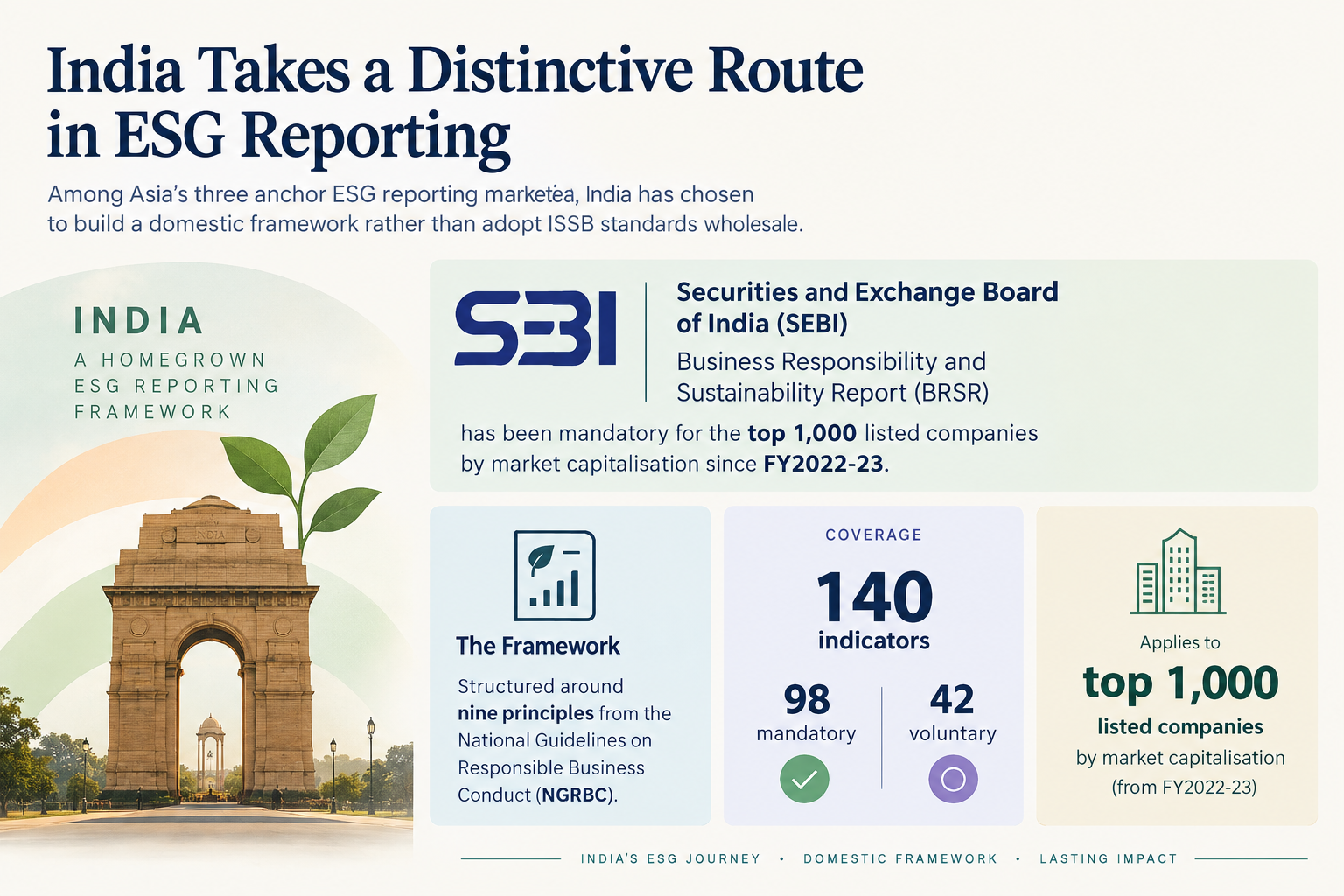
India has taken the most distinctive route among Asia's three anchor ESG reporting markets, building a domestic framework rather than adopting ISSB standards wholesale. The Securities and Exchange Board of India's (SEBI) Business Responsibility and Sustainability Report (BRSR) has been mandatory for the top 1,000 listed companies by market capitalisation since FY2022-23, structured around nine principles from the National Guidelines on Responsible Business Conduct and covering 140 indicators — 98 mandatory, 42 voluntary.
BRSR Core Assurance and Value-Chain Disclosure
The more consequential recent shift in India's ESG reporting requirements is BRSR Core, which layers reasonable assurance onto nine specific ESG attributes — greenhouse gas emissions, water and waste management, energy use, gender diversity, wages, and business ethics — for a phased cohort expanding toward the full top 1,000 companies by FY2026-27. SEBI has also extended disclosure down the supply chain: since FY2024-25, the top 250 listed entities report ESG data on material suppliers and customers, becoming mandatory with assurance for the full top 1,000 from FY2026-27. Notably, SEBI in 2024 softened its terminology from strict "assurance" to "assessment or assurance," widening the pool of eligible verifiers beyond chartered accountants — even as the scope of what must be verified keeps expanding.
BRSR Core's inclusion of gender diversity and wage data as assured, not merely disclosed, indicators is notable in a regional context where social metrics are often treated as secondary to environmental ones. It puts India ahead of both Singapore and Japan on codifying workforce inclusion as a reportable, verifiable ESG attribute — a distinction worth watching as SGX and SSBJ frameworks mature and decide how much social data, beyond emissions, ultimately requires assurance.
A gap worth naming across all three markets: none of these frameworks yet reaches deep into the small and mid-cap issuer base or unlisted supply chain, even though SMEs often do the actual manufacturing behind a large company's emissions footprint. India's extension of disclosure to material suppliers, and Singapore's plan to bring large non-listed companies into scope from FY2027, are early signs of regulators recognising this — but for now, ESG accountability in Asia still runs heaviest at the top of the market and thins out fast below it.
What Asia's ESG Reporting Requirements Mean for Businesses
Across Singapore, Japan and India, investor expectations for ESG disclosure are moving faster than regulation itself. International asset managers increasingly request ISSB-aligned data as a condition of capital allocation, regardless of whether a company falls within mandatory scope. For businesses positioning for regional competitiveness or access to global capital, early alignment with IFRS S1/S2 — even ahead of a formal local mandate — is now a baseline expectation rather than a differentiator. Building that internal capability is itself a variant of the resourcing question raised in Beyond Numbers: Understanding the Purpose and Future of Financial Reporting, where reporting is reframed as a strategic function rather than a back-office compliance cost.
Export readiness is a related pressure point: companies supplying into the EU, or into multinational customers already reporting under CSRD or equivalent frameworks, are being pulled into ESG disclosure requirements through commercial relationships even where domestic law hasn't caught up.
Asia ESG Reporting Timeline — What's Next Through 2028
The next two to three years will likely narrow — but not eliminate — the gap between Asia's three ESG reporting frameworks. Singapore's assurance requirements and Japan's market-cap-tiered mandate are both scheduled to widen substantially by 2027 and 2028 respectively, while India's BRSR Core assurance perimeter reaches the full top 1,000 listed companies by FY2026-27. What is unlikely to converge in the near term is enforcement rigour: Singapore's move toward mandatory external assurance puts it ahead of Japan, which has yet to commit to any assurance requirement, and India, which has deliberately loosened its verification language even as it broadens disclosure scope.
Frequently Asked Questions: Asia's ESG Reporting Requirements
What are the main ESG reporting requirements in Asia in 2026?
Singapore requires SGX-listed companies to report Scope 1 and 2 emissions under ISSB-aligned standards; Japan mandates SSBJ disclosure for large Tokyo Stock Exchange Prime Market issuers from 2026; and India requires its top 1,000 listed companies to file SEBI's BRSR, with BRSR Core assurance expanding through FY2026-27.
Which Asian country has the strictest ESG assurance requirements?
Singapore currently has the strictest trajectory, with mandatory external limited assurance over Scope 1 and 2 emissions from FY2027. Japan has not yet mandated third-party assurance, and India has softened its assurance language to "assessment or assurance."
Do Asia's ESG standards align with the EU's CSRD or the ISSB framework?
Singapore and Japan are both aligning directly with the ISSB's IFRS S1 and S2 standards. India has built its own BRSR framework rather than adopting ISSB standards outright, though its indicators overlap substantially with global sustainability reporting norms.