
Beyond Numbers: Understanding the Purpose and Future of Financial Reporting

Financial reporting is often perceived as a technical process limited to accountants and auditors. Many
people associate accounting with numbers, calculations, and financial statements, overlooking its
broader role in shaping economic decisions including even investments. In reality, accounting is much more than bookkeeping—it is the language through which businesses communicate their financial performance, position, and prospects to investors, creditors, regulators, and society. High-quality financial reporting enables transparency, promotes trust, and supports the efficient allocation of economic resources in an increasingly interconnected global economy.
What Accounting and Financial Reporting Really Mean
At its core, accounting is the process of identifying, measuring, and communicating financial information
about an economic entity to interested users. Financial accounting focuses on preparing financial
reports for external users, including investors, creditors, government agencies, and other stakeholders,
while managerial accounting provides information for internal decision-making. Although both branches
serve different audiences, they share the common objective of supporting informed economic decisions.
The Core Components of Financial Statements
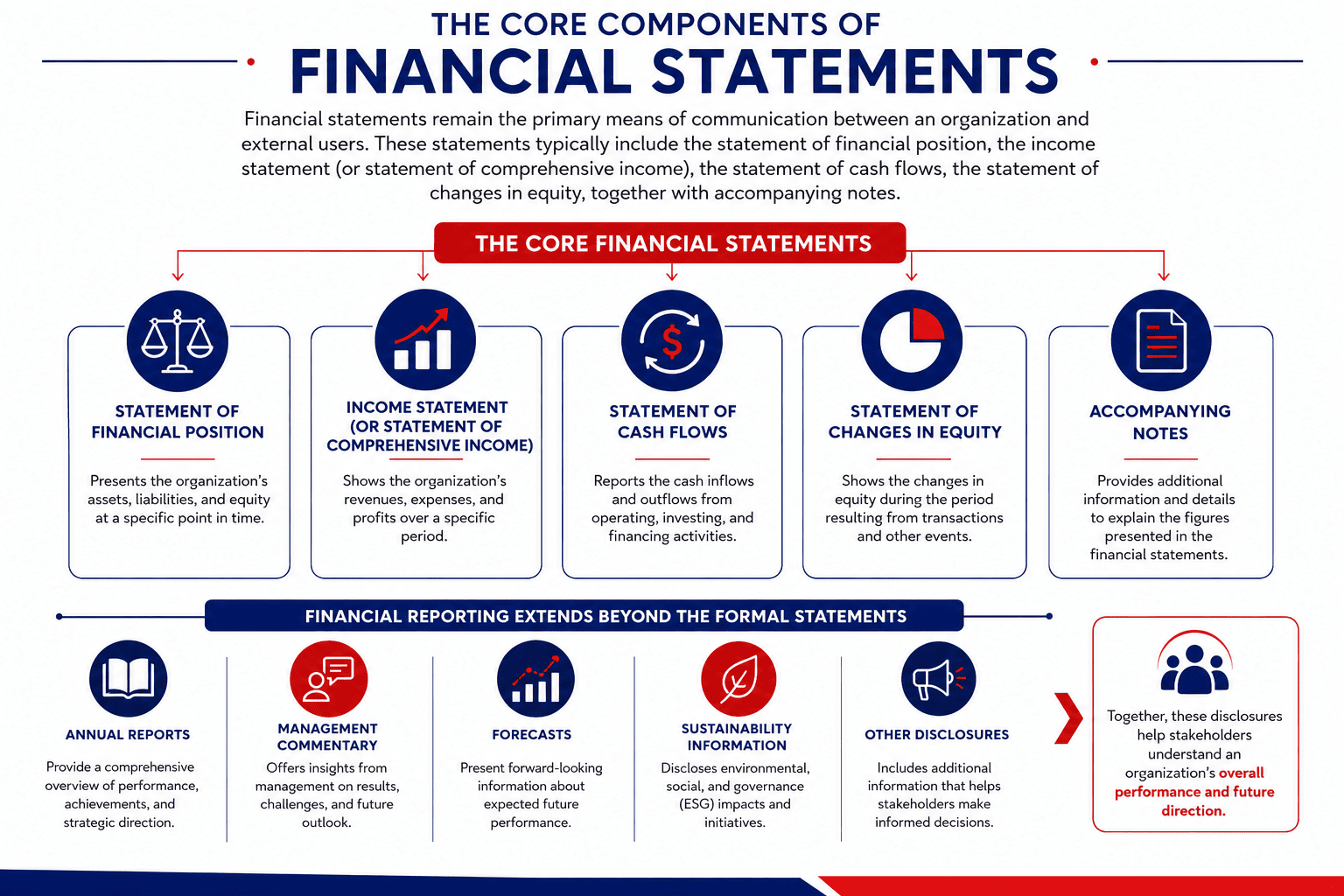
Financial statements remain the primary means of communication between an organization and
external users. These statements typically include the statement of financial position, the income
statement (or statement of comprehensive income), the statement of cash flows, the statement of
changes in equity, together with accompanying notes the main types of financial statements every stakeholder should understand.. However, financial reporting extends beyond these formal statements to include annual reports, management commentary, forecasts, sustainability information, and other disclosures that help stakeholders understand an organization's overall performance and future direction.
The Role of Financial Reporting in Capital Allocation
One of the most significant contributions of financial reporting is its role in capital allocation. Since
financial resources are limited, investors and lenders must determine where to invest or provide
financing. Reliable and relevant financial information enables comparisons between companies
operating across different industries and countries, allowing capital to flow toward organizations that
use resources effectively and generate sustainable value. Conversely, poor-quality or misleading
financial information can result in inefficient investment decisions, weakened financial markets, and
reduced economic growth.
The primary objective of general-purpose financial reporting is to provide useful financial information to
existing and potential investors, lenders, and other creditors when making decisions about providing
resources to an entity. These decisions include buying, selling, or holding equity and debt instruments as
well as extending or settling credit. High-quality financial reporting therefore emphasizes information
that is relevant, faithfully represented, and capable of supporting sound economic decision-making.
Accrual Accounting as a Foundation for Reliable Reporting
An important concept emphasized in financial reporting is the use of accrual accounting rather than cash
accounting. Under the accrual basis, revenues and expenses are recognized when economic events
occur rather than when cash is received or paid. This approach provides a more accurate representation
of an organization's financial performance and its ability to generate future cash flows, making financial
statements more useful for investors and creditors.
The Global Shift Towards IFRS
Another major development in modern accounting has been the growing adoption of International
Financial Reporting Standards (IFRS). Developed by the International Accounting Standards Board (IASB),
IFRS seeks to establish a single set of globally accepted accounting standards that enhance
comparability, consistency, and transparency across international markets. As businesses increasingly
operate across national borders, common accounting standards reduce barriers to investment and
improve confidence among international investors.
How the IASB Develops Global Standards
The IASB follows an extensive and transparent due process when developing new accounting standards.
This process involves consultation with investors, regulators, academics, business leaders, and
accounting professionals before new standards are issued. Such openness strengthens the legitimacy
and acceptance of IFRS while ensuring that accounting standards respond to changing economic
conditions without sacrificing quality or independence.
Challenges Facing Modern Financial Reporting
Despite remarkable progress, financial reporting continues to face significant challenges. Political
pressures, differing stakeholder interests, financial scandals, technological change, and evolving investor
expectations all influence the development of accounting standards. Users increasingly demand
information that extends beyond historical financial results, including forward-looking information, non-
financial performance indicators, environmental and sustainability reporting, and real-time digital
reporting. Traditional financial statements alone may no longer satisfy the information needs of modern
capital markets.
The Impact of Technology on Accounting
Technology is also transforming the accounting profession. Digital reporting formats such as eXtensible
Business Reporting Language (XBRL), greater use of fair value information, and improved online financial
reporting have enhanced the accessibility and timeliness of financial information. As digital
transformation accelerates, accountants will increasingly combine technical expertise with analytical
thinking, ethical judgment, and technological competence to meet the evolving expectations of
stakeholders.
Why Ethics Remains Central to the Profession
Ethics remains a cornerstone of the accounting profession. Technical knowledge alone is insufficient if
financial information is manipulated or presented without integrity. Accountants frequently encounter
ethical dilemmas involving pressure from management, clients, or market expectations. Upholding
professional ethics ensures that financial reports remain trustworthy and continue to serve the public
interest. Integrity, objectivity, and professional judgment are therefore just as important as technical
competence in financial reporting.

The Future: Toward Globally Comparable Financial Reporting
Looking ahead, international convergence of accounting standards continues to advance as more
jurisdictions adopt or align with IFRS. Although differences in legal systems, cultures, and economic
environments remain, the long-term vision is the development of globally comparable financial
reporting that enhances transparency, facilitates investment, and strengthens confidence in
international capital markets.
Financial reporting is therefore far more than a collection of numbers. It is a communication system that
supports informed decision-making, strengthens accountability, promotes investor confidence, and
contributes to sustainable economic development. As global business continues to evolve, future
accountants will not simply prepare financial statements—they will play a vital role in building
transparency, trust, and responsible economic growth. Understanding this broader purpose is essential
for every business student preparing to become part of tomorrow's financial world.