
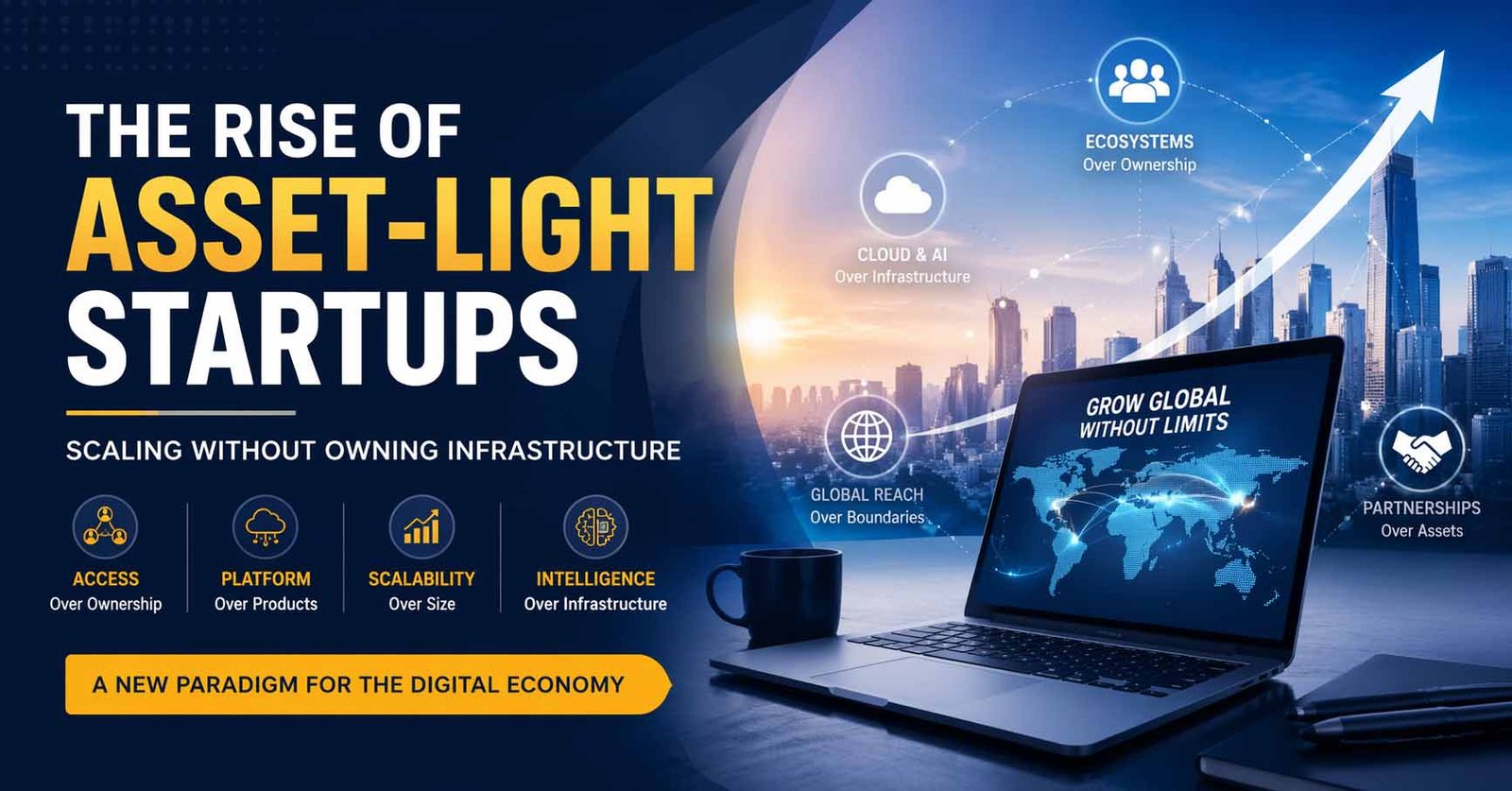
The Rise of Asset-Light Startups: Scaling Without Owning Infrastructure in the Digital Economy

The asset-light business model has become one of the most powerful drivers of modern enterprise value, enabling companies to scale globally while owning minimal physical infrastructure. In 2023 alone, platform-based, asset-light companies like Uber and Airbnb generated billions in revenue without owning the core assets that traditionally defined their industries. This is not an anomaly—it is a structural shift in how businesses are designed, financed, and scaled.
At its core, the asset-light business model reduces capital expenditure (Capex), increases return on investment (ROI), and enables exponential scalability by externalising infrastructure and internalising intelligence. Unlike traditional asset-heavy firms, where growth is constrained by physical expansion, asset-light companies operate within the platform economy, leveraging networks, data, and intellectual property to create value. The result is a new category of capital-light business model that prioritises coordination over ownership and speed over scale in the traditional sense.
This article examines how the asset-light business model works in practice, how asset-light startups operationalise it from inception, why investors consistently favour these models, and what the long-term implications are for industries transitioning from ownership to orchestration.
The asset-light business model has become one of the most powerful drivers of modern enterprise value, enabling companies to scale globally while owning minimal physical infrastructure. In 2023 alone, platform-based, asset-light companies like Uber and Airbnb generated billions in revenue without owning the core assets that traditionally defined their industries. This is not an anomaly—it is a structural shift in how businesses are designed, financed, and scaled.
At its core, the asset-light business model reduces capital expenditure (Capex), increases return on investment (ROI), and enables exponential scalability by externalising infrastructure and internalising intelligence. Unlike traditional asset-heavy firms, where growth is constrained by physical expansion, asset-light companies operate within the platform economy, leveraging networks, data, and intellectual property to create value. The result is a new category of capital-light business model that prioritises coordination over ownership and speed over scale in the traditional sense.
This article examines how the asset-light business model works in practice, how asset-light start-ups operationalise it from inception, why investors consistently favour these models, and what the long-term implications are for industries transitioning from ownership to orchestration.
What Is an Asset-Light Business Model?
An asset-light business model is a strategic approach in which a company minimizes ownership of physical assets and instead relies on external partners, digital platforms, and ecosystem networks to deliver its products or services. Rather than investing heavily in infrastructure such as factories, inventory, or logistics systems, these companies use outsourcing vs ownership as a core operating principle—retaining control over the customer interface, data, and experience while delegating execution to third parties. This represents a fundamental redefinition of value creation. In traditional models, value was derived from production efficiency—how effectively a company could manufacture, store, and distribute goods. In asset-light models, value is derived from coordination efficiency—how effectively a company can connect supply and demand, optimise interactions, and scale participation within a network. The shift is enabled by digital infrastructure. Cloud computing, mobile platforms, and data analytics allow companies to operate complex global systems without owning the underlying assets. In this sense, the asset-light business model is not simply a cost-saving strategy—it is a structural evolution aligned with the economics of the digital age.
Asset-Light Start-ups: Built for Speed, Designed for Scale
While the asset-light business model can be adopted by established enterprises, asset-light start-ups are fundamentally different because they are designed around this model from inception. Their operating logic is not constrained by legacy infrastructure, allowing them to prioritise scalability, flexibility, and rapid market entry. Asset-light start-ups typically focus on building platforms rather than products. They invest in software, user experience, and data systems—elements that scale without significant marginal cost. This enables what is often described as asset-light scaling, where growth is driven by increased participation rather than increased production capacity. The implications for competitive dynamics are significant. Asset-light start-ups can enter markets faster, iterate more quickly, and expand globally without the friction associated with physical infrastructure. This is why many traditional incumbents struggle to compete: they are structurally optimized for efficiency, not adaptability.
How the Platform Economy Powers Asset-Light Growth
The platform economy provides the operating environment in which asset-light business models thrive. Platforms function as intermediaries, connecting different user groups—drivers and riders, hosts and guests, buyers and sellers—and facilitating transactions between them. This model creates powerful network effects. As more users join the platform, its value increases for all participants, creating a self-reinforcing cycle of growth. Importantly, this growth does not require proportional investment in physical assets, making it inherently aligned with capital-light business models. Platforms also enable companies to specialise. By outsourcing non-core functions, businesses can focus on areas where they create the most value—typically user experience, data analytics, and ecosystem management. This division of labour increases efficiency across the system, even as it introduces new dependencies that must be carefully managed.
Asset-Light Business Model Examples: Uber and Airbnb in Depth
Uber: Asset-Light Scaling in the Gig Economy
Uber illustrates how the asset-light business model can transform an industry built on physical infrastructure. Traditional taxi companies required fleets, licensing, and dispatch systems. Uber replaced these with a digital platform that coordinates independent drivers. By 2023, Uber generated approximately $37.2 billion in revenue and facilitated over 9 billion trips annually, all without owning vehicles. Its cost structure is fundamentally different from traditional transport companies, with a higher proportion of variable costs and significantly lower capital requirements. However, this model is deeply tied to the gig economy, which introduces regulatory complexity. In the UK, a Supreme Court ruling required Uber to classify drivers as workers entitled to benefits, increasing operational costs. Similar debates continue globally, highlighting a core tension in asset-light models: flexibility versus compliance. Uber’s success demonstrates the scalability of the model, but its challenges illustrate the importance of governance in managing distributed networks.
Airbnb: Redefining Hospitality Without Ownership
Airbnb represents one of the most successful asset-light business model examples, operating at global scale without owning property. In 2023, Airbnb reported approximately $9.9 billion in revenue and maintained over 7.7 million active listings worldwide. Its growth is driven by a marketplace model that connects hosts and guests, with Airbnb providing the platform, trust systems, and brand. Unlike traditional hotel chains, which require significant capital investment in real estate, Airbnb’s expansion is constrained primarily by user adoption, not infrastructure. This allows for rapid entry into new markets and high margins relative to capital invested. However, Airbnb has faced regulatory pushback in cities like New York and Barcelona, where governments have introduced restrictions to address housing shortages. These challenges underscore a broader reality: asset-light models often disrupt existing systems faster than regulation can adapt.
SaaS and Marketplace Models: The Purest Forms of Asset-Light Design
Beyond Uber and Airbnb, the most scalable asset-light business model examples are found in SaaS and marketplace businesses. SaaS companies operate with near-zero marginal cost. Once the software is built, additional users can be onboarded with minimal incremental expense. This leads to gross margins often exceeding 70–90%, significantly higher than asset-heavy industries. Marketplace models, on the other hand, generate revenue through transactions. Their scalability is driven by network effects, making them highly efficient once critical mass is achieved. However, they also require careful balancing of supply and demand to maintain platform health. Both models demonstrate how asset-light strategy advantages translate into financial performance, particularly when combined with strong intellectual property.
How asset-light models deliver high ROI with lower capital expenditure.
The financial appeal of the asset-light business model lies in its ability to decouple growth from capital intensity.
Traditional businesses require significant Capex to expand—new facilities, equipment, and inventory. Asset-light companies avoid these costs, allowing them to scale with significantly lower investment. This results in higher return on invested capital (ROIC) and faster paths to profitability. Empirical data supports this advantage. SaaS and platform companies often trade at 10x–20x revenue multiples, compared to 2x–5x for asset-heavy firms. This valuation premium reflects both higher margins and greater scalability. For investors, the combination of reduced Capex and high ROI is compelling. It reduces downside risk while preserving upside potential, making asset-light start-ups particularly attractive in venture capital portfolios.
Why Asset-Light Companies Outperform: A Strategic Perspective
Understanding why asset-light companies are good requires moving beyond cost advantages to strategic implications.
Asset-light companies are inherently more adaptable. Without fixed infrastructure, they can pivot in response to market changes, reallocate resources quickly, and experiment with new business models. This adaptability is critical in environments characterised by rapid technological change and shifting consumer expectations. They also scale more efficiently. Because growth is driven by participation rather than production, asset-light companies can expand globally without the delays associated with physical expansion. This creates a first-mover advantage in many markets, allowing them to establish dominant positions before competitors can respond.
Intellectual Property as the Core Asset
In the asset-light business model, intellectual property replaces physical infrastructure as the primary source of value.
Software platforms, algorithms, data, and brand ecosystems become the assets that drive competitive advantage. These assets are scalable, defensible, and capable of generating high-margin revenue streams. This shift has profound implications for how companies invest. Capital is directed toward innovation rather than infrastructure, and success depends on the ability to build and protect intangible assets. In this sense, the asset-light business model is not asset-free—it is asset-redefined.
What are the risks and challenges of an asset-light business model?
The advantages of asset-light models are significant, but they are not without risks. Dependency on external networks creates vulnerability. Companies must rely on partners to deliver services, which can lead to inconsistencies and operational disruptions. Managing these relationships requires sophisticated governance systems. Control is another challenge. Without ownership, maintaining quality and accountability becomes more complex. Platforms must rely on incentives, ratings, and policies rather than direct oversight. Regulatory risk is perhaps the most significant challenge. As seen with Uber and Airbnb, asset-light start-ups often operate in areas where regulation is unclear or evolving. This creates uncertainty and can lead to sudden changes in operating conditions. Finally, sustainability is a concern. Rapid scaling without infrastructure can prioritise growth over resilience, leading to long-term vulnerabilities if not carefully managed.
The Future of Asset-Light Business Models
The future of the asset-light business model will be shaped by advances in technology and changes in market structure.
Artificial intelligence will enhance coordination capabilities, enabling more efficient matching of supply and demand. Blockchain technologies may enable decentralized platforms that reduce reliance on central intermediaries. At the same time, hybrid models are emerging. Companies are combining asset-light scalability with selective ownership to balance efficiency and control. This suggests that the distinction between asset-light and asset-heavy models will become increasingly blurred.
Frequently Asked Question (FAQ)
What is an asset-light business model?
An asset-light business model is a strategic approach in which a company minimises ownership of physical assets — such as factories, fleets, or real estate — and instead relies on digital platforms, third-party partners, and ecosystem networks to deliver value. Rather than investing heavily in infrastructure, these companies retain control over the customer experience, data, and intellectual property while delegating execution to others. The result is a highly scalable, capital-efficient operating structure.
What are examples of asset-light business models?
The most widely cited asset-light business model examples include Uber, which facilitates billions of rides annually without owning vehicles, and Airbnb, which operates the world's largest accommodation network without owning property. Beyond these, SaaS companies such as Salesforce and HubSpot, and marketplace platforms such as Etsy and Amazon Marketplace, represent the purest forms of asset-light design — generating high-margin revenue through software and coordination rather than production.
What are the advantages of an asset-light business model?
The key advantages of an asset-light business model include significantly reduced capital expenditure (Capex), higher return on invested capital (ROIC), and the ability to scale rapidly without the constraints of physical infrastructure. These companies typically achieve gross margins of 70–90% in SaaS and command valuation multiples of 10–20x revenue, compared to 2–5x for asset-heavy peers. Adaptability and speed to market are additional strategic advantages.
What are the disadvantages of an asset-light business model?
The main disadvantages of an asset-light business model include dependency on third-party networks, reduced direct control over service quality, and significant regulatory risk. Companies like Uber and Airbnb have faced legal challenges in multiple jurisdictions — from driver classification rulings in the UK to short-term rental restrictions in New York and Barcelona. Without ownership, maintaining consistency and accountability requires sophisticated governance systems and robust incentive structures.
How do asset-light companies make money?
Asset-light companies typically generate revenue through platform fees, commissions, or subscriptions rather than the direct sale of goods or services. Uber charges a percentage of each fare; Airbnb takes a service fee from both hosts and guests; SaaS platforms charge recurring monthly or annual licence fees. The common thread is that revenue scales with user activity and platform participation — not with physical production capacity or capital investment.
Is an asset-light business model suitable for all industries?
Asset-light models work best in industries where coordination, data, and software can substitute for physical ownership — such as transport, hospitality, financial services, education, and media. They are less suited to capital-intensive sectors where ownership of physical assets is essential to operations, such as manufacturing, mining, or heavy infrastructure. However, hybrid models are increasingly common, combining asset-light scalability with selective ownership where quality control demands it.