

Building a Global Career in 2027: Mobility, Skills and the New Rules of Cross-Border Work

Your passport used to be the gatekeeper of an international career. In 2027 it is only one variable among several, and rarely the decisive one. Employers now hire across time zones, deploy talent in shorter bursts and judge candidates on demonstrable skills. This guide maps the global career opportunities 2027 will reward, the capabilities that unlock them and a practical 90-day plan to move from ambition to offer.
Why Global Career Opportunities in 2027 Look Different
Three shifts explain the new terrain.
First, geography has become a design choice rather than a destiny. Organisations that once relocated people for years now blend short assignments, hybrid arrangements and fully distributed roles. Our guide to remote work best practices for distributed teams shows that the strongest cross-border teams are built deliberately, not by accident.
Second, proof is displacing pedigree. Employers want evidence that you can deliver in unfamiliar contexts. A portfolio, a verified credential or a well-run international project often carries more weight than a long job title.
Third, careers are no longer linear. The professionals who thrive treat change as a design principle, a theme we explored in career transition in a changing global economy.
The implication is practical. Planning an international career is no longer about choosing a country and hoping a visa follows. It is about choosing a problem worth solving, a route that fits your circumstances and a body of evidence that makes the move credible.
Four Routes Across Borders
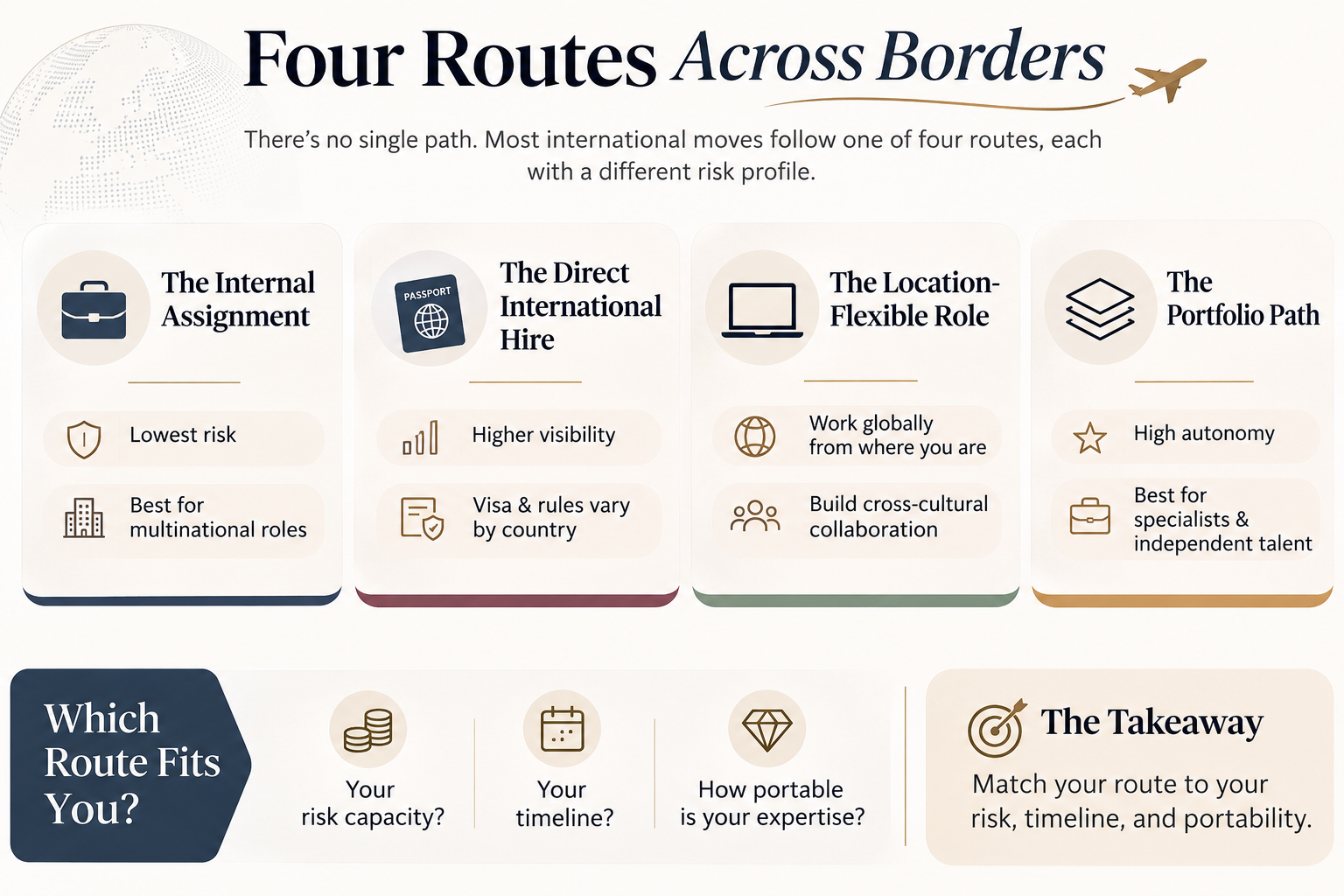
There is no single path. Most successful moves follow one of four routes, each with a different risk profile.
1. The internal assignment.
Your current employer sends you abroad. This is the lowest-risk route, but it depends on a single sponsor. It suits professionals in multinational organisations who can make a clear business case for a posting.
2. The direct international hire.
You apply to a foreign employer, which may or may not sponsor your right to work. Visibility is high, and so is administrative friction. Immigration rules differ by country and change often, so always verify current requirements with official government sources.
3. The location-flexible role.
A distributed employer hires you where you live. You gain global exposure without relocating, provided you learn to collaborate asynchronously across cultures.
4. The portfolio path.
You serve clients in several countries at once. It rewards specialists with a clear reputation and the discipline to run their own pipeline.
Choosing between them.
Mid-career professionals can use any of the four. For those weighing a late pivot, career reinvention after 40 offers a grounded roadmap.
Ask three questions. How much risk can your finances and family absorb? How quickly do you need to move? And how portable is your expertise today? Someone with a scarce, portable skill and a flexible household can pursue the direct hire or portfolio path. Someone with deep company knowledge and limited mobility should start with an internal assignment or a location-flexible role, then widen the circle.
The Global Career Capability Stack
Employers evaluating cross-border candidates tend to look for five layers. Think of them as a stack: weakness in any one layer limits the rest.
Craft.
Deep expertise in a field that travels, such as finance, engineering, education, health or data.
Context.
The ability to read cultural, regulatory and market differences without stereotyping them.
Credentials.
Portable, verifiable evidence of capability. Degrees, certifications and digital badges all count, and business education is adapting quickly.
Communication.
Clarity in writing, precision in meetings and empathy across languages. These are the human potential leadership skills that drive peak performance and they travel better than any technical specialism.
Network.
Genuine relationships in more than one market. Opportunities abroad rarely appear on public job boards first.
Running through all five is fluency with artificial intelligence. To understand how employers are thinking about it, read our 90-day AI strategy playbook for business leaders.
A quick self-assessment.
Score each layer from one to five, honestly. Any layer below three is your priority for the next quarter. Most professionals discover that their craft scores highest and their network scores lowest, which is why relationships feature so prominently in the plan below.
A 90-Day Plan for Building a Global Career
The plan below is deliberately modest. Ninety days is not enough to complete a relocation, but it is enough to learn whether a route is viable, to generate evidence and to start conversations that matter. Treat it as a pilot rather than a promise.
Days 1 to 30: audit and aim
- Choose one route and no more than two target markets.
- Read a dozen real job descriptions in those markets and note which skills recur.
- Check whether your qualifications, licences and work authorisation transfer, using official sources.
Days 31 to 60: build proof
- Deliver one cross-border project, whether through your employer, a freelance client or voluntary work.
- Publish one piece of expert work that shows how you think.
- Close your biggest gap in the capability stack with a focused course or credential.
Days 61 to 90: test the market
- Hold at least ten conversations with people already working where you want to be.
- Apply selectively, tailoring each application with evidence rather than adjectives.
- Review what the market told you, then adjust your route or your target.
Progress is rarely linear. Expect at least one setback, whether a rejected application, a delayed visa or a market that proves less welcoming than the research suggested. Build that expectation into the plan and keep a second route alive.
Mistakes That Stall International Careers
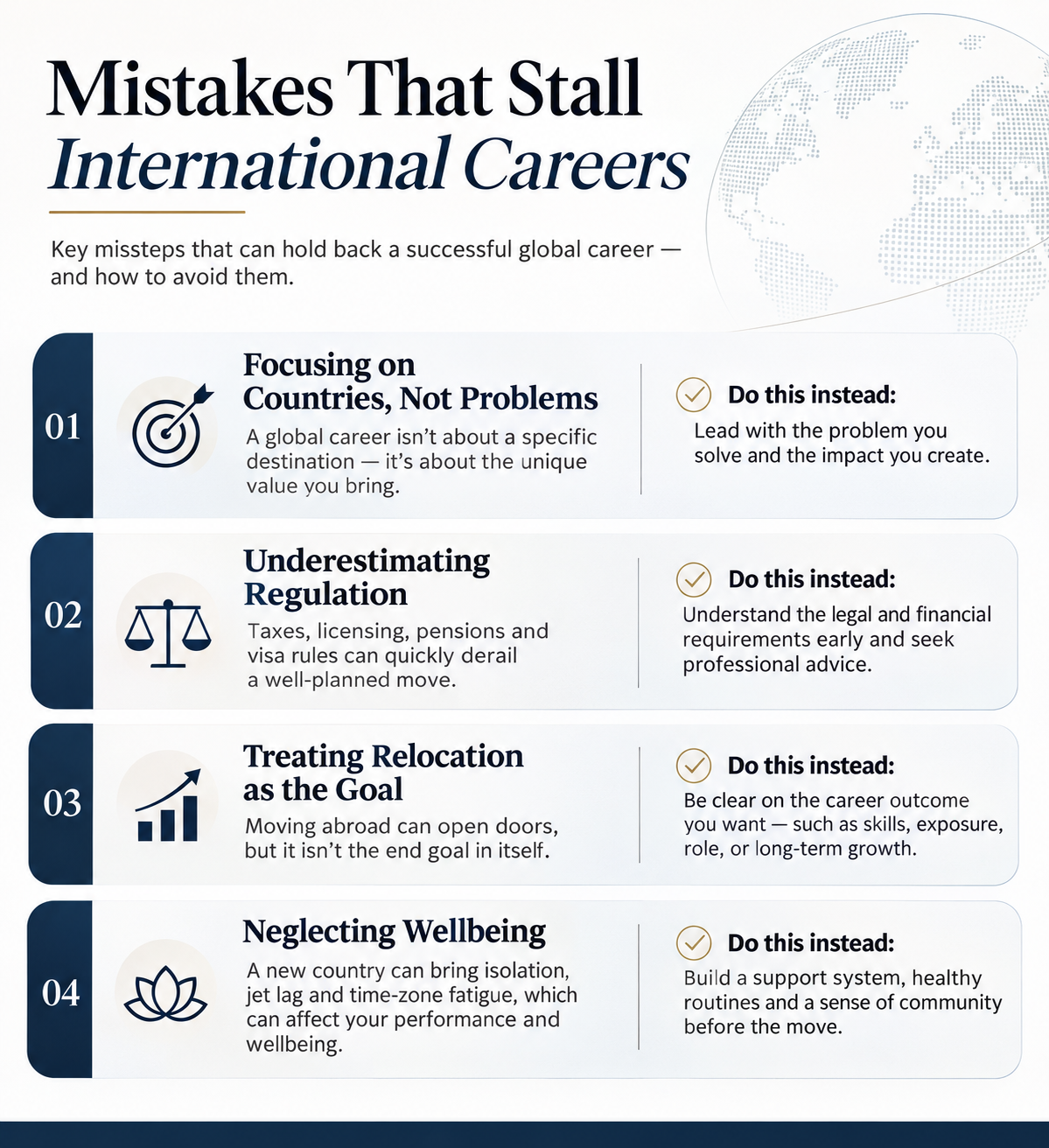
Chasing countries instead of problems
Employers hire you to solve something. Lead with the problem you solve, not the place you want to live.
Underestimating regulation
Tax, licensing, pensions and visas can undo a promising move. Seek qualified professional advice early.
Treating relocation as the goal
A move is a means. Define the career outcome first.
Neglecting wellbeing
Isolation and time-zone fatigue are real. Build routines and community before you need them.
Plan Like a Portfolio, Move Like a Professional
The most resilient international careers in 2027 will belong to people who treat mobility as a skill, not a gamble. They choose routes deliberately, build portable proof and invest in relationships before they need them. The professionals who win will not necessarily be the most travelled or the most credentialled. They will be the ones who learn fastest, communicate most clearly and keep their options open longer than their competitors.
Frequently Asked Questions
What are the main routes to an international career?
There are four: an internal assignment with your current employer, a direct hire by a foreign employer, a location-flexible role with a distributed employer, and a portfolio path serving clients in several countries. Choose according to your risk tolerance, timeline and how portable your expertise is.
How long does it take to build a global career?
There is no fixed timeline. The 90-day plan is a pilot that helps you test a route and gather evidence. Work authorisation, licensing and credential recognition can take longer, depending on the country and the route you choose.
Do I need to relocate to have a global career?
Not necessarily. Location-flexible and portfolio routes offer international exposure from home, provided you develop strong asynchronous communication and cross-cultural skills.
Where can I check visa and professional licensing rules?
Use the official government immigration and professional-licensing bodies of your destination country. Rules change often, so confirm current requirements and consider advice from a qualified adviser.