Do Micro-Credentials Actually Matter to Employers? What the Data Shows

Every few months, a new certificate promises to make graduates more employable. Universities launch them, platforms sell them and learners collect them. Sceptics ask a fair question: does any employer actually care? The answer matters, because time and money are being invested on the assumption that the market is listening. This article examines what recent data suggests about the value of micro-credentials to employers, where the evidence is strong and where it deserves caution.
What the Latest Evidence Says
Two sources shed useful light on the question.
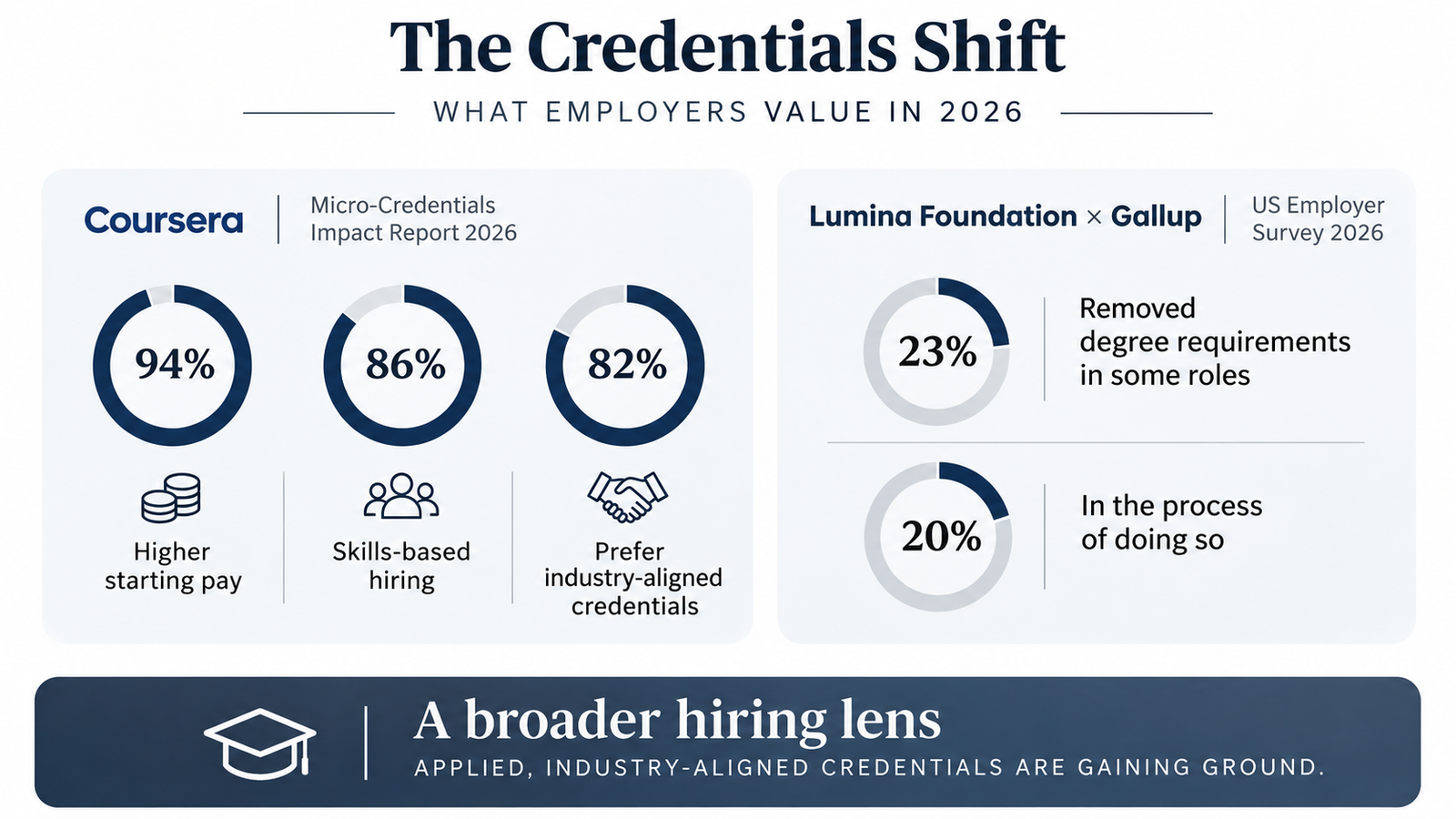
The first is the Micro-Credentials Impact Report 2026 from Coursera, based on a survey of more than 3,500 learners, employers and higher education leaders in seven countries. According to the company, 94 per cent of employers said they would offer higher starting salaries to graduates holding micro-credentials, and 86 per cent said they rely on skills-based hiring for entry-level roles. The report also found that 82 per cent of employers place greater value on credentials developed with industry partners than on those created solely by academic institutions.
The second is a 2026 Lumina Foundation and Gallup survey of 2,000 US employers, reported by BestColleges. It found that 23 per cent of employers had removed degree requirements from some roles over the previous three years, with a further 20 per cent in the process of doing so.
Taken together, these findings point in one direction. Employers are widening the range of signals they accept, and applied, industry-aligned credentials are among the signals gaining ground.
Why Employers Respond
The appeal is easy to understand. A degree certifies broad preparation. A micro-credential certifies something narrower and more current: that a person has demonstrated a specific skill, often through a project or assessment. For a hiring manager facing a skills shortage, narrow and verifiable can be more useful than broad and general.
Three attractions recur:
- Job-readiness. Industry-aligned credentials suggest that a candidate can contribute sooner.
- Faster screening. Clear skill labels help recruiters compare candidates more objectively.
- Lower training cost. Employers hope that candidates arriving with relevant skills need less expensive onboarding.
These attractions also explain why universities are paying attention. Our article on what students really want from higher education shows that learners increasingly expect study to translate into visible career outcomes.
Where the Evidence Falls Short
A balanced reading requires four caveats.
- The research is not neutral. Coursera sells micro-credentials. That does not invalidate its findings, but readers should interpret vendor-commissioned surveys with appropriate care and look for independent confirmation.
- Willingness is not behaviour. Saying you would pay more for a credential is not the same as actually doing so. Survey intent often exceeds practice.
- Quality varies enormously. A rigorous, assessed credential and a lightly supervised certificate of attendance can look identical on a CV. Employers who are burnt once may discount the entire category.
- Systems lag behind intentions. Labour-market analysts note that many hiring systems still struggle to recognise signals other than degrees. A company may say it values skills, while its applicant-tracking software quietly filters on qualifications.
The honest conclusion is that micro-credentials matter to many employers, but not automatically and not equally.
Consider the reader's perspective as well. A recruiter reviewing a stack of applications has perhaps a minute for each. A credential that names the skill, the assessment method and the issuer in plain language earns that minute. A vague title, however impressive-sounding, rarely does. Learners should therefore describe each credential on their CV in terms of what they can now do, not merely what they completed.
A Five-Question Quality Test
Whether you are a learner, a university or an employer, apply this test before investing in any credential.
- Who issued it? Does the issuer have credibility with the employers you care about?
- How was it assessed? Credentials earned through projects or practical demonstration carry more weight than those earned by watching content.
- Who helped design it? Industry involvement signals relevance and, according to the survey evidence above, increases perceived value.
- Does it stack? Can the credential count towards a larger qualification, or combine with others to form a coherent profile?
- Can it be verified? A credential that an employer can authenticate in seconds is worth more than one that requires a phone call.
A credential that scores well on at least four questions is usually worth serious consideration.
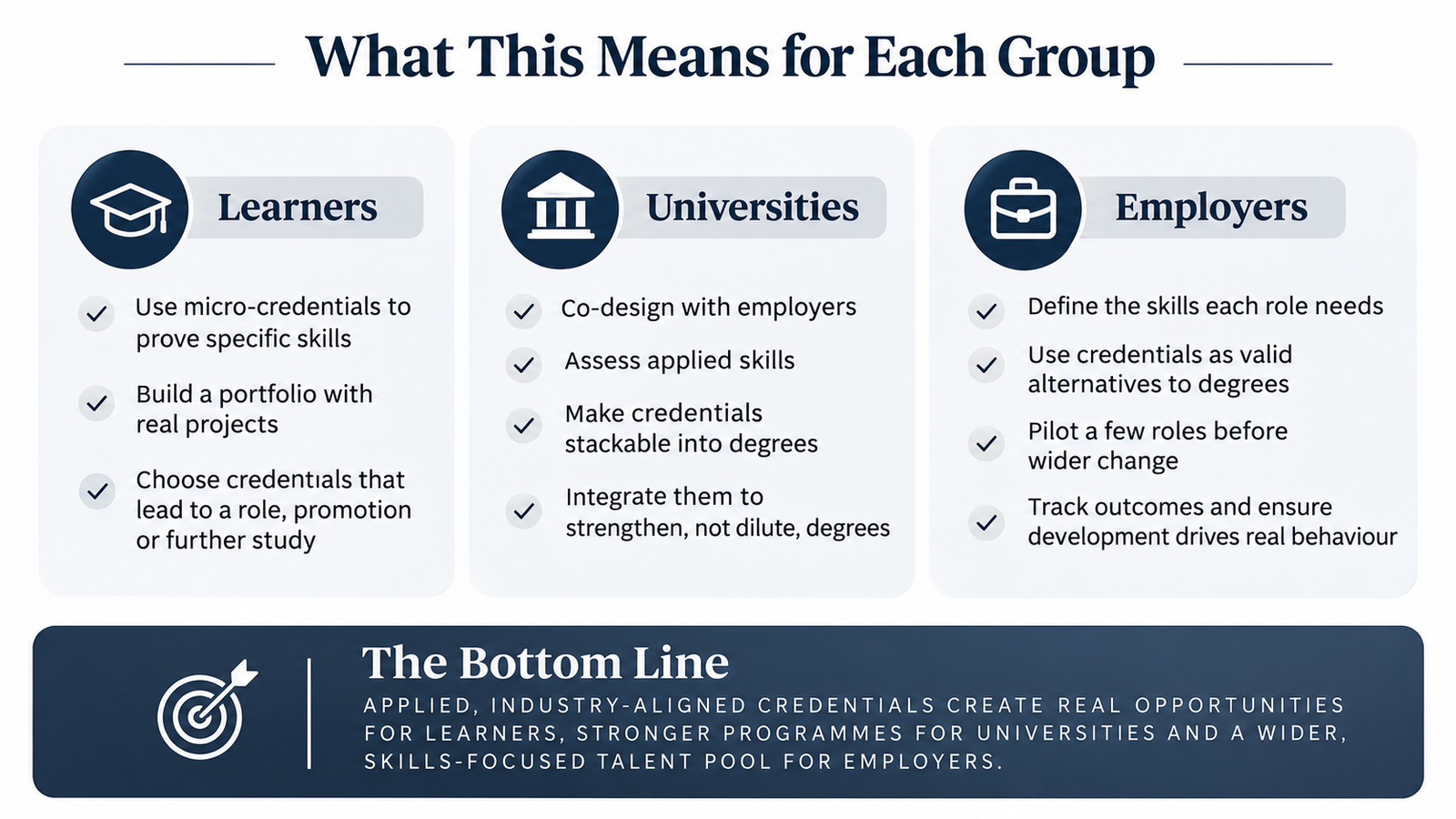
What This Means for Each Group
For learners.
Treat micro-credentials as proof of specific capability, not as a substitute for depth. Combine them with a portfolio, real projects and a clear narrative. Choose credentials that lead somewhere, whether to a role, a promotion or a larger qualification. The principles in our guide to competency-based education apply equally to adult learners: demonstrate what you can do, not merely what you have studied.
For universities.
Co-design credentials with employers, assess applied skills and make them stackable into degrees. Institutions that treat micro-credentials as a marketing add-on will be exposed by employers who see through weak design. Those that integrate them thoughtfully can strengthen their degrees rather than dilute them.
For employers.
Define the skills each role needs, then decide which credentials genuinely evidence them. Update recruitment systems so that credible alternatives to degrees are not filtered out. Pilot a small number of roles before changing policy widely and track outcomes. Professional development should also lead to changed behaviour, a point made in our article on CPD that changes behaviour.
Degrees and Micro-Credentials: Partners, Not Rivals
The debate is often framed as a contest. The evidence suggests something more nuanced. Employers continue to value degrees, and many of the strongest candidates will hold both a degree and targeted, verified skills. Even at the postgraduate level, institutions are re-examining how they combine breadth with practical relevance, as our look at what is working and evolving in leading MBA programmes illustrates.
The sensible position is neither to dismiss micro-credentials as a fad nor to treat them as a miracle. It is to ask of each one what we would ask of any qualification: what does it prove, who stands behind it and does it help someone do the job?
Judge the Credential, Not the Category
Micro-credentials matter to employers when they are rigorous, industry-aligned and verifiable. They matter much less when they are decorative. The data supports cautious optimism, tempered by awareness that much of it comes from organisations with a commercial interest. Learners, universities and employers who apply a consistent quality test will make better decisions than those who follow the trend.
Frequently Asked Questions
Do employers value micro-credentials?
Many say so. Coursera's 2026 survey found 94 per cent of employers would offer higher starting salaries to holders. However, the survey comes from a company that sells micro-credentials, and stated willingness is not the same as actual behaviour.
Will micro-credentials replace degrees?
The evidence suggests partnership rather than replacement. Some employers are dropping degree requirements for certain roles, according to the Lumina–Gallup survey, but degrees remain widely valued.
How can I judge the quality of a micro-credential?
Ask five questions: who issued it, how it was assessed, who helped design it, whether it stacks into a larger qualification and whether an employer can verify it easily.
How should I present micro-credentials on my CV?
Describe each in terms of what you can now do. Name the skill, the assessment method and the issuer in plain language, and support it with a portfolio or project where possible.