
How to Build a Learning Culture That Survives the Quarter-End Rush

Most corporate training programmes collapse the moment the pipeline gets busy. The organisations that avoid this trap aren't training harder — they're building differently, from the ground up.
Every L&D leader knows the pattern. January: training calendars are full, completion rates look healthy, leadership nods approvingly at the numbers. Then March arrives. Deals need closing. Reports need filing. And one by one, the learning sessions get cancelled, the modules get deferred, and the carefully structured corporate training programme quietly dissolves under the weight of short-term operational pressure.
This is not a scheduling problem. It is a cultural one. And the distinction matters enormously because scheduling problems can be solved with better calendars, while cultural problems require a fundamentally different architecture of how learning is valued, integrated, and sustained inside an organisation.
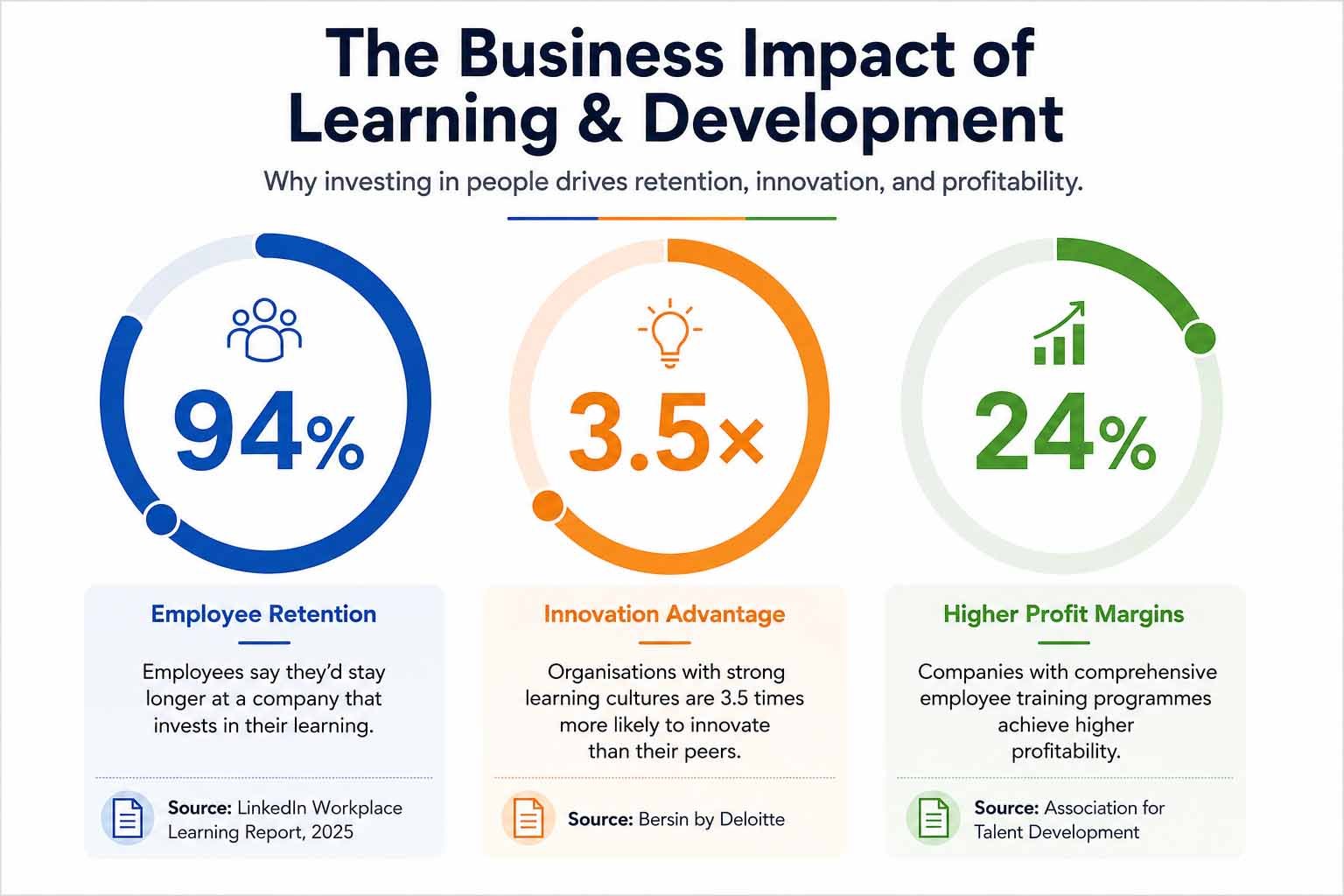
The organisations that have successfully built a learning culture that endures through quarter-end pressure, reorganisations, and market volatility share a common insight: they stopped treating learning as a programme and started treating it as an operating principle. This article examines exactly how they did it and what any organisation can do to replicate their approach.
Why most corporate training programmes fail under pressure
The standard model of corporate learning and development is built on a faulty premise: that learning is a discrete activity, separate from work, to be scheduled into the white space around "real" tasks. Under this model, a training programme is something employees attend when operations allow, which means it is perpetually vulnerable to the one force that operations always generate: urgency.
Quarter-end is merely the most acute expression of a chronic condition. The pipeline is always pressured. There is always a product launch, a client crisis, a compliance deadline, or a restructure competing for the same hours that L&D has tentatively marked as learning time. Any employee training strategy that depends on protected white space is structurally fragile from day one.
Research from the Corporate Executive Board consistently shows that in high-pressure environments, learning is the first discretionary activity to be abandoned — not because employees don't value it, but because they haven't been given the tools, permissions, or cultural signals to treat it as non-negotiable. The problem, in short, is that learning has been made optional.
A learning culture is not what happens when work is quiet. It is what happens when work is at its most demanding and people still make space for growth.
The four signals that you have a learning culture — not just a training programme
Before diagnosing what needs to change, it is worth being precise about what a genuine organisational learning culture actually looks like in practice. It is not characterised by high LMS completion rates or a generous training budget. It is characterised by behaviours:
Learning is conversational : Teams routinely discuss what they are learning, not just what they are doing. Retrospectives reference skill gaps alongside project gaps.
Failure is instructional : Errors are systematically debriefed for insight, not suppressed for optics. Psychological safety enables candid post-mortems.
Leaders learn visibly : Senior leaders share what they are learning, reference books or courses in meetings, and acknowledge their own skill development needs.
Learning is in the work : Development is embedded into live projects, stretch assignments, and peer coaching not only in off-site workshops or e-learning modules.
The absence of any one of these signals is a diagnostic indicator. The absence of all four means the organisation has training infrastructure, not a learning culture and that infrastructure will always be the first casualty of a busy quarter.
How to build a learning culture that sustains itself: a framework for L&D leaders
Building workplace learning culture resilience is not about increasing the training budget or deploying better technology. It is about changing the structural relationship between learning and work. The following framework represents the practices consistently present in organisations where L&D survives and compounds through operational pressure.
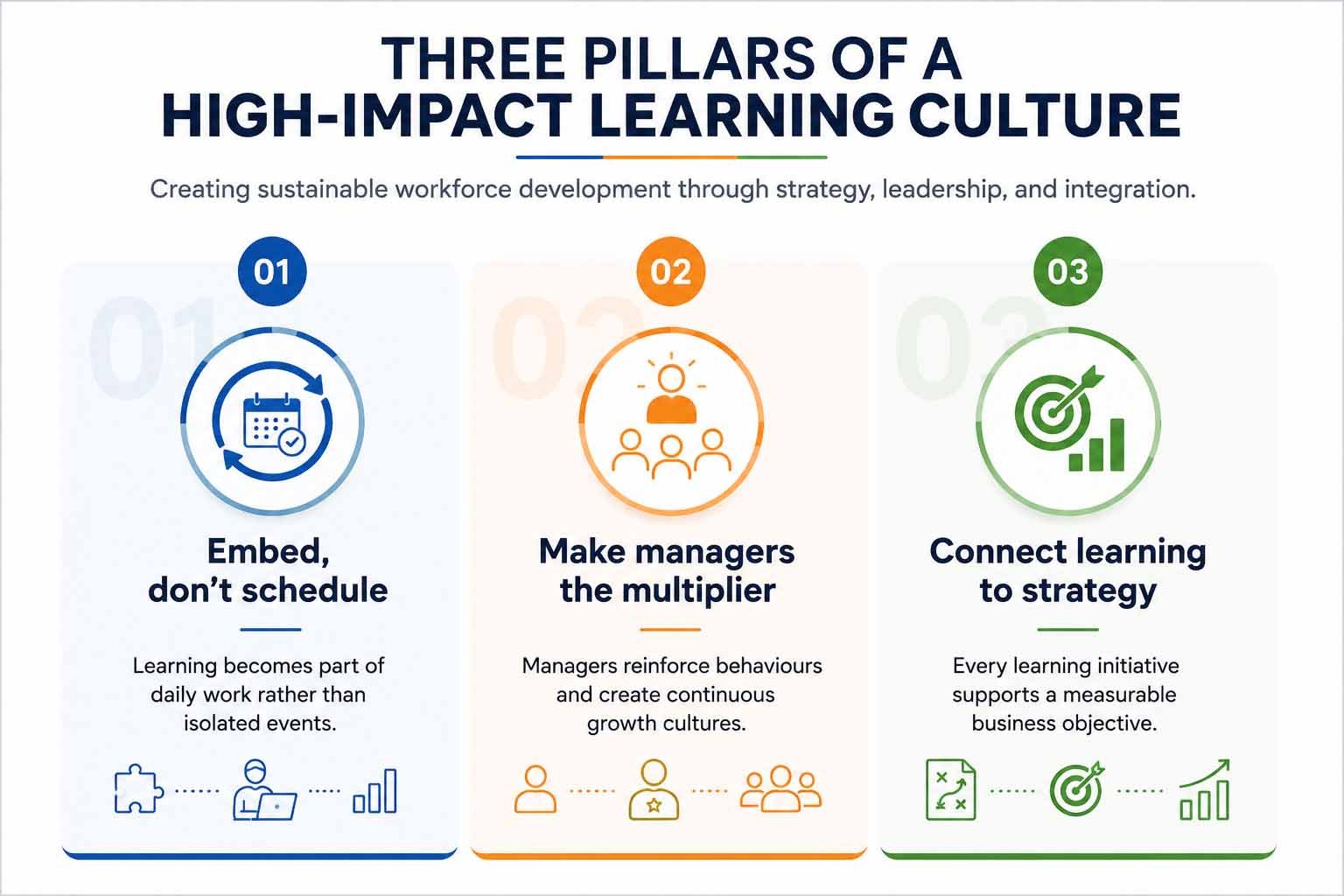
Integrate micro-learning into workflows. 5–10 minute learning moments within existing processes beat 2-hour sessions booked six weeks out.
Line managers not L&D teams determine whether learning happens. Train managers to coach, delegate developmentally, and protect learning time.
Every learning initiative must have a visible line to a business priority. Disconnected programmes are the first to be cut when pressure mounts.
1. Integrate learning into the rhythm of work, not around it
The most durable corporate training strategies are those that make learning inseparable from how work gets done. This means replacing event-based training (a workshop, a course, a conference) with flow-of-work learning — short, contextual, immediately applicable development moments that do not require employees to step away from their responsibilities.
Platforms like Microsoft Viva Learning and tools like Degreed have made this architecturally possible. But the design principle matters more than the technology: learning content must be surfaced at the moment of need, in the context of the task, and sized to fit the available cognitive window. A two-minute explainer on negotiation tactics, served before a key client call, is worth more than a half-day negotiation workshop scheduled in Q1 and forgotten by Q2.
2. Managers: The Most Powerful Learning Multiplier
No investment in employee development programmes will survive consistent manager resistance. And manager resistance does not have to be active — passive de-prioritiation is equally fatal. When a manager reschedules an employee's learning session for the third time to meet a deadline, the cultural message is unambiguous: learning is less important than delivery. Repeated often enough, this message becomes the organisation's operating system.
The solution is not to protect learning time from managers; it is to make managers the primary architects of learning culture. This means developing manager coaching capabilities explicitly, building learning conversations into performance frameworks, and — critically — measuring and rewarding managers on their direct reports' development, not just their output metrics. Organisations that have made this shift report consistently that continuous learning in the workplace becomes self-sustaining rather than L&D-dependent.
3. Treat learning investments as non-discretionary budget lines
One of the clearest signals of a learning culture is how training budgets behave in a downturn. In organisations where learning is cultural, L&D spend is defended in the same conversations where travel, discretionary headcount, and marketing are being trimmed. In organisations where learning is programmatic, it is the first line item to go.
Making the L & D budget non-discretionary requires a specific language shift: from "training costs" to "capability investments." The former is easy to cut; the latter requires an explicit case for the capability gap it leaves behind. Boards and CFOs respond to capability arguments — particularly when those arguments are tethered to specific strategic risks — in a way they simply do not respond to training participation statistics.
4. Use the quarter-end rush as a learning design constraint
Rather than designing learning programmes that assume calm operational conditions and then watching them fail under pressure, forward-thinking L&D leaders design for pressure from the outset. This means explicitly asking: what does learning look like when the team is at peak operational load? What formats, durations, and delivery modes work when no one has ninety minutes to spare?
The answers tend to converge on a common set of principles: asynchronous over synchronous, pull over push, social and peer-led over instructor-led, and contextual over conceptual. Sustainable learning strategies are not those that protect learning from operational reality — they are those that are designed to function within it.
5. Measure learning culture, not just training activity
The metrics most organisations use to evaluate their L&D function — completion rates, hours of training per employee, learner satisfaction scores — are all measures of training activity, not learning culture. They tell you how many people attended a programme, not whether the organisation is becoming more capable.
Genuine learning culture measurement looks different. It tracks knowledge transfer into workflow, improvement in specific capability gaps identified in talent reviews, manager-reported development behaviour, and the correlation between learning engagement and retention, promotion velocity, and performance. These metrics are harder to collect, but they are the ones that make a compelling case to leadership — and that survive the budget conversations at quarter-end.
Embed micro-learning into daily workflows : Replace event-based training with short, contextual, immediately applicable learning moments. Design for the conditions that actually exist, not the ideal conditions that rarely do.
Build manager coaching capabilities as a first-order priority : Managers are the primary culture carriers. Unless they model, protect, and facilitate learning, no L&D programme will take root — regardless of design quality.
Connect every learning initiative to a live business priority : Programmes without a strategic anchor are cut first. Frame capability development in the language of business risk and strategic readiness, not learning outcomes.
Design explicitly for high-pressure conditions : Ask what learning looks like at peak operational load and build for that scenario. Asynchronous, peer-led, and contextual formats are structurally more resilient than synchronous, instructor-led alternatives.
Replace activity metrics with culture and capability metrics : Measure what actually changes — capability gaps closed, manager coaching behaviours, knowledge application rates — rather than what is easy to count.
The leadership imperative: learning culture starts at the top
No framework, technology, or L&D programme design will create a durable learning culture in the workplace if senior leadership does not model it visibly. This is the most consistently underestimated variable in organisational learning research. When a CEO references a book they are reading in a town hall, when a CFO openly discusses a skill they are building, when a CTO makes their own learning goals public alongside their business objectives — the entire organisation's relationship to learning shifts.
Conversely, when leadership consistently reschedules learning commitments, skips development reviews, and frames capability-building as something that happens "when things settle down," the cultural message cascades instantly. No amount of L&D infrastructure recovers from consistent leadership signals that learning is optional.
The organisations that have successfully sustained learning through operational pressure are those in which the senior team has made a visible, repeated, and unambiguous commitment to their own development not as a performance, but as a genuine operating practice. That commitment is contagious in a way that policy, budget, and technology simply are not.
Frequently asked questions
How do you build a learning culture in a fast-paced organisation?
Building a learning culture in a high-velocity environment requires embedding learning into the flow of work rather than scheduling it around it. This means designing for asynchronous, micro-format, contextual learning; making managers accountable for team development; and connecting every L&D initiative to a live business priority. Culture is built through repeated behaviours not training events.
Why do corporate training programmes fail under operational pressure?
Most corporate training programmes fail because they are designed for conditions of operational calm discrete sessions, protected time blocks, and voluntary engagement that rarely survive contact with real business pressure. When urgent priorities compete with scheduled learning, learning loses by default unless it has been structurally integrated into daily workflows and culturally protected by leadership.
What is the difference between a training programme and a learning culture?
A training programme is a scheduled set of learning activities. A learning culture is a set of organisational behaviours, norms, and values in which continuous development is treated as inseparable from how work gets done. The former is an event; the latter is an operating condition. Programmes can be cancelled; culture cannot be switched off in the same way.
How do you measure learning culture in an organisation?
Genuine learning culture measurement moves beyond completion rates and training hours to track: capability gap closure rates from talent reviews, knowledge application in workflow, manager coaching behaviour frequency, and the correlation between learning engagement and retention, promotion velocity, and performance ratings. These metrics are harder to collect but far more predictive of organisational capability.
What role do managers play in sustaining a learning culture?
Managers are the single most influential variable in learning culture sustainability. They determine in practice whether team members have time, encouragement, and permission to learn. Organisations that invest in manager coaching capability and that measure and reward managers on their direct reports' development consistently outperform those that rely solely on centralised L&D programmes.
The organisations that will develop the deepest talent reserves over the next decade are not those that invest most heavily in training technology or L&D headcount. They are those that make learning so structurally embedded, so culturally normalised, and so visibly championed by leadership that no quarterly pressure cycle, however intense, can dislodge it. The quarter-end rush is not the enemy of learning culture. It is its ultimate test.