
Learning Architecture for Enduring Business Excellence: Linking Skills to Strategy

The Strategy–Skill Gap
Boards don’t lose sleep over training calendars. They lose sleep over execution. Every enterprise can articulate a five‑year strategy; far fewer can align the capabilities to deliver it at speed. The result is a familiar tension where millions are invested in transformation, yet value stalls at the last mile because the organizations miss to focus on the actual skills for the workforce, leadership depth, or learning systems to make the strategy real. The question that separates enduring organizations from exhausted ones is deceptively simple. IS YOUR LEARNING FUNCTION ARCHITECTED TO YOUR STRATEGY OR JUST CALENDARING PROGRAMS?
Treating learning as a series of events underestimates its strategic weight. In a volatile, tech‑accelerated economy, learning architecture is no longer a support service. It is an enterprise‑level infrastructure that translates intent into capability and capability into performance. When learning is designed as architecture, not activity, strategy stops being a presentation and starts becoming a habit.
At the heart of this challenge lies a widening strategy–skill gap. Organizations continue to invest in transformation, yet struggle with workforce skills alignment and structured capability building. Without a clear leadership development strategy, even the strongest vision fails to translate into business execution excellence.
Redefining Learning Architecture : From Training Calendar to Strategic Blueprint
Learning architecture is a structured, future‑facing capability blueprint that aligns skills, leadership depth, culture, and measurement to declared business outcomes. It replaces ad‑hoc workshops with a system that is explicit about what capabilities we need to win and how we build them, measure them, and refresh them over time.
Three persistent patterns signal when an organization needs a learning architectural reset:
1. Ad‑hoc training: spending on content without clarity on the capabilities required for growth.
2. Compliance‑driven L&D with high completion rates but low performance lift.
3. True capability architecture: skills mapped to strategic intent, embedded into roles, measured against business KPIs.
In practice, the understanding is:
1. Moving from “hours learned” to “skills earned”
2. From generic curricula to strategic pathways
3. From one‑size‑fits‑all courses to multi‑modal experiences
These shifts speak to both Gen Z’s need for bite‑sized progress and senior leaders’ demand for applied, business‑anchored learning.
Execution Is a Capability Question
Digital transformation without digital fluency is a lecture theatre. AI adoption without an analytical culture is a slide deck. Geographic expansion without leadership strength is a castle built on sand, ambition hiding fragility. Every one of these scenarios is a capability gap masked as a strategy problem.
Consider a field‑tested observation:
A global manufacturer hit by a nine‑figure recall despite a “healthy” 98% compliance rate on safety modules. The failure wasn’t content; it was the architecture. Younger technicians spotted a recurring glitch but had no mechanism to turn tacit insight into institutional knowledge, while seasoned engineers were executing to a roadmap that excluded real‑time anomalies. When learning isn’t designed to capture, connect, and cascade knowledge across generations, execution fractures. The lesson is straightforward: “Strategy is intent. Skills are infrastructure.” Unless capability is deliberately built and refreshed, transformation remains a promise rather than a performance.
The Five Pillars of Learning Architecture for Enduring Business Excellence
This is the backbone of an operating system that links skills to strategy and strategy to measurable results.
Pillar 1: Strategic Skill Mapping
This ensures workforce skills alignment across roles, functions, and growth priorities. Reverse-engineer learning priorities from growth ideas—designing new products, expanding digital channels, planning automation, and increasing customer confidence—while clearly defining role-specific skill outcomes. This is the first operational step in addressing the broader strategy–skill gap. Success criteria shift from attendance to “skills earned that move KPIs.”
Pillar 2: Leadership Development as Infrastructure
Leadership development must evolve from episodic programs into a structured leadership development strategy aligned with succession and business goals. Build competency‑based academies for mid‑level leaders; tie pathways to succession maps; measure pipeline strength and time‑to‑readiness. Leadership depth becomes a lead indicator of strategic execution, not an HR footnote.
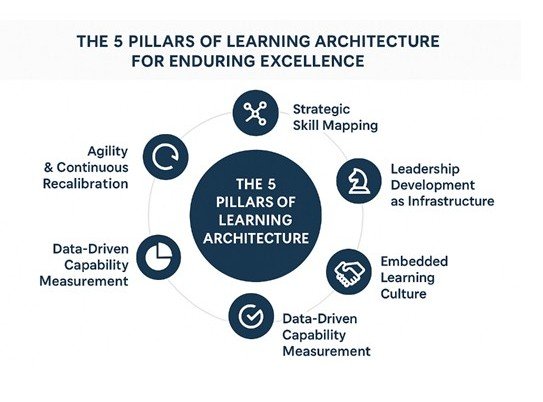
Pillar 3: Embedded Learning Culture
Integrate learning into the workflow. Pair mobile, bite‑sized learning for early‑career talent with cross‑functional projects, mentoring, coaching labs, and peer studios for experienced leaders. Design for cross‑generational integration so insight moves laterally, not just top‑down. Create safe spaces to unlearn and relearn and catalyse curiosity quotient “CQ” which is the real engine of adaptability.
Pillar 4: Data‑Driven Capability Measurement
Stop at smile sheets (L1 and L2). Instrument programs to business KPIs ( L3 and L4) uptime, cycle time, win rate, NPS, cost‑to‑serve etc. so every pathway declares the metric it intends to move, and reports against it. Build skill dashboards that let leaders see capability health the way they see revenue and cash.
Pillar 5: Agility & Continuous Recalibration
Strategy evolves so should capability. Run quarterly capability reviews that reconcile shifts in market, technology, or regulation with the skills portfolio. Treat the architecture as a living system to refresh pathways, retire stale assets, and redeploy attention to emergent skills like AI literacy, design for trust, and data storytelling.
Case Insight
From Fragmented Training to Capability Architecture
Before:
A complex organization with impressive training participation metrics remains stagnant with performance indicators. Compliance was high; capability wasn’t. Programs were abundant; the flow of knowledge was not. Implicit insights from the field lived and died within business units; leadership capacity for scale was thin; digital modules existed, but a culture of applied learning did not.
Architected Response:
The enterprise reframed learning as a strategic system. It mapped a three‑to‑five‑year capability outlook, integrated micro‑learning for early career talent with applied projects and peer forums for senior workforce, and hard‑wired mentorship to capture and transmit know‑how. Success shifted from “hours completed” to KPI‑linked capability building for example:
- predictive maintenance skills tied to reduced equipment downtime
- design thinking pathways tied to innovation throughput
- leadership pathways tied to pipeline readiness
After:
The organization saw fewer incidents, faster problem resolution, higher engagement, and measurable lift on targeted KPIs. Most importantly, it developed a learning habit a way to connect strategy to skills continuously rather than episodically.
Result:
Within two business cycles, the enterprise demonstrated:
- 15–20% reduction in operational inefficiencies where predictive maintenance was introduced
- Higher innovation velocity, with teams producing more viable improvement proposals
- Strengthened succession pipelines, improving role ready talents, depth in leadership
- Cross‑generational knowledge flow, reducing dependency on legacy silos
- This shift proved that effective capability building is not about content volume, it is the improved execution quality and organizational resilience. Organizations must shift from training delivery to structured capability building systems.
Disclaimer: The case described is illustrative and not based on any one organization.
The Governance Question
Owner of Learning
If learning is infrastructure, it demands governance. The right answer isn’t “HR” versus “Strategy” versus “The CEO.” The right answer is shared ownership with clear accountabilities:
• CEO & Board: Set the capability narrative, review skill dashboards, and hold leaders accountable for pipeline health.
• Strategy & Business Leaders: Define the 3 to 5 years capability map; sponsor pathways tied to growth belts.
• HR/L&D: Architect the system modalities, platforms, measurement metrics, ensuring equity, scalability, and experience design.
• Learning Council: A cross‑functional forum that reconciles business pivots with capability refresh, quarterly.
When governance is explicit, learning ceases to be a workshop problem and becomes an enterprise operating discipline.
The Risk of Ignoring Learning Architecture
Organizations that treat learning as content distribution face five predictable consequences:
1) Strategy fatigue: People listen, but don’t move forward change feels staged, not lived.
2) Talent flight: High‑potentials leave when growth pathways are opaque or generic.
3) Transformation theatre: Leaders talk AI and digitization; the frontline lacks the skills to use them.
4) Reputation erosion: Quality issues, missed SLAs, or stagnant innovation cycles signal fragility to the market.
5) Cultural fragmentation: Without cross‑generational and cross‑functional learning, insight stays trapped in pockets.
Each risk multiplies. The solution isn’t more content it’s designing capability.
Enduring Excellence Is Designed
Excellence is the product of design. It is engineered through aligned systems that translate intent into capability at scale. The institutions that will endure are deliberate about two things:
I. the skills they choose to master
II. the architecture they use to build them
Cross‑Generational Flow: Gen Z micro‑progress + senior leadership depth + cross functional learning design that captures and transmits tacit knowledge.

KPI‑Linked Design: Downtime reduction, cost savings, innovation proposals per quarter, pipeline strength, role‑ready gap reduction.

From Hours to Skills: Shift measures from learning hours to skills earned that move business KPIs.
“Leadership development is not an event - it’s succession architecture.” Enduring organizations are built on systems that enable consistent business execution excellence.
Sources & References
1. World Economic Forum - Future of Jobs Report 2025
2. Gartner HR Research - Capability Building & Digital Learning Trends
3. NBER DuPont Study (Learning Impact & Human Performance)
4. Concepts, industry‑practice insights, and frameworks are drawn from the author’s original research