
Microlearning in Education: How Bite-Sized Learning Is Transforming K–12 Classrooms and Teacher CPD

Learners’ attention tends to fragment after roughly ten minutes of structured instruction. Yet most classroom periods run 45 to 60 minutes, and much teacher training still arrives in full-day blocks that educators often describe as disconnected from daily practice. Microlearning in education closes this gap by redesigning how knowledge is delivered, retained and applied, in both K–12 classrooms and teacher professional development.
This is not a passing edtech trend. Cognitive science consistently supports short, focused, well-sequenced learning over long stretches of passive instruction. As schools and training providers adapt to digital-first environments and time-poor educators, bite-sized learning and modular education have moved from the margins of pedagogical innovation to the centre of curriculum design. They also sit at the heart of the wider shift towards competency-based education, where progress is measured by what learners can do, not by seat time.
What Is Microlearning in Education? The Cognitive Science Behind It
Microlearning is the delivery of short, focused learning experiences, typically three to fifteen minutes long, each built around a single, clearly defined objective. In schools, this means breaking curriculum content or teacher training into discrete units that learners can use at the point of need rather than absorbing in long, linear sessions.
Its main theoretical foundation is cognitive load theory, developed by educational psychologist John Sweller. Working memory has limited capacity, so when learners receive more information than they can process at once, retention drops. Microlearning respects this limit by presenting content in manageable segments and letting learners consolidate before moving on. The same principle shapes how leaders handle complexity, as explored in cognitive load management and decision-making under stress.
Microlearning is not simply “shorter lessons”. Effective design is deliberate:
Each module targets one learning objective only. Content is followed immediately by an application activity or retrieval practice task.
Modules are sequenced to scaffold complexity progressively.
Spaced repetition, revisiting concepts at planned intervals, is built into the pathway to strengthen long-term retention.
Designed this way, microlearning does not sacrifice depth. It builds depth one consolidated layer at a time. For more on learning formats that deliver lasting results, see our High-Impact Learning section.
How Modular Education Works in K–12 Classrooms
Modular education applies the logic of microlearning to curriculum architecture. Instead of rigid, linear units that every student completes at the same pace, the curriculum is organised into stackable modules, each with its own outcome, assessment and link to broader learning goals.
In K–12 classrooms, this enables three important shifts:
- Differentiated learning pathways. Students who have mastered a concept move ahead, while others consolidate without holding up the class. This is especially valuable in mixed-ability classrooms, where whole-class instruction tends to under-challenge some students and overwhelm others.
- Targeted concept delivery. Teachers can build modules around known sticking points, such as a common maths misconception, a frequently misunderstood grammar structure, or a science concept with several prerequisites, and use them exactly when needed.
- Real-world application built in. Short tasks between modules, such as collaborative problem-solving, written reflections and peer explanation, support experiential learning without breaking curricular coherence.
Khan Academy shows how far this model can scale. Its short instructional videos paired with practice exercises are used in classrooms worldwide, and its mastery-based progression is a direct application of microlearning principles.
Microlearning for Teacher Professional Development: A Smarter CPD Model
The case for microlearning in teacher professional development (CPD) is just as strong, and often easier for school leaders to act on. Traditional training has three structural weaknesses that microlearning addresses directly.
- Episodic delivery. Conventional CPD arrives in infrequent full-day sessions that are hard to connect to everyday classroom challenges. Microlearning CPD is on demand: teachers access specific content when they need it, whether that is designing a formative assessment, leading a discussion-based lesson or introducing a new digital tool.
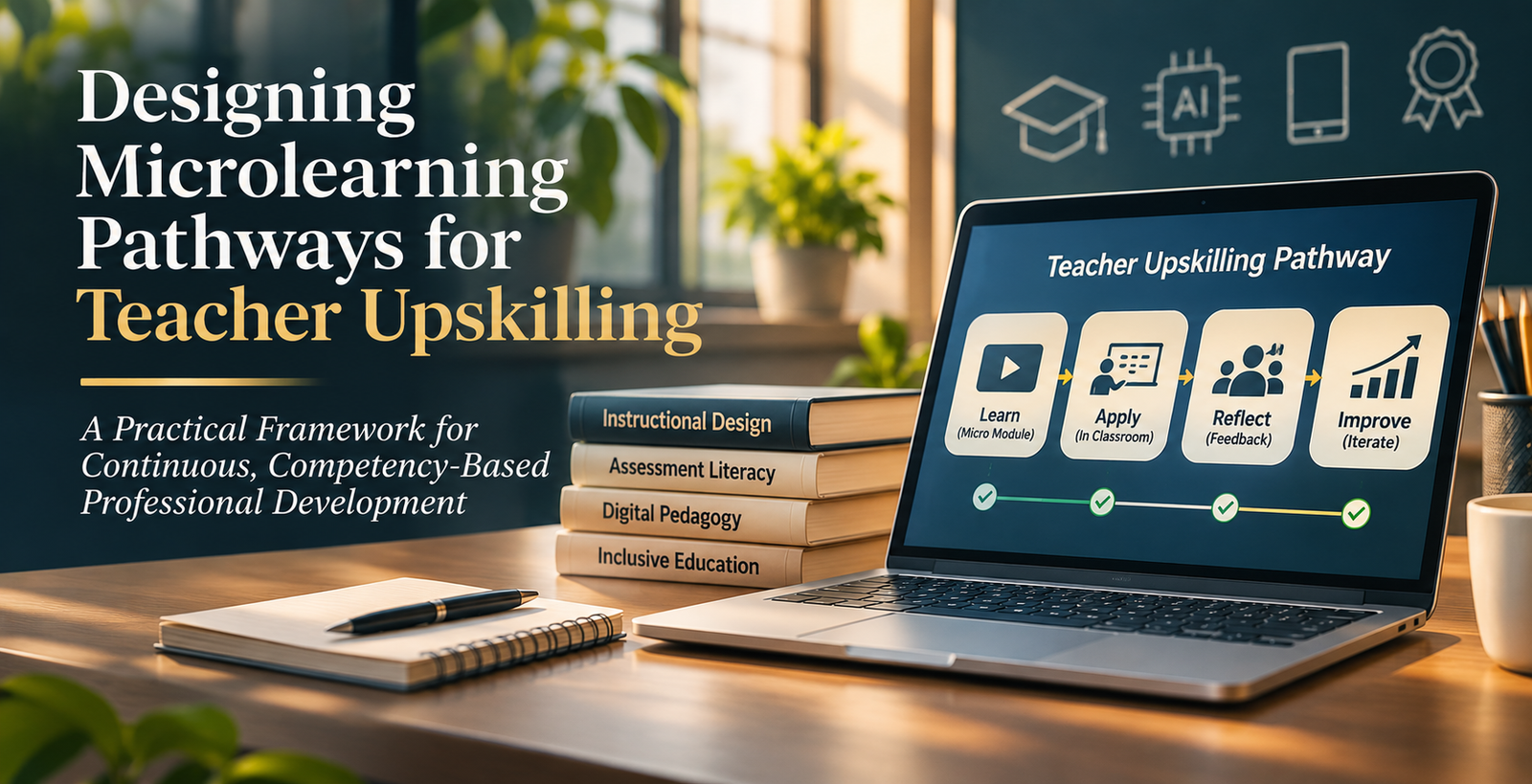
- Disconnection from practice. Learning removed from the classroom transfers poorly. A five-minute module on a questioning technique, followed by immediate classroom use and a structured reflection prompt, forms a complete CPD cycle that can change teaching behaviour. Pairing such cycles with a supportive environment matters too; see why school culture matters as much as teaching itself.
- One-size-fits-all design. Teachers differ by subject, year group, experience and current challenges. Modular pathways let them choose, or be directed to, the modules most relevant to their priorities.
Research from the Teacher Development Trust indicates that the most effective teacher development is sustained, contextually relevant and focused on specific classroom practices, which are the very qualities well-designed microlearning pathways offer.
Microlearning Platforms and Real-World Examples in Education
Seeing how microlearning platforms work in practice helps school leaders and curriculum designers judge their potential.
Khan Academy delivers curriculum-aligned content in short video segments with adaptive practice. Students advance only after demonstrating competency.
Duolingo shows the power of spaced repetition and short sessions at scale. Its five-to-ten-minute daily lesson format challenges assumptions about how long a session must be to teach something meaningful.
Google for Education’s Teacher Center offers self-paced units of roughly 15–30 minutes that teachers can apply straight away.
Seesaw builds short, targeted learning activities into classroom communication and assignments.
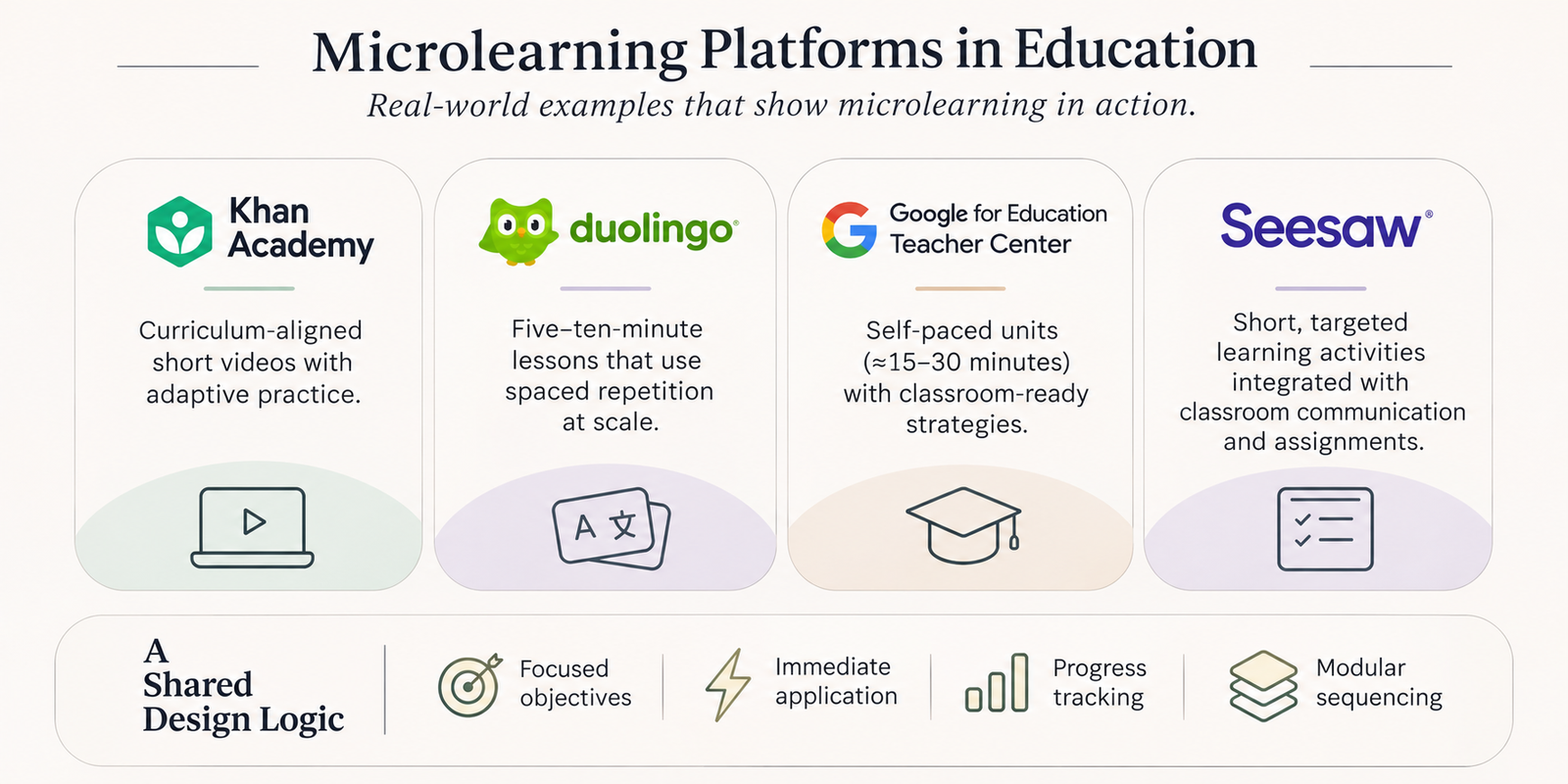
These platforms share one design logic: focused objectives, immediate application, progress tracking and modular sequencing that respect both cognitive limits and real-world time pressure.
The Risks of Bite-Sized Learning, and How to Design Around Them
The case for microlearning is strong, but educators must manage three real challenges.
- Fragmentation. Without a coherent architecture linking modules to wider outcomes, learning becomes a string of isolated skills. A student who completes twelve modules on the parts of photosynthesis may still be unable to explain the process as a whole system.
- Passive consumption. Content that is merely watched or read, with no retrieval, application or dialogue, mimics social media scrolling rather than active learning. Every module should require learners to do something with the content.
- The assessment gap. Competency-based modular progression needs granular assessment, yet most school assessment systems are built for summative evaluation and struggle to capture module-by-module progress. This is a genuine implementation challenge for school systems.
Mitigation requires intentional design:
- Connect every module explicitly to the unit and course outcome it serves.
- Build application and retrieval activities into every module, not as optional extras.
- Redesign assessment frameworks alongside the curriculum.
- Train teachers not only to use microlearning tools but to judge whether the sequences they deploy produce real depth of understanding.
Microlearning and Educational Equity: Low-Bandwidth Learning as Inclusion
One of the most underexplored strengths of microlearning is its potential to advance educational equity. Short learning units need less bandwidth, less device processing power and less continuous connectivity than long video sessions or heavy multimedia files.
This low-bandwidth adaptability means meaningful, curriculum-aligned learning can reach schools in low-income communities, rural areas with limited broadband and education systems where device access is intermittent. Experiential learning, dialogue and conceptual depth depend on good design, not expensive technology.
For education leaders committed to equity, this is not a side benefit. It is a core argument for investing in microlearning infrastructure.
The Future of Microlearning: AI, Mobile Learning and Micro-Credentials
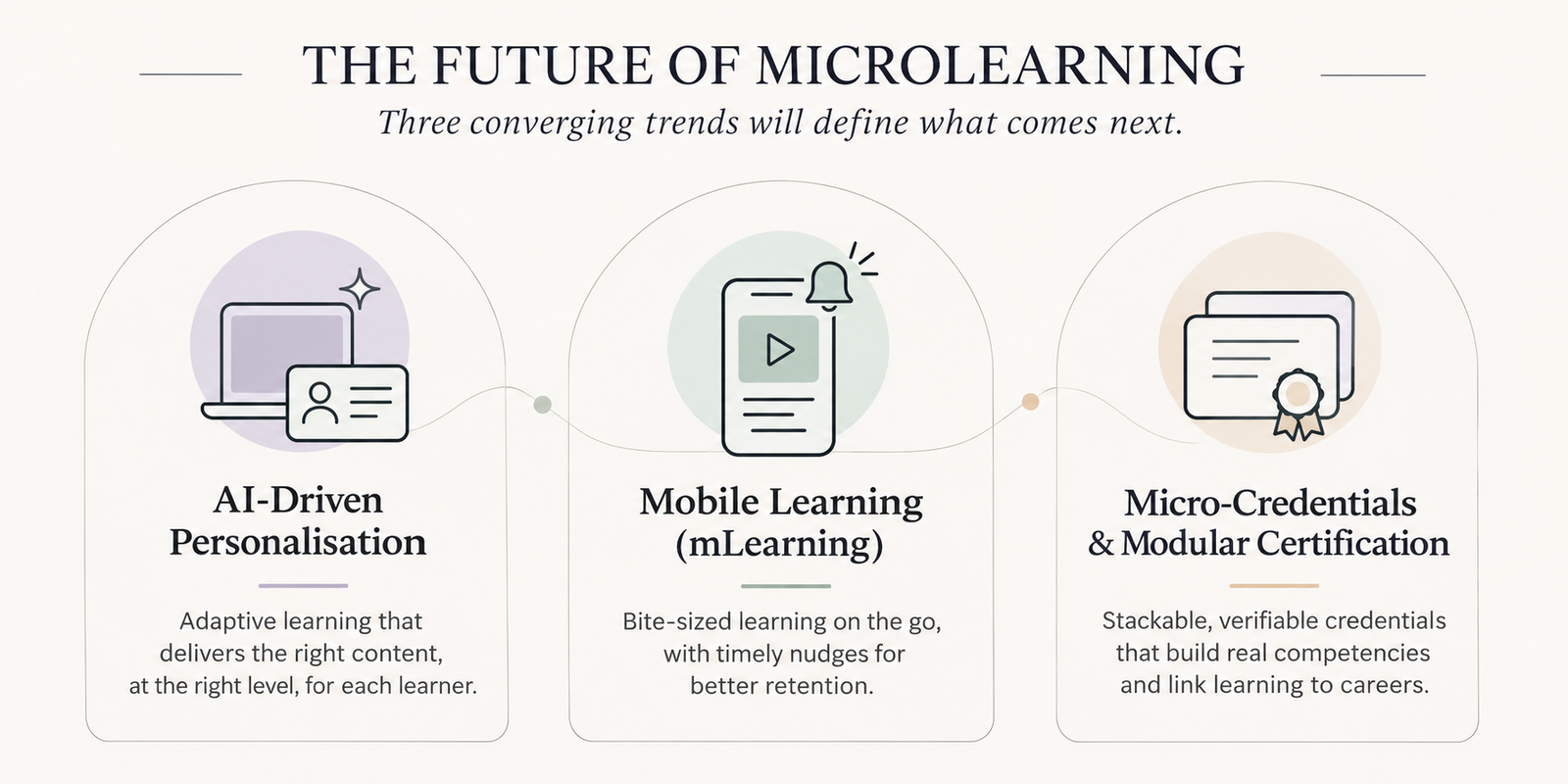
Three converging developments will shape the next phase of microlearning.
- AI-driven personalisation. Adaptive systems can analyse learner performance in real time and serve the precise module, at the right difficulty and in the most effective format, that each student needs. That level of personalisation is hard for any single teacher to deliver at scale, though it raises important questions about data and ethics.
- Mobile learning (mLearning). For many learners, the smartphone is already the default learning device. Short modules fit naturally into the time windows a phone offers, and push notifications can prompt spaced-repetition practice at the right moments. Systems designed mobile-first will reach learners that desktop-first systems miss.
- Micro-credentials and modular certification. Stackable micro-credentials, short, competency-verified digital qualifications that employers can check, are reshaping the link between education and employment. For K–12 systems, they point towards modular pathways that connect school learning to recognised competency frameworks.
Frequently Asked Questions
What is microlearning in education and how does it work?
Microlearning in education delivers short, focused learning experiences, typically three to fifteen minutes long, each targeting a single objective. Grounded in cognitive load theory, it presents information in segments that respect working memory, followed by immediate application or retrieval practice. Sequenced into modular pathways with spaced repetition, it builds durable understanding without cognitive overload.
How is microlearning used in K–12 classrooms?
Through short instructional videos, targeted concept modules and bite-sized practice activities tied to specific curriculum objectives. Modular education frameworks allow differentiated progression, targeted remediation and embedded application tasks. Khan Academy is a widely used example.
What are the best microlearning platforms for teachers and students?
Widely used options include Khan Academy for modular K–12 content, Duolingo for spaced-repetition language learning, Google for Education’s Teacher Center for modular teacher CPD, and Seesaw for classroom-embedded bite-sized activities. The best choice depends on subject, infrastructure and whether the main user is the student or the teacher.
What are the disadvantages of microlearning in education?
The main risks are fragmentation, where isolated modules never cohere into real understanding, and passive consumption, where learners receive content without engaging with it. Both are reduced by linking every module to broader outcomes, including a retrieval or application task, and using assessment that captures modular competency.
How does microlearning support teacher professional development?
It replaces infrequent, disconnected full-day training with short, practice-embedded pathways delivered at the point of need. A typical cycle pairs a ten-minute module on a pedagogical technique with classroom application and a reflection prompt, which supports transfer into practice far better than one-off training days.
Designing for Depth, Not Just Speed
Microlearning in education is an evidence-based shift towards more flexible, learner-centred and scalable instructional design, across K–12 classrooms, teacher CPD and the growing landscape of credentialled learning.
The strategic message for education leaders is clear: microlearning done well is not an efficiency compromise but a design challenge. When modules connect to a coherent learning architecture, when application and retrieval are built in, and when assessment evolves to capture modular competency, bite-sized learning does not dilute depth. It enables it.