

Learning Ecosystems: How Institutions Achieve EdTech Excellence

Most universities and schools have invested heavily in digital technology over the past decade. They have learning management systems (LMS), student analytics platforms, AI-powered assessment tools, CRM databases and compliance software. What many do not have is any of these systems talking meaningfully to each other.
The result is a paradox that plagues education at every level: institutions that are simultaneously over-tooled and under-integrated. Staff duplicate data entry across platforms. Leaders make decisions from incomplete dashboards. Students receive fragmented experiences shaped not by pedagogical intent but by whichever system happens to hold the relevant data that week.
Learning ecosystems, meaning genuinely integrated, ethically governed digital environments, are the answer to this fragmentation. But building them requires institutions to make a strategic choice that goes beyond procurement: the decision to stop accumulating tools and start designing systems. That choice is the foundation of lasting EdTech excellence.
The Tool Trap: Why Fragmentation Is an Operational and Ethical Problem
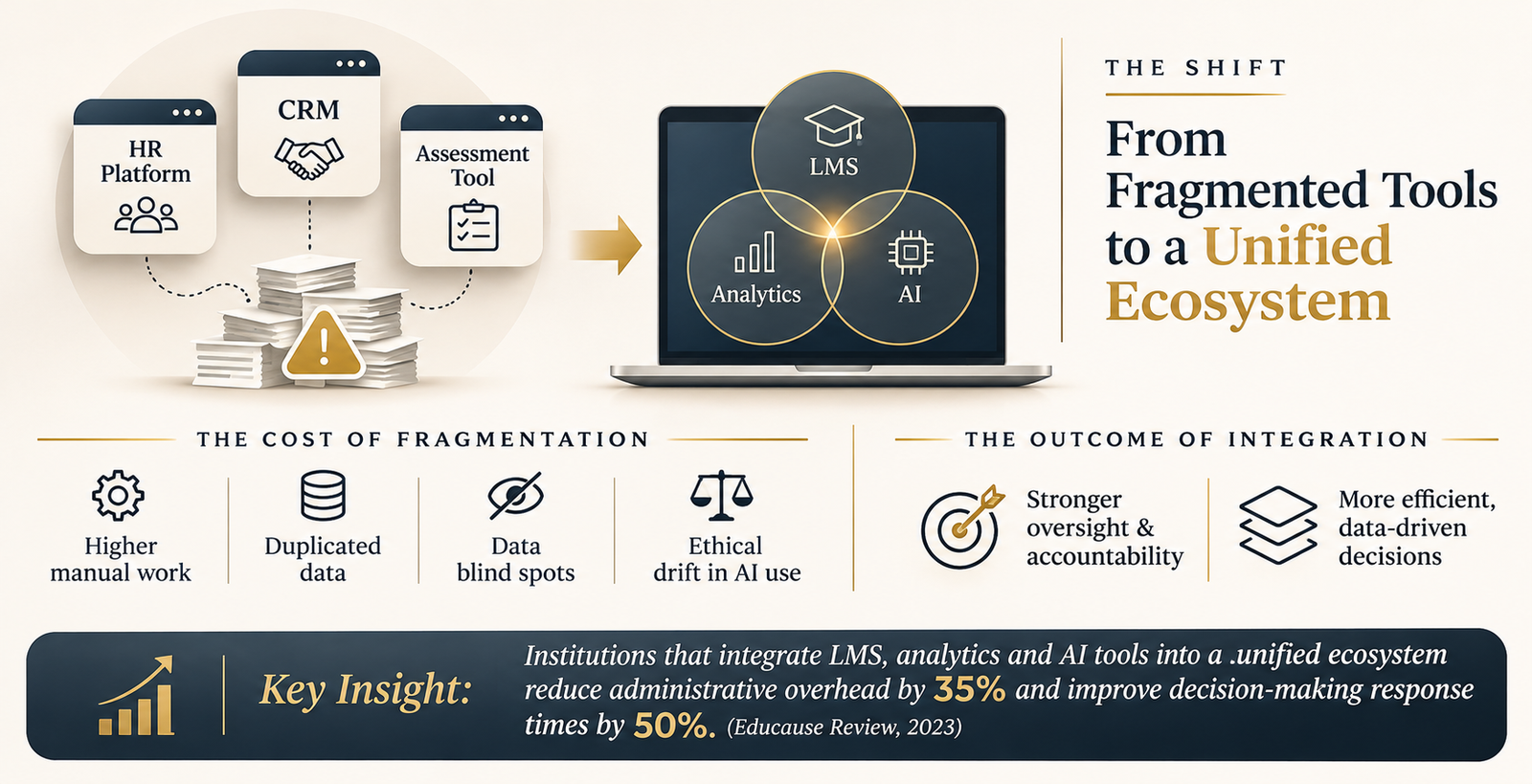
The pattern is familiar. A department adopts a best-in-class HR platform. Another implements a market-leading CRM. A third deploys a specialist assessment tool. Each decision is locally rational. The cumulative effect is an institution held together by manual workarounds, duplicated records and persistent data blind spots.
This is what systems thinkers call technical siloing, and its consequences extend well beyond inefficiency. When data is fragmented, institutional oversight weakens. Decisions get made on partial information. And critically, when AI and automation tools are layered on top of disconnected systems, something more troubling emerges: what can be called ethical drift, where the speed at which technology operates outpaces the institution's capacity to govern what it is doing. Our piece on engineering ethical EdTech infrastructures explores this risk in depth.
An AI system drawing on incomplete or siloed data does not just produce suboptimal recommendations. It produces recommendations that no one can fully account for. In a learning environment, where those recommendations may influence student placements, performance assessments or resource allocation, the stakes of that opacity are high.
Operational excellence in education is not achievable through fragmented infrastructure. It requires integration, not as a technical aspiration but as a structural commitment.
Key Insight: Institutions that integrate LMS, analytics and AI tools into a unified ecosystem reduce administrative overhead by an average of 35% and improve data-driven decision-making response times by 50%. (Educause Review, 2023)
What a True Integrated Learning Ecosystem Looks Like
The term "learning ecosystem" is used loosely enough to have lost some of its meaning. For clarity, an integrated learning ecosystem has three defining characteristics that distinguish it from a collection of connected software.
- A single source of truth. This is a data architecture where information flows continuously between systems rather than being replicated, reconciled manually or siloed by department. Leaders, educators and support staff access the same real-time picture of student progress, resource usage and operational performance. Decisions are faster and more confident because they are grounded in complete information.
- Ethics as infrastructure. This is not a policy document or a periodic review, but a set of principles embedded into how systems are designed, what data they use and how their outputs are governed. In a genuinely integrated ecosystem, ethical AI in education standards apply consistently across every platform, not selectively to the ones that happened to flag a compliance requirement. For a wider view of how organisations turn this into advantage, see From AI Ethics to Enterprise Advantage.
- Feedback-driven workflow. Insights generated in one part of the organisation automatically inform decisions in another. A student engagement signal captured by the LMS triggers a pastoral support workflow. A curriculum gap identified through assessment analytics feeds into faculty development planning. The system learns from itself, continuously.
Personalised Learning at Scale, With Ethical Guardrails
One of the most compelling arguments for integrated learning ecosystems is the capacity they unlock for genuine personalised learning. When data from assessments, attendance, engagement and support interactions flows into a unified environment, institutions can identify individual student needs with a precision that isolated tools simply cannot match, and respond with targeted interventions before problems escalate.
The evidence on this is strong. Institutions that have implemented integrated student analytics report measurable improvements in student retention, earlier identification of at-risk learners and higher satisfaction scores across student populations. The same logic underpins efforts such as closing the completion gap through academic support, not scholarships alone.
But personalisation at scale also introduces risk. The more granular the data profile built on a student, the greater the obligation to be transparent about how it is used, who accesses it and what decisions it influences. Integrated ecosystems must build data governance, privacy and student data rights into their architecture from the outset, not retrofit them after deployment. That includes treating cybersecurity in EdTech as a front-line institutional risk.
Personalisation without accountability is surveillance. The distinction matters, and it is a leadership decision.
The Leadership Imperative: Why Integration Fails Without Clear Ownership
Technology integration projects fail most often not because of technical complexity but because of governance ambiguity. When no single leader owns the digital strategy, integration becomes a negotiation between competing departmental interests, and the integrated vision loses, incrementally, to local priorities.
Achieving genuine learning ecosystems requires centralised leadership accountability. This does not mean one person controls every technology decision. It means one person, or one cross-functional team with clear authority, is responsible for ensuring that the institution's technology investments are coherent, interoperable and strategically aligned. This mirrors the broader shift in university strategic management and the idea that governance is no longer just a boardroom issue.
This is also where the human dimension of integration becomes critical. Technology can connect systems. It cannot on its own build the shared understanding, trust and capability that make integrated data actually useful. Staff at every level need to understand what the ecosystem is doing, why their data inputs matter and how the outputs should and should not be used. Training, change management and ongoing communication are not supplementary to integration. They are constitutive of it. As we note in why school culture matters more than teaching alone, culture shapes whether any system actually works.
Overcoming the Legacy Systems Challenge in Educational Technology Integration
For most institutions, the path to an integrated learning ecosystem runs through legacy systems that were not designed for interoperability. Replacing core systems entirely is rarely feasible, financially or operationally. The practical answer is a phased integration strategy that prioritises high-value data flows first, builds interoperability incrementally and avoids the trap of waiting for perfect conditions before starting.
A pragmatic sequence typically involves three stages:
- Standards first. Establish shared data standards and a common identity framework across existing systems.
- Priority workflows second. Integrate the highest-priority workflows, typically those touching student outcomes and resource planning.
- AI and analytics third. Layer AI and analytics capabilities on top of a now-coherent data foundation. Leaders weighing this step may find AI as Strategy a useful companion read.
Institutional resistance is real and should be anticipated, not dismissed. Departments that have built workflows around their own tools will experience integration as disruption before they experience it as improvement. Leadership communication, early wins and visible benefit to frontline staff are the most effective tools for managing that transition.
What Institutions Should Do Now to Build Learning Ecosystems
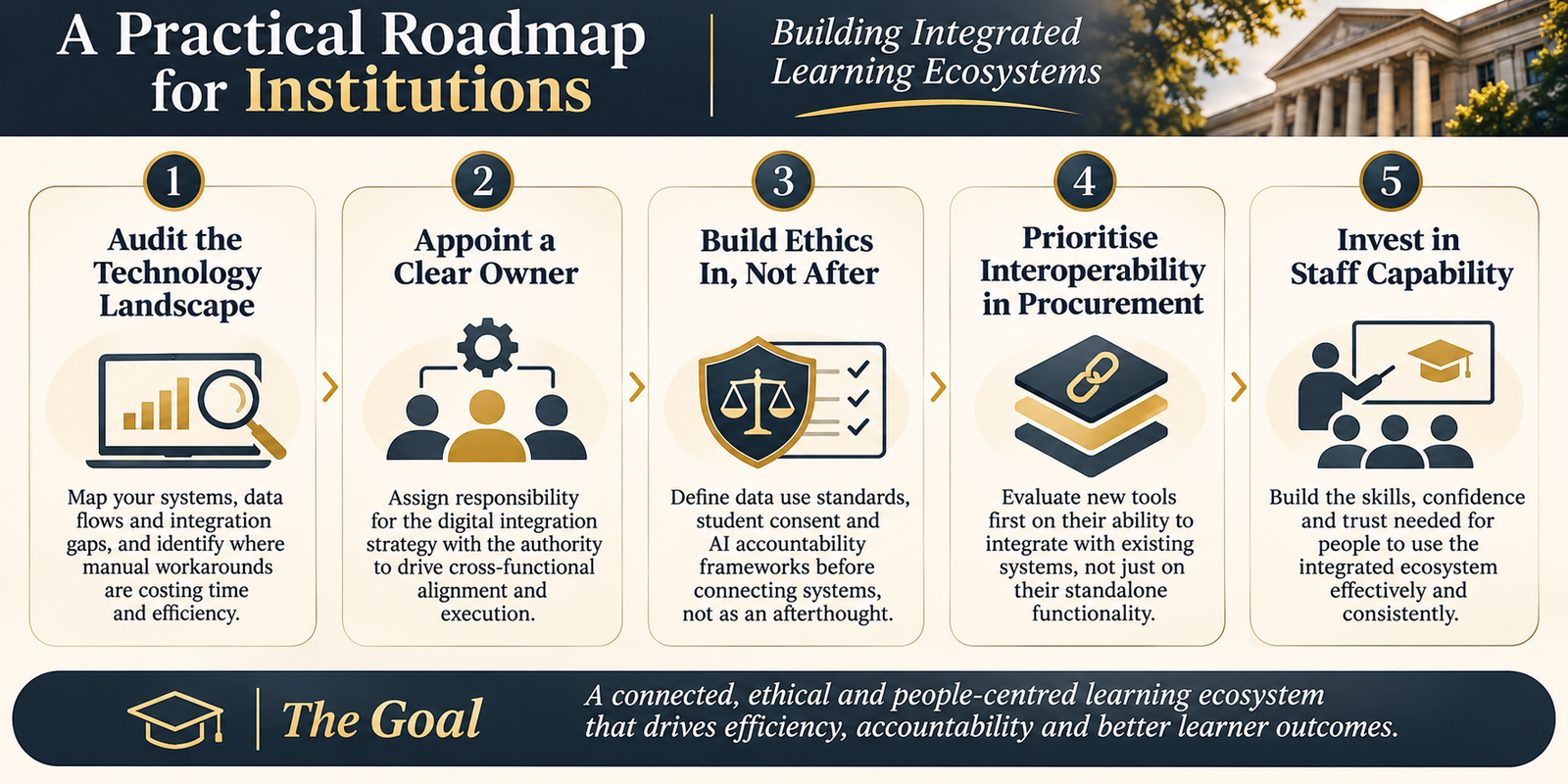
- Audit your current technology landscape for integration gaps. Map which systems hold what data, how they connect (or don't), and where manual bridging is consuming staff time.
- Appoint a clear owner for digital integration strategy. Cross-departmental committees without decision-making authority will not drive the coherence that ecosystems require.
- Build ethics into the integration architecture, not the governance afterthought. Define data use standards, student consent frameworks and AI accountability structures before connecting systems, not after.
- Prioritise interoperability criteria in every future procurement decision. New tools should be evaluated first on their ability to integrate, not just their standalone functionality.
- Invest in staff capability alongside system deployment. The most sophisticated ecosystem delivers no value if the people working within it do not understand it or trust it.
The Shift From Tools to Learning Ecosystems Is a Strategic Choice
Operational excellence in education will not be achieved by accumulating better tools. It will be achieved by institutions that make the harder, longer-term investment in coherence: in systems that share data, enforce ethics consistently and enable decisions that isolated platforms never could.
Learning ecosystems are not a technology destination. They are a continuous organisational commitment to integration, governance and improvement. The institutions that make that commitment now will build the infrastructure for a decade of educational innovation. Those that don't will spend that decade managing the consequences of fragmentation.
Frequently Asked Questions About Learning Ecosystems
What is a learning ecosystem in education?
A learning ecosystem is an integrated, ethically governed digital environment in which an institution's LMS, analytics, AI and administrative systems share data and workflows, rather than operating as disconnected tools. It is defined by a single source of truth, ethics built into the infrastructure and feedback-driven workflows.
Why do educational technology integration projects fail?
Most fail because of governance ambiguity rather than technical complexity. When no single leader or empowered team owns digital strategy, integration becomes a negotiation between departmental priorities, and the integrated vision loses out to local ones.
How can institutions integrate legacy systems without replacing them?
Through a phased strategy: establish shared data standards and a common identity framework first, integrate the highest-priority workflows next, then layer AI and analytics on top of the coherent data foundation.
How do learning ecosystems support ethical AI in education?
By embedding ethical standards, data-use rules and accountability structures into the architecture itself, so they apply consistently across every platform, instead of being checked selectively after the fact.