
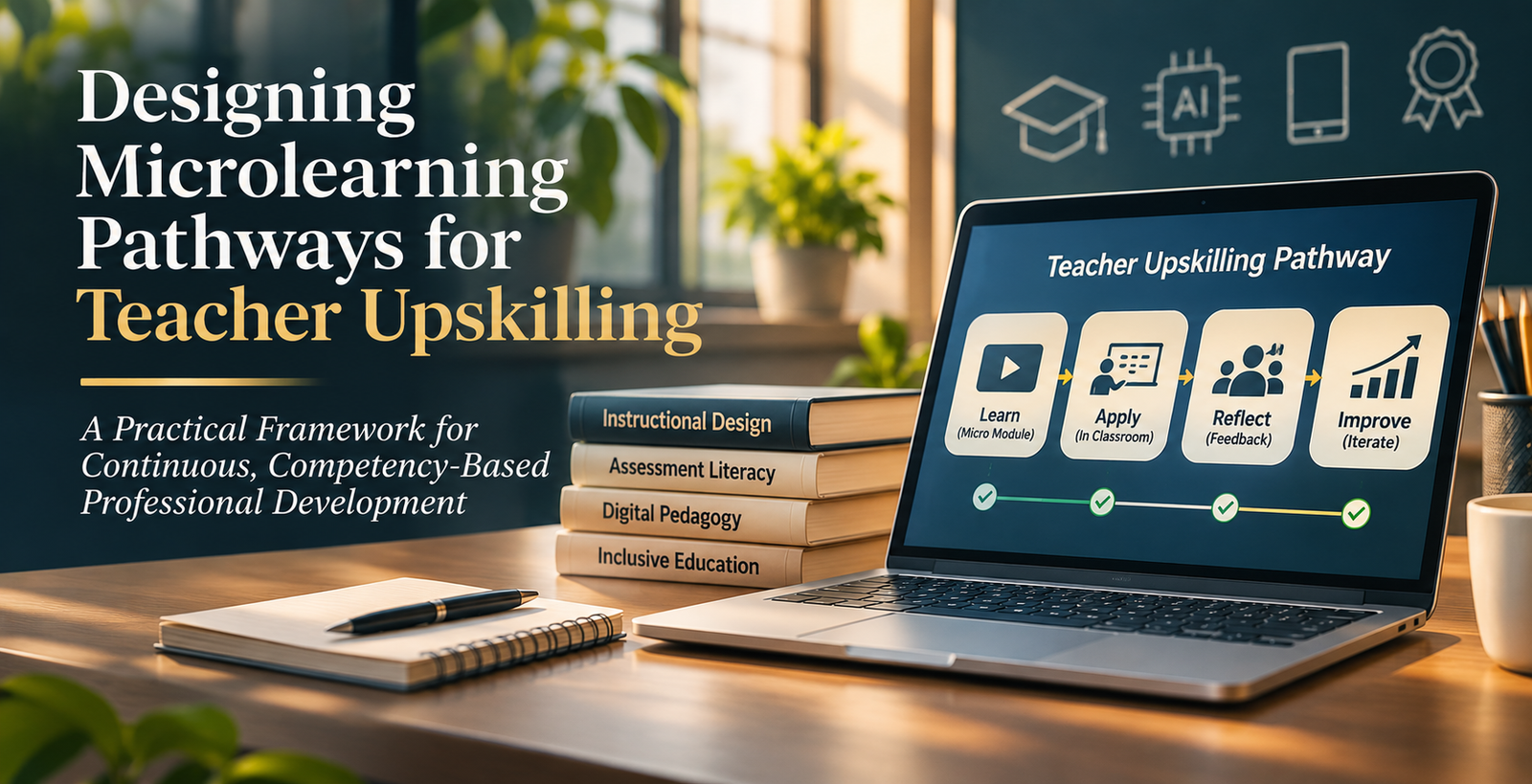
Designing Microlearning Pathways for Teacher Upskilling in K–12 Education

Designing microlearning pathways for teacher upskilling has become a strategic priority in K–12 education. Schools are adopting digital classrooms, personalised learning models and continuous professional development (CPD), and microlearning and modular education are now central to building agile, future-ready educators. Traditional professional development is often episodic and disconnected from classroom realities. Microlearning pathways offer structured, goal-oriented and flexible learning journeys in which teachers acquire, apply and refine skills in real time.
What Is a Microlearning Pathway for Teachers?
A microlearning pathway is not a collection of short modules. It is a deliberately sequenced learning architecture aligned with competency-based outcomes. Effective pathways break complex pedagogical skills into manageable units and build in repeated cycles of application, reflection and refinement.
Take a pathway on digital pedagogy. It might begin with a short module on student engagement strategies. A classroom implementation task, peer feedback and a reflective assessment follow. This keeps learning both actionable and grounded in the teacher’s own classroom. It also puts the principles of competency-based education into practice, with progress judged by demonstrated skill rather than time spent.
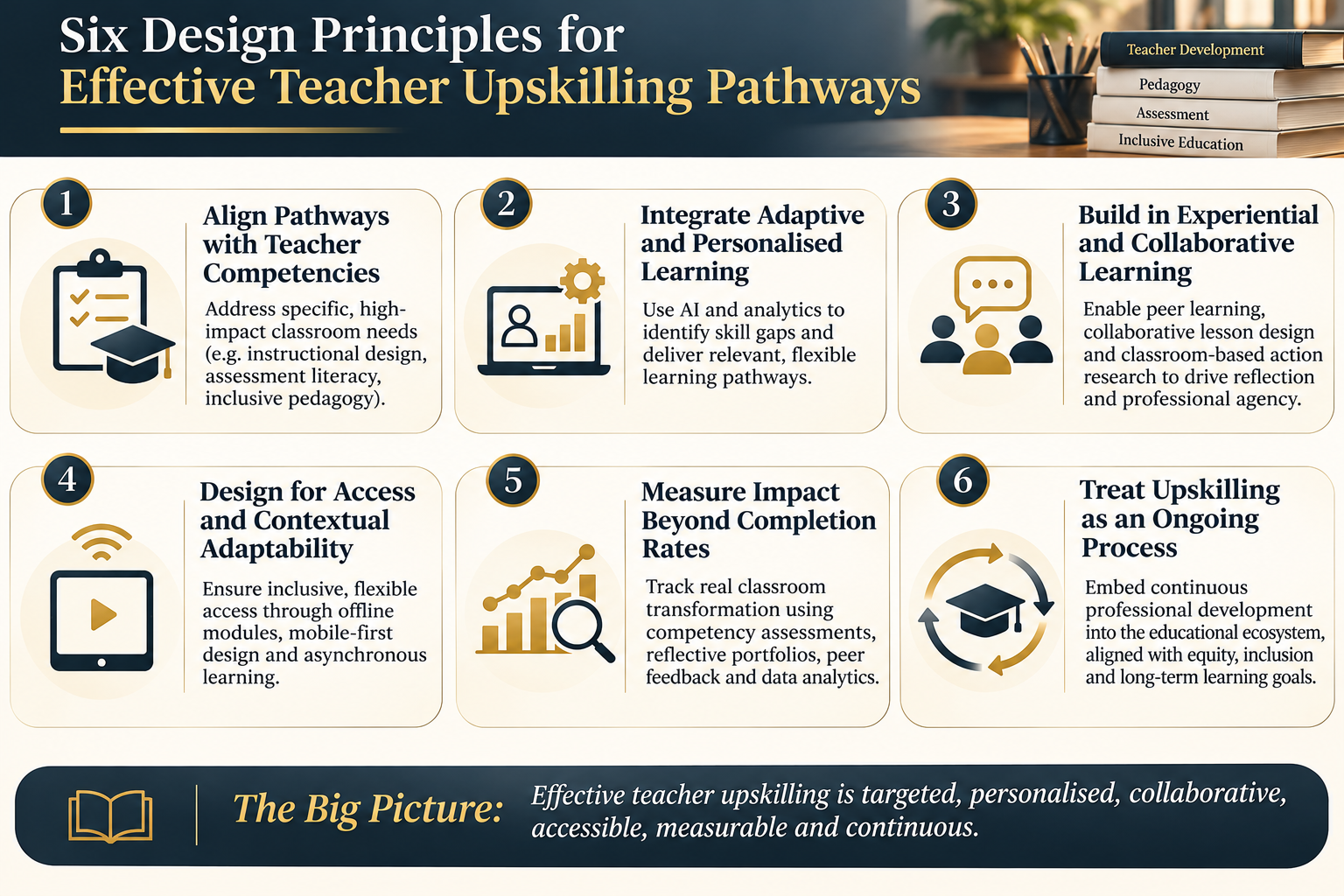
Six Design Principles for Effective Teacher Upskilling Pathways
1. Align pathways with teacher competencies and classroom needs
Map every pathway to clearly defined skill domains such as:
- Instructional design
- Assessment literacy
- Classroom management in digital environments
- Inclusive pedagogy
Rather than offering generic training, address specific, high-impact teaching challenges. This reflects the shift from compliance-based professional development to practice-based CPD, where learning is embedded in everyday teaching.
2. Integrate adaptive and personalised learning
Modern edtech lets microlearning platforms recommend modules based on a teacher’s performance, preferences and classroom context. AI-driven analytics can identify skill gaps and adjust the pathway dynamically, making teacher professional development more efficient and relevant.
Personalisation must be balanced with pedagogical coherence, though. Otherwise modular learning becomes fragmented and loses touch with broader educational goals. Institutions adopting AI-driven tools should also consider ethical EdTech infrastructure and the cybersecurity risks facing education institutions.
3. Build in experiential and collaborative learning
Teachers should be active participants in a learning ecosystem, not passive recipients of content. Strong pathways include:
- Peer learning communities
- Collaborative lesson design
- Classroom-based action research
Drawing on Vygotsky’s social constructivism and Schön’s concept of the reflective practitioner, effective pathways create space for dialogue, feedback and iterative improvement. In this sense, microlearning becomes a catalyst for professional agency, not just skill acquisition. A supportive environment matters here too, as we explore in why school culture matters as much as teaching itself.
4. Design for access and contextual adaptability
Pathways must work across diverse settings, including low-bandwidth and resource-constrained schools. Practical features include:
- Offline-accessible modules
- Mobile-first design
- Asynchronous learning formats
Meaningful professional development depends on the relevance and applicability of the learning experience, not the sophistication of the tools.
5. Measure impact beyond completion rates
Completion rates alone cannot show whether a pathway works. Evaluation should focus on classroom transformation: changes in instructional practice, student engagement and learning outcomes. More useful methods include:
- Competency-based assessments
- Reflective portfolios
- Peer evaluations
- Data analytics to spot patterns in learning behaviour and outcomes
6. Treat upskilling as an ongoing process
Professional development is no longer a one-time intervention. It is an iterative process embedded in the educational ecosystem. Policymakers and education leaders should invest in scalable platforms, foster a culture of continuous learning, and align CPD with goals such as equity, inclusion and experiential learning.
The Future of Teacher Upskilling: AI, Mobile Learning and Stackable Credentials
The convergence of microlearning with AI, mobile technologies and competency-based education will further redefine teacher upskilling. Stackable credentials and modular certification pathways point towards more flexible and transparent recognition of teacher competencies. Staying current with these shifts is easier through our EdTech & Technological Learning coverage.
Long-term success will depend on balancing efficiency with depth, so that microlearning supports critical thinking and pedagogical innovation as well as skill acquisition.
Frequently Asked Questions
What is a microlearning pathway for teachers?
A microlearning pathway is a sequenced set of short, focused modules aligned with teacher competencies. Each module is paired with classroom application, reflection and feedback, so teachers can learn and apply skills in real time.
How do you design microlearning pathways for teacher upskilling?
Start by mapping skill domains such as instructional design and assessment literacy. Then break each skill into short modules, add application and reflection tasks, build in peer collaboration, and measure impact through classroom change rather than completion rates.
How can AI support teacher professional development?
AI-driven analytics can identify skill gaps and recommend modules suited to each teacher’s performance and context. Pathways still need pedagogical coherence so that personalised learning does not become fragmented.
How do you measure the impact of microlearning on teaching?
Look at changes in instructional practice, student engagement and learning outcomes. Competency-based assessments, reflective portfolios and peer evaluations give a fuller picture than completion data.
Can microlearning work in low-bandwidth schools?
Yes. Offline-accessible modules, mobile-first design and asynchronous formats allow teacher upskilling to continue in resource-constrained environments.
From Fragmented Training to Cohesive Learning Journeys
Designing microlearning pathways for teacher upskilling is a paradigm shift in K–12 professional development. By combining modular flexibility with pedagogical rigour, these pathways enable continuous, context-responsive and experiential learning. Implemented well, they move beyond fragmented training to create cohesive learning journeys that improve both teaching practice and student outcomes. For education systems navigating digital transformation, they offer a scalable, sustainable way to build teacher capacity in the 21st century.