
Preventing Executive Burnout: The Cost of Always-On Leadership Culture

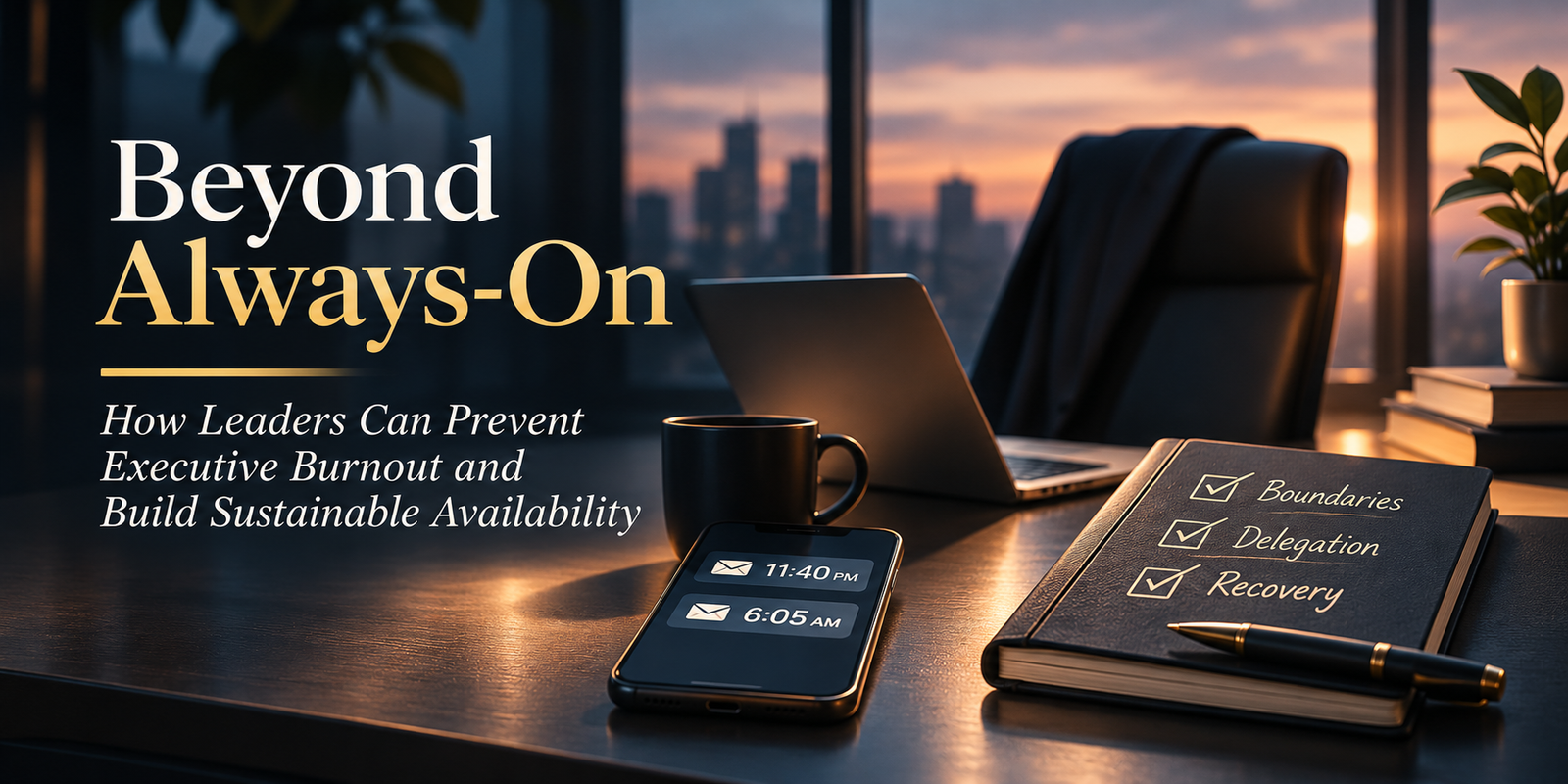
There is a particular kind of executive who replies to emails at 11:40pm and again at 6:05am, and who has, somewhere along the way, come to read this pattern as evidence of their own commitment. Often, their organization reads it the same way. Preventing executive burnout starts with correcting that reading, because near-constant availability isn't usually a sign of a leader who is thriving under pressure. It is frequently the earliest visible sign that they aren't.
This guide explains how always-on culture takes hold, what it costs senior leaders and their organizations, the burnout warning signs in senior leaders that most teams miss, and three practical steps for rebuilding executive availability on purpose.
How Always-On Culture Takes Hold in Leadership
Always-on culture wasn't designed. It accumulated: one urgent late-night message answered "just this once," one holiday interrupted by a call that felt unavoidable at the time, one leader modelling constant reachability until it quietly became the unwritten expectation for everyone below them.
The mechanism is worth naming precisely because it's so ordinary. Executive availability becomes a proxy for commitment in cultures that haven't built better ways to signal seriousness. Once that substitution happens, stepping back, even briefly, starts to feel professionally risky, regardless of what the actual policy says.
What Chronic, Unmanaged Availability Actually Costs
The costs of chronic work stress at the executive level rarely show up as a single dramatic event. They accumulate quietly, in ways an organization often notices only in retrospect.
- Decision quality erodes first. Leaders operating without genuine recovery windows tend to show narrower thinking under complexity: more reliance on familiar patterns, less genuine consideration of alternatives, and faster convergence on the first workable answer rather than the best one. The neuroscience of leadership and cognitive load explains why.
- Emotional regulation goes next. The capacity to stay calm and read a room accurately is cognitively expensive, and it is one of the first things to degrade under sustained strain. Leaders who are usually thoughtful become noticeably shorter with their teams, often without registering the change themselves. Building emotional resilience in high-pressure jobs is one way to catch this early.
- Then, eventually, the leader themselves. The executives who step away suddenly, mid-career, are disproportionately the ones who never built recovery into how they worked. The departure looks sudden from the outside. It rarely is from the inside.
Burnout Warning Signs in Senior Leaders: Recognizing the Early Signals
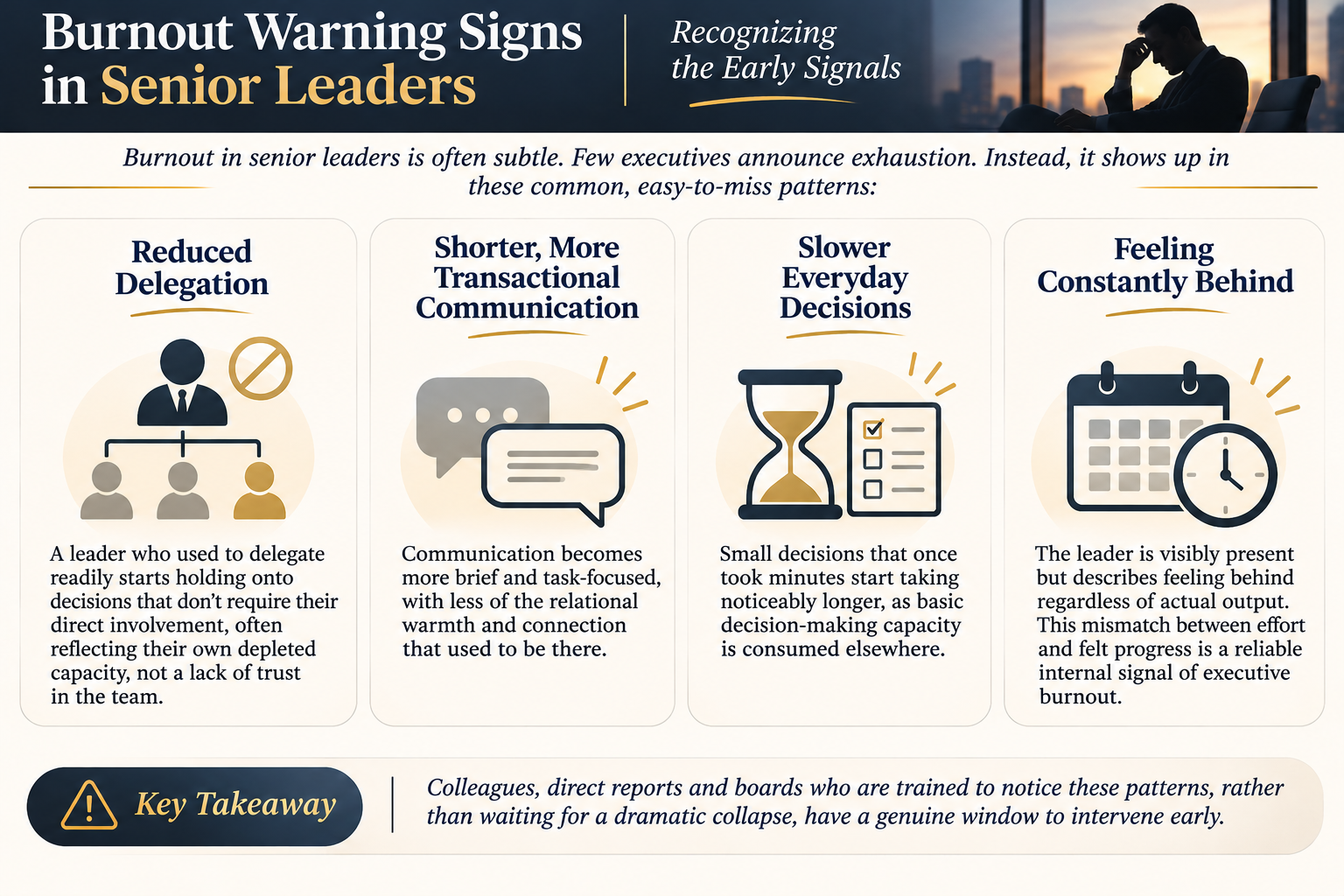
Burnout warning signs in senior leaders are frequently missed because they don't look like the textbook version. Few executives announce exhaustion. What tends to show up instead:
- Reduced delegation. A leader who used to delegate readily starts holding onto decisions that don't require their direct involvement. This subtle loss of trust in others often reflects depleted capacity in themselves, not a genuine judgment about the team.
- Shorter, more transactional communication, with less of the relational warmth that used to be there.
- Slower everyday decisions. Small decisions that once took minutes start taking noticeably longer, as basic decision-making capacity is consumed elsewhere.
- Feeling constantly behind. The leader is visibly present but describes feeling behind regardless of actual output. This mismatch between effort and felt progress is one of the more reliable internal signals of executive burnout in high-functioning people.
Colleagues, direct reports and boards who are trained to notice these patterns, rather than waiting for a dramatic collapse, have a genuine window to intervene before the cost becomes irreversible.
3 Steps for Preventing Executive Burnout: Rebuilding Executive Availability on Purpose
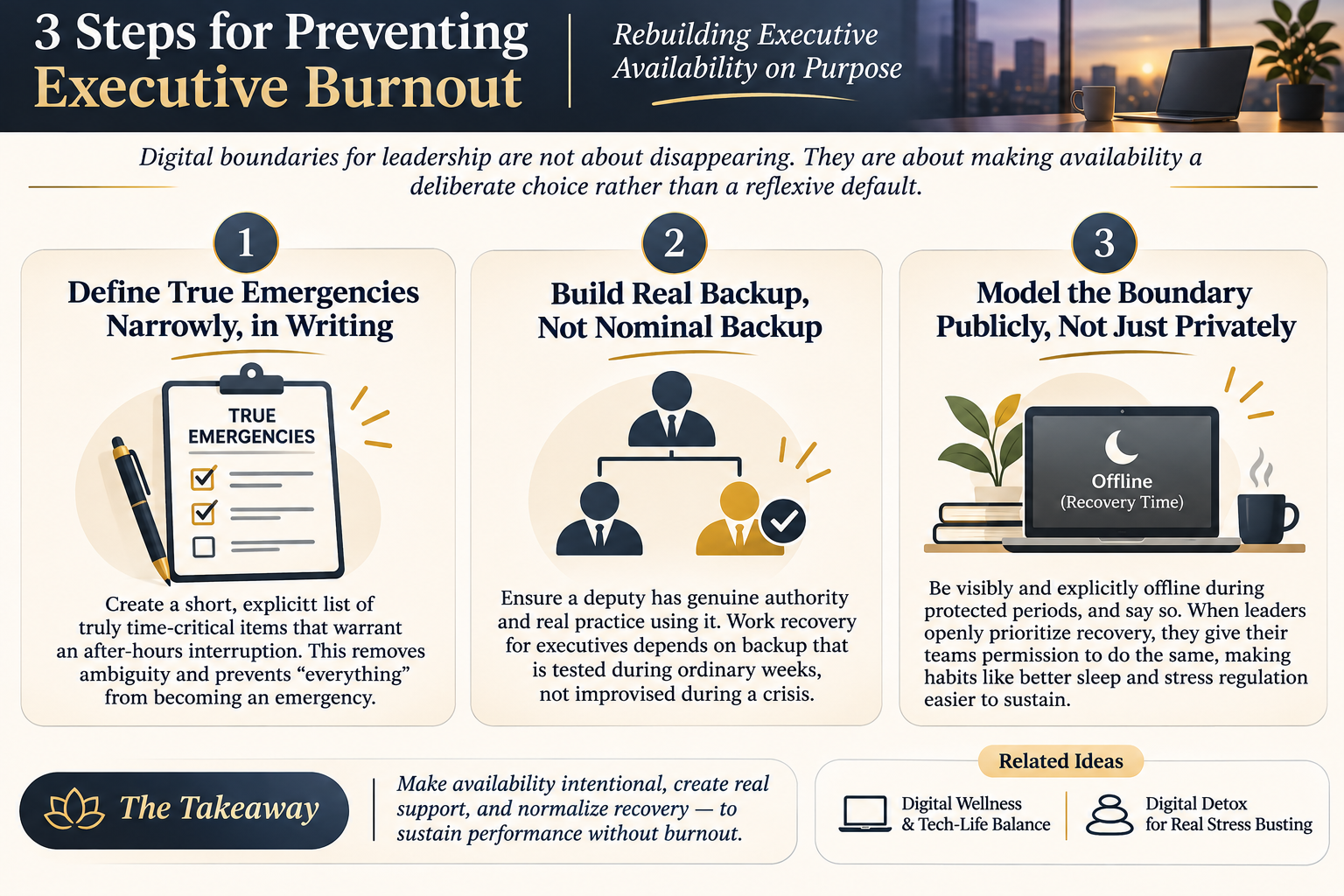
Digital boundaries for leadership are not about disappearing. They are about making availability a deliberate choice rather than a reflexive default. For related ideas, see our pieces on digital wellness and tech-life balance and digital detox for real stress busting.
Define true emergencies narrowly, in writing
Most organizations have never actually specified what warrants an after-hours interruption for their most senior leader. Left undefined, the category expands to include almost anything that feels urgent to whoever is sending it. A short, explicit list of genuinely time-critical items removes the ambiguity that currently defaults to "always."
Build real backup, not nominal backup
A deputy who is technically authorized to make decisions but never actually does so provides no real recovery for the primary leader. Work recovery for executives depends on backup that has genuine authority and genuine practice using it, tested during ordinary weeks rather than improvised during a crisis. The shift from control to continuity as businesses scale is a useful model for this kind of delegation.
Model the boundary publicly, not just privately
A leader who quietly protects their own recovery time without ever being seen doing so gives their team no permission to do the same. The organizations that shift this culture successfully tend to have a senior leader who is visibly, explicitly offline during protected periods, and who says so rather than hiding it. Recovery habits such as better sleep and body-based techniques to calm the mind are easier to defend when leaders are open about practicing them.
Why Executive Burnout Is a Leadership Culture Problem, Not a Personal Failing
It is worth being direct about something often left implicit in this conversation: struggling with always-on culture is not a personal weakness in the leaders experiencing it. It is frequently the predictable result of a system that has never built any other way to demonstrate seriousness.
The fix, correspondingly, is not more individual willpower. It is redesigning what the organization actually rewards, which is a leadership and culture problem, not a wellness-app problem. As we argue in Burnout Is Not a Personal Problem, burnout is often a leadership design flaw. Our guide to creating a mentally healthy workplace shows what that redesign can look like in practice.
Frequently Asked Questions About Preventing Executive Burnout
What causes always-on culture among executives?
Always-on culture typically develops gradually, as constant availability becomes an informal proxy for commitment. It is often modeled unintentionally by senior leaders and then absorbed as an unwritten expectation throughout the organization.
What are early warning signs of executive burnout?
Common early signs include reduced delegation, shorter and more transactional communication, slower everyday decision-making, and a persistent sense of being behind despite steady or high output.
How can organizations reduce always-on pressure on senior leaders without harming responsiveness?
By narrowly defining genuine emergencies in writing, building backup leadership with real (not nominal) decision-making authority, and having senior leaders visibly model protected offline time rather than only endorsing it in policy.
Is executive burnout an individual problem or an organizational one?
Both, but the organizational causes are the ones most often overlooked. When availability is read as commitment, individual leaders are rewarded for the behavior that leads to burnout, so lasting prevention requires changing what the organization rewards, not only coaching individuals.
The Takeaway: Remove the Penalty for Rest
Preventing executive burnout isn't a matter of persuading leaders to want rest more. It is a matter of removing the professional penalty that currently attaches to taking it. Until that changes, always-on will keep being read as commitment, right up until the leader it costs most quietly steps away.