Decision Fatigue in Leadership: How Senior Leaders Protect Their Best Thinking

A senior executive makes, by conservative estimate, dozens of consequential decisions on an ordinary day. Some are strategic and deliberate. Most are small and easy to overlook as decisions at all: which email gets a real answer, which meeting request gets accepted, which direct report's concern gets full attention rather than a distracted nod. Research on decision fatigue in leadership points to one consistent pattern across that volume: decision quality does not stay flat from the first choice to the fiftieth. It degrades, steadily and predictably, and most senior leaders have no system for protecting against it.
This guide explains what decision fatigue is, how to spot decision fatigue symptoms in yourself and your team, and which structural habits protect executive decision-making and long-term leadership performance.
What Is Decision Fatigue in Leadership?
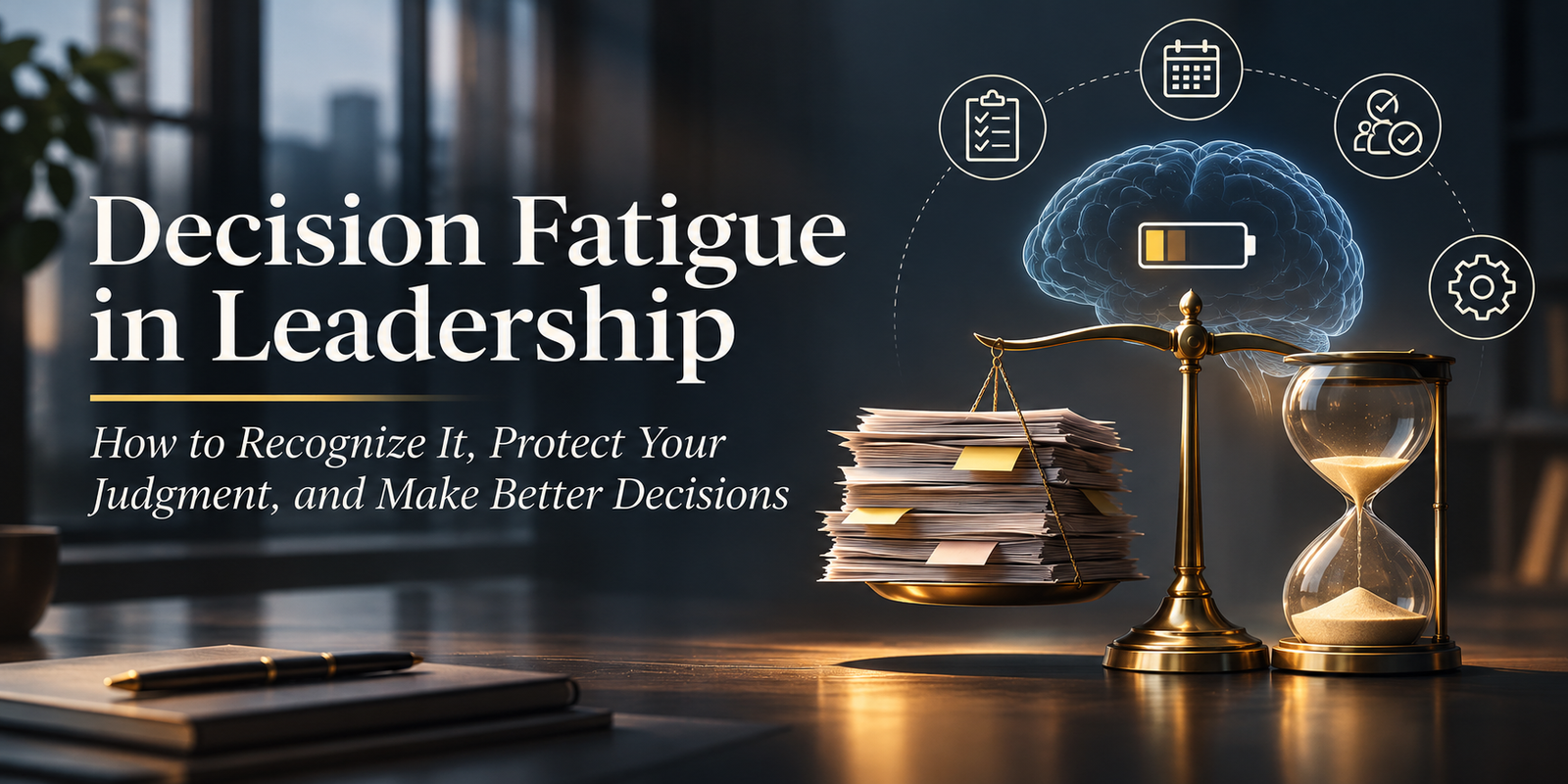
Decision fatigue describes the well-documented decline in decision quality that follows sustained decision-making, regardless of how important any individual choice is. It isn't about intelligence or discipline. It affects capable, well-intentioned leaders as reliably as anyone else, because it reflects a genuine limit on cognitive load rather than a character flaw.
The mechanism is straightforward: every decision, however small, draws on the same limited pool of mental resources. Spend that pool on fifty minor choices before lunch, and the fifty-first decision, which might be the most consequential of the day, gets made by a brain that has less left to give it, whether or not the leader is aware of the depletion.
Decision Fatigue Symptoms: Recognizing Depletion in Yourself and Others
Decision fatigue symptoms are frequently misread as something else entirely, usually as a values or character issue rather than a depleted-resource issue. Three patterns show up most often in senior leaders:
- Defaulting to the easiest option. A leader late in a demanding day starts choosing whichever option requires the least additional analysis, rather than genuinely weighing alternatives. It is often the status quo, or whatever a confident colleague proposed first.
- Rising irritability. Even small choices now feel disproportionately effortful, so frustration increases, particularly around decisions that would normally be straightforward. Building emotional resilience in high-pressure roles helps leaders notice this early.
- Avoiding the decision altogether. Leaders under decision fatigue become measurably more likely to defer, postpone, or ask for "more information" on choices they would ordinarily make quickly, because avoidance costs less immediate cognitive effort than a real decision does.
None of these patterns look, on the surface, like fatigue. They look like indecisiveness, irritability, or excessive caution. Leaders who can correctly identify them as depletion, in themselves and in the people around them, are far better positioned to respond appropriately instead of reading the pattern as a genuine change in judgment or character. Strong emotional intelligence in leadership and decision-making makes that kind of self-awareness much easier.
How to Protect Executive Decision-Making Capacity
The leaders who consistently make sound calls late on demanding days aren't simply more disciplined than everyone else. They have typically built specific structural habits that protect executive decision-making capacity rather than relying on willpower to overcome its natural limits.
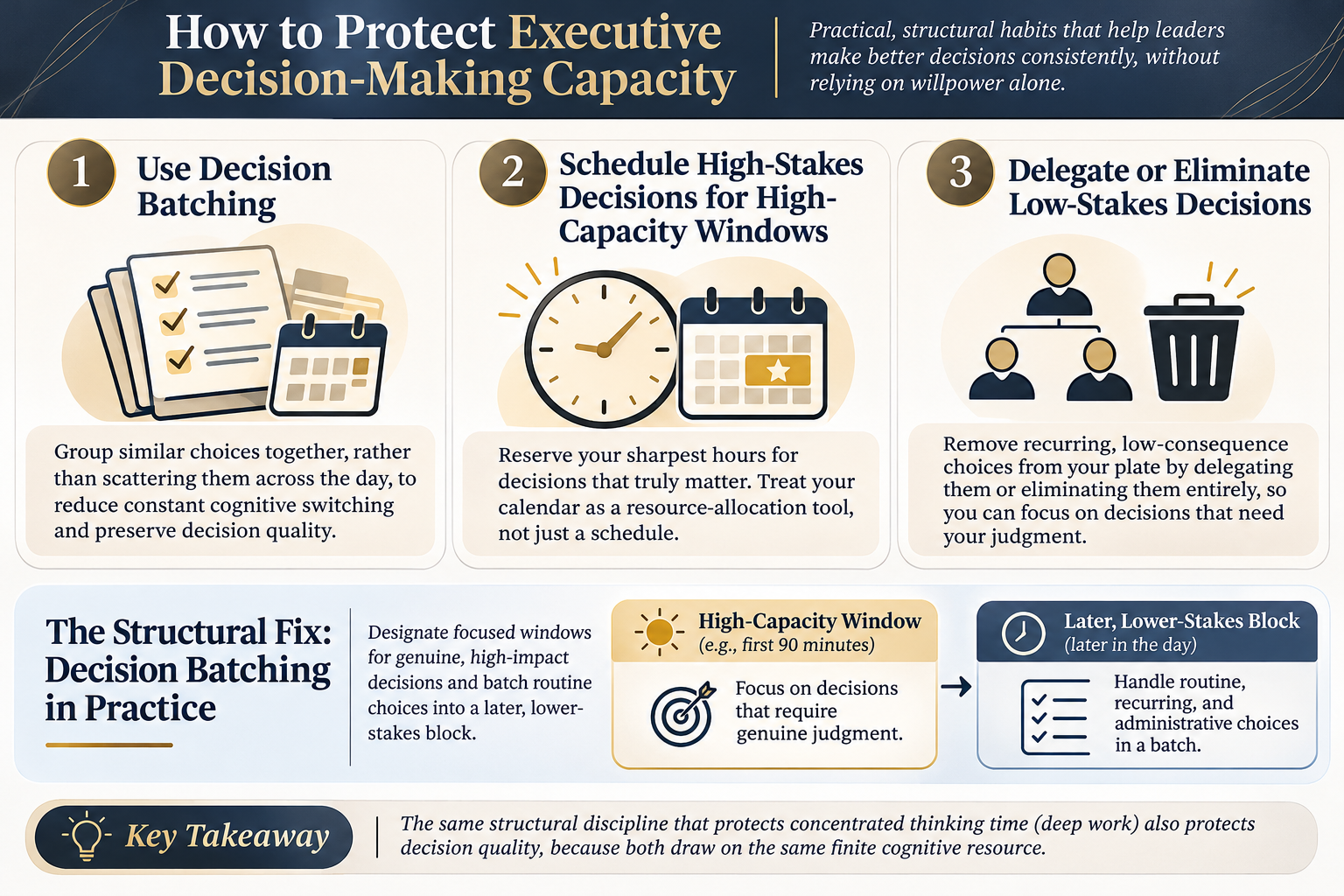
Use decision batching
Decision batching groups similar choices together, rather than scattering them across the day between unrelated work. That reduces the cognitive cost of constantly switching between different types of judgment. A leader who reviews all pending approvals in one focused block, rather than one at a time between meetings, preserves meaningfully more capacity for each individual decision.
Schedule high-stakes decisions for high-capacity windows
High-stakes decisions belong in genuinely high-capacity windows, not whatever slot happens to be free. The leaders who protect decision quality most effectively treat their calendar as a resource-allocation problem, not just a scheduling one. They reserve their sharpest hours, whenever those happen to be for them personally, for the choices that actually warrant that sharpness. For a wider framework, see our guide to decision-making under uncertainty for modern leaders.
Delegate or eliminate low-stakes decisions
Low-stakes decisions get delegated or eliminated outright, on purpose. Every recurring, low-consequence choice a senior leader keeps making personally, such as which vendor for a routine purchase or which format for a standard report, is capacity that isn't available for the decisions that need their judgment. Willpower depletion research suggests that removing these small decisions from a leader's plate delivers outsized returns relative to how trivial each one seems.
The Structural Fix: Decision Batching in Practice
Decision batching is the single most actionable habit on this list, so it is worth unpacking. In practice, it means designating specific windows, perhaps the first ninety minutes of the day before fatigue accumulates, exclusively for decisions requiring genuine judgment, and protecting that window as rigorously as any external meeting. Everything routine gets pushed outside it, batched into a lower-stakes block later in the day, when residual capacity is enough for choices that don't need peak sharpness.
This connects to a broader theme in our coverage of deep work for executives: the same structural discipline that protects concentrated thinking time also protects decision quality, because both draw on the same finite cognitive resource across a demanding day.
Why Decision Fatigue Matters More at the Top
Decision fatigue exists at every level of an organization, but its cost scales sharply with seniority. A depleted decision from a junior employee typically affects a single task. A depleted decision from a senior leader, made at 6pm on the fiftieth choice of the day when the temptation to default to the easiest option is highest, can shape strategy, culture, or capital allocation for years.
Protecting decision quality at the top isn't a personal productivity nicety. It is a genuine governance issue that boards and leadership teams have historically under-examined, which is why corporate governance is no longer just a boardroom issue. It is also a question of executive wellbeing: as we argue in Burnout Is Not a Personal Problem, many leadership strain problems are design flaws, not individual failings.
Frequently Asked Questions About Decision Fatigue in Leadership
What is decision fatigue in leadership?
Decision fatigue in leadership is the well-documented decline in decision-making quality that occurs after sustained decision-making over the course of a day. It is driven by depleted cognitive resources rather than any change in a leader's underlying judgment or character.
What are common decision fatigue symptoms in senior leaders?
Common decision fatigue symptoms include defaulting to the lowest-effort option rather than genuinely weighing alternatives, increased irritability around otherwise straightforward choices, and a measurable increase in avoiding or postponing decisions altogether.
How can leaders reduce the impact of decision fatigue?
Leaders can reduce decision fatigue by batching similar decisions together, scheduling high-stakes choices for their highest-capacity hours, and deliberately delegating or eliminating low-stakes recurring decisions. Those decisions quietly consume capacity better reserved for judgment calls that matter.
Why is decision fatigue a bigger risk for senior executives?
Because the cost of a poor decision scales with seniority. A depleted late-day decision by a senior leader can shape strategy, culture, or capital allocation for years, which is why decision quality at the top is a governance concern as well as a productivity one.
The Takeaway: Protect Your Judgment Deliberately
Research on decision fatigue in leadership points to an uncomfortable but useful truth: a senior leader's judgment is not a constant resource available equally at 8am and 8pm. It is finite, and it depletes with use. The leaders who protect it deliberately, through decision batching, smart scheduling and disciplined delegation, consistently make sounder calls than those relying on willpower alone to push through the decline.