The Business Models Set to Dominate 2026 (And Why Others Are Fading)

As 2026 unfolds, the global economy is undergoing a structural reset driven by data, automation, and intelligent systems. The defining question is no longer whether business models will evolve—but which ones will lead. The Business Models 2026 landscape is being shaped by platform dominance, subscription-driven predictability, digital ecosystems, and AI-enabled intelligence.
With 2026 unfolding, the business landscape is undergoing a structural reset. Platforms like Amazon and TikTok are projected to cross $2 trillion in combined revenue, while traditional, asset-heavy retail chains continue to shut down under pressure from AI, automation, and shifting consumer behaviour. This is not speculation—it is the natural outcome of business model innovation driven by data, networks, and intelligent systems.
What’s becoming clear is this: platform business models, subscription-based business models, digital ecosystems, and AI-enabled operating models are pulling decisively ahead. Meanwhile, linear, transaction-heavy models are steadily losing relevance.
This Business Excellence pillar analysis, within our Business Models cluster, breaks down why some models are scaling effortlessly—and why others are quietly fading.

Platform Business Models in 2026: Powering Network Effects
Platform business models no longer simply connect buyers and sellers—they orchestrate entire markets.
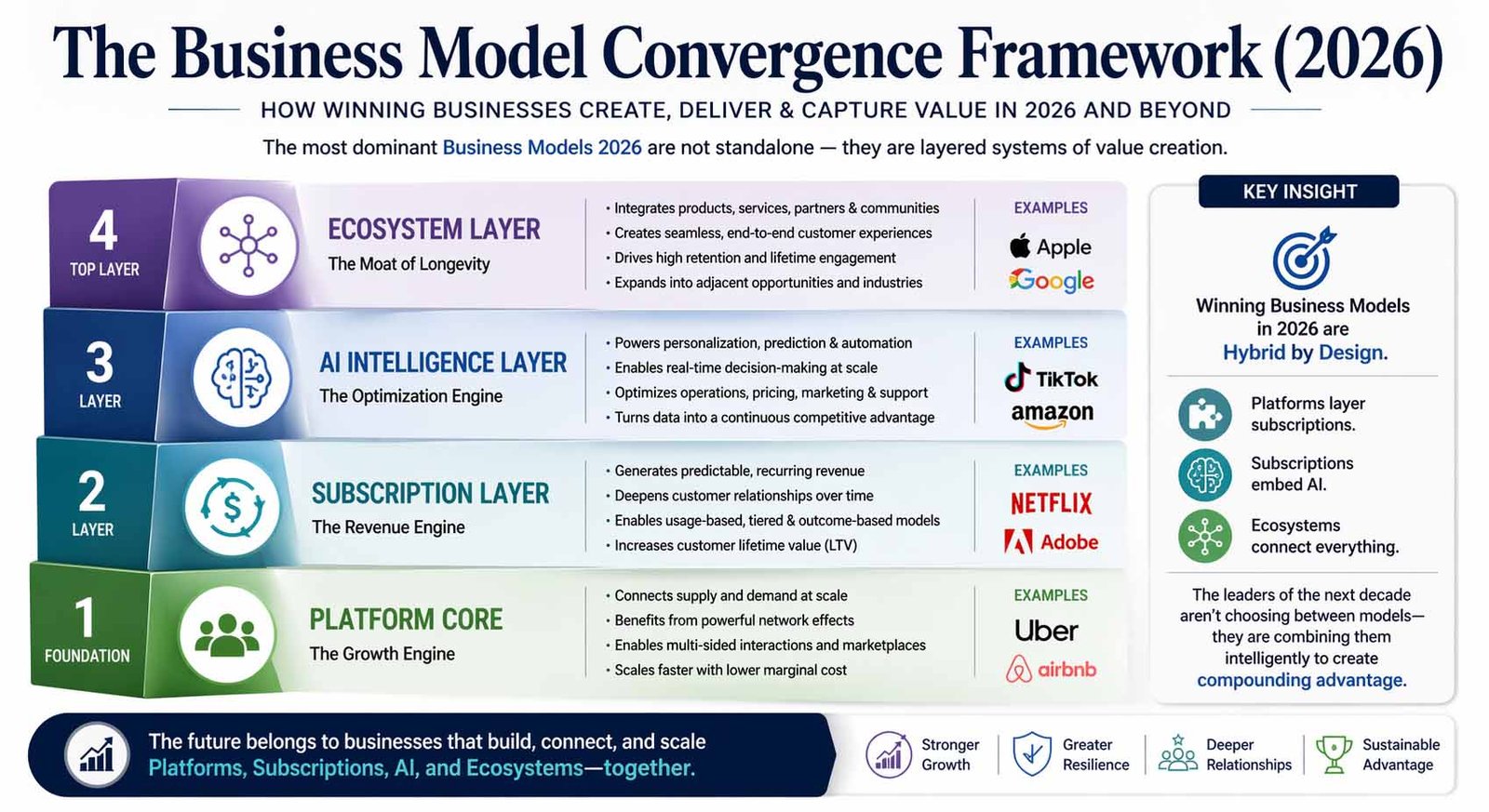
By enabling interactions without owning underlying assets, platforms such as Airbnb, Uber, Amazon Marketplace, and TikTok Shop scale faster, learn continuously, and adapt in real time. What changes in 2026 is the AI layer supercharging this flywheel.
AI-driven platforms are expected to deliver:
- Demand prediction accuracy above 90%
- Customer churn reduction of up to 40%
- Record-high supplier and inventory utilisation
Live commerce exemplifies this shift. TikTok’s rapid rise in commerce shows how entertainment, discovery, and transaction now collapse into a single loop. Each new user improves targeting, each creator attracts merchants, and each transaction sharpens the algorithm.
Platforms are no longer just commerce engines—they dominate attention, advertising, and distribution.
Subscription Business Models in 2026: Driving Predictable Growth
In uncertain economies, predictability becomes a strategic advantage.
Subscription-based business models—spanning SaaS, media, education, and even mobility—continue to outperform one-time transaction models because they convert customers into long-term relationships, not isolated sales.
In 2026, AI reshapes subscriptions through:
- Adaptive pricing tiers
- Usage-based upgrades
- Predictive churn management
- Personalised value bundles
Companies like Netflix, Adobe, and leading SaaS firms are shifting toward outcome-based subscriptions, where value continuously recalibrates based on customer behaviour.
Forecasts place the subscription economy at $1.5 trillion, while traditional linear sales models continue to contract.
Ecosystems: The New Moat of Business Excellence
If platforms are highways, ecosystems are entire cities.
Ecosystem-based business models integrate hardware, software, services, partners, and data into a seamless experience. Customers don’t just buy—they stay.
By 2026, leading ecosystems are evolving through:
- AI-powered handoffs across devices and services
- Unified identity and payment layers
- Cross-industry integrations spanning health, finance, mobility, and media
Retention within strong ecosystems is projected to be up to 3× higher than standalone offerings—making ecosystems one of the strongest defensible advantages in modern strategic management models.
AI-Driven Business Models in 2026: Intelligence at Scale
AI is no longer a feature—it is becoming the operating system.
In 2026, AI-enabled business models move beyond analytics into autonomous decision-making:
- AI agents negotiating purchases
- Predictive supply-chain orchestration
- Automated sales and customer service
- Dynamic pricing and product optimisation

Businesses without embedded intelligence increasingly feel slow, expensive, and outdated by comparison.
Why Linear Business Models Are Fading
Traditional linear models—those dependent on:
- One-time transactions
- Physical scale without digital leverage
- Manual decision-making
- Narrow differentiation
are structurally disadvantaged.
Without network effects, recurring revenue, or AI-driven optimisation, these models struggle to defend margins or respond to shocks. Forecasts suggest up to 30% of large enterprises face disruption or irrelevance if they fail to adapt their business model canvas for the digital era.
Conclusion: The Hybrid Future of Business Excellence
The defining insight of 2026 is this:
Winning business models are hybrid by design. Platforms layer subscriptions. Subscriptions embed AI. Ecosystems connect everything.
The leaders of the next decade aren’t choosing between models—they are combining them intelligently.
The defining insight from the Business Models 2026 landscape is clear: the future does not belong to a single model, but to those that combine them intelligently. Platforms are embedding subscriptions, subscriptions are leveraging AI, and ecosystems are connecting it all into seamless value networks. As market dynamics accelerate, businesses that remain linear and reactive will struggle to compete. The advantage will lie with organisations that redesign their operating logic around adaptability, intelligence, and long-term engagement. In this new era, business model innovation is not a strategy—it is the foundation of sustained growth and relevance.