The Future of Robotics: How Smart Systems Are Revolutionizing Healthcare, Education, and Everyday Life

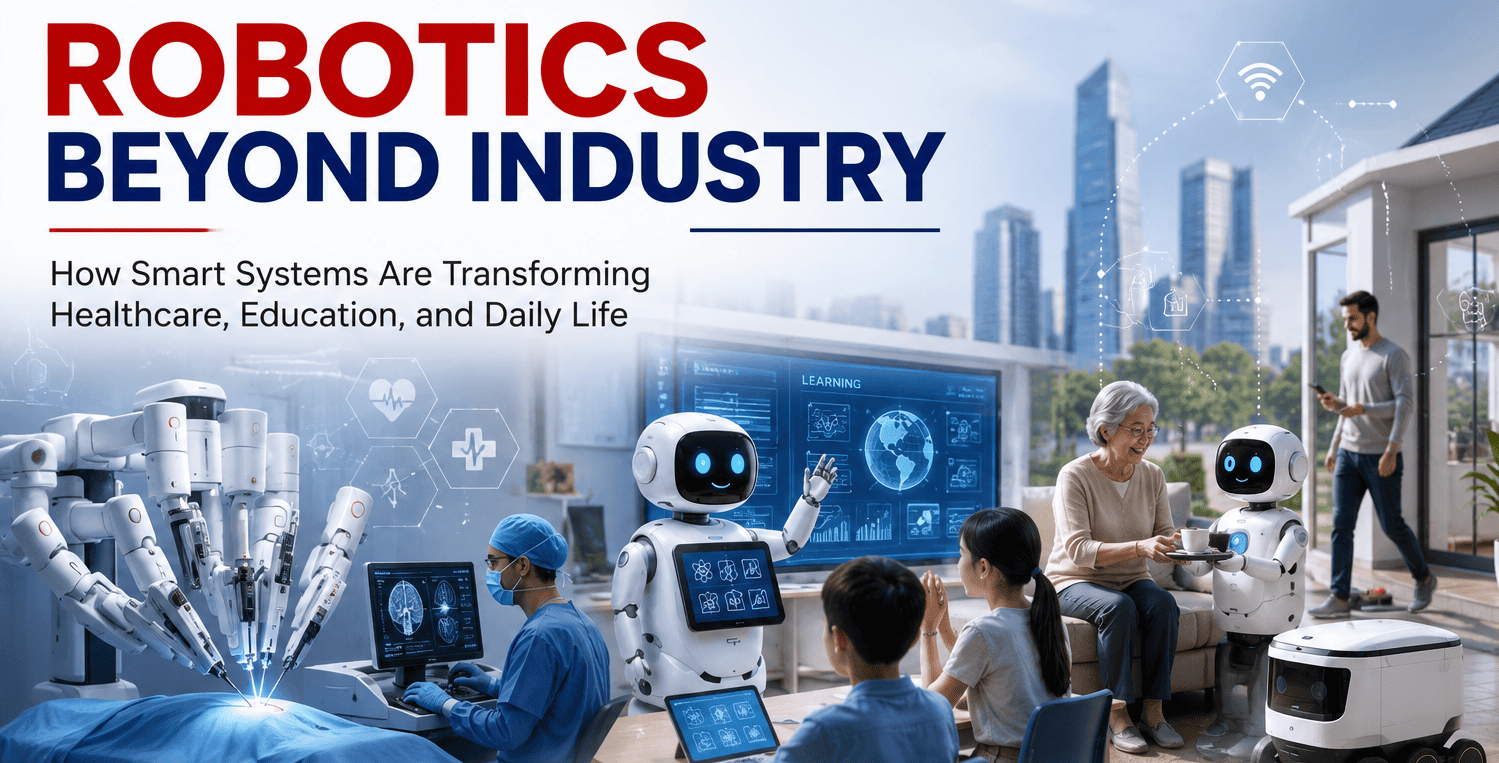
Robotics beyond industry is not a prediction. It is already happening, quietly and persistently, in the spaces where human life is most fragile and most formative. The operating theatre.
The special education classroom. The home of an 84-year-old living alone. Smart robotic systems — once the exclusive property of automotive assembly lines and warehouse logistics — have crossed a threshold.
They are now embedded in the fabric of how we heal, how we learn, and how we age. The question is no longer whether this transformation is real. The question is how fast it is moving, and whether society is ready to receive it.
For decades, the popular imagination of robotics was calibrated to the wrong image: steel arms on conveyor belts, sparks in a factory at 3 a.m. That image was never wrong — it simply was never the whole picture. The robots that will define the next twenty years are softer, smarter, and far more intimate. They are trained not on bolt specifications but on human behaviour, on emotional cues, on the messy, unstructured, deeply personal demands of everyday existence.
_1784002774.png)
What Does Robotics Beyond Industry Actually Mean?
Robotics beyond industry refers to the deployment of smart robotic systems outside traditional manufacturing and factory environments. It encompasses service robots, surgical robots, educational robots, companion robots, and autonomous domestic assistants — any intelligent robotic system designed to operate in human-facing, unstructured environments like hospitals, schools, care homes, and private residences.
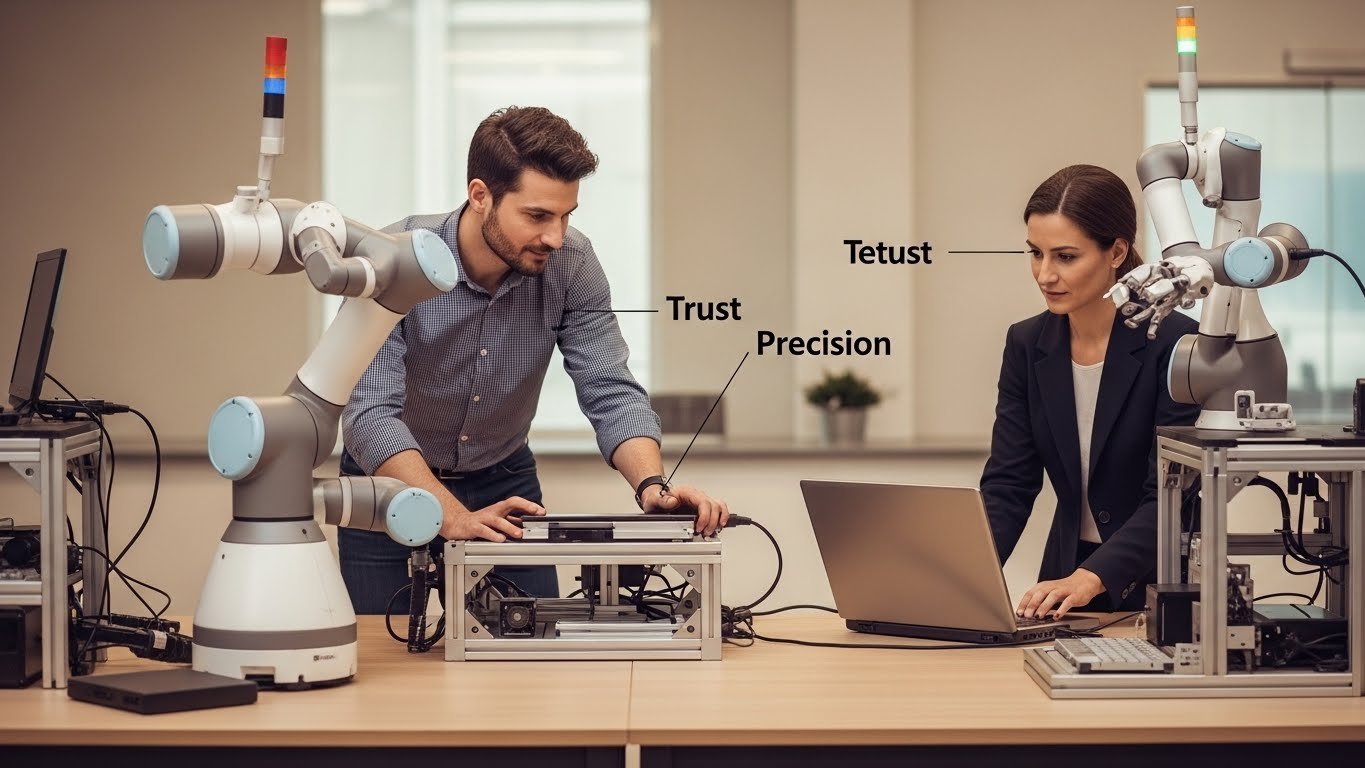
The distinction matters because it reframes what we demand of a robot entirely. Industrial robots are optimised for precision in controlled, predictable environments. Robots beyond industry must navigate chaos: a patient who moves unexpectedly, a child who cries, a corridor full of unpredictable people. This demands not just mechanical precision but adaptive intelligence — the capacity to sense context, adjust in real time, and operate safely alongside humans. That is a fundamentally different engineering problem, and its solution is what is now arriving at scale.
Robotics in Healthcare: From Surgical Suites to Bedside Companions
Healthcare is the domain where the impact of smart robotic systems is most immediate and most measurable. The stakes are not productivity metrics — they are human lives. And the evidence is accumulating in a way that is increasingly difficult to dismiss.
Surgical Robots and Precision Medicine
The da Vinci Surgical System, developed by Intuitive Surgical, has now been used in over 10 million procedures globally. Its robotic arms translate a surgeon's hand movements into micro-scale precision that no unassisted human hand can reliably reproduce. But surgical robotics is evolving past the da Vinci model. New systems incorporating machine learning can now flag anomalies during procedures in real time — detecting early signs of complications before they become crises, effectively giving surgeons a second pair of eyes that never blink and never tire.
Rehabilitation Robots and Patient Recovery
Post-stroke rehabilitation is one of the most labour-intensive and emotionally demanding fields in medicine. Robotic exoskeletons — such as the Ekso Bionics suit — now enable paralysed patients to begin walking recovery earlier and with more consistency than traditional physiotherapy alone can offer. According to a Lancet Neurology study (2024), patients using robotic-assisted rehabilitation showed 34% faster motor recovery compared to control groups receiving standard physiotherapy. The robot does not replace the therapist. It amplifies the therapy.
Companion Robots and Elderly Care
Loneliness in elderly populations is a public health crisis. PARO, the therapeutic robot developed by Japan's National Institute of Advanced Industrial Science and Technology, has been used in care homes across seventeen countries to reduce anxiety and depression in elderly patients — including those with dementia. It does not pretend to be a human. It is, conspicuously, a soft robotic seal. And yet the research consistently shows measurable improvements in emotional wellbeing. The mechanism is not deception — it is engagement, reliably delivered at scale.
The robot in healthcare does not aim to replace the nurse. It aims to give the nurse back the time to be human — to sit, to listen, to hold a hand. The machine handles the logistics. The human handles the meaning.
_1784002425.png)
Robotics in Education: The Classroom Gets a New Kind of Teacher
The case for robotics in education rests on a simple but uncomfortable truth: traditional pedagogy was designed for the average student. It was never built to simultaneously engage the child who processes information visually, the one who needs kinetic reinforcement, and the one whose anxiety makes group learning impossible. Educational robots do not teach better than great human teachers — but they do something great human teachers cannot always do: they adapt continuously, patiently, and without fatigue.
STEM Robots and Hands-On Learning
Robots like NAO, developed by SoftBank Robotics, and Dash & Dot by Wonder Workshop are now deployed in primary schools across Europe, Asia, and North America to teach coding, logical reasoning, and collaborative problem-solving. A 2025 OECD education report found that classrooms using interactive robotics in STEM instruction saw a 28% improvement in student engagement scores and a 19% increase in girls opting into advanced mathematics — a data point with implications far beyond the classroom.
Robots and Inclusive Education for Special Needs
Perhaps the most quietly revolutionary application of educational robotics is in inclusive education. Children with autism spectrum disorder, for instance, often find human social interaction overwhelming — the unpredictability of human facial expressions and tone creates a barrier that traditional teaching cannot always cross. Robots, by contrast, are predictable, non-judgemental, and patient. Research published in the Journal of Autism and Developmental Disorders found that children with ASD demonstrated measurably improved social communication skills after structured robot-assisted therapy sessions — skills that then transferred to human interactions. The robot served as a bridge, not a destination.
Smart Robotic Systems and the Transformation of Daily Life
Beyond hospitals and classrooms, human-robot interaction is becoming a feature of ordinary domestic existence. This is not the science-fiction vision of humanoid robots serving dinner. It is quieter, more granular, and far more useful: a robotic vacuum that learns your household's movement patterns. An autonomous delivery robot that navigates your street. A smart prosthetic limb that reads muscle signals and responds within milliseconds.
Domestic Robots and Household Autonomy
The global home robotics market, valued at $9.1 billion in 2024 according to Statista, is projected to reach $180 billion by 2030 as autonomous domestic assistants move from single-function devices toward multi-capability platforms. The convergence of computer vision, natural language processing, and dexterous manipulation is producing machines that can load a dishwasher, sort laundry, and remind elderly residents to take medication — all without a dedicated operator.
Smart Prosthetics and Personal Mobility
For the estimated 57 million people globally living with limb loss or limb difference (Amputee Coalition, 2024), smart prosthetics represent a transformation in embodied autonomy. Bionic hands like the Ossur i-Limb use electromyographic sensors to detect muscle contractions and translate them into grip patterns with over 36 distinct positions. The gap between a prosthetic limb and a biological one is narrowing — not to zero, but to something closer to functional equivalence than any previous technology has managed.
We built robots to do what humans couldn't be bothered to do. We are now building robots to do what humans, for all their effort, simply cannot do well enough alone.
The Ethical Challenges of Service Robots in Human Spaces
No honest account of service robots and smart systems in human life can ignore the tensions they introduce. Privacy is the sharpest edge. Companion robots in care homes gather behavioural data. Educational robots build longitudinal profiles of children's learning patterns. Domestic assistants map the physical and behavioural geography of private homes. Who owns that data? Who audits the algorithms that act upon it? These are not hypothetical concerns — they are live regulatory debates in the European Union, the United States, and across Southeast Asia.
The equity dimension is equally urgent. The households and healthcare systems that can afford advanced robotic systems today are, overwhelmingly, in high-income contexts. If the productivity and care gains of smart robotics accrue only to those already resourced, the technology does not solve inequality — it deepens it. The conversation about autonomous robots and social impact cannot remain solely technological. It must become political, distributional, and urgently public.
Key Benefits of Smart Robotic Systems Beyond Industry
Precision in high-stakes environments — surgical robots reduce human error in complex procedures
Tireless, consistent care delivery — companion and rehabilitation robots operate without fatigue
Personalised, adaptive learning — educational robots adjust pace and method to individual students
Extended independence for vulnerable populations — domestic and mobility robots support elderly and disabled users
Scalable expertise — smart systems bring specialist-level assistance to under-resourced settings
The Future of Robotics Beyond Industry: Where the Trajectory Points
The trajectory of robotics beyond industry bends toward ubiquity. Not the cold, alienating ubiquity of surveillance infrastructure, but something more like the ubiquity of electricity — a presence so integrated into the structure of daily life that its absence becomes unthinkable. The hospital that operates without surgical robotic assistance. The classroom that cannot adapt to a neurodiverse learner. The elderly person who has no robotic companion during the eighteen-hour gap between care visits. These will come to seem not like normal baselines, but like failures of provision.
The leaders and institutions that will shape this transition most productively are not those racing to deploy the most advanced systems. They are those asking the harder, slower questions: Who is this for? What are the conditions of its ethical use? How do we ensure the benefits compound across society rather than concentrating at its peaks? Smart robotic systems are no longer a promise on the horizon. They are here, operational, and consequential. The only question that remains is the quality of the human judgement that governs them.
Frequently Asked Questions
What does robotics beyond industry mean?
Robotics beyond industry refers to the application of smart robotic systems outside traditional manufacturing and factory settings — spanning healthcare, education, elder care, domestic assistance, and public services. These robots are designed to operate in unstructured, human-facing environments and interact directly with people.
How are robots being used in healthcare today?
Robots in healthcare are used for surgical assistance (such as the da Vinci system, used in over 10 million procedures globally), medication delivery, rehabilitation therapy via exoskeletons, companion care for elderly patients, and hospital logistics. AI-driven robotic systems can now detect surgical complications in real time, improving patient outcomes significantly.
What are the benefits of robots in education?
Educational robots improve learning outcomes through interactive, personalised instruction. They support students with special needs — particularly children with autism spectrum disorder — teach coding and STEM skills, and adapt their pace to individual learning profiles. Research shows a 28% improvement in student engagement in classrooms that use robotic learning tools.