

Platform vs Product: Why Ecosystem-Led Businesses Are Winning

Seven of the world's ten most valuable companies by market capitalization are platform businesses. They do not manufacture the world's most-used products or own the world's largest inventories. They own the networks through which others create, exchange, and consume value. This is not a coincidence. It is the logical outcome of a fundamental shift in how competitive advantage is built in the modern economy. Unlike product companies that create value internally, platform businesses enable value creation between users, partners, and developers. This shift from ownership to orchestration is not just strategic, it is structural, and it explains why ecosystem-led companies are consistently outperforming traditional firms. Understanding why ecosystem-led businesses are winning requires examining not just what platforms do differently, but why those differences compound over time into structural advantages that product-led firms find increasingly difficult to close.
What is the difference between a platform and a product business model?
A product business creates and delivers value through goods or services it owns and produces internally, scaling primarily through production and sales. A platform business, by contrast, facilitates interactions between users, enabling them to create and exchange value. Platforms scale through network effects, where each additional participant increases value for others.
Platform Business Model vs Product Model: A Fundamental Shift
At its core, the difference between a platform business model and a product model is a difference in the direction of value creation. Product-led businesses build value internally. They design, manufacture, and distribute. Their competitive advantage lies in operational efficiency, proprietary technology, or brand equity, all of which are owned assets that depreciate or can be replicated. They operate in linear supply chains, scaling through production volume and facing the diminishing returns that come with physical and organisational limits.
Platform or ecosystem-led businesses, by contrast, build value externally. As Parker, Van Alstyne, and Choudary argue in Platform Revolution (2016), platforms invert the firm, shifting value creation from inside the organisation to interactions between users. The platform does not produce the value; it governs the conditions under which participants produce it for each other.
This reconfiguration has profound strategic implications. A hotel chain scales by building more hotels. Airbnb scales by adding more hosts. A taxi company scales by hiring more drivers. Uber scales by expanding its network. The asset base required for each additional unit of growth is fundamentally different, and that difference accelerates as the network grows. This is not just a structural distinction, it is the foundation of platform strategy, where advantage is built through ecosystem design rather than internal optimisation.
According to research by Sangeet Paul Choudary, platform businesses generate approximately 20–30% higher profit margins than equivalent product businesses operating in the same sectors, driven primarily by the absence of production costs for the value exchanged on the platform. While product companies must invest to grow, platforms invest once in infrastructure and then orchestrate growth through participation.
How do Network Effects Give Platform Businesses a Structural Advantage?
No concept is more central to understanding the platform economy than network effects. In a product business, adding one more customer does not make the product more valuable to existing customers. In a platform business, it typically does. Each additional user, developer, or producer who joins a platform increases the value of the system for everyone already in it. More drivers make Uber more useful to riders. More sellers make Amazon Marketplace more useful to buyers.
More developers make iOS more valuable to iPhone owners. This self-reinforcing dynamic, what economists call demand-side economies of scale, is structurally unavailable to product companies and represents the primary engine of platform dominance. A higher number of sellers also make Amazon Marketplace more useful to buyers, illustrating the marketplace business model, where the platform’s primary role is to match supply and demand efficiently rather than produce goods itself.
The practical consequences of network effects are significant and compound quickly. Platforms that achieve critical mass in their markets tend to experience rapid, non-linear growth with relatively modest marginal cost increases. They generate high switching costs, users who have built reputations, connections, or workflows within a platform face real friction in leaving. And they create self-reinforcing growth loops where scale attracts participants, participation generates data, data improves the platform, and an improved platform attracts more scale.
This dynamic explains why platform markets tend toward concentration. A 2021 analysis by the OECD found that in digital markets characterised by strong network effects, the top two players typically capture over 70% of market value, a winner-take-all or winner-take-most outcome that product markets rarely produce. It is not that platform companies are better managed. It is that the structural economics of network effects reward scale in ways that are qualitatively different from production-based competition. These dynamics are typical of a two-sided market, where platforms connect distinct user groups and create value through their interactions.
Why do Platforms Function as Economic Infrastructure, Not Just Technology?
A persistent misconception about platform businesses is that they are primarily technology companies. They are not. Technology is the mechanism. The strategic reality is that successful platforms function as economic infrastructure, they do not participate in markets so much as they reconfigure them and questions who really would be held accountable.
This distinction matters enormously for understanding platform power. As Van Dijck, Poell, and de Waal argue in The Platform Society (2018), platforms operate as gatekeepers of visibility, participation, and value distribution. They determine who can access markets, on what terms, and at what cost. They structure user behaviour through algorithmic curation, govern participation through rules and incentive systems, and shape competitive dynamics for every business that operates within their ecosystem.
Consider Apple's App Store. Apple does not build most of the applications that make the iPhone valuable. It builds and governs the infrastructure through which millions of developers build them. In doing so, Apple captures a share of every transaction that occurs within its ecosystem, not by producing value, but by controlling the conditions of access to a market it has created. The same logic applies to Google's search infrastructure, Amazon's marketplace, and Salesforce's AppExchange.
This infrastructural position creates a form of competitive advantage that product companies cannot replicate: the platform becomes structurally embedded in the operations of its participants. Businesses that build on Shopify's platform, developers who depend on AWS, advertisers who rely on Google's targeting infrastructure, all face exit costs that extend far beyond switching to a competing product. They are embedded in an ecosystem, not merely using a service.
Data Strategy in Platform Ecosystems: From Transactions to Intelligence
In product-driven firms, competitive value is embedded in the object, the design, the formula, the component. In platform ecosystems, competitive value is embedded in data flows and the intelligence derived from them.
Every interaction on a platform generates data: clicks, transactions, dwell time, abandonment patterns, social connections, search queries. This continuous stream of behavioural information feeds directly into the platform's ability to optimise recommendations, personalise pricing, predict demand, and improve matching between producers and consumers. The platform learns at scale in ways that no product company can replicate, because the product company does not sit between millions of buyers and sellers generating real-time interaction data.
Shoshana Zuboff's concept of surveillance capitalism, developed in her 2019 work of the same name, provides the critical framework for understanding the darker dimension of this dynamic. Zuboff argues that the extraction of behavioural data, often without meaningful user awareness or consent, has become the primary mechanism of value creation for platform businesses. The user is not merely the customer; the user is the raw material.
This raises urgent and unresolved questions about data asymmetry, privacy, and the concentration of predictive intelligence in the hands of a small number of platform operators. It also explains why data strategy, not just technology strategy, has become the central competitive battleground of the platform economy. Organisations that understand what data their ecosystem generates, and how to convert it into intelligence, hold structural advantages that accumulate rather than depreciate. This data advantage directly supports platform monetization strategies, enabling personalized pricing, targeted advertising, and optimized matching.
These dynamics directly underpin platform monetization strategies. Rather than relying on unit sales, platforms capture value through transaction fees, take rates, subscriptions, advertising, and data-driven services. The choice of monetization model is itself strategic: it shapes participant behaviour, influences network growth, and determines how value is distributed across the ecosystem.
How do Platform Models Turn Customers Into Value Creators?
Perhaps the most consequential shift in the platform business model is the transformation of the user's role. In product models, the customer is the endpoint of the value chain, the final recipient of something produced elsewhere. In platform models, the user becomes an active participant in value creation.
This takes multiple forms. Developers building applications within Apple's or Google's ecosystems are creating value that neither Apple nor Google produced. Sellers on Amazon Marketplace are generating product availability and price competition that Amazon itself does not supply. Drivers on Uber are providing the core service the platform sells. Reviewers on TripAdvisor are generating the content that makes the platform useful. In each case, the platform captures a share of value created by participants it did not employ, train, or directly manage.
Henry Jenkins' concept of participatory culture, introduced in Convergence Culture (2006), anticipated this dynamic before it reached its current commercial scale. Jenkins described the collapse of the boundary between producer and consumer, the rise of the "prosumer", as a cultural phenomenon driven by digital media. Platform businesses have since converted that cultural shift into an economic model, building participation directly into their value creation architecture.
The strategic implication for organisations is significant. A business that successfully transitions users from passive consumers to active contributors does not just gain customers, it gains a self-expanding production base that scales without proportional cost. This is why platform models can grow faster and more efficiently than product models at equivalent revenue scales.
The Governance Problem: Monopoly, Data Asymmetry, and Algorithmic Control
Ecosystem-led businesses are not without serious critique, and any honest analysis of the platform economy must engage with its structural tensions rather than simply celebrating its efficiencies. The governance problem in platform businesses is not just regulatory it is a question of platform governance, control, and accountability at scale.
Three concerns dominate the governance debate.
Monopolistic Concentration: When Platforms Become Market Regulators
The first is monopolistic concentration. Network effects, as noted, tend to produce winner-take-most market structures. Nick Srnicek, in Platform Capitalism (2017), warns that platforms' tendency toward centralisation creates new forms of market power that existing competition frameworks were not designed to address. When a single platform controls the infrastructure through which an entire industry operates, the distinction between market participant and market regulator begins to collapse.
Data Asymmetry: The Invisible Power Imbalance in Platform Ecosystems
The second is data asymmetry. Platforms accumulate detailed behavioural intelligence about every participant in their ecosystem. Participants, whether individual users or businesses operating on the platform, have no equivalent visibility into the platform's operations, algorithms, or decision criteria. This asymmetry of information creates structural power imbalances that Zuboff argues cannot be resolved through consent mechanisms alone, because meaningful consent requires comprehension, and the complexity of modern data extraction makes comprehension effectively impossible for most users.
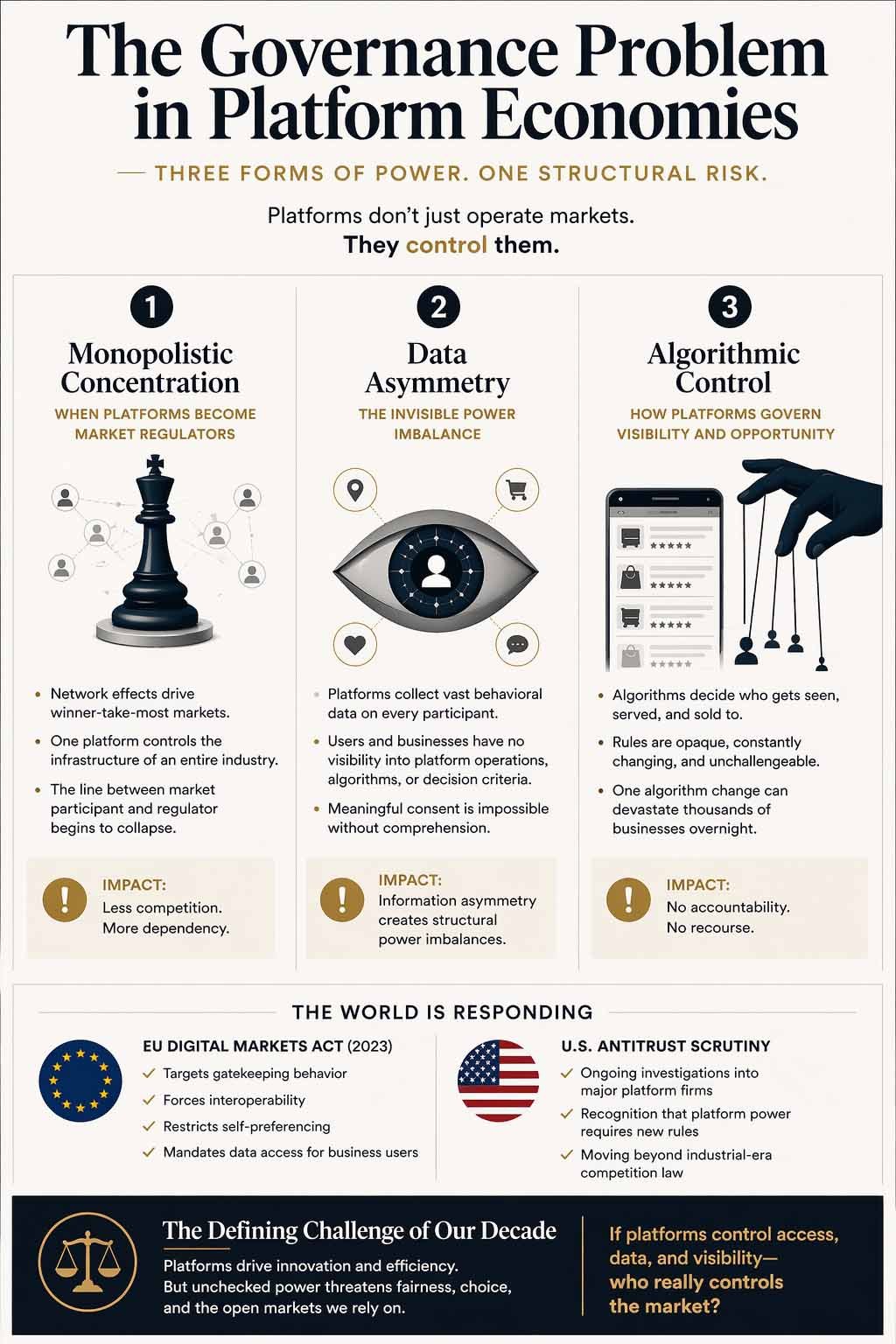
Algorithmic Control: How Platforms Govern Visibility and Opportunity
The third is algorithmic control over visibility and opportunity. On every major platform, access to audiences, customers, and markets is mediated by algorithms that participants cannot inspect, challenge, or appeal. A change in Google's search algorithm, Amazon's ranking system, or Instagram's feed logic can materially alter the commercial prospects of thousands of businesses overnight, with no recourse available to those affected.
Regulators are responding. The EU's Digital Markets Act, which came into force in 2023, specifically targets gatekeeping behaviour by large platform operators, imposing interoperability requirements, restricting self-preferencing, and mandating data access for business users. In the United States, ongoing antitrust scrutiny of Apple, Google, Amazon, and Meta reflects a growing recognition that platform power requires governance frameworks designed specifically for platform economics, not adaptations of industrial-era competition law. The tension between platform innovation and platform power is the defining regulatory challenge of the current decade.
Why Ecosystem-Led Businesses Outperform Traditional Product Companies
The accumulated evidence for platform outperformance is substantial, and it operates across multiple dimensions simultaneously. Ecosystem-led businesses scale more efficiently because their marginal cost of serving an additional user or enabling an additional transaction is typically a fraction of a product company's marginal production cost. They adapt more rapidly because continuous data flows from millions of interactions provide real-time feedback that product companies, operating through slower market research and sales cycles, cannot match. And they generate more durable competitive positions because network effects, switching costs, and ecosystem embeddedness create defensive moats that product differentiation alone cannot replicate.
A 2023 report by McKinsey Global Institute found that platform and digital ecosystem led businesses in the top quartile of their sectors delivered shareholder returns approximately 2.4 times higher than comparable product-led businesses over a ten-year period. The gap was widest in sectors where network effects were strongest, digital media, financial services, and logistics, and narrowest in sectors with significant physical asset requirements.
Critically, this outperformance is not primarily a function of technology investment. It is a function of business model architecture. Product companies that invest heavily in digital technology without restructuring their value creation logic, shifting from internal production to external orchestration, consistently fail to capture platform-level returns. The technology is necessary but insufficient. The model is what drives the outcome.
Platform Strategy: How Organisations Can Make the Transition From Product to Ecosystem
The future of competitive business is ecosystem-native. Not simply platform-adjacent, not digitally enabled, but fundamentally restructured around the logic of network orchestration rather than production management. For organisations navigating this transition, the strategic questions are concrete. Who are the producers and consumers whose interactions you could facilitate? What data does your current business model generate, and how could it be converted into platform intelligence? Where do switching costs and network effects exist in your industry, and who currently captures them? These are not questions for technology teams. They are questions for boards and executive leadership, because the answers require decisions about business model architecture, partnership strategy, and long-term value creation that cannot be delegated to product or engineering functions.
As boundaries between industries blur and digital infrastructure becomes ubiquitous, the most resilient organisations will be those that think in systems rather than silos, that ask not only what they are building, but what environments they are enabling and who gets to participate in creating value within them. Much of this infrastructure is operationalised through the API economy, where platforms expose core functionalities to external developers, enabling third parties to build, extend, and monetise services on top of the platform.
The shift from product to platform is ultimately a shift from the firm as producer to the firm as framework. Ecosystem-led businesses do not just create value. They design the conditions under which value continuously emerges, and in doing so, they have restructured the terms on which competitive advantage is built, sustained, and defended in the modern economy. Transitioning successfully requires a deliberate platform strategy, not just digital transformation. This means defining how the firm will orchestrate interactions, govern participants, and capture value across the ecosystem.
FREQUENTLY ASKED QUESTIONS
What are the advantages of a platform business model over a product business model?
Platform business models offer superior scalability, lower marginal costs, and stronger network-driven growth than product models. By enabling external participants to create value, platforms expand without proportional investment in production. This structure also supports higher margins, faster adaptation through data, and the development of durable competitive moats.
How do network effects create competitive advantage for platform businesses?
Network effects increase the value of a platform as more users join, creating a self-reinforcing growth loop. Each additional participant improves matching, liquidity, and overall utility for others. This dynamic drives rapid scale, raises switching costs, and forms a powerful competitive moat that makes it difficult for new entrants to compete.
What are the risks and governance challenges of ecosystem-led businesses?
Ecosystem-led businesses face risks related to monopolistic concentration, data asymmetry, and algorithmic control. Platforms often act as gatekeepers, controlling access, visibility, and value distribution within their ecosystems. These dynamics raise concerns around fairness, transparency, and accountability, prompting increasing regulatory scrutiny such as the Digital Markets Act.
What is a platform business model with examples?
A platform business model enables interactions between different user groups, allowing them to create and exchange value. Instead of producing goods or services internally, platforms facilitate transactions and participation. Examples include Uber connecting drivers and riders, Airbnb linking hosts and guests, and Amazon enabling third-party sellers to reach buyers.
Why do platform companies scale faster than product companies?
Platform companies scale faster because they rely on network effects rather than production capacity. As more users join, the platform becomes more valuable, attracting even more participants. This creates exponential growth with relatively low marginal costs, unlike product companies that must increase resources, manufacturing, or inventory to grow.
What are examples of marketplace business models?
Marketplace business models connect buyers and sellers, earning revenue by facilitating transactions rather than owning inventory. Prominent examples include Amazon Marketplace, eBay, and Etsy, all of which create value by matching supply and demand efficiently at scale.