
The Succession Problem No One Wants to Talk About: Governance in Family-Owned Enterprises

Ask the founder of a thriving family company about the next five years and the answers come easily: new markets, new products, new investment. Ask who will lead the business in fifteen years and the room goes quiet. Succession is the subject that family enterprises most often postpone, because it touches love, loyalty, money and mortality all at once. Yet family business succession governance is not a private matter to be settled at the dinner table. It is a strategic discipline that determines whether a business outlives its founder.
Why Succession Is a Governance Problem
In a listed company, a board follows a defined process to appoint a leader. In a family firm, the same decision is entangled with relationships. A parent must judge a child. Siblings must accept each other's authority. In-laws and cousins hold opinions, and sometimes shares. When there is no agreed process, emotion fills the vacuum.
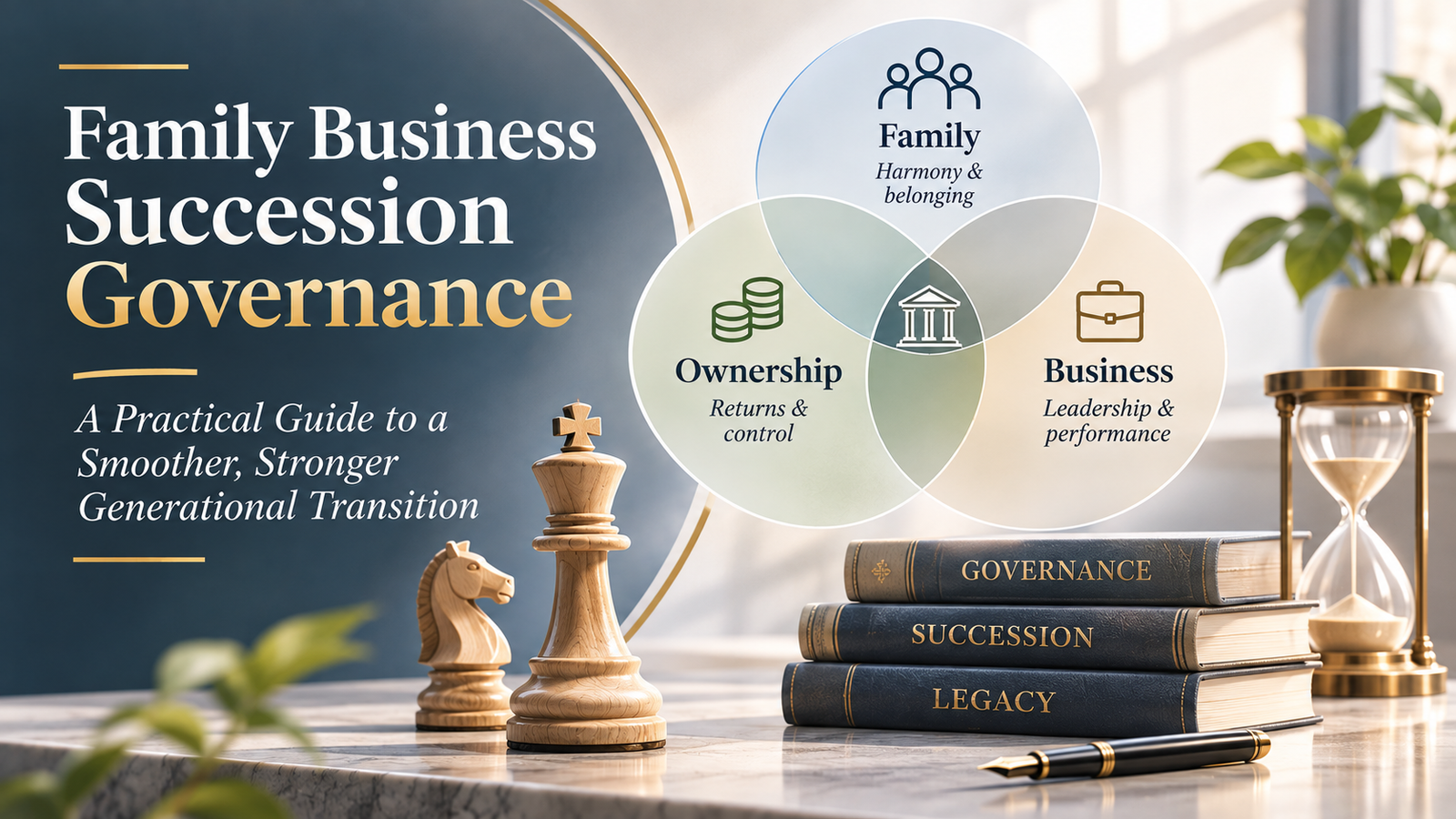
Scholars Renato Tagiuri and John Davis offered a helpful picture in the three-circle model. It describes a family enterprise as three overlapping systems: the family, the ownership and the business. Each has different goals. The family values harmony and belonging. Owners care about returns and control. The business needs competent leadership and clear accountability. Succession becomes difficult precisely where those goals collide, and governance is the mechanism that keeps them from colliding destructively.
Delay carries a cost. The longer a family waits, the more the decision is shaped by circumstance, such as illness or a sudden departure, rather than by choice.
The Warning Signs
Many families recognise some of these symptoms.
- The founder holds all key decisions and relationships personally.
- No written succession plan exists, or it has not been revisited in years.
- Roles for family members are decided informally, often by sentiment.
- Different branches of the family hold unequal information about the business.
- Conversations about the future are avoided because they feel disloyal.
- The board, if there is one, consists entirely of family and close friends.
The presence of two or three signals is common. The presence of most of them suggests urgent attention is needed.
Five Building Blocks of Family Business Succession Governance
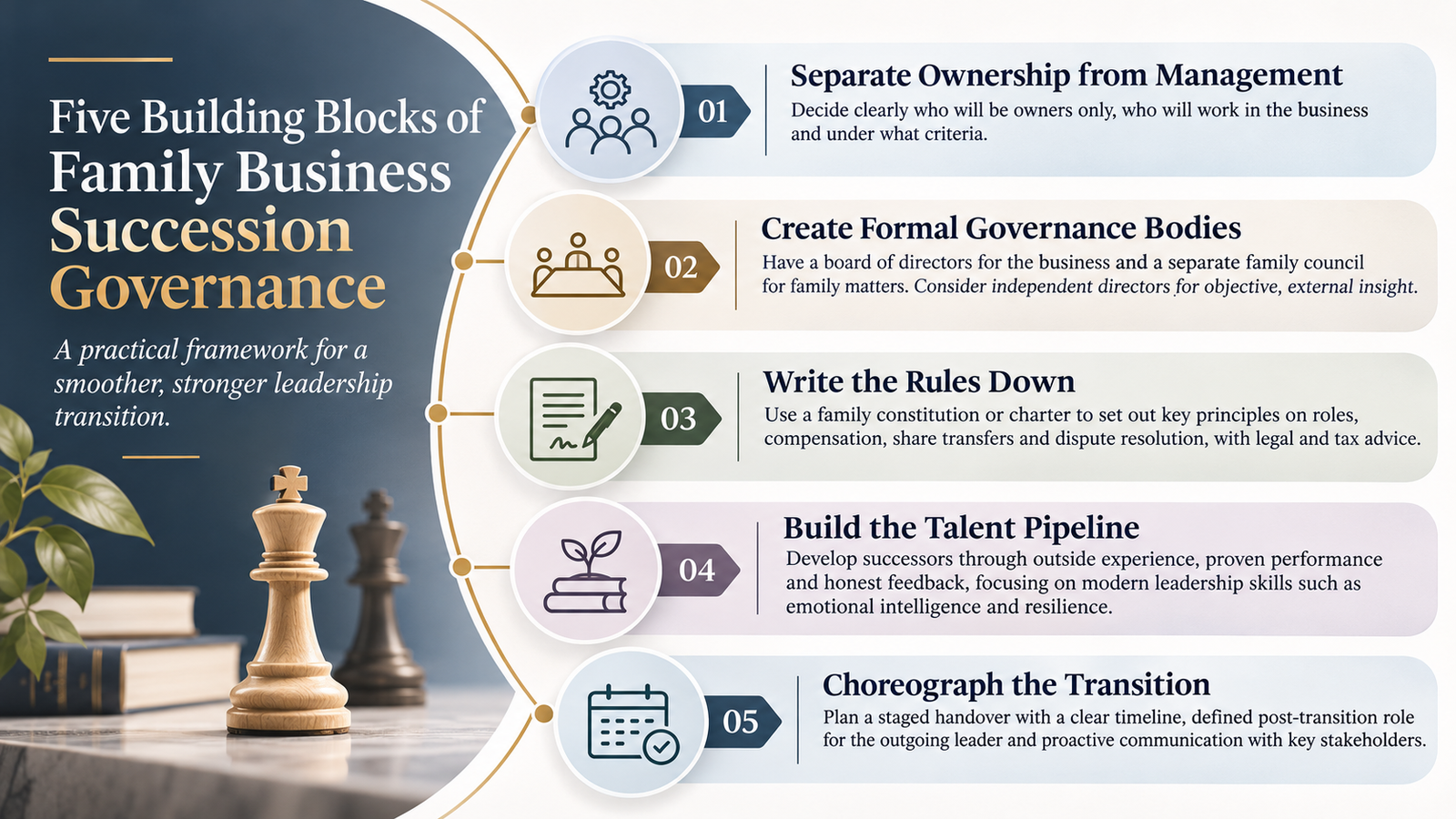
- Separate ownership from management. Owning shares does not automatically qualify someone to run the company. Decide explicitly which family members will be owners only, which will work in the business and under what criteria. Clear separation protects both the family and the enterprise.
- Create formal governance bodies. A board of directors oversees the business. A family council, meeting separately, handles family matters such as education, employment policy and shared values. Keeping these forums distinct prevents business debates becoming family quarrels and vice versa. Many families also benefit from independent directors who bring objectivity and challenge. Our guide to decision-making under uncertainty shows why outside perspective improves judgement when stakes are high.
- Write the rules down. A family constitution or charter records agreed principles on questions such as who may join the business, how compensation is set, how shares may be transferred and how disputes are resolved. The document matters less for its legal weight than for the conversations required to produce it. Take legal and tax advice, because inheritance, ownership and tax rules differ widely between jurisdictions.
- Build the talent pipeline. Successors need development, not just opportunity. Encourage next-generation members to gain experience outside the firm, earn credibility through performance and receive honest feedback. The qualities that make a leader effective in modern organisations, including emotional intelligence and resilience, are examined in our article on why high-EQ leaders thrive in uncertain times.
- Choreograph the transition. Handover should be a staged process rather than a single event. Define a timeline, agree what the outgoing leader will and will not do afterwards and communicate the plan to employees, lenders and key customers. A founder who remains in the corner office offering opinions can undermine a successor as surely as a founder who leaves without notice.
Fair Does Not Always Mean Equal
One of the hardest questions is how to treat children who have different talents and ambitions. Giving every child an identical stake and an identical role may feel fair, yet it can leave the company led by someone unsuited to the task or burden a non-working heir with the decisions of an operating sibling.
Many families find a more durable principle in the idea that fairness means each person is treated according to a transparent process, not that every person receives the same outcome. Heirs who do not work in the business might receive other assets, or ownership with limited governance rights. The details are deeply personal and legal, so professional guidance is essential. The principle of transparency, however, applies universally.
A Five-Step Readiness Plan
Use this sequence to begin.
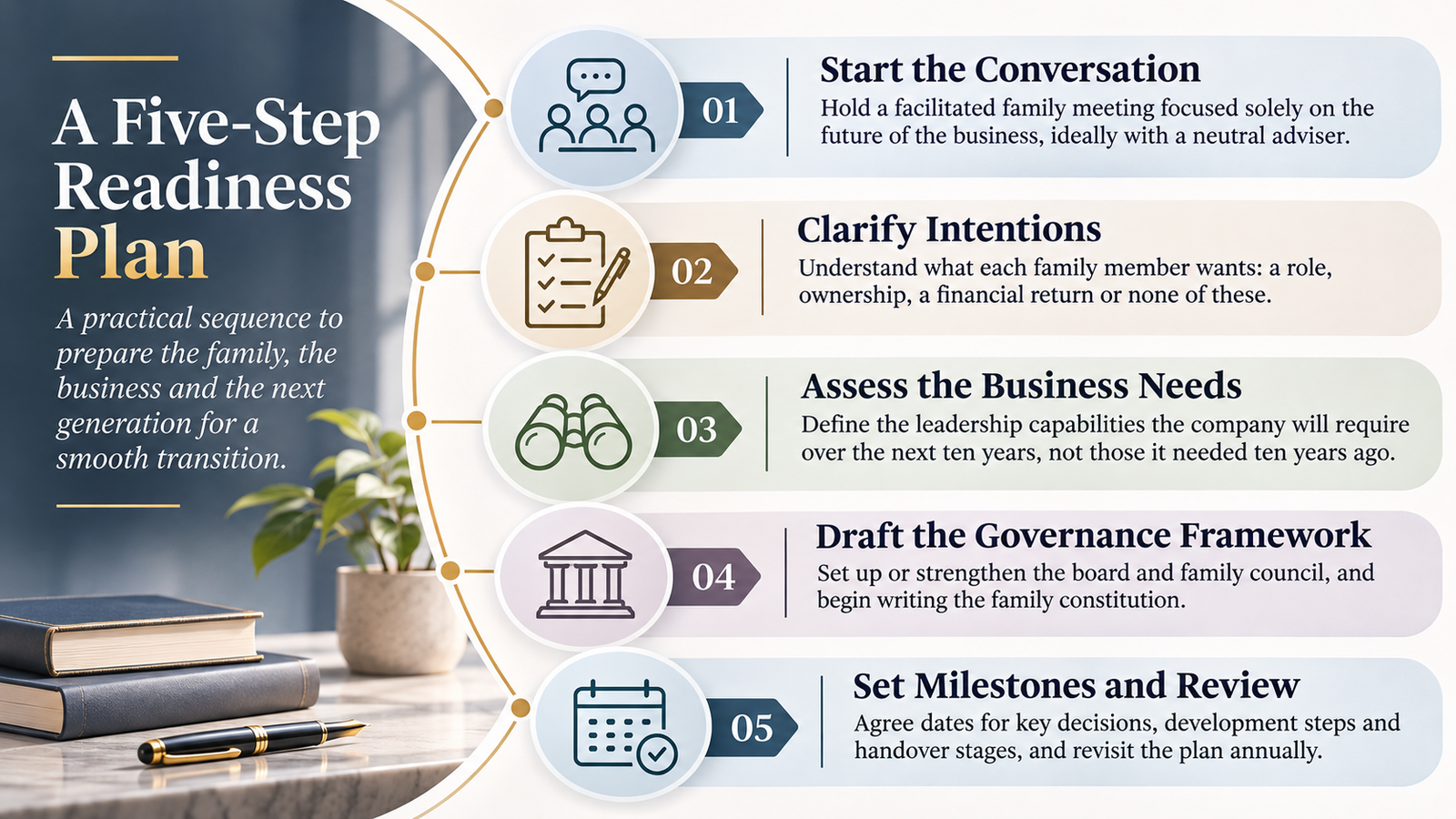
- Start the conversation. Arrange a facilitated family meeting whose only agenda is the future of the business. A neutral adviser often makes honest discussion easier.
- Clarify intentions. Ask each family member individually what they want: a role, ownership, a financial return, or none of these.
- Assess the business needs. Define the leadership capabilities the company will require over the next ten years, not those it needed ten years ago.
- Draft the governance framework. Set up or strengthen the board and family council, and begin writing the family constitution.
- Set milestones and review. Agree dates for decisions, development steps and handover stages. Revisit annually.
Connecting Succession to Business Excellence
Succession should not be treated as an isolated project. Organisations that follow a [business excellence framework](https://www.globalexcellencedigest.com/Digital-Editions) examine leadership, strategy, people and results together, and succession touches all four. A company with strong systems, transparent decision-making and a culture where people speak openly will find the transition far easier.
Plan the Handover While You Still Have Choices
The most successful family enterprises treat succession as a continuing responsibility, not a crisis response. They speak early, document decisions, develop successors with care and invite independent voices into governance. None of this removes the emotion from the subject, nor should it. It simply gives emotion a structure within which good decisions can be made.
If you lead a family business, choose one action this month: schedule the first family meeting, appoint an independent adviser or begin drafting your constitution. The legacy you protect will be your own.
Frequently Asked Questions
What is family business succession governance?
It is the set of structures and rules, such as a board, a family council and a family constitution, that guide how leadership and ownership pass between generations in a family enterprise.
What is the three-circle model?
Developed by Renato Tagiuri and John Davis, it describes a family enterprise as three overlapping systems: the family, the ownership and the business. Each has different goals, and governance keeps them from colliding destructively.
When should a family start planning succession?
Early. The longer a family waits, the more the decision is shaped by circumstances such as illness or a sudden departure, rather than by choice.
Must every child receive an equal share and role?
Not necessarily. Fairness is better understood as a transparent process than as identical outcomes. Because inheritance and tax rules vary, take professional legal and tax advice.