

Which hard-earned lessons give serial entrepreneurs a measurable edge

Entrepreneurship is frequently portrayed as a meritocratic game in which the best ideas win. The data tells a more complicated story. Fewer than 10% of start-ups survive beyond their first decade, and the single strongest predictor of whether a venture succeeds is not the quality of the idea, the size of the market, or even the initial funding secured. It is the prior experience of the person building it.
First-Time vs Serial Founders: Who Has the Edge?
| Metric | First-Time Founder | Serial Founder |
|---|---|---|
| Startup Success Rate | Baseline | +30–50% Higher |
| Fundraising Efficiency | Lower | Higher |
| Time to Product-Market Fit | Slower | Faster |
| Investor Confidence | Developing | Established |
| Hiring Accuracy | Learning Curve | Experience-Led |
The second-time founder advantage is one of the most well-documented and least-discussed phenomena in start-up research. Serial entrepreneurs founders who have built and exited at least one previous venture succeed at rates 30–50% higher than first-time founders, according to research published by the Harvard Business School and the Kauffman Foundation. They raise more capital, hire more effectively, reach product-market fit faster, and exit at higher valuations.
What accounts for this gap? It is not better ideas or more resources. The real difference lies in accumulated pattern recognition, decision-making maturity, and a fundamentally different relationship with uncertainty factors that reshape how ventures are built, scaled, and ultimately won or lost.
The Reality Gap: Why First-Time Founders Struggle
Every founding journey begins with vision, energy, and an implicit assumption that execution will follow naturally from the quality of the idea. The reality that first-time founders encounter is consistently more complex, more expensive, and more psychologically demanding than any pre-launch planning could prepare them for.
The core challenge is not a lack of knowledge the modern start-up ecosystem offers an unprecedented volume of resources, frameworks, and mentorship. The challenge is the gap between knowing and doing. Reading about product-market fit does not prepare a first-time founder for the experience of receiving customer feedback that systematically contradicts their core assumptions. Understanding burn rate intellectually is entirely different from managing the emotional and strategic pressure of three months of runway.
First-time founders typically make a predictable set of costly mistakes:
Over-engineering before validating demand. Building a technically sophisticated product before confirming that the market wants it at all — investing months of development time in features that users will never prioritise.
Mistimed hiring. Either hiring too early (burning cash on headcount before achieving product-market fit) or too late (attempting to scale a validated product without the team infrastructure to support it).
Misreading customer feedback. Confusing politeness with validation. Users who say a product is "interesting" or "useful" are not the same as users who will pay for it, return to it, and recommend it.
Underestimating cash flow complexity. Revenue projections that do not account for payment delays, churn, and the gap between contracted ARR and cash in the bank.
Over-weighting the fundraising milestone. Treating a successful seed round as evidence of product-market fit rather than as a signal to accelerate the search for it.
These are not failures of intelligence or commitment. They are failures of pattern recognition the inability to connect what is happening in real time to what it reliably predicts about what will happen next. That connection is precisely what serial entrepreneurs have built through prior experience, often through the hardest possible route: watching a previous venture fail.
What Serial Entrepreneurs Know That First-Timers Don't
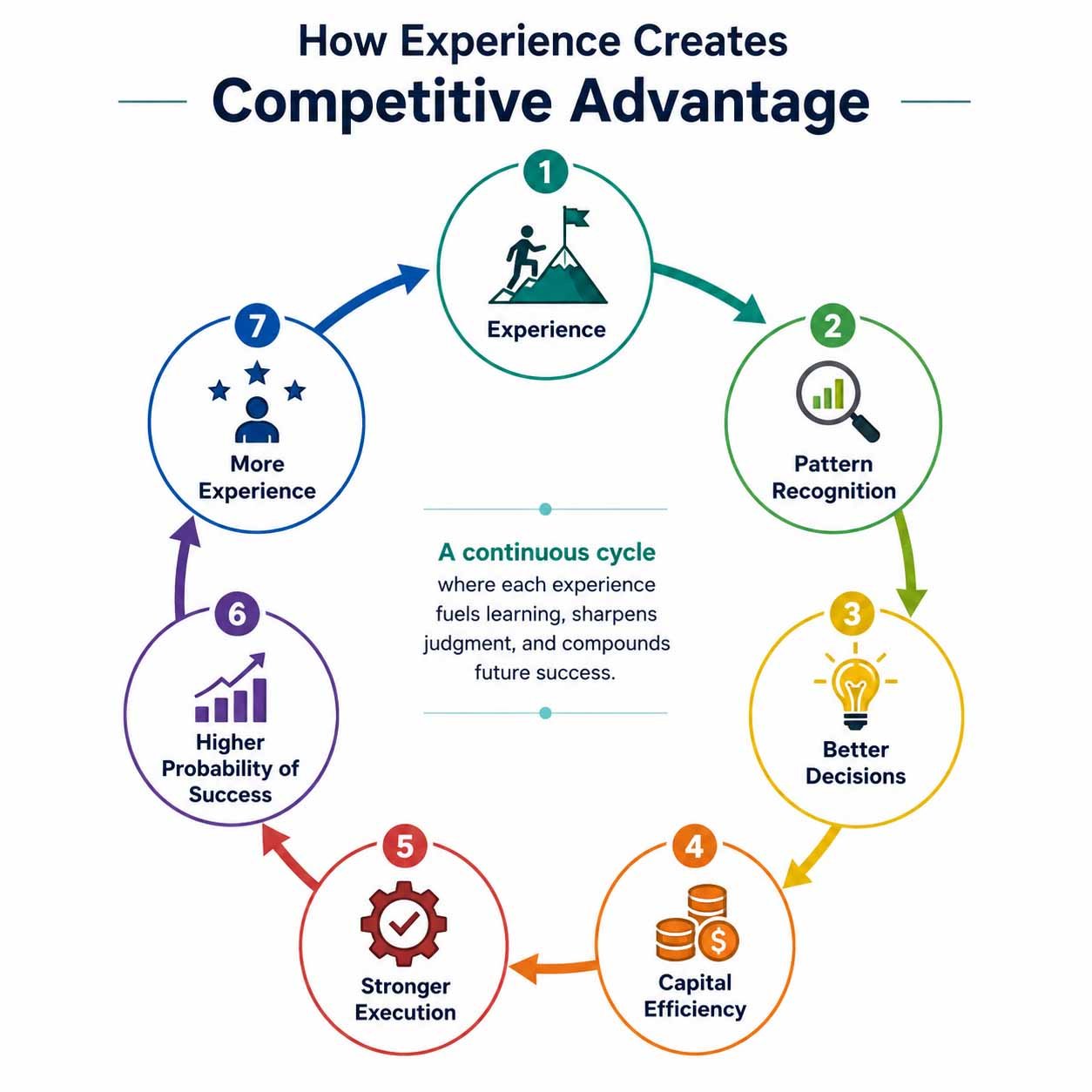
The second-time founder advantage is not a single insight it is a compounding stack of tacit knowledge that only experience can reliably produce. The most significant elements fall into four categories.
Pattern Recognition in Start-ups: How Serial Entrepreneurs See Around Corners
The most valuable asset a serial entrepreneur carries into a new venture is the ability to recognise patterns that first-time founders cannot yet see. A repeat founder who has previously navigated a product pivot, a co-founder conflict, a Series A due diligence process, or a critical hiring mistake can identify the early signals of each of those situations weeks or months before they become crises.
This is not intuition in the mystical sense — it is memory operating as a sophisticated predictive model. Reid Hoffman, co-founder of LinkedIn and Greylock partner, has described this as the ability to ask better questions: not "what should we build?" but "what does the pattern of early user behaviour tell us about what we should build next?"
For first-time founders, every setback is genuinely new. For serial entrepreneurs, most setbacks are variations on situations they have navigated before. The emotional regulation that comes from knowing you have survived comparable situations before is itself a strategic asset; it allows clearer thinking precisely when the pressure is highest.
Capital Efficiency: Spending with Precision
Serial entrepreneurs allocate capital differently from first-time founders, and the difference is measurable. A study by the Kauffman Foundation found that repeat founders spend significantly less on product development in early stages and significantly more on customer discovery and distribution, a prioritisation that reflects hard-won experience with how start-ups actually die.
First-time founders often treat their initial funding as confirmation that they are on the right path and invest heavily in building out their vision. Serial entrepreneurs treat their initial funding as time bought to find the right path and they know that path requires discovery before development.
This produces a concrete operational difference: repeat founders typically reach meaningful product-market fit signals faster and with less capital spent, preserving more runway for the scaling phase where capital efficiency matters less and speed to market matters more.
Hiring Smarter: Building the Right Team
Perhaps no area separates experienced founders from first-timers more clearly than hiring. The cost of a wrong senior hire in equity, in culture damage, in the management distraction required to manage and eventually exit the person is one of the most expensive lessons in the start-up curriculum. Most first-time founders learn it at least once. Serial entrepreneurs have already paid that tuition.
Repeat founders hire more selectively, move faster when they identify exceptional candidates, and are significantly better at distinguishing between candidates who interview well and candidates who will perform in the ambiguous, resource-constrained environment of an early-stage startup. They also have the network to access talent that first-time founders cannot reach a compounding advantage that grows with each subsequent venture.
Venture Capital and Serial Founders: The Investor Network That Opens Doors
Serial entrepreneurs arrive at fundraising conversations with something that first-time founders cannot manufacture: a track record. Even a failed previous venture, if the failure was handled with integrity and produced genuine learning, is a powerful signal to sophisticated investors. It demonstrates that the founder understands the realities of building a company, has operated under pressure, and is capable of the self-reflection required to do better the second time.
This gives repeat founders access to warmer introductions, faster term sheet processes, and investors who are prepared to back them earlier in the company lifecycle than they would a first-time team.
Why Investors Prefer Repeat Founders
The investor preference for serial entrepreneurs is not simply a bias, it is a rational response to the data. Research by First Round Capital found that founder experience is one of the strongest predictors of portfolio performance, and that companies led by repeat founders deliver materially higher returns relative to the capital invested.
From an investor's perspective, backing a serial entrepreneur is a form of de-risking. The founder has already made and survived the most costly category of early-stage mistakes. They have demonstrated the psychological resilience required to operate through adversity. They understand the mechanics of a cap table, the dynamics of a board, and the expectations that come with institutional funding.
For first-time founders, this creates a structural fundraising challenge that is worth naming directly: the most valuable signal investors want is proof that you can build and lead a venture through adversity is precisely what you cannot have before your first venture. The path through this constraint is not to pretend the limitation does not exist, but to compensate for it through unusually deep domain expertise, an exceptional co-founder, or a track record of relevant operational achievement in adjacent roles.
How Pattern Recognition in Start-ups Shapes Serial Entrepreneur Decision-Making
The concept of pattern recognition deserves more specific treatment than it typically receives in discussions of the second-time founder advantage, because it is the mechanism that underpins almost every other advantage serial entrepreneurs hold.
Pattern recognition in business is the ability to identify that a current situation resembles a class of situations you have encountered before and to apply the lessons of those prior situations to the decisions you face now. It is, in essence, a form of compressed experience: years of tacit learning made immediately available at the moment of decision.
In start-up contexts, this manifests most powerfully in three areas:
Reading the market. Serial entrepreneurs can distinguish between early adopter enthusiasm and genuine market validation — a distinction that first-time founders consistently struggle to make and that costs many ventures their chance to pivot before running out of runway.
Managing the team. Experienced founders recognise the early signs of co-founder tension, cultural drift, and performance issues before they become existential. They have the language and the frameworks to address these dynamics before they compound.
Navigating investor dynamics. Serial entrepreneurs understand which investor behaviours in early conversations are positive signals, which are polite deferrals, and which indicate a misalignment in expectations that will not resolve itself after the term sheet is signed.
The Limits of the Second-Time Founder Advantage: When Prior Success Becomes a Blindspot
The second-time founder advantage is genuine and well-documented but it is not unlimited. Serial entrepreneurs carry a second category of accumulated knowledge alongside the valuable pattern recognition: a set of deeply embedded assumptions about how start-ups are built that may be entirely wrong for the new venture.
A founder whose first success was built in B2B SaaS may struggle to suppress the assumptions of that world when building a consumer hardware company. A founder who succeeded through aggressive growth-hacking may be poorly calibrated for a regulated industry where trust and compliance are the primary currency.
The research on this is sobering: the highest failure rates among serial entrepreneurs are not among those whose first ventures failed, but among those whose first ventures succeeded too easily in conditions that are unlikely to repeat. Success without sufficient adversity can produce overconfidence in the transferability of lessons that are in fact highly context-specific.
The most self-aware serial entrepreneurs actively manage this risk. They interrogate their own assumptions about the new domain. They hire people whose experience differs from their own. They seek out contradictory evidence. They treat their pattern library as a starting point for hypothesis generation, not a set of proven answers.
Frequently Asked Questions
What is the second-time founder advantage and why does it matter?
The second-time founder advantage refers to the measurable performance edge that serial entrepreneurs hold over first-time founders across key start-up metrics — including funding success, time to product-market fit, scaling efficiency, and exit outcomes. Harvard Business School and Kauffman Foundation research consistently shows repeat founders succeed at rates 30–50% higher than first-timers. The advantage stems from accumulated pattern recognition, capital efficiency, and network access that only direct experience can produce.
Do serial entrepreneurs really have higher start-up success rates?
Yes, substantially so. Research on repeat founders consistently finds that prior start-up experience including experience of failure correlates strongly with improved performance on subsequent ventures. The key mechanism is not that serial entrepreneurs have better ideas, but that they make better decisions under uncertainty, because they have navigated comparable situations before and can recognise patterns that first-time founders cannot yet see.
Why do venture capitalists prefer serial entrepreneurs over first-time founders?
Investors favour serial entrepreneurs because prior experience is one of the strongest available predictors of portfolio performance. A repeat founder has demonstrated the ability to build and operate a company under pressure, understands the mechanics of institutional funding, and has already made and survived the most common and costly early-stage mistakes. First Round Capital's research found companies led by repeat founders deliver materially higher returns relative to capital invested.
What do serial entrepreneurs know about product-market fit that first-timers don't?
Serial entrepreneurs have developed the ability to distinguish between early adopter enthusiasm and genuine, scalable market validation a distinction first-time founders consistently struggle to make. They recognise that customers who say a product is "interesting" are not the same as customers who will pay for it, retain it, and refer others to it. This pattern recognition allows repeat founders to pivot earlier, conserving runway, or to scale faster with greater confidence that the market signal is real.
Can first-time founders develop the same advantages as serial entrepreneurs?
Yes — through deliberate exposure to the experiences that produce the advantage. First-time founders who join early-stage start-ups before founding their own, who work closely with experienced mentors who share pattern-recognition frameworks openly, and who run structured post-mortems on their own decisions in real time can compress the learning curve significantly. The advantage cannot be fully replicated without experience but the gap can be narrowed through structured, honest engagement with the lessons that experience typically delivers at higher cost.
Closing the Learning Gap: Lessons for First-Time Founders
The second-time founder advantage is real but it is not destiny. The conditions that produce it are replicable, even for founders on their first venture, if they are approached with sufficient rigour and honesty. Invest in structured reflection before decisions, not just after failures. The pattern recognition that experienced founders have built up is essentially compressed retrospective learning. First-timers can accelerate this by building reflection into their operating rhythm — weekly decisions journals, formal pre-mortems before major commitments, and honest after-action reviews that separate what they expected from what actually happened.
Find advisors who will tell you what you are missing, not what you want to hear. The most valuable advisor for a first-time founder is not one who validates their strategy but one who has seen enough start-ups to recognise the patterns they cannot yet see themselves — and who is willing to name them directly. Get as close to prior failure as possible before founding. Joining an early-stage startup that is navigating genuine adversity product pivots, funding pressure, key departures — and operating close enough to the founders to observe how decisions are made in real time is one of the most effective accelerants available to a future founder.
The second-time founder advantage is, at its core, the advantage of earned experience. It cannot be a shortcut entirely but it can be deliberately pursued. And the founders who understand this, who approach their first venture as the training ground for their second, will be better prepared at every stage than those who assume the best idea will be enough. In today's start-up ecosystem, success is not just about starting. It is about starting smarter — and the most reliable path to starting smarter is knowing, before you begin, what experience will eventually teach you.