

What Is an AI-Native Startup: Rewriting Entrepreneurship

What Is an AI-Native Startup? Rewriting Entrepreneurship in the Age of Intelligent Systems
The most consequential shift in entrepreneurship today is not a new funding model, a new market, or a new technology platform. It is a fundamental change in what a business actually is. The AI-native startup does not simply use artificial intelligence as a tool — it is built from the ground up around intelligence as its operating principle. In this model, the business itself learns, adapts, and evolves in real time. Understanding what distinguishes an AI-native startup from a traditional venture is no longer a theoretical exercise. It is the defining strategic question for every founder, investor, and business leader operating in 2025 and beyond.
AI-Native vs Traditional Startups: Key Differences in Business Models and Growth Strategy
Traditional startups are built on fixed assumptions. A founder identifies a market, defines a value proposition, and builds a product to serve it. The business model — however well-constructed — is essentially a static document, a snapshot of the founder's best understanding at a given moment in time.
An AI-native startup operates on an entirely different logic. Rather than building a product and then gathering feedback to improve it, AI-native companies build systems that continuously gather feedback and improve themselves. The distinction is architectural: traditional startups layer technology onto a human-designed business; AI-native startups design the business around the capabilities of intelligent systems.
Consider the difference in practice. A traditional SaaS company might run quarterly user research to inform its product roadmap. An AI-native company like Notion AI or Character.ai continuously refines its product based on millions of real-time interaction signals, updating its models without a human decision at every step. The product and the business model are the same thing: a self-improving system.
Three structural differences define AI-native startups:
Intelligence at the core, not the edge. AI is not a feature added to an existing product — it is the mechanism through which the product delivers value. Data as infrastructure, not insight. Every user interaction is not just logged but actively fed back into systems that improve performance, personalisation, and prediction. Adaptive business logic. Pricing, positioning, user segmentation, and product features are not set annually — they are continuously optimised by algorithms responding to real-world signals.
Why AI-Native Business Models Continuously Evolve
Established startup frameworks — from the lean canvas to the business model canvas — were designed to help founders navigate uncertainty by making their assumptions explicit. This was a genuine innovation: structured thinking under conditions of imperfect information. The limitation of these frameworks is that they capture a moment. They are inherently static. An AI-native business model, by contrast, is a living system of feedback loops. It does not represent the business — it is the business.
Where a traditional startup updates its model through deliberate, human-led iteration (a product sprint, a pivot, a strategic review), an AI-native startup updates continuously and automatically. The model is not revised when the data suggests it should be — the model is the data, processing itself in real time.
This shift has a profound implication for how we think about competitive advantage. In traditional startups, advantage is built through proprietary technology, brand equity, or distribution. In AI-native startups, advantage accumulates through what researchers and practitioners call the data flywheel: the more users interact with the system, the more data it generates; the more data it generates, the better the system becomes; the better the system becomes, the more users it attracts. This compounding loop, once established, creates a form of competitive moat that is extraordinarily difficult for newcomers to replicate.
Decision Intelligence: The Competitive Advantage of AI-Native Startups
One of the most transformative concepts in the AI-native startup ecosystem is decision intelligence — the use of data, machine learning, and predictive modelling to systematically improve the quality and speed of decisions across the business. Traditional startups make decisions through a familiar hierarchy: founder intuition, informed by periodic analytics, reviewed in scheduled meetings. This process is slow, expensive in management time, and inherently limited by the cognitive bandwidth of the humans involved. AI-native startups replace significant portions of this process with algorithmic infrastructure:
Predictive models anticipate customer behaviour, churn risk, and demand patterns before they become visible in conventional metrics.
Real-time dashboards enable operational decisions — pricing adjustments, inventory signals, content recommendations — to be made automatically, at speed and at scale.
Automated experimentation allows AI-native companies to run hundreds of simultaneous A/B tests, a volume of learning that no human-led product team could match.
The outcome is a shift from guesswork to probabilistic precision. Decisions that previously required a senior leadership discussion can be delegated to a well-trained model. This does not eliminate the need for human judgment — but it elevates the level at which human judgment is applied, freeing founders and leadership teams to focus on the strategic and ethical dimensions of the business.
Research by McKinsey & Company has found that organisations adopting decision intelligence at scale report 20–30% improvements in operational efficiency within the first 18 months of implementation — a figure that compounds as the underlying models continue to learn.
The Data Flywheel: Building Sustainable Competitive Advantage Through AI
The data flywheel is the central mechanism of AI-native competitive strategy. Unlike traditional competitive moats — which are built and then defended — the data flywheel is self-reinforcing and self-expanding. It does not require active maintenance; it grows through use. The mechanics are straightforward: each user interaction generates data. That data trains and improves the AI model. The improved model delivers a better user experience. A better experience attracts more users. More users generate more data. The cycle accelerates.
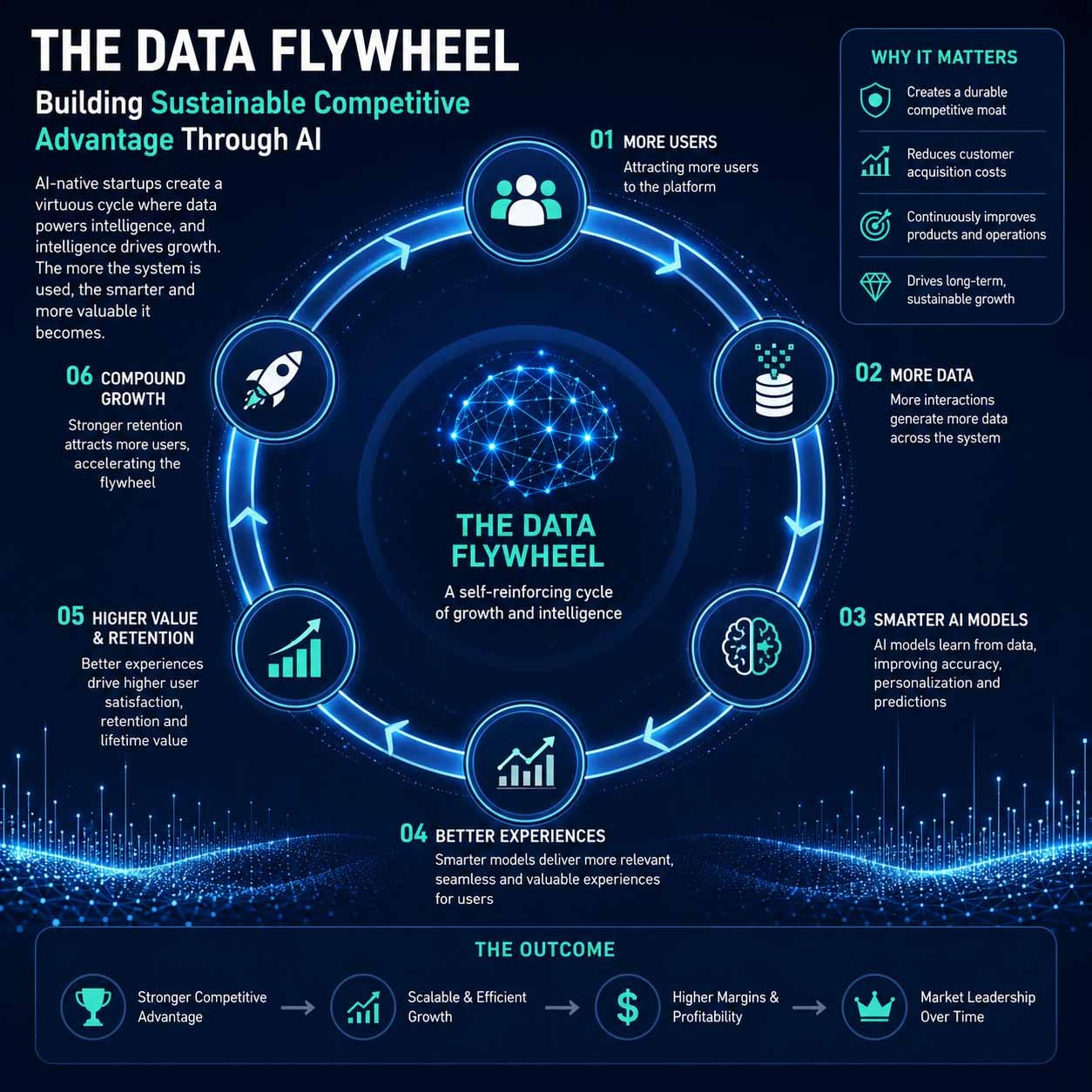
Spotify's recommendation engine is a well-documented example. The more music users listen to, the more precisely the algorithm can predict what they will enjoy next. This precision increases engagement. Increased engagement generates more listening data. The moat is not the algorithm itself — any sufficiently resourced competitor could build a comparable algorithm. The moat is the 600 million user interactions that have trained it to a level of accuracy that a new entrant cannot replicate.
For AI-native startups operating in platform ecosystems — where access to APIs, third-party data, and network infrastructure is available from day one — this flywheel can begin spinning at a much earlier stage than was historically possible. Startups no longer need to own infrastructure to benefit from data at scale. They need to design systems that extract compounding intelligence from the infrastructure they access.
The AI Founder Playbook: How Leadership Is Changing in AI-Native Companies
The AI-native model does not eliminate the need for exceptional founders — it changes what exceptional founders do. The traditional founder role combined visionary thinking with operational decision-making and direct team management. In an AI-native company, the balance shifts significantly.
AI-native founders increasingly operate as:
System architects. The founder's primary creative act is designing the feedback loops, data flows, and model architectures that will drive the business — not making individual operational decisions.
Model supervisors. AI systems require ongoing oversight: monitoring for drift, bias, and failure modes that the model itself cannot detect. Founders must understand enough about their AI infrastructure to govern it responsibly.
Ethical gatekeepers. As AI systems take on greater decision-making authority — over pricing, content, user access, and more — the ethical implications of those decisions become a strategic and reputational concern that only senior leadership can own.
This shift is creating a new archetype of entrepreneurial excellence: the founder who combines the strategic vision of a traditional CEO with the systems thinking of a product engineer and the governance sensibility of a compliance professional.
Ecosystem Integration: The Secret to AI-Native Startup Scalability
AI-native startups have extended and deepened the asset-light model that defined the previous generation of software startups. They do not simply avoid owning physical infrastructure — they abstract their entire operational stack through intelligent systems and platform integrations. Through deep embedding in API ecosystems, AI-native startups can access capabilities — language models, computer vision, speech recognition, data enrichment — that would have required years and hundreds of millions of dollars to build independently just a decade ago. This dramatically lowers the cost of building intelligence into a product and dramatically raises the ceiling on what a small team can achieve.
The strategic implication: startup scalability in the AI-native era is a function of system design, not headcount. A team of twelve with well-designed AI infrastructure can outperform a team of two hundred operating through traditional processes — not in every domain, but in the specific domains where intelligence compounds.
Key Risks of Building an AI-Native Business Model
The power of AI-native business models carries proportionate risks. Founders who do not actively design for these risks will encounter them, and in high-stakes domains the consequences can be severe. Over-reliance on quantitative data. AI systems optimise for what they can measure. But some of the most important signals in a business — customer sentiment, cultural fit, emerging qualitative trends — are difficult or impossible to quantify. Companies that delegate too much to their models risk optimising away the very qualities that made them distinctive.
Algorithmic bias. Machine learning models trained on historical data inherit the biases embedded in that data. In areas such as hiring, lending, content moderation, and healthcare, biased algorithms do not merely produce inaccurate outputs — they systematically disadvantage already-marginalised groups. The legal, reputational, and ethical exposure is substantial.
Opacity and accountability gaps. As AI systems make more decisions, the question of who is accountable when those decisions cause harm becomes genuinely difficult to answer. Regulators in the EU, UK, and US are actively developing frameworks — including the EU AI Act — to address this gap. AI-native founders who do not design for transparency and explainability from the outset will face costly retrofits as regulation matures.
Frequently Asked Questions About AI-Native Startups
What Is an AI-Native Startup?
An AI-native startup is a company built around artificial intelligence as its core operating principle — not as a feature added to an existing product, but as the mechanism through which the business learns, makes decisions, and delivers value. Unlike traditional startups that use AI as a tool, AI-native companies embed intelligence into every layer of their business model: product, operations, pricing, and strategy.
How Does the Data Flywheel Create Competitive Advantage?
AI-native startups build competitive advantage through the data flywheel: as more users interact with the product, more data is generated; that data trains and improves the AI model; the improved model delivers a better experience; better experience attracts more users. This compounding loop creates a moat that deepens automatically with scale, making it increasingly difficult for new entrants to compete.
Why Is Decision Intelligence Critical for AI-Native Companies?
Decision intelligence is the use of predictive models, real-time data systems, and automated experimentation to improve the quality and speed of business decisions. AI-native startups use decision intelligence to replace slow, human-led decision cycles with algorithmic infrastructure — enabling them to run hundreds of simultaneous experiments, anticipate customer needs before they become visible, and optimise operations continuously rather than periodically.
What Are the Major Risks of AI-Native Businesses?
The three most critical risks are: (1) over-reliance on quantitative data, which causes systems to optimise away important qualitative signals; (2) algorithmic bias, where models trained on historical data systematically reproduce existing inequalities; and (3) accountability gaps, where the opacity of AI decision-making makes it difficult to identify responsibility when outcomes cause harm. Emerging regulation, including the EU AI Act, is making these risks increasingly material.
How Are AI-Native Founders Different from Traditional Entrepreneurs?
In AI-native companies, founders shift from operational decision-makers to system architects — designing the feedback loops and model governance structures that drive the business. They become model supervisors, monitoring AI outputs for bias and failure modes, and ethical gatekeepers, ensuring that the decisions made by their systems reflect the values and responsibilities of the organisation.
The Future of Generative AI Startups: From Business Plans to Living Systems
The traditional lean canvas helped founders navigate uncertainty by making their assumptions explicit and testable. It was the right tool for its era — an era in which uncertainty was managed through structured iteration. In an AI-native world, uncertainty is no longer merely managed. It is continuously learned from, reduced in real time, and converted into competitive advantage. The most successful AI-native startups of the next decade will not be those with the most sophisticated initial technology. They will be those with the most intelligently designed systems — systems that learn faster, adapt more precisely, and compound their advantage more effectively than any competitor can match.
The question facing every founder today is no longer simply: What is our business model? It is a deeper and more consequential question: How intelligently can our system evolve?
Because the future of entrepreneurship belongs not to the best-planned ventures — but to the most intelligently designed ones.