
Culture Eats Deals for Breakfast: Why Most M&A Fails on People, Not Numbers

The spreadsheet said the deal made sense. The synergies were modelled, the price was agreed and the announcement was polished. Eighteen months later, the best people had left and the combined company moved more slowly than either predecessor ever did. M&A culture integration is the discipline that separates deals that create value from deals that merely change the logo. Leaders who treat it as a soft afterthought are, in effect, betting against their own spreadsheet.
Why M&A Culture Integration Decides the Outcome
There is a maxim, often attributed to Peter Drucker, that culture eats strategy for breakfast. Mergers and acquisitions put that claim under maximum stress. Financial due diligence is rigorous and well resourced. Cultural due diligence, where it exists at all, tends to rely on impressions formed over a few polite dinners.
The precise failure rate of deals is debated, because it depends on how success is defined. What is less contested is where disappointment originates. Talented people leave, decisions slow down, customers sense confusion and managers retreat into defensive habits. Every one of those outcomes is human, and every one is predictable.
Our article on building business excellence through purpose, culture and leadership makes the underlying point: results follow from how an organisation behaves, not only from what it owns. Organisations that use a business excellence framework already examine leadership and culture alongside financial results. An acquisition deserves the same discipline.
Consider how this plays out in practice. A founder-led technology firm is acquired by an established industrial group. On paper the fit is excellent: complementary products, shared customers and a clear route to scale. In reality, engineers who shipped weekly are asked to complete quarterly approval cycles, and managers who valued autonomy discover that every spending decision now needs a signature two levels up. Nobody has behaved badly. The cultures have simply collided.
The Five Culture Clashes to Look For
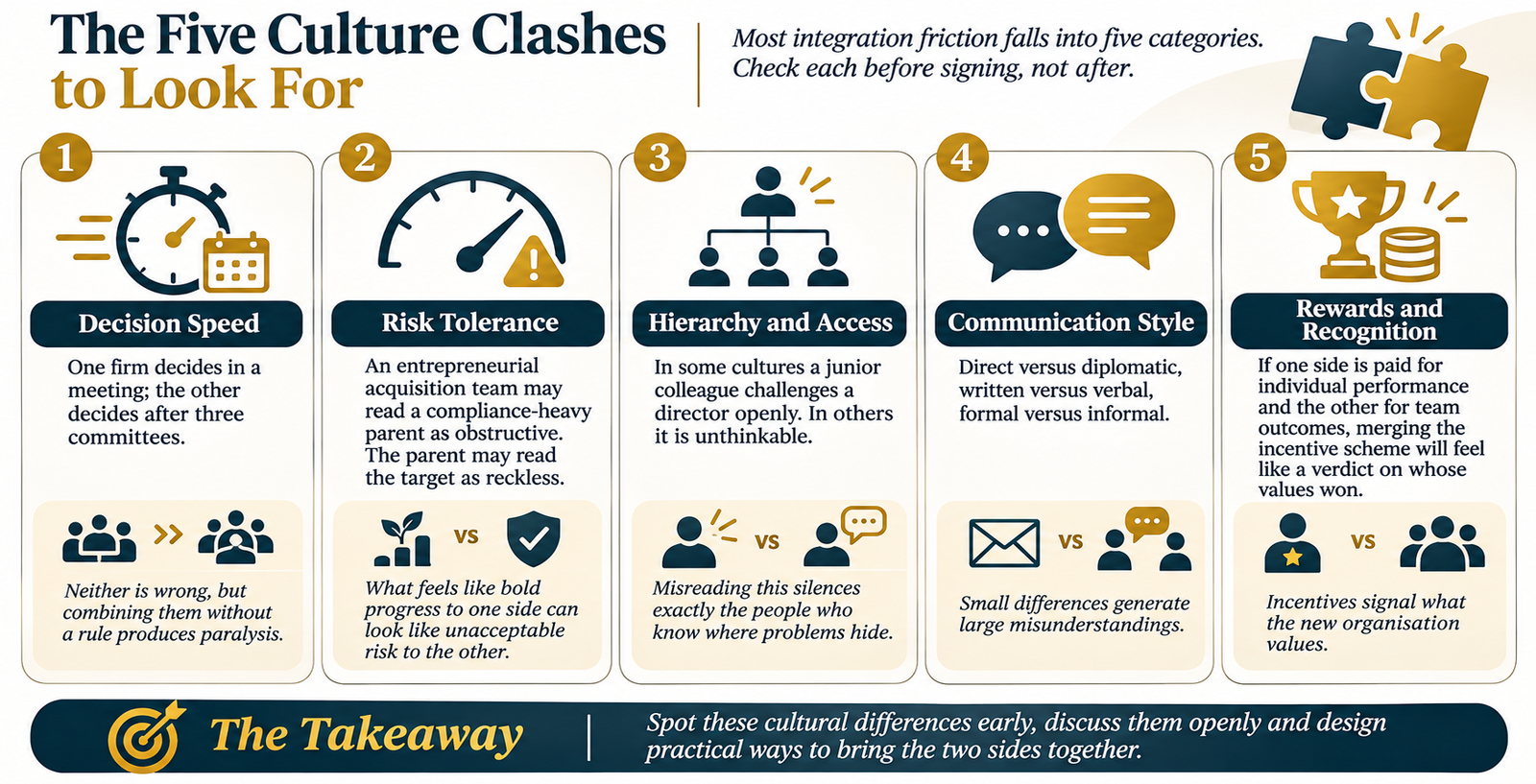
Most integration friction falls into five categories. Check each before signing, not after.
Decision speed. One firm decides in a meeting; the other decides after three committees. Neither is wrong, but combining them without a rule produces paralysis.
Risk tolerance. An entrepreneurial acquisition team may read a compliance-heavy parent as obstructive. The parent may read the target as reckless.
Hierarchy and access. In some cultures a junior colleague challenges a director openly. In others it is unthinkable. Misreading this silences exactly the people who know where problems hide.
Communication style. Direct versus diplomatic, written versus verbal, formal versus informal. Small differences generate large misunderstandings.
Rewards and recognition. If one side is paid for individual performance and the other for team outcomes, merging the incentive scheme will feel like a verdict on whose values won.
Diagnose Before You Decide
A useful starting point is the Competing Values Framework developed by Kim Cameron and Robert Quinn. It describes four broad culture types:
- Clan: collaborative, family-like, loyalty-driven.
- Adhocracy: creative, experimental, comfortable with risk.
- Market: competitive, results-focused, externally oriented.
- Hierarchy: structured, controlled, process-driven.
Every organisation blends all four, but usually one or two dominate. Ask leaders on both sides to describe their organisation honestly, then compare the profiles. A large gap is not a reason to abandon a deal. It is a reason to budget time, attention and senior sponsorship for integration. The gap also tells you where to expect resistance, and where the combined organisation might borrow strengths from each side.
A practical way to run the comparison is a two-hour workshop with eight to ten leaders from each side. Ask each group to describe how decisions really get made, what gets rewarded and what gets quietly punished. Then swap the descriptions and ask the other side to react. The surprises are where your integration risk lives.
Resist the temptation to declare a winner. The question is not whose culture is better. It is which behaviours the combined business needs in order to deliver the strategy that justified the deal.
The 100-Day Integration Playbook
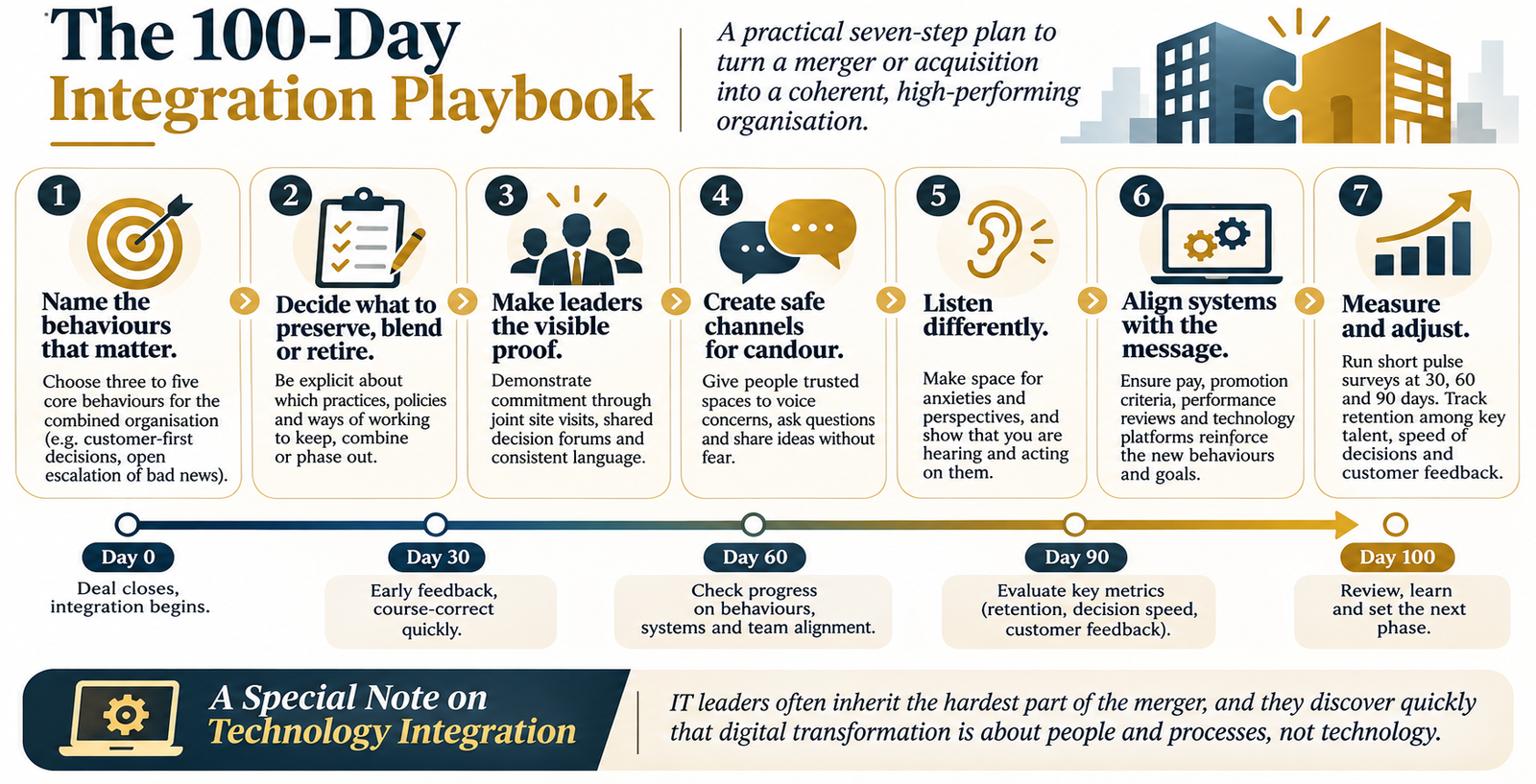
Once the deal closes, the first hundred days set the tone. Use this sequence.
Name the behaviours that matter. Choose three to five behaviours the combined organisation must demonstrate, such as customer-first decisions or open escalation of bad news. Fewer is better.
Decide what to preserve, blend or retire. Be explicit. Ambiguity breeds rumour, and rumour is the most expensive form of communication.
Make leaders the visible proof. People watch what senior leaders do, not what they say. Joint site visits, shared decision forums and consistent language signal that integration is real.
Create safe channels for candour. Integration surfaces anxieties that staff will not voice unless the environment allows it. The research on psychological safety and high-performing teams shows why teams that can speak up outperform those that cannot.
Listen differently. Anxious employees need to feel heard before they can absorb a new direction. Our piece on the empathy advantage explains how leaders can turn listening into a business skill.
Align systems with the message. Pay, promotion criteria, performance reviews and technology platforms must support the new behaviours. If they contradict them, staff will follow the systems.
Measure and adjust. Run short pulse surveys at thirty, sixty and ninety days. Track retention among key talent, speed of decisions and customer feedback.
Technology integration deserves a special warning. IT leaders often inherit the hardest part of the merger, and they discover quickly that digital transformation is about people and processes, not technology. Systems can be consolidated by a project plan. Working habits cannot.
Warning Signs That Integration Is Drifting
Watch for these signals in the first six months:
- Key talent from the acquired business is leaving or quietly disengaging.
- Meetings include "us" and "them" language.
- Decisions are escalated more often than before.
- Customers receive inconsistent answers from the two legacy teams.
- Leaders announce cultural values but cannot point to a single changed practice.
If you see two or more, convene a short, honest review and act on it. Delay compounds the damage.
Who Should Own Integration?
Culture integration fails when everyone is responsible and no one is accountable. Appoint a senior executive with real authority, not a project manager with a slide deck. Give that person a direct line to the chief executive, a budget and the mandate to challenge decisions that undermine the agreed behaviours. Pair them with a counterpart from the acquired business so that the process feels shared rather than imposed.
Treat Culture as a Line Item
Every acquisition is a promise that two organisations will be worth more together than apart. That promise is kept by people who trust the new direction, understand how decisions are made and believe their contribution is valued. Put culture on the diligence checklist, name an accountable executive and fund integration as seriously as you fund the purchase. The numbers will follow the people, not the other way round.
Frequently Asked Questions
What is M&A culture integration?
It is the process of aligning behaviours, decision-making norms and values across two organisations after a deal, so that the combined business can deliver the strategy that justified the transaction.
When should cultural due diligence begin?
Before signing, alongside financial due diligence. Comparing the two cultures early shows where friction is likely and how much time, sponsorship and budget integration will need.
Should one company's culture simply win?
No. The better question is which behaviours the combined business needs. Decide explicitly what to preserve, blend or retire, rather than letting the larger party's habits prevail by default.
How can leaders tell that integration is going wrong?
Typical signals include key talent leaving, 'us and them' language, more decisions being escalated, inconsistent answers to customers and values announcements that change no actual practice.