The Feedback Gap: Why Senior Leaders Stop Getting Honest Input, and How to Fix It

Early in a career, feedback arrives constantly. Managers correct drafts, peers question assumptions and clients complain without ceremony. Then promotion follows promotion, and something curious happens. The criticism thins out. Meetings become smoother, agreement becomes unanimous and compliments become routine. Many senior leaders interpret this as proof that they are doing well. More often it is evidence that they have stopped hearing the truth. Executive feedback does not disappear because leaders improve. It disappears because it becomes risky to give.
Why the Feedback Gap Opens
Several forces combine to shield senior leaders from honest input.
- Power distorts information. People calibrate what they say to the person who controls their pay, promotion and reputation. Even a leader who sincerely welcomes challenge is still, in the listener's mind, someone with power.
- Bad news is filtered on the way up. Each layer of the hierarchy softens a message slightly. By the time a problem reaches the top, it may be accurate in outline and misleading in emphasis.
- Past reactions are remembered. One visible flash of irritation can teach an entire team to stay quiet for years. Leaders rarely remember the moment. Staff never forget it.
- Courtesy substitutes for candour. In many cultures, openly contradicting a senior figure is considered disrespectful. Politeness is a virtue, but it can become a barrier to truth.
- Leaders stop asking. Seniority creates the illusion of completeness. When you are expected to have answers, asking "How am I doing?" can feel like a sign of weakness. It is the opposite.
What the Gap Costs
A feedback gap is a form of organisational blindness, and it carries practical costs.
Decisions are made with incomplete information, because dissenting views never reach the table. Behavioural patterns that damage morale, such as interrupting, micromanaging or favouring certain voices, continue unchecked. Talented people disengage or leave rather than risk confrontation. And leaders themselves stagnate, because development without feedback is guesswork.
The Johari Window, created by psychologists Joseph Luft and Harrington Ingham in the 1950s, offers a helpful picture. It divides what we know about ourselves into four areas: what is known to both ourselves and others, what others see but we do not, what we know but conceal, and what is unknown to everyone. The feedback gap enlarges the second area, the blind spot. Everyone else sees the leader's habits clearly. The leader sees only the flattering version.
The same dynamic appears in the research on teams. Our article on the science of speaking up explains why groups where people feel safe to challenge ideas make better decisions and catch errors sooner.
Diagnose Your Own Gap
Ask yourself these questions honestly.
- When did a colleague last disagree with me in a meeting, and what happened next?
- When did someone last tell me something I did not want to hear?
- Do I learn about problems early, or only after they have grown?
- Does my team bring me solutions only, or also unresolved doubts?
- If I left tomorrow, would anyone tell me what it was like to work for me?
If most answers are uncomfortable, the gap is probably wider than you think.
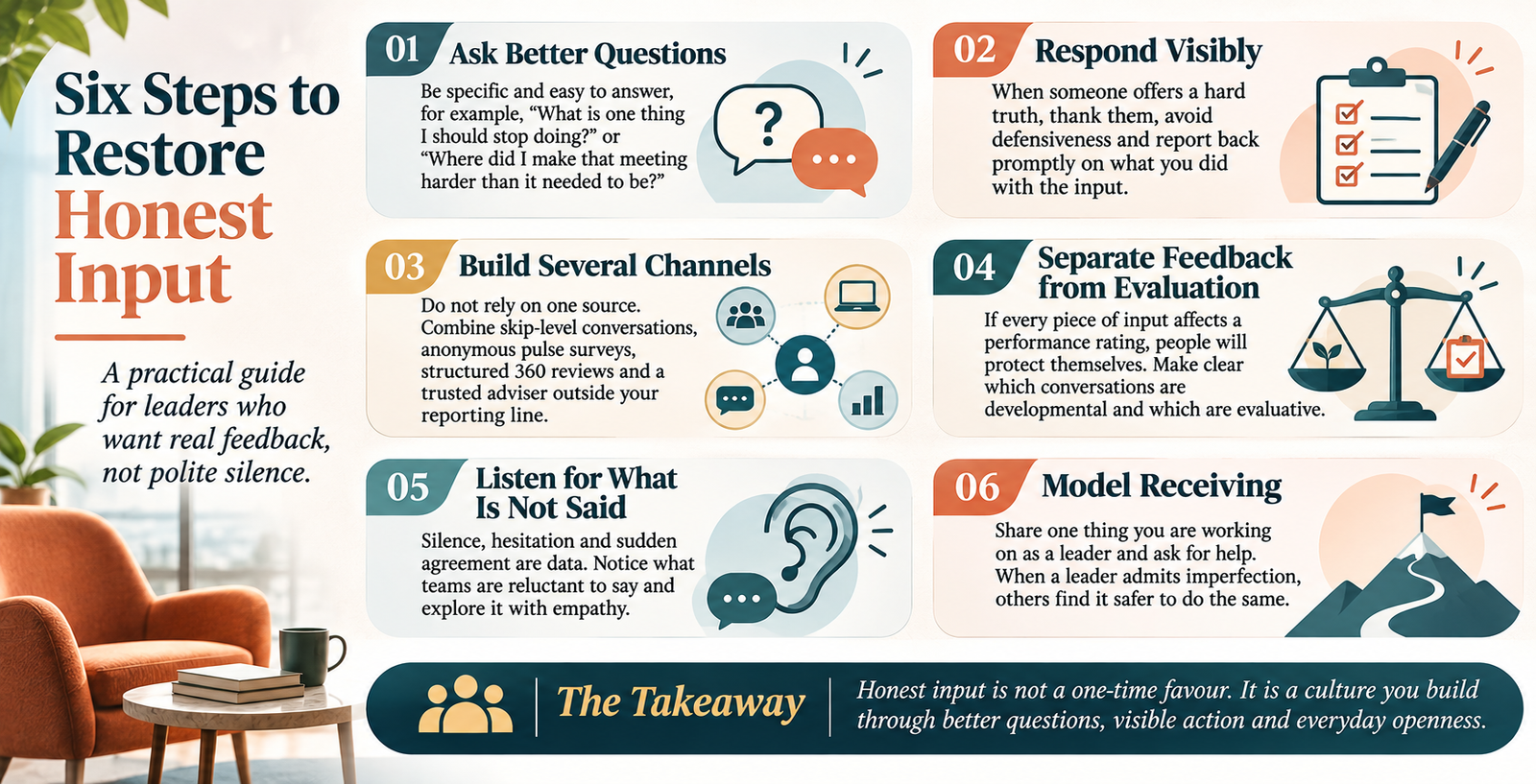
Six Steps to Restore Honest Input
- Ask better questions. "Any feedback?" invites a polite "No, all good." Ask something specific and easy to answer: "What is one thing I should stop doing?" or "Where did I make that meeting harder than it needed to be?" Specific questions lower the cost of candour.
- Respond visibly. The first time someone offers a hard truth, your reaction sets the precedent. Thank them, resist the urge to defend yourself and, within a short time, report back on what you did with the input. Feedback that vanishes into silence soon stops.
- Build several channels. Relying on one source is fragile. Combine skip-level conversations, anonymous pulse surveys, structured 360 reviews and at least one trusted adviser outside the reporting line whose job is to tell you what others will not.
- Separate feedback from evaluation. If every piece of input feeds a performance rating, people will protect themselves. Make clear which conversations are developmental and which are evaluative.
- Listen for what is not said. Silence, hesitation and sudden agreement are data. Our piece on the empathy advantage describes how leaders can listen beyond the words and notice what teams are reluctant to say.
- Model receiving. Share one thing you are working on as a leader and ask for help. When a leader admits imperfection, others find it safer to do the same. This is one of the human potential leadership skills highlighted in our playbook for peak performance.
A simple script. When someone offers a difficult observation, try three sentences: "Thank you for telling me. Let me make sure I have understood: you are saying that..., is that right? I will think about it and come back to you by Friday." This acknowledges courage, confirms understanding without arguing and sets a deadline for a response. It takes less than thirty seconds and protects the relationship that made the feedback possible.
Make It Easier for Others to Be Honest
Receiving feedback well is only half the task. Leaders also shape the conditions in which feedback is possible.
Stress narrows what people can absorb and what they dare to say. The way leaders manage pressure matters, and our analysis of cognitive load and decision-making under stress shows why overloaded leaders become harder to approach. Leaders who protect their own capacity are more open to challenge.
Structure helps too. Build disagreement into decision processes. Invite someone to argue the opposite case before a major choice, rotate the role of devil's advocate and record dissenting views in minutes. When dissent is part of the process, it no longer feels like personal opposition.
What Not to Do
Avoid these common mistakes.
- Demanding candour without earning it. Announcing an open-door policy changes nothing if past behaviour contradicts it.
- Punishing the messenger. A single defensive response can undo months of effort.
- Collecting feedback and doing nothing. This is worse than not asking, because it signals that candour is pointless.
- Treating anonymous surveys as a substitute for conversation. Surveys reveal patterns. Conversations reveal reasons.
Treat Honest Input as a Strategic Asset
The feedback gap is not a flaw in individuals. It is a predictable consequence of power. That is exactly why it requires deliberate design. Leaders who ask precise questions, respond with grace and build multiple channels for truth will see problems earlier, decide better and develop faster than those who rely on a comfortable silence.
Begin small. This week, ask one person one specific question and listen to the answer without defending yourself.
Frequently Asked Questions
Why do senior leaders receive less honest feedback?
Power distorts information, bad news is softened on its way up, past defensive reactions are remembered, courtesy can replace candour, and leaders often stop asking.
What is the Johari Window?
It is a model created by Joseph Luft and Harrington Ingham in 1955 that divides self-knowledge into four areas. The feedback gap enlarges the blind spot: what others see in a leader but the leader does not.
What is the best way to ask for feedback?
Ask specific, low-risk questions such as 'What is one thing I should stop doing?' Then thank the person, avoid defending yourself and report back on what you did with the input.
Are anonymous surveys enough?
No. Surveys reveal patterns, but conversations reveal reasons. Combine skip-level meetings, pulse surveys, structured 360 reviews and at least one trusted adviser outside your reporting line.