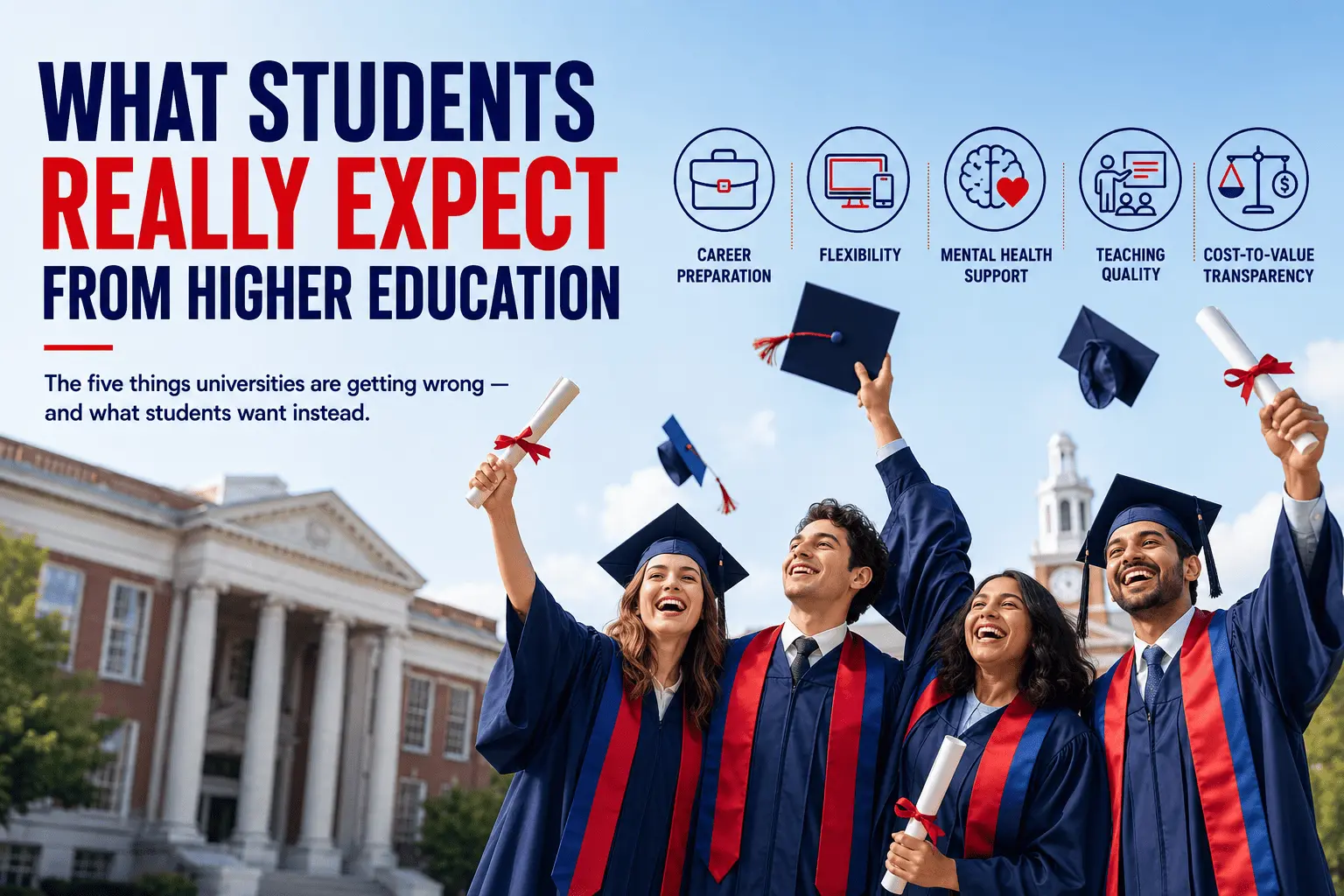

The Transformation of Global Higher Education

In today’s rapidly evolving education landscape, universities are no longer measured solely by academic prestige—they are evaluated by their ability to sustain, adapt, and lead with purpose. The convergence of academic vision and financial sustainability has become a defining priority for institutions seeking long-term relevance and global credibility, directly influencing higher education leadership success.
Modern higher education leadership demands more than intellectual direction; it requires strategic alignment between governance, resource management, and institutional goals. As funding models shift, competition intensifies, and stakeholder expectations grow, leaders must move beyond traditional frameworks and embrace a more integrated, future-focused approach—one that is increasingly shaped by corporate governance in higher education and robust decision-making structures.
The institutions that will define the next decade are not just academically strong—they are structurally resilient. By embedding sustainability into long-term university strategy and strengthening institutional resilience, universities can unlock lasting impact and reinforce institutional excellence in universities. This integrated approach enables leaders to build truly future-ready universities that strengthen their global standing and maximise long-term value
The Growth of Hybrid and Digital Universities
Technology is redefining the academic experience, making learning more personalised, adaptable, and accessible. The conventional boundaries of time and space in education have been upended by the rise of digital universities and hybrid learning models.
Key Developments in this field include:
• AI-supported personalised learning: Adaptive systems now use AI to tailor content, pacing and assessment to individual learners.
• Hybrid degree programs: Blended models offer flexibility combining online learning and in-person instruction without sacrificing quality and maintaining a balance between systematic and in-person interaction.
• Global virtual classrooms promote: Cross-cultural learning allows students from all around the world to work together in real time.
• Digital learning ecosystems: Integrated platforms combine assessment, content distribution, analytics, and student support services within a unified digital framework.
Due to the advent of digital transformation, universities can now scale their offerings to non-traditional learners, including working professionals and international students.
In this connection, it will be apt to quote Sir Michael Barber, education policy expert, “The future of education lies in its ability to be both deeply personal and globally connected through technology.”
However, institutions must ensure that digital expansion is accompanied by robust quality assurance, adequate faculty training, and equitable access- particularly in regions where digital infrastructure remains uneven.
Cross-Border Education and Globalisation
The conventional notion of universities serving primarily local or national populations is rapidly evolving. Higher education now functions in a global environment where mobility and cooperation are central factors.
Key forces driving this shift include:
• Global student mobility: Students increasingly seek international
educational education to improve their employability and broaden their exposure to the world.
• International academic collaborations: Exchange programs, joint degrees, and cooperative research projects are more prevalent.
• International campuses: Universities are establishing overseas campuses to increase their global presence and expand their global footprint.
• Transnational degree programs: Institutions are offering programmes that transcend national borders through online resources, partnerships and digital platforms.
While globalisation fosters innovation, diversity, and knowledge exchange, it also presents challenges, including cultural adaptability, regulatory disparities, and geopolitical unpredictability.
Industry Cooperation and the Skills Economy
The rise of the skills economy has significantly reshaped higher education. Employers now prioritise graduates who possess practical, job- ready skills besides strong theoretical foundations.
Key Developments in this field include:
- Industry-embedded degree programs: Academic curricula are increasingly co- designed with industry partners to ensure relevance and alignment with market needs.
- Collaborative research with industry: Businesses and universities work together to solve problems to drive innovation and address real- world challenges.
- Innovation hubs and incubators: Campuses are evolving into hubs for technological development and encourage participation of corporate funds for entrepreneurship, thanks to innovation laboratories and start-up incubators.
- Work-integrated learning models: Academic programs now incorporate project-based learning, internships, and apprenticeships to bridge the gap between theory and practice.
The orientation of education is shifting towards outcome-based models, where success is measured through employability and practical application. However, maintaining a balance between vocational relevance and the preservation of critical thinking is essential.
The Emergence of Lifelong Learning Universities
The conventional view of education as a one-time event that occurs early in life is growing out of date. People need to constantly update their knowledge and abilities in a world that is changing quickly.
Universities are changing to become institutions of lifelong learning that assist students at all phases of their lives.
Key Developments in this field are :
- Micro-credentials: Short, targeted courses that impact specific abilities, known as micro-credentials.
- Stackable degrees: Stackable degrees are adaptable programs that let students accumulate credentials over time.
- Executive education: Programs for professionals looking for higher skills and leadership are known as executive education.
- Modular learning pathways: Personal objectives are aligned, customising academic goals.
- Keeping in mind the sectors impacted by automation and technological upheaval, these courses bring about the necessity for reskilling and upskilling.
Additionally, it brings about lifelong learning by allowing accessibility and inclusion in higher education programs to people from diverse backgrounds.
International Knowledge Networks and Multidisciplinary Research
A single subject cannot adequately address contemporary global issues, including public health, artificial intelligence, and climate change. Multidisciplinary research ecosystems are receiving more funding from universities.
Key Developments in this field are:
- AI and healthcare partnerships: integrating technology and medicine to enhance diagnosis and care.
- Sustainability innovation centres: Using interdisciplinary research to address environmental issues.
- Cross-faculty research institutes: assembling specialists from many disciplines to tackle challenging issues.
- Global knowledge networks: International collaborations where organisations work together internationally to exchange resources and expertise, and frequently assist these endeavours.
In addition to improving research results, interdisciplinary techniques train students to think creatively and holistically, preparing them for the complexity of today's world.
Leadership and Institutional Strategy in a Changing Landscape
Strategic agility and imaginative leadership are necessary for the transformation of higher education. Academic excellence, financial sustainability, and technological innovation are among the conflicting priorities of a university administrators must manage.
Priorities for Strategy
- Investing in digital infrastructure: Making sure technology systems are reliable and scalable.
- Global partnerships: Creating alliances that improve scholarly and research capacities.
- Learner engagement, well-being, and results are the main focus of student-centric learning methods.
- Initiatives for social effect and sustainability: coordinating organisational objectives with worldwide issues.
In addition to implementing new tactics, effective leadership entails managing change, encouraging an innovative culture, and involving stakeholders from all areas of the organization.
Universities will be better positioned to prosper in an uncertain future if they adopt forward-thinking tactics and flexible governance.
In conclusion, expanding international connections and using new technologies are only two aspects of the development of global higher education. It signifies a more profound change in how academic institutions define their purpose,
disseminate information, and engage with society.
The trends influencing higher education show a shift toward more adaptability, inclusivity, and relevance, from digital learning ecosystems and international collaboration to lifelong learning and multidisciplinary research.
Institutions that successfully manage this transition will be those that welcome change while upholding fundamental principles, strike a balance between innovation and academic integrity, and continue to be sensitive to the needs of students and society.
Universities will be crucial in influencing not just the future of education but also the future of employment, innovation, and international growth as they develop further.
References
- Altbach, P. G., Reisberg, L., & de Wit, H. (2019). Responding to massification: Differentiation in postsecondary education worldwide. Sense Publishers.
- Barber, M., Donnelly, K., & Rizvi, S. (2013). An avalanche is coming: Higher education and the revolution ahead. Institute for Public Policy Research.
- Marginson, S. (2016). High participation systems of higher education. The Journal of Higher Education, 87(2), 243–271.
- OECD. (2021). Higher education in the digital age. OECD Publishing.
- World Economic Forum. (2020). The future of jobs report 2020. World Economic Forum.
- UNESCO. (2022). Reimagining our futures together: A new social contract for education. UNESCO Publishing.
- Photo by Keira Burton: https://www.pexels.com/photo/cheerful-multiethnic-students-with-books-sitting-near-university-6146978/