
What Global Boards Are Really Looking for in 2027 Leadership Hires

Ask any board chair what they want in the next chief executive and you will hear the familiar list: vision, integrity, results. Yet the executives who actually win senior appointments tend to share something less obvious. They can show how they think when the evidence is thin, how they handle scrutiny and how they lead people who are nothing like them. This article examines executive search trends 2027 from the boardroom's perspective and sets out what ambitious leaders should build now.
Why the Brief Is Changing
Boards are operating in a more exposed environment. Regulators ask harder questions, investors expect clearer reporting on risk and sustainability, and new technologies raise accountability issues that did not exist a decade ago. A senior hire is no longer judged only on past financial performance. Boards ask whether this person will protect the organisation when conditions turn hostile.
That shift matters for anyone planning a global career. As our guide to building a global career in 2027 argues, mobility now rewards proof of capability over proximity to power. At board level the same principle applies with greater force.
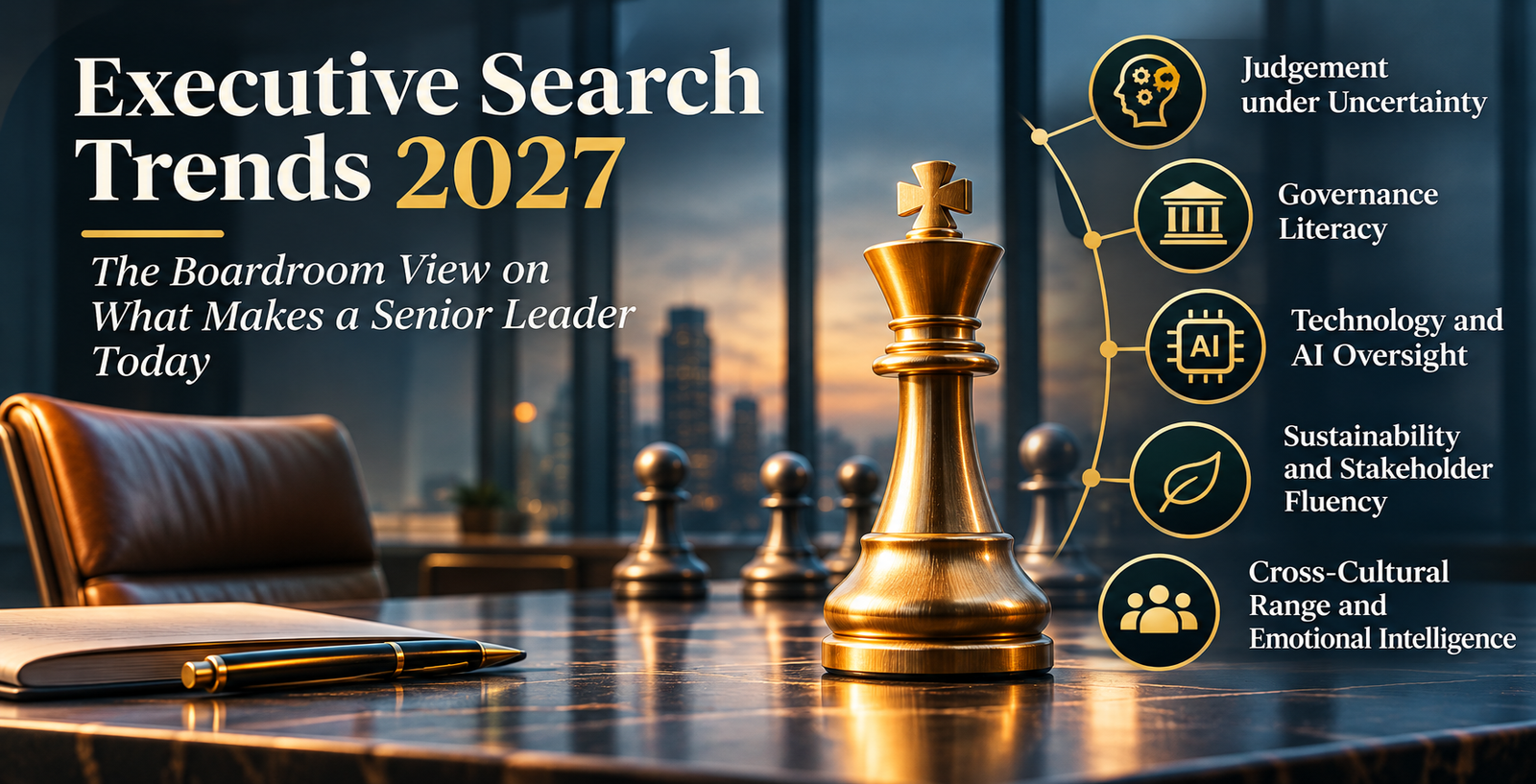
The Five Qualities Boards Increasingly Prize
The following scorecard reflects a pattern visible in senior appointments. Treat it as an analytical lens rather than a universal rule, since every board and sector differs.
Judgement under uncertainty
Boards rarely need executives who can follow a plan. They need leaders who can decide well when the plan fails. Candidates are probed on past decisions made with incomplete information, and on what they learned when they were wrong.
Governance literacy
An executive does not need to be a lawyer, but must understand how risk, audit, compliance and regulation shape decisions. Board members notice quickly whether a candidate sees governance as a brake or as a source of trust. For a practical illustration of what scrutiny looks like in practice, see our primer on responding to regulatory investigations.
Technology and AI oversight
Boards do not expect executives to build models. They do expect them to ask who is accountable when algorithms decide, how errors are detected and what data is being used. The AI governance gap is fast becoming a standard topic in senior interviews.
Sustainability and stakeholder fluency
Environmental, social and governance questions are now part of strategic conversation, not a separate reporting exercise. Candidates who can explain how sustainability creates competitive advantage stand out, as our article on ESG beyond compliance demonstrates.
Cross-cultural range and emotional intelligence
Global organisations need leaders who can earn trust across languages, hierarchies and expectations. Boards look for evidence of adaptation, such as having led a team in an unfamiliar market or integrated a business with a different culture. The capacity to stay composed and perceptive under pressure is central, as our analysis of emotional intelligence in uncertain times shows.
What This Looks Like in the Interview Room
Qualities are easy to list and hard to demonstrate. In practice, board interviews tend to test them through a handful of probing questions:
- "Tell us about a decision you made that turned out to be wrong. What did you do next?"
- "Describe a time when you disagreed with your chair or chief executive. How did you handle it?"
- "Which risk in our sector keeps you awake, and what would you do about it in your first ninety days?"
- "How would you build trust with a team in a country you have never worked in?"
Notice that none of these asks for a list of achievements. Each asks for reasoning, candour and self-awareness. Candidates who prepare a polished highlights reel often find themselves exposed by the follow-up question. Those who have rehearsed honest, specific stories, including ones that do not flatter them, usually come across as more credible and more suitable for a role that carries fiduciary weight.
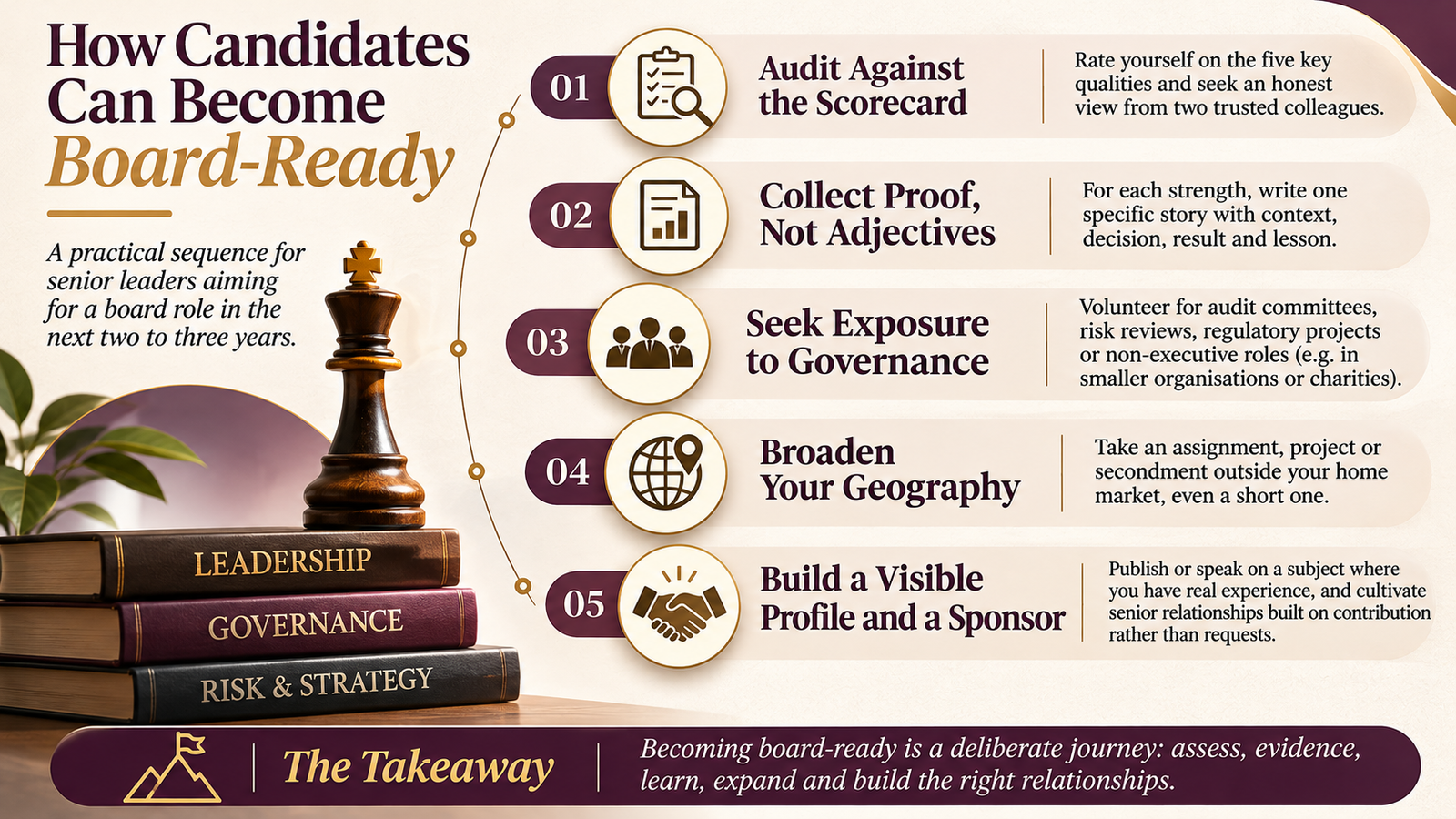
How Candidates Can Become Board-Ready
If a senior role is your goal within the next two to three years, work through this sequence.
- Audit against the scorecard. Rate yourself honestly on each of the five qualities and ask two trusted colleagues to do the same.
- Collect proof, not adjectives. For each strength, write one specific story with context, decision, result and lesson.
Seek exposure to governance. Volunteer for audit committees, risk reviews, regulatory projects or non-executive roles in smaller organisations or charities. - Broaden your geography. Take an assignment, project or secondment outside your home market, even a short one.
Build a visible body of thinking. Publish or speak on a subject where you have real experience, so that search firms and board members can find you. - Develop a sponsor. Board seats rarely go to strangers. Cultivate senior relationships built on contribution rather than requests.
How Boards Can Improve Their Own Process
The responsibility is shared. Boards that want stronger appointments should examine their own habits.
- Define the problem before the profile. Start with the three challenges the next leader must solve, not with a list of past job titles.
- Reduce sameness. If every shortlisted candidate shares the same background, the process is likely replicating the board rather than serving the company.
- Test judgement directly. Use scenario interviews that mirror real dilemmas, rather than relying solely on achievements summarised on a résumé.
- Plan for the first year. Agree what success looks like at six and twelve months, and who will support the new leader.
A Note for Executives Outside Traditional Markets
Many talented leaders work in regions or sectors that global search firms visit rarely. If that describes you, visibility becomes part of your strategy. Join cross-border industry bodies, accept invitations to speak at international forums and keep your professional profile current and specific. Boards cannot appoint leaders they have never heard of, and a clear, evidence-based public presence is often what turns an unknown name into a serious shortlist candidate.
Common Mistakes on Both Sides
Candidates often overstate achievements and understate learning. Boards that dig beneath a polished narrative frequently value a candid account of a failure more than another success story. Boards, for their part, sometimes mistake charisma for capability and hire for confidence rather than evidence. Both errors are avoidable with preparation.
Build the Reputation Before the Vacancy
The most important executive search trends 2027 will reveal are not about job titles or sectors. They concern character under pressure and the ability to govern complexity. Leaders who invest now in judgement, governance literacy and cross-cultural range will be ready when the right vacancy appears, and boards that sharpen their own processes will find better leaders.
Frequently Asked Questions
What do boards look for in senior hires in 2027?
This article highlights five qualities: judgement under uncertainty, governance literacy, technology and AI oversight, sustainability and stakeholder fluency, and cross-cultural range with emotional intelligence. It is an analytical lens, not a universal rule.
How can an executive become board-ready?
Audit yourself against the five qualities, prepare evidence-based stories, seek exposure to governance, gain experience outside your home market, build a visible body of thinking and cultivate sponsors.
Do I need a formal governance qualification?
Not necessarily. Boards value demonstrated governance literacy. Audit or risk committee work, regulatory projects and non-executive roles in smaller organisations or charities are practical ways to build it.
How can boards improve their own appointment process?
Define the problems the next leader must solve before writing the profile, reduce sameness among shortlisted candidates, use scenario-based interviews and agree what success looks like at six and twelve months.