
Why Corporate Governance Is No Longer Just a Boardroom Issue

Back in 2001, Enron stood as the seventh-largest company in the United States by revenue. Within a year, it collapsed into bankruptcy. While fraud was the immediate trigger, the deeper issue was far more revealing — a breakdown of governance at every level. The very systems meant to provide oversight had quietly stopped working. Audit committees weren’t truly auditing. Risk frameworks overlooked obvious risks. Oversight existed in theory, but not in practice.
More than twenty years later, that lesson still holds — and yet, many organisations continue to relearn it the hard way. Corporate governance is not just a compliance requirement; it is fundamental to survival. When treated as a formality rather than a strategic priority, it leaves organisations exposed.
In 2026, the stakes are even higher. ESG investing is now mainstream. Regulatory frameworks are tightening across borders. Stakeholders — from investors to employees — are far more informed and demanding. Governance has moved from the background into the spotlight. Companies that get it right are attracting capital, retaining talent, and building long-term credibility. Those that don’t are facing more than penalties — they are being questioned on their very right to operate.
What Is Corporate Governance and Why It Matters Today
At its core, corporate governance is about how organisations are directed, controlled, and held accountable. It covers the structures and relationships between boards, executives, shareholders, and stakeholders — essentially, how decisions are made and monitored. For much of the twentieth century, this was seen in fairly narrow terms: board structure, audits, executive pay, and shareholder rights. Important, yes — but largely administrative. That narrow view no longer works. Three major shifts have changed the definition entirely.
First, stakeholder expectations have evolved. Today, organisations are judged not only on financial performance but also on environmental impact, social responsibility, and ethical decision-making. The question is no longer “Are we compliant?” — it’s “Are we credible and trustworthy?”
Second, ESG has become central to investment decisions. With global ESG assets exceeding $40 trillion, governance alone accounts for roughly 30% of scoring models. In 2024, Institutional Shareholder Services voted against 42% of executive pay proposals due to governance concerns. Major investors like BlackRock now actively assess governance quality before making decisions. Governance is no longer reviewed annually — it’s under constant scrutiny.
Third, regulations across regions are aligning. Frameworks such as the EU’s CSRD, SEC climate rules, India’s SEBI reforms, and Singapore’s reporting standards are setting global expectations. Organisations can no longer “choose” easier jurisdictions — the bar is rising everywhere.
Put together, these shifts have repositioned governance as what it truly is: the foundation on which performance, reputation, and resilience are built.
How Corporate Governance Failures Destroy Brand Trust and Business Value
The impact of poor governance is not theoretical — it’s well documented.
Take Volkswagen’s emissions scandal. The company deliberately manipulated emissions tests across around eleven million vehicles, leading to costs exceeding €30 billion. But beyond financial loss, the damage to trust was far deeper and longer-lasting. At its heart, this wasn’t just a technical issue — it was a governance failure. A culture where problems weren’t challenged, and accountability was missing.
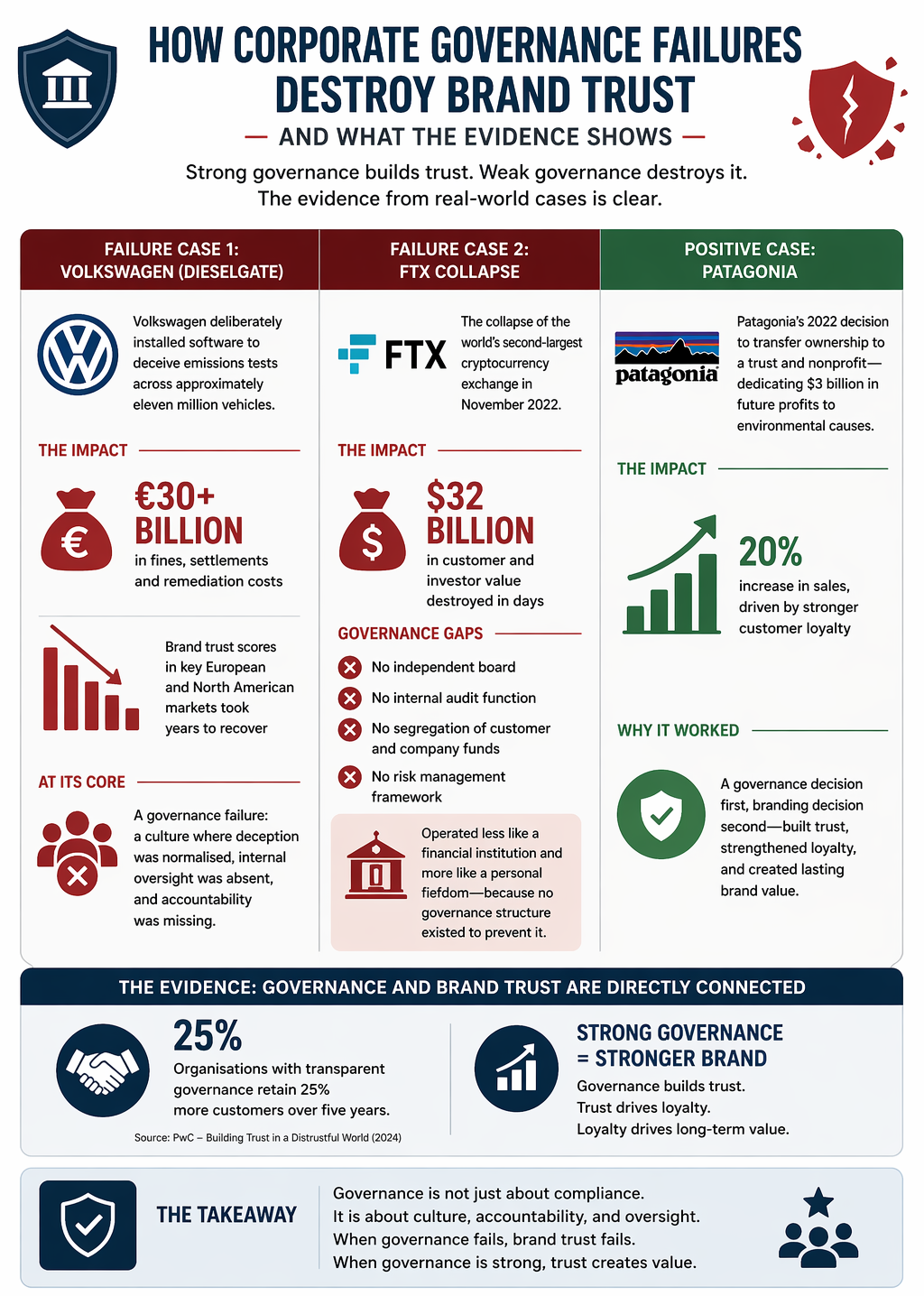
Then there’s FTX. Once the world’s second-largest cryptocurrency exchange, it collapsed in 2022, wiping out $32 billion in value almost overnight. What investigations revealed was striking — not complex fraud, but an absence of even basic governance: no board, no audits, no separation of funds, no risk controls. It operated without structure because no governance system existed to enforce one.
“In the long run, a company’s reputation is more important than any single transaction.”
— Warren Buffett
On the other hand, strong governance can drive positive outcomes. Patagonia’s 2022 decision to transfer ownership to a trust and non-profit — effectively dedicating $3 billion in future profits to environmental causes — was a governance move first, and a branding decision second. The result? A 20% increase in sales, driven by stronger customer loyalty.
Research supports this pattern. Organisations with transparent governance retain 25% more customers over five years. The link is simple: governance builds trust — and trust drives long-term value.
Corporate Governance and ESG: Why Governance Drives Investor Decisions
Governance is often seen as one part of ESG — but in reality, it’s what makes the other parts credible. A company can publish ambitious sustainability goals or social initiatives. But without governance structures to support them — clear accountability, measurable tracking, and transparent reporting — they remain surface-level claims. Investors today can tell the difference.
Boeing’s MAX crisis is a clear example. Two fatal crashes led to investigations that uncovered governance failures — safety concerns didn’t reach the board, oversight lacked technical depth, and accountability gaps persisted. The financial impact exceeded $70 billion, but the root cause was governance, not engineering alone.
Data reinforces this shift. Companies with stronger governance reporting have a 12% lower cost of capital. Salesforce, for example, tied executive compensation to governance metrics and saw an 18% improvement in operating margins over three years.
For today’s CXOs, the takeaway is clear: governance is no longer a “soft” factor. It is directly tied to valuation, investor confidence, and financial performance.
How Strong Corporate Governance Frameworks Improve Crisis Resilience
The true test of governance is not stability — it’s how organisations respond under pressure. Evidence consistently shows that companies with strong governance frameworks recover faster and perform better during crises. McKinsey’s research indicates they are 2.5 times more likely to survive major disruptions. This comes down to structure. Clear decision-making, defined accountability, and effective risk escalation systems allow organisations to act quickly and confidently when needed.
Tata Group is a strong example. With operations in over 100 countries and a market value exceeding $365 billion, its consistent governance practices — independent oversight, transparency, and stakeholder focus — have enabled it to navigate decades of economic and geopolitical challenges.
Contrast that with General Electric, which saw a 90% drop in market value between 2000 and 2020. Analyses point to governance gaps — concentrated decision-making, weak oversight, and short-term focus — as contributing factors. In emerging markets like India, Singapore, and the UAE, governance quality is increasingly linked to investment inflows. It has become a signal of readiness, not just compliance.
Corporate Governance Best Practices for High-Performing Organisations
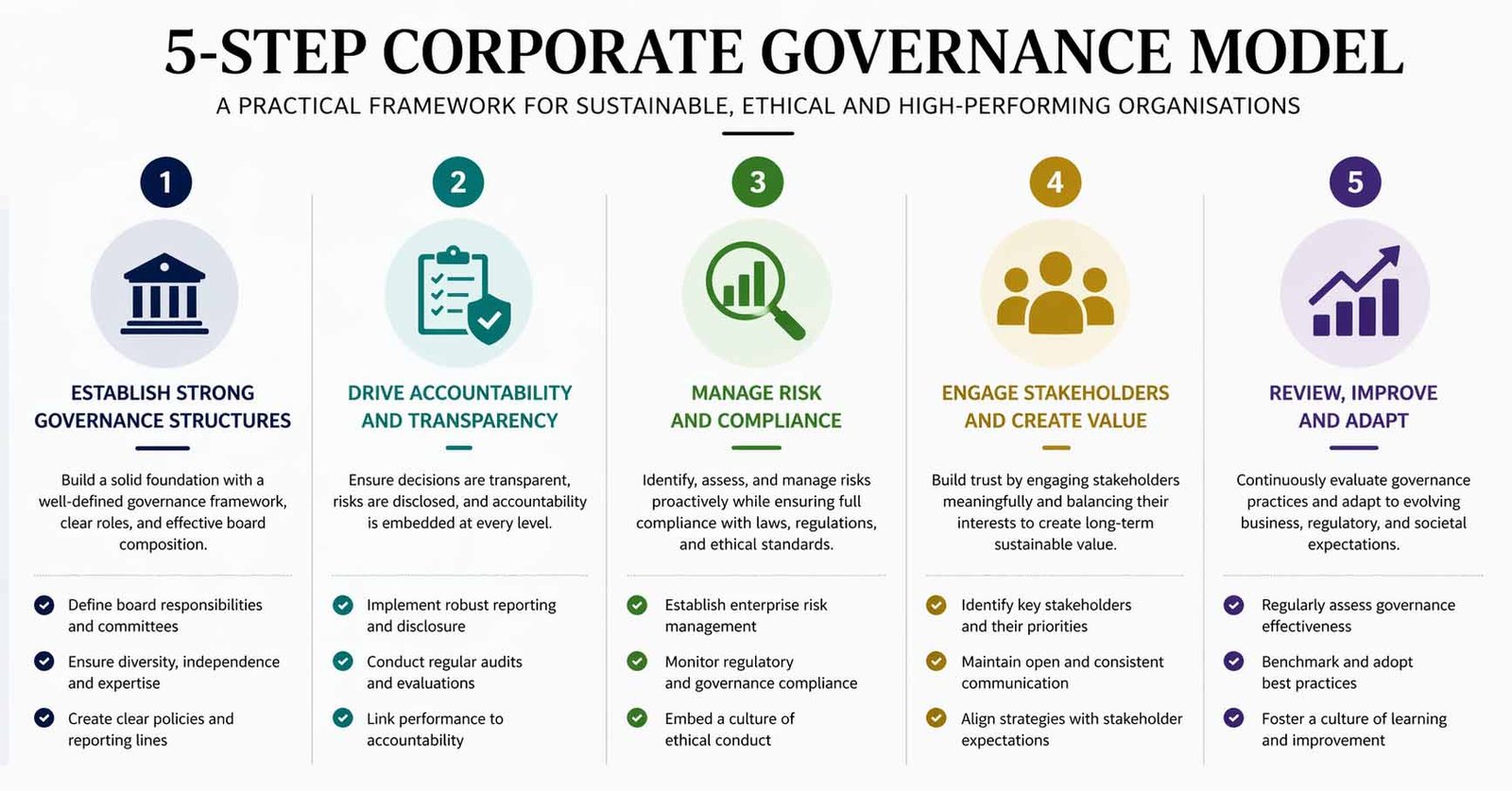
The difference between strong and average governance isn’t policy — it’s how those policies are applied. Effective governance today spans multiple areas: board structure, executive accountability, risk management, stakeholder engagement, ESG oversight, data governance, and organisational culture.
“Trust is the ultimate currency in business.”
— Satya Nadella
Top-performing organisations stand out in a few key ways:
They build boards for capability, not tradition
Boards include independent members with expertise in areas like technology, climate risk, and regulation — ensuring better decision-making.
They tie governance to incentives
When at least 30% of executive compensation is linked to governance and ESG outcomes, accountability improves significantly.
They monitor risk continuously
Instead of relying on periodic reviews, they use real-time tools to identify and respond to risks early.
They extend governance beyond their organisation
Supply chains and third-party relationships are treated as part of their governance responsibility.
They focus on outcomes, not just policies
Governance frameworks are regularly reviewed and updated based on real-world effectiveness, not just compliance checklists.
Governance Frameworks in Practice: The Global Regulatory Landscape
Governance today is shaped by an increasingly interconnected regulatory environment.
The EU’s CSRD requires detailed sustainability and governance reporting — even for non-EU companies with European operations. The SEC’s climate rules now link governance directly to financial disclosures. In India, SEBI has strengthened governance norms for listed companies.
The direction is clear: organisations can no longer design governance for the lowest standard. They must meet the highest.
Suggested Reading : Corporate Governance in 2025: A Year-End Wrap-Up of Viral Trends Reshaping Boardrooms Worldwide
Frequently Asked Questions: Corporate Governance
What are the key principles of a corporate governance framework?
A strong corporate governance framework is built on transparency, accountability, fairness, and responsibility. It ensures that decision-making is aligned with long-term value creation while maintaining governance compliance with regulatory standards. Effective frameworks also integrate corporate ethics and stakeholder governance, ensuring that the interests of shareholders, employees, customers, and society are balanced and protected.
How do corporate governance failures impact companies?
Failures in corporate governance can lead to significant financial losses, reputational damage, and regulatory penalties. When governance compliance is weak or ignored, organisations risk poor oversight, unethical decision-making, and lack of accountability. Over time, this erodes trust among stakeholders, disrupts stakeholder governance, and can ultimately threaten the organisation’s long-term sustainability and market position.
What is the relationship between corporate governance and ESG?
Corporate governance forms the foundation of ESG (Environmental, Social, and Governance) performance. A well-defined corporate governance framework ensures that ESG commitments are not just symbolic but backed by measurable actions, accountability, and reporting. Strong corporate ethics and robust stakeholder governance practices enhance credibility, while consistent governance compliance reassures investors that ESG strategies are effectively implemented and monitored.
What is corporate governance and why does it matter for businesses in 2026?
Corporate governance refers to how organisations are structured, directed, and held accountable. It includes board oversight, executive accountability, risk management, and transparency. In 2026, it directly impacts investment, trust, and long-term performance.
How does corporate governance affect ESG scores and investor decisions?
Governance makes up about 30% of ESG evaluations. Strong governance signals credibility, while weak governance raises concerns about whether ESG commitments are genuinely implemented.
What are the key elements of an effective corporate governance framework?
An effective framework includes independent boards, clear accountability, strong risk management, transparent reporting, supply chain oversight, and continuous monitoring — all working together as one system. Looking ahead, the organisations that will lead are not simply those with the best technology or fastest growth. They are the ones that can make sound decisions, adapt under pressure, and maintain trust over time.