

Corporate Governance in 2025: A Year-End Wrap-Up of Viral Trends Reshaping Boardrooms Worldwide

Top Corporate Governance Trends in 2025 Reshaping Global Boardrooms
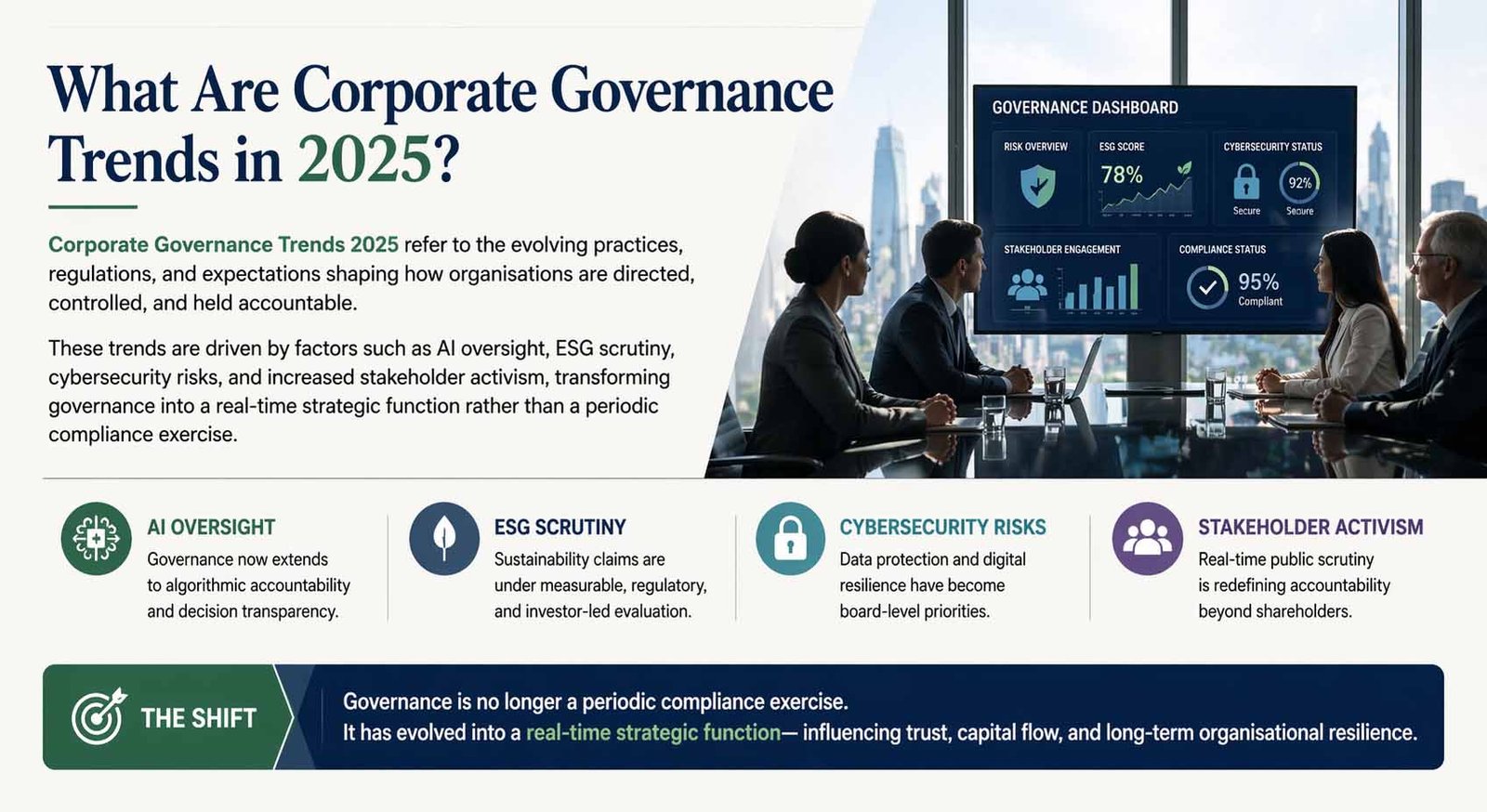
In Q3 2025, a major Big Tech firm triggered a global compliance crisis when an unchecked AI decision engine resulted in a USD 1.5 billion regulatory fine. The fallout extended far beyond financial loss — it exposed a deeper failure of oversight and accountability at the highest levels. This moment became symbolic of a broader shift captured in the Corporate Governance Trends 2025, where governance moved from internal policy to public scrutiny. Across industries, boards are no longer evaluated on intent, but on execution — in real time, under the lens of regulators, investors, and an increasingly informed global audience.
The year 2025 marked a turning point where governance moved from policy binders to viral metrics. Amid an AI acceleration cycle, climate litigation, geopolitical fragmentation, and rising shareholder activism, boards were forced into public accountability. By mid-year, 72% of institutional investors reported weighting governance as the decisive pillar of ESG decision-making, while social and professional platforms amplified governance failures faster than quarterly earnings calls ever could. This shift has become central to conversations around Business Excellence, where governance is no longer treated as compliance infrastructure but as a strategic growth driver. Increasingly, forward-looking organisations are aligning governance models with Sustainable Enterprise frameworks that integrate accountability, resilience, and long-term value creation.
This article unpacks the five most influential governance trends of 2025—shaped not just by regulation, but by digital scrutiny, stakeholder capitalism, and real-time reputational risk. These were not peripheral developments. They were seismic shifts.
“Governance is the new growth engine.” — World Economic Forum 2025
Trend 1: AI Governance Trends in 2025: Why Oversight Became Mandatory
The defining governance storyline of 2025 was the rapid formalisation of AI oversight. What began as voluntary ethical guidelines transformed into enforceable governance mandates across markets. Mid-year enforcement of the EU AI Act, coupled with new AI disclosure expectations from securities regulators, triggered widespread board-level recalibration.
Key Shift: AI Governance in 2025
- Mandatory board-level oversight
- Real-time monitoring systems
- Increased regulatory enforcement
A viral catalyst accelerated this shift: a leaked internal ethics thread from a leading AI lab amassed over 250 million views, exposing gaps between public AI commitments and internal controls. Almost overnight, “AI governance” entered mainstream discourse — reinforcing why governance oversight can no longer remain confined to directors’ meetings, as explored in Why Corporate Governance Is No Longer Just a Boardroom Issue. Boards responded by institutionalising roles such as Chief AI Ethics Officer, with 55% of large enterprises introducing mandatory human-veto protocols on high-risk algorithmic decisions.
This shift marked a structural change. AI governance moved from IT committees to the board agenda. Explainability audits replaced black-box tolerance, while real-time algorithm monitoring became standard. Governance platforms offering board-level AI dashboards recorded triple-digit growth as directors demanded visibility into model risk, bias exposure, and regulatory alignment.
Implications for boards:
• Continuous AI risk assessment, not annual reviews
• Personal liability exposure for AI-related failures
• Integration of AI ethics into enterprise risk frameworks
Governance Standard Comparison
| Aspect | Pre-2025 | 2025 Standard |
|---|---|---|
| Oversight | Ad-hoc | C-suite mandatory |
| Audits | Annual | Real-time |
| Liability | Corporate entity | Board-level |
Trend 2: ESG Governance Risks in 2025: The Rise of Greenwashing Lawsuits
If ESG dominated the early 2020s as a reputational asset, 2025 reframed it as a litigation and governance risk. The year saw a sharp rise in greenwashing lawsuits, driven as much by public scrutiny as by regulators. A widely shared backlash against asset managers’ shifting ESG narratives—tagged #Greenwash2025—generated over 700 million engagements and placed corporate disclosures under forensic analysis.
By year-end, climate-related lawsuits globally exceeded USD 40 billion in claims. The message was clear: symbolic sustainability was no longer defensible. Boards were required to demonstrate “double materiality”—showing both financial impact and societal consequence—across climate risk, supply chains, and stakeholder commitments.
Executive compensation became a focal point. Several high-profile firms linked climate targets to long-term incentives, introducing clawback clauses for sustainability underperformance. Governance committees, once peripheral to ESG strategy, became central to validating climate disclosures and overseeing third-party assurance.
Key implications:
• ESG shifted from narrative to evidence-based governance
• Climate risk embedded into fiduciary duty discussions
• Heightened scrutiny of sustainability-linked marketing
Trend 3: DEI 2.0 – Beyond Quotas to Inclusive AI
Diversity, Equity, and Inclusion entered a second phase in 2025—less performative, more systemic. A late-year release of a major AI bias audit went viral, crossing 800 million views across digital platforms and reframing DEI as both a human and technological governance issue.
Boards began to recognise that algorithmic bias posed reputational, legal, and strategic risks. As a result, DEI metrics evolved beyond representation quotas to include inclusive system design, neurodiversity frameworks, and bias-resistant AI training data. Several regions pushed board diversity targets beyond symbolic thresholds, while others experimented with merit-based DEI hybrids to counter political backlash.
The governance lesson was clear: inclusion was no longer a values statement—it was a performance variable. Boards that failed to embed DEI into decision architecture faced not just criticism, but operational blind spots.
“Diversity powers decisions.” — Global business leader, 2025
Trend 4: Cyber Governance in 2025: Why Boards Must Lead Security Strategy
Cybersecurity crossed a governance threshold in 2025, driven by a single viral moment. A simulated quantum breach at a global financial institution demonstrated how future computing power could compromise legacy encryption systems. The scenario, shared widely under #Cyber2025, accumulated over 1.5 billion impressions within weeks.
Boards responded by redefining cybersecurity as a strategic governance issue rather than a technical one. Dedicated cyber-risk board seats became common, and post-quantum readiness emerged as a new governance benchmark. Regulatory bodies updated standards, while insurers began adjusting premiums based on quantum preparedness disclosures.
The implications extended beyond IT. Cyber resilience became a proxy for board competence, crisis readiness, and long-term value protection.
Governance implications:
• Cyber expertise as a board competency requirement
• Scenario-based cyber simulations at board level
• Reduced insurance and capital costs for compliant firms
Trend 5: Activist AGMs Go Virtual and Viral
Shareholder activism entered a new era in 2025 as annual general meetings went virtual, immersive, and public. A metaverse-based AGM protest attracted 350 million viewers, transforming what was once a closed-door governance ritual into a global spectator event.
Blockchain-enabled voting, AI-powered proxy analysis, and social amplification empowered retail investors and activist coalitions alike. By year-end, activist campaigns succeeded in nearly half of contested resolutions, signalling a decisive shift toward stakeholder capitalism.
Boards were no longer insulated by procedural complexity. Governance decisions were debated in real time, with reputational consequences unfolding live.
Forward view:
• Rise of decentralised governance models
• Increased transparency expectations for board deliberations
• Early experimentation with DAO-inspired oversight frameworks
Real-World Case Studies: Frontline Lessons
The governance shifts of 2025 were not theoretical. Several organisations demonstrated how adaptive governance could restore trust and unlock value.
Corporate Governance Trends 2025 at a Glance
Trend | Key Impact | Board Implication |
| AI Governance | Real-time oversight | Increased liability |
| ESG Risk | Legal exposure | Stronger disclosure |
| Cybersecurity | Strategic risk | Board-level expertise |
| DEI Evolution | Decision quality | System-level integration |
| Activism | Transparency | Real-time accountability |
Case 1: Consumer Goods Multinational – AI Recovery
Following a public AI governance failure, the company restructured oversight, introduced board-level AI audits, and improved governance ratings by 12% within two quarters.
Case 2: Conglomerate ESG Turnaround
Amid regional and investor scrutiny, a diversified group strengthened climate disclosures, aligned incentives with sustainability outcomes, and avoided major litigation while maintaining investor confidence.
Case 3: Technology Services Firm – Cyber Shield
After proactively adopting post-quantum security frameworks, the firm recorded an 18% stock appreciation, driven by renewed institutional trust.
Before-and-After Governance Metrics
| Metric | Pre-Intervention | Post-Intervention |
|---|---|---|
| Total Shareholder Return | Flat | +15–18% |
| Regulatory Fines | High risk | Nil reported |
| Governance Score | Below median | Top quartile |
Conclusion: Governance Roadmap for 2026
The governance narrative of 2025 can be distilled into five interconnected forces: AI accountability, ESG credibility, inclusive decision-making, cyber resilience, and activist transparency. Together, they formed the “Fab Five” reshaping corporate governance worldwide.
For boards and executive leaders, the lesson is not to chase viral moments, but to anticipate them. Governance excellence in 2026 will be defined by integrated dashboards, genuinely diverse boards, and proactive compliance embedded into strategy—not appended after crises erupt. Governance excellence in 2026 will be defined. At a deeper level, many of these governance shifts are driven by how leadership interprets emerging risks and opportunities—highlighting the growing importance of strategic sensemaking in business.
The outlook is cautiously optimistic. Forecasts suggest that by 2026, the vast majority of large enterprises will operate under formal AI oversight frameworks, reflecting lessons hard-earned in 2025.
Key Takeaways from Corporate Governance Trends 2025
- Governance is now continuous, not periodic
- AI and cybersecurity are board-level risks
- ESG requires evidence, not narrative
- Stakeholders influence governance in real time
- Trust is the ultimate outcome of strong governance
“Anticipate, don’t react.”
As governance becomes both a risk shield and a growth lever, the question for leaders is no longer whether governance matters—but how visibly and credibly it is practiced. The defining lesson from the Corporate Governance Trends 2025 is clear: governance is no longer a reactive safeguard — it is a proactive driver of trust, resilience, and long-term value. As organisations move into 2026, those that embed governance into strategy, culture, and decision-making will not only mitigate risk but unlock sustainable growth. The future belongs to leaders who anticipate governance challenges before they surface — and demonstrate accountability not just in principle, but in practice.
What’s your 2026 governance prediction?
FREQUENTLY ASKED QUESTIONS
Q1: What are the top corporate governance trends in 2025?
The top corporate governance trends in 2025 include AI governance mandates, ESG accountability, cybersecurity oversight, evolving DEI frameworks, and increased shareholder activism.
Q2: Why is AI governance important for boards in 2025?
AI governance is critical because organisations are now accountable for algorithmic decisions, requiring transparency, oversight, and risk management at the board level.
Q3: How is ESG changing corporate governance?
ESG has shifted governance from voluntary disclosure to measurable accountability, with legal, financial, and reputational consequences for non-compliance.