
The Quiet Automation of Middle Management: What AI Is Actually Replacing

Nobody announced it, yet it is happening in plain sight. Status reports compile themselves, schedules rearrange themselves and first drafts of performance summaries appear before a manager has opened a blank page. The debate about AI automation of middle management often swings between panic and denial. Both miss the point. AI is not replacing middle managers wholesale. It is quietly absorbing parts of their work, and leaders who understand which parts will design stronger organisations than those who simply cut layers.
What the Forecasts Actually Say
In October 2024, Gartner predicted that through 2026, one in five organisations would use AI to flatten their structure, eliminating more than half of current middle management positions. It is a striking claim, and it has been widely repeated.
Treat it with care. It is a forecast, not a measurement, and it describes what organisations may attempt rather than what will succeed. Delayering is also not new. Companies were removing management layers long before generative AI arrived. What AI changes is the economic case: tasks that once justified a coordinating layer can now be done faster and more cheaply by software.
The sensible question for leaders is therefore not "Will AI replace our managers?" but "Which parts of management work can AI do well, and what happens to the rest?"
What Middle Managers Actually Do
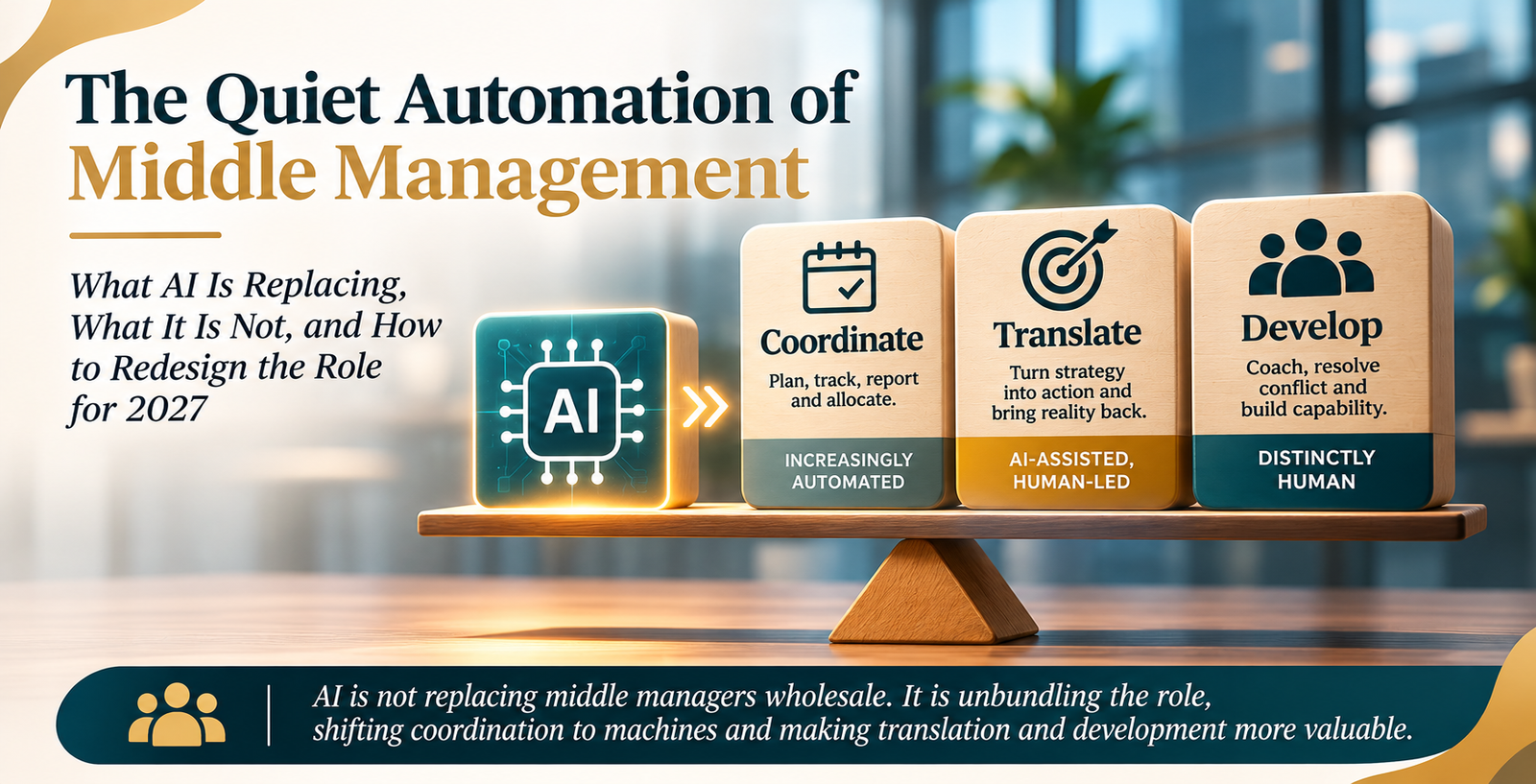
Strip away the job titles and middle management consists of three distinct activities.
- Coordinate. Scheduling, allocating work, tracking progress, consolidating reports and chasing approvals. This is the administrative core of the role.
- Translate. Turning strategy into priorities a team can act on, and carrying ground-level reality back to senior leaders. This requires context, credibility and judgement.
- Develop. Coaching people, resolving conflict, spotting potential and building the team's confidence. It depends on trust earned over time.
AI is strongest at the first activity, improving at parts of the second and weakest at the third. That asymmetry explains why the quiet automation of middle management is real but incomplete.
It helps to be precise about what "managing" means in practice. In many organisations, a surprising share of a manager's week is spent assembling information for other people: updating the weekly report, preparing the slide for the monthly review, confirming who is doing what by when. None of this is trivial, but little of it requires judgement. That is exactly why it is the first territory AI is entering.
What AI Is Replacing, and What It Is Not
Look at tasks, not roles. Tasks that AI tools increasingly handle include:
- Compiling status updates and dashboards.
- Scheduling meetings and summarising them afterwards.
- Producing first drafts of reports and routine communications.
- Routing standard approvals and flagging exceptions.
- Suggesting resource allocation based on workload data.
Tasks that remain stubbornly human include:
- Judging a difficult situation where the data is incomplete. Our guide to decision-making under uncertainty explains why.
- Coaching a struggling colleague through a hard conversation.
- Mediating between teams with competing priorities.
- Making ethical calls when the efficient option is the wrong one.
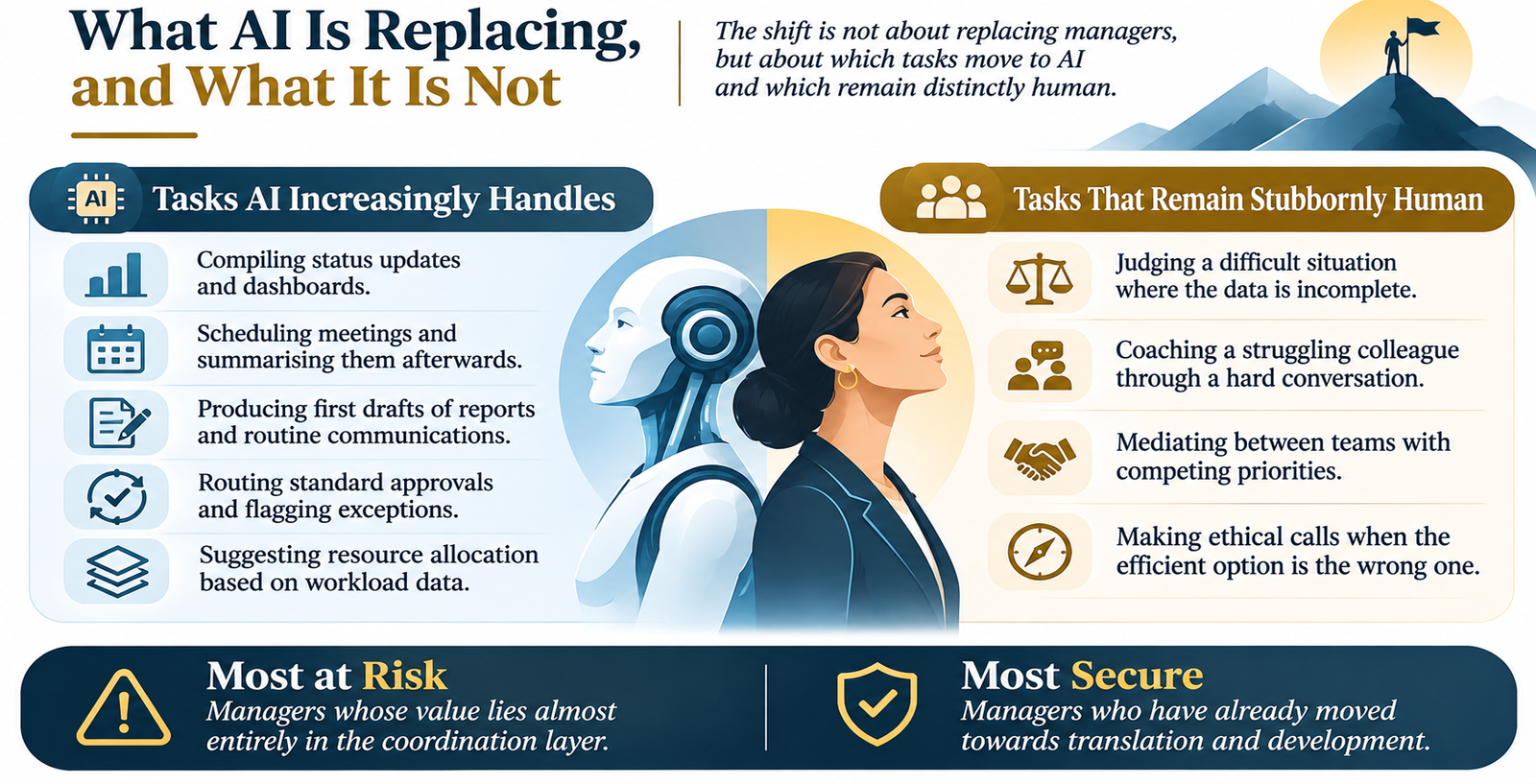
The managers most at risk are those whose value lies almost entirely in the coordination layer. The managers most secure are those who have already moved towards translation and development.
The Hidden Costs of Flattening Too Fast
Cutting a layer is easy to model and hard to reverse. Four risks deserve attention.
- Span-of-control overload. If one manager now supervises many more people, coaching quality falls first, because it is the activity easiest to postpone.
- A broken talent pipeline. Middle management has traditionally been where future senior leaders learn to lead. Remove the training ground and you may find a shortage of ready successors in a few years.
- A lost translation layer. Without people who interpret strategy for teams, directives arrive unfiltered and feedback travels upward more slowly.
- An accountability gap. When an algorithm recommends and a human merely approves, it becomes unclear who owns the outcome. Our analysis of the AI governance gap examines this problem, while lessons on turning AI ethics into enterprise advantage shows how leading organisations keep humans meaningfully in the loop.
The Human Side of the Shift
Employees notice when the layer above them changes. If managers are told that their role is under review while AI tools quietly appear in their workflows, anxiety travels fast and the best people start updating their CVs. Be transparent about intent. Explain which tasks are changing, what new responsibilities will replace them and how people will be supported in building new skills. Clarity does not remove concern, but it prevents rumour from filling the gap.
A Framework: The Coordinate, Translate, Develop Audit
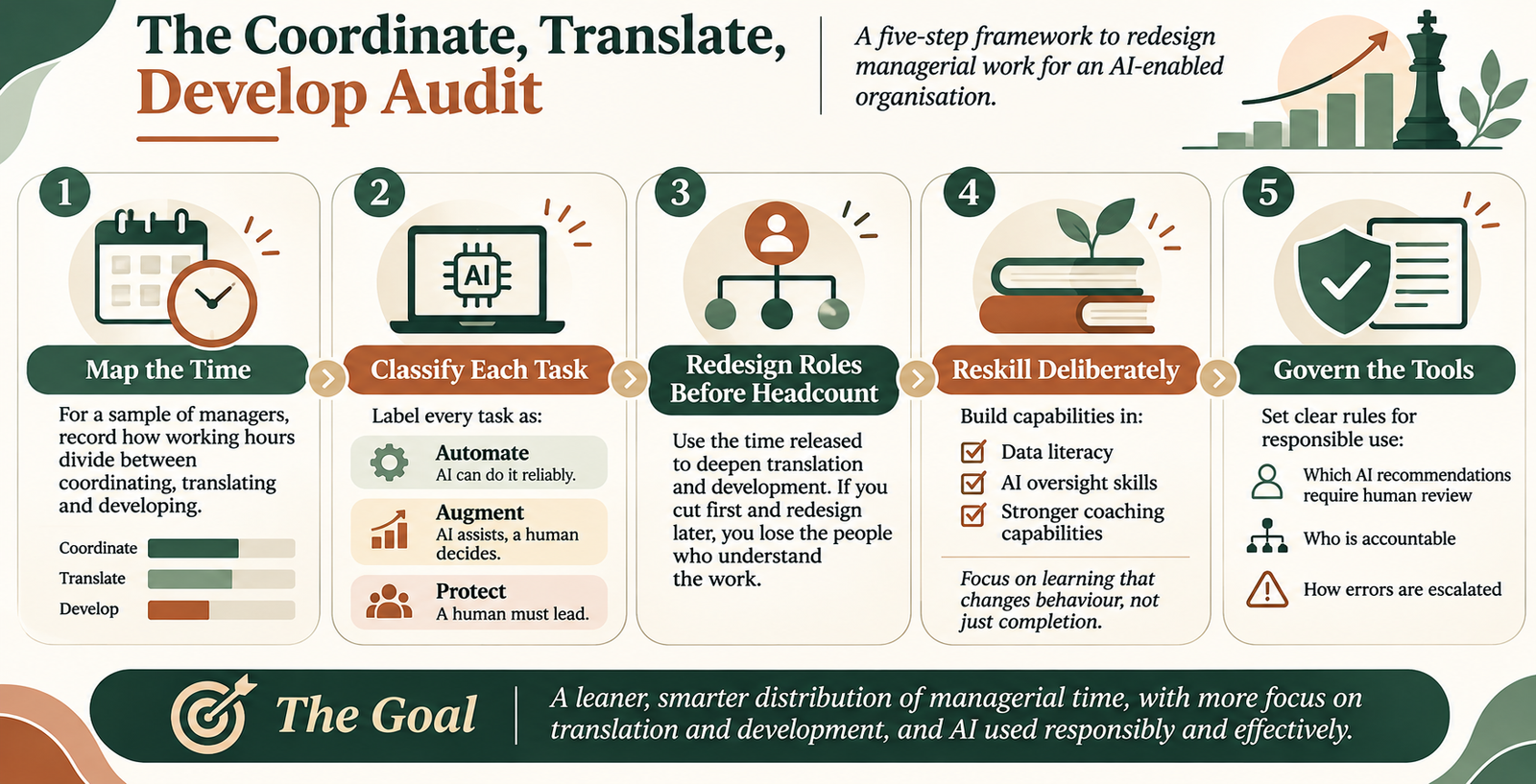
Before restructuring, run this five-step audit with your leadership team.
- Map the time. For a sample of managers, record how working hours divide between coordinating, translating and developing. Most leaders are surprised by how much is coordination.
- Classify each task. Label it automate (AI can do it reliably), augment (AI assists, a human decides) or protect (a human must lead).
- Redesign roles before headcount. Use the time released to deepen translation and development. If you cut first and redesign later, you lose the people who understand the work.
- Reskill deliberately. Managers need data literacy, AI oversight skills and stronger coaching capabilities. Learning that changes behaviour matters here, a point made in our piece on CPD that changes behaviour.
- Govern the tools. Decide which AI recommendations require human review, who is accountable and how errors are escalated.
Readiness matters as much as design. Our checklist of AI adoption readiness indicators is a useful companion to the audit.
Where This Fits in Your AI Strategy
Middle management is only one part of a larger question: how should work be divided between people and machines?
The 90-day AI strategy playbook for business leaders sets out how to move from vision to operating model, and the manager audit above belongs inside that plan. Leaders who track developments in our AI & Automation section will see the same pattern repeatedly: the organisations that benefit most are those that redesign work first and automate second.
Redesign the Role, Do Not Just Remove It
The quiet automation of middle management is best understood as an unbundling. Coordination is moving to machines. Translation and development are becoming the core of the manager's job, and they matter more, not less, as organisations grow leaner. Leaders who protect and invest in those human capabilities will keep the connective tissue that makes strategy work. Those who strip it out in pursuit of a flatter chart may discover that they have removed the very layer that made the rest function.
A useful test is to ask what your best manager does that no software could replicate. If the answer is "reports and scheduling", your organisation has a design problem. If the answer is "she notices when someone is struggling before they say a word", you have found the capability worth protecting. The task for 2027 is clear. Audit the work, automate what is routine, strengthen what is human and keep accountability visible.
Frequently Asked Questions
Will AI replace middle managers?
Not wholesale, on the evidence available. Gartner's 2024 prediction is a forecast, not a measurement. AI is absorbing coordination tasks, while translating strategy and developing people remain human strengths.
Which management tasks can AI automate today?
Examples include compiling status updates, scheduling and summarising meetings, drafting routine reports, routing standard approvals and suggesting resource allocation based on workload data.
What are the risks of flattening an organisation too quickly?
Four stand out: overloaded spans of control, a weakened pipeline of future leaders, a lost translation layer between strategy and teams, and unclear accountability when algorithms recommend and humans merely approve.
Where should leaders start?
With the Coordinate, Translate, Develop audit: map how managers spend their time, classify each task as automate, augment or protect, and redesign roles before changing headcount.