
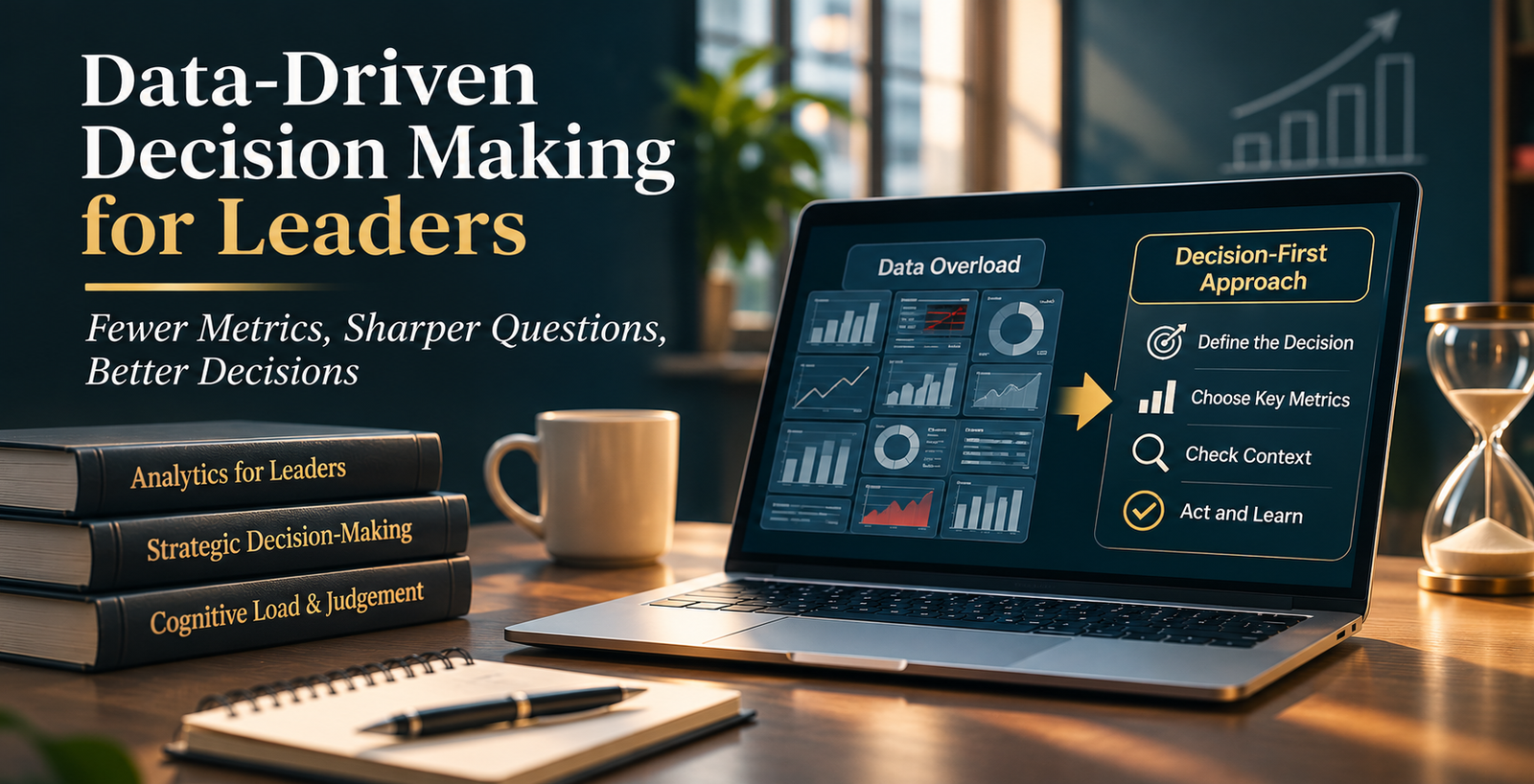
Data-Driven Doesn't Mean Data-Overwhelmed: A Leader's Guide to Signal Over Noise

Somewhere in your organisation, a dashboard is being refreshed right now. It has forty charts, three shades of red and a footnote nobody reads. Leaders were promised that more data would bring more clarity. Many have discovered the opposite: more data brings more arguments about which number matters. Real data-driven decision making for leaders is not about collecting everything. It is about knowing which few signals deserve attention, and which are simply noise.
Why More Data Often Means Worse Decisions
Three habits turn a data advantage into a burden.
Metrics multiply faster than decisions. Every team adds a measure to prove its value, and nobody removes the old ones. Within a few years the organisation tracks hundreds of numbers and acts on a handful.
Availability beats relevance. Leaders tend to examine what is easy to measure, such as page views, headcount or activity counts, rather than what actually predicts success.
Numbers become targets. There is a well-known principle, often called Goodhart's law, that when a measure becomes a target it stops being a good measure. If a call centre is judged on call length, calls get shorter and problems stay unsolved.
The statistician and writer Nate Silver popularised the distinction between signal and noise in his book The Signal and the Noise. The signal is the meaningful pattern. The noise is random variation that looks like a pattern. Treating every wobble in a weekly figure as a trend is the quickest way to make nervous, expensive decisions.
Start with the Decision, Not the Data
The most useful shift a leader can make is to reverse the usual order. Instead of asking "What does the data say?", ask "What decision are we trying to make, and what evidence would change it?"
This sounds obvious, yet most reporting begins with available data and hopes a decision will emerge. A decision-first approach begins with a choice, such as whether to enter a new market, hire ahead of demand or retire a product, and works backwards to the few facts that would genuinely tip the balance.
The Decision-First Method: Five Steps
Name the decision and its owner.
Write it as a question: "Should we extend the pilot to two more regions by March?" Assign one accountable person. Decisions owned by committees tend to produce reports instead of choices.
Define what would change your mind.
Before looking at any data, state which results would lead you to proceed, pause or stop. This protects against reading evidence selectively once you have a favourite outcome.
Choose a few metrics, and mix their types.
Combine lagging indicators, which confirm what has happened (revenue, churn), with leading indicators, which hint at what is coming (pipeline quality, early customer engagement). Keep the set small enough that a leader can recall it without notes.
Check quality and context.
Ask where the data came from, how it was collected and what is missing. A number without context invites false confidence. Compare against a baseline, a prior period or a peer group, and look for the story behind any sudden change.
Close the loop.
Record the decision, the evidence used and the expected outcome. Revisit it after the result is known. Organisations that keep a simple decision log learn faster, because they can see which judgements held up and why.
Build a One-Page Decision Brief
A practical discipline is to require a single page for any significant decision. It should contain the question, the options considered, the three or four metrics that matter, the main risk and the recommended action. If a team cannot fit its case on one page, it has probably not yet decided what the case is.
This habit also improves meetings. When everyone has read the same page, discussion moves from "what does this chart show?" to "what should we do?" Leaders interested in making sound choices when evidence is incomplete will find further tools in our guide to decision-making under uncertainty.
Protect the Human Side of Analysis
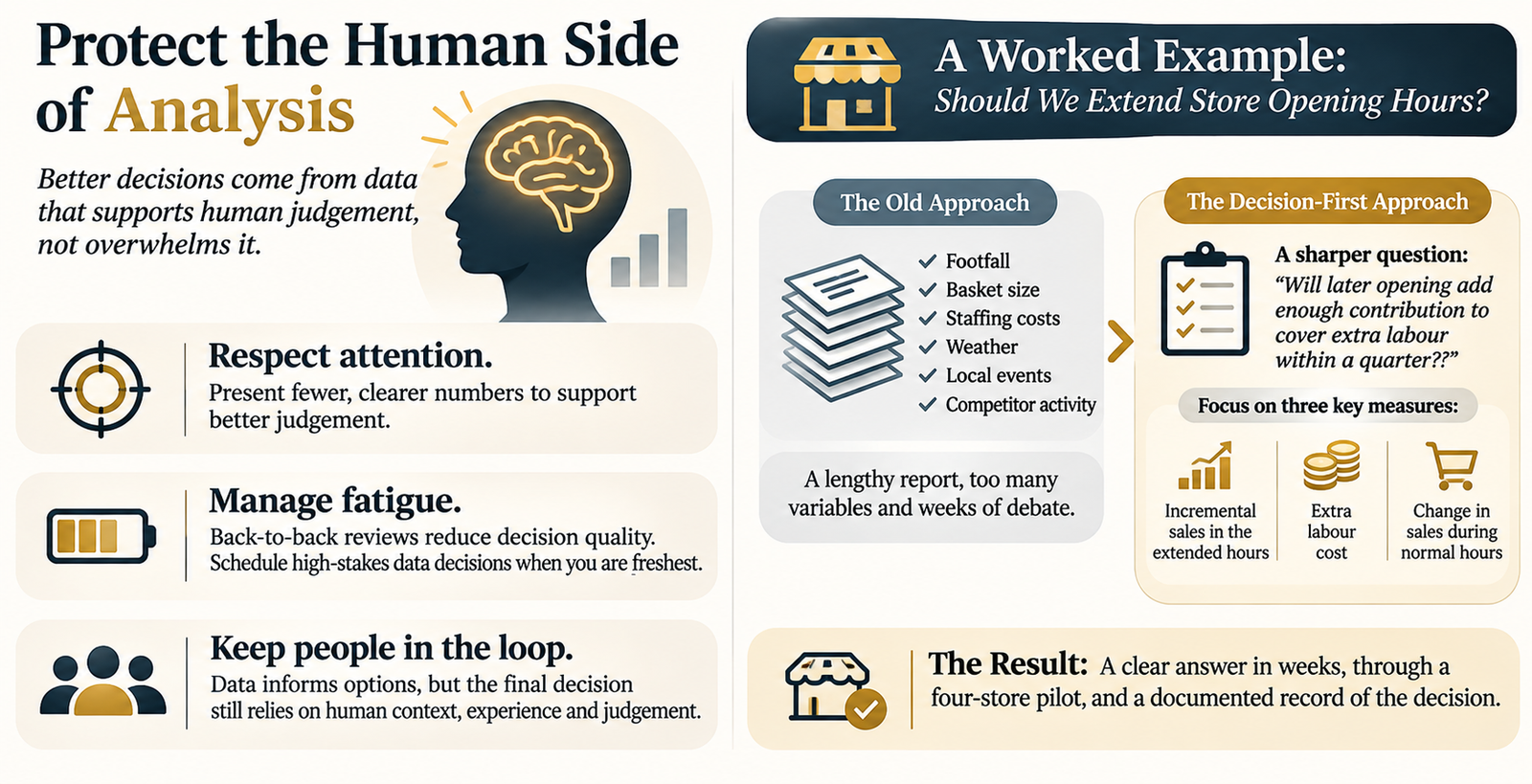
Data does not make decisions. People do, and people have limited attention. Our article on cognitive load and decision-making under stress explains why overloaded leaders default to habit or to whoever speaks most confidently. Presenting fewer numbers, more clearly, is not dumbing down. It is respecting how judgement actually works.
Fatigue matters too. A day of back-to-back reviews degrades the quality of later decisions, which is the central point of our piece on decision fatigue in leadership. Schedule the weightiest data decisions when you are freshest, and keep routine reporting out of that window.
A Worked Example
Imagine a retail operations director deciding whether to extend opening hours in twenty stores. The old approach would be to commission a report covering footfall, basket size, staffing costs, weather, local events and competitor activity, and then debate it for weeks. The decision-first approach asks a sharper question: "Will later opening add enough contribution to cover extra labour within a quarter?" The director chooses three measures, namely incremental sales in the extended hours, extra labour cost and the change in sales during normal hours, then sets a threshold in advance and pilots in four stores. The result is a clear answer in weeks, and a record of why it was chosen.
Signs You Are Data-Overwhelmed
Ask whether any of these sound familiar:
- Meetings begin with ten minutes of explaining the dashboard.
- Different teams report different figures for the same measure.
- Leaders request a new report whenever a decision feels uncomfortable.
- Nobody can say which metric would make the organisation change course.
- Analysts spend more time preparing slides than investigating questions.
If three or more apply, prune before you add. Retire any report that has not informed a decision in the past quarter.
Where Data Strategy Fits in the Bigger Picture
Data discipline is part of broader organisational readiness. Our 90-day AI strategy playbook for business leaders assumes that leaders can identify which problems are worth solving with data, and our checklist of AI adoption readiness indicators lists data quality among the signs of readiness. Without sound data habits, advanced tools simply produce faster noise.
Technology alone will not fix this. As our article on why digital transformation is about people and processes argues, the hardest changes are in how people work. Better analytics requires clearer questions, shared definitions and the courage to say that a favourite metric no longer matters.
Fewer Numbers, Better Questions
Being data-driven is not a contest to see who has the most charts. It is a discipline of asking sharper questions, committing to what would change your mind and learning from outcomes. Start this week with one decision. Write the question, choose three metrics, set the thresholds in advance and record what happens. Repeat, and your organisation will gradually find that it has fewer reports, quicker decisions and far more confidence in both.
Frequently Asked Questions
What does data-driven decision making mean for leaders?
It means using evidence to inform choices while recognising its limits. The emphasis is on starting from the decision, selecting a few relevant metrics and learning from outcomes, not on collecting as much data as possible.
How many metrics should a leadership team track?
There is no universal number, but the test is practical: can leaders recall the key measures without notes, and does each one inform a specific decision? If not, the set is probably too large.
What is the difference between signal and noise in data?
Signal is a meaningful pattern that reflects something real. Noise is random variation that can look like a pattern. Comparing against baselines and looking at trends over time helps distinguish the two.
What is Goodhart's law?
It is the principle that when a measure becomes a target, it ceases to be a good measure. People adapt their behaviour to hit the number, which can undermine the goal the number was meant to represent.