

The Portfolio Career Goes Mainstream: How Senior Professionals Are Redesigning Work

For most of the twentieth century, a successful career meant climbing one ladder inside one organisation. Today, a growing number of experienced leaders are stepping off it. They are advising two companies, sitting on a board, teaching a course and building a small venture, all in the same year. The portfolio career senior professionals once regarded as a fallback is becoming a deliberate design choice. This guide explains why the model is spreading, how to build one well and what to guard against.
Where the Idea Comes From
The management thinker Charles Handy popularised the concept of a portfolio working life in The Age of Unreason, published in 1989. His argument was that people would increasingly assemble work from several sources rather than rely on one employer. Three decades later, technology and changing attitudes have made that vision practical.
Several forces are at work. Digital tools let experts serve clients anywhere, as our guide to remote work best practices shows for distributed teams. Organisations increasingly buy expertise by project rather than by headcount. And longer working lives mean that many professionals want a second or third act, not a slow descent from a peak. Our article on career reinvention after 40 explores the personal side of that shift.
Why Senior Professionals Are Choosing It
Motivations vary, but four recur.
- Autonomy. Leaders who have spent decades following corporate calendars want control over how, when and with whom they work.
- Variety. Intellectual curiosity does not retire. Multiple roles allow a professional to keep learning across sectors.
- Resilience. Several income sources can be steadier than one, because losing a single client does not remove all earnings. This is a possibility, not a guarantee, and it depends heavily on how the portfolio is built.
- Meaning. Some professionals use part of their time for teaching, mentoring or social impact work that a full-time executive role never allowed.
The Four Strands of a Portfolio
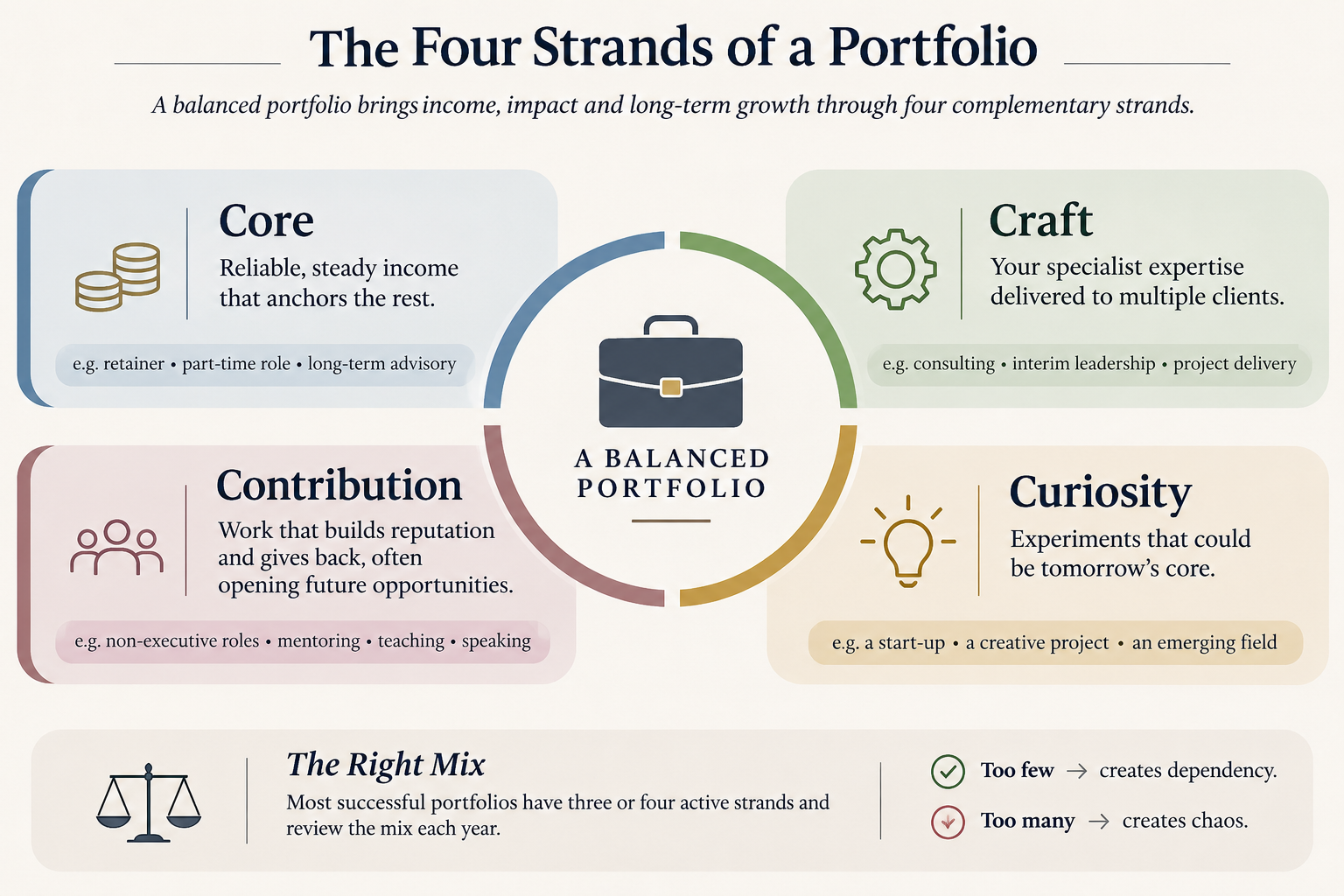
A well-designed portfolio balances different kinds of work. One useful way to plan it is to think in four strands.
- Core. Work that provides reliable income, such as a retainer, a part-time executive role or a long-term advisory contract. It anchors the rest.
- Craft. Your specialist expertise sold to multiple clients: consulting, interim leadership, fractional roles or project delivery.
- Contribution. Activities that build reputation and give back, including non-executive directorships, mentoring, teaching and speaking. They often generate future work as well as satisfaction.
- Curiosity. Experiments that may become tomorrow's core, such as a start-up, a creative project or an exploration of an emerging field. The rise of founders who build lean, technology-enabled ventures is discussed in our article on the AI-native startup.
Most successful portfolios contain three or four active elements and review the mix each year. Too few creates dependency. Too many creates chaos.
To make the model concrete, imagine a former finance director. Her core strand is a three-day-a-month retainer as part-time financial adviser to a growing company. Her craft strand is interim finance leadership for two or three clients a year. Her contribution strand is a non-executive role at a charity and a guest lecture series at a business school. Her curiosity strand is a small advisory product for founders. This is an illustration, not a template, but it shows how each strand serves a different purpose.
Pricing and Time: The Hidden Discipline
Many senior professionals underprice their first independent work because they compare it with a former salary. A salary, however, includes benefits, paid leave, equipment and employer contributions that an independent must now fund personally. Price by the value you create and the scarcity of your expertise, then check that your effective rate covers unbilled time spent on sales, administration and learning. Equally important, guard your calendar. Set a cap on the number of active commitments and leave deliberate gaps for thinking and rest.
The Risks to Manage
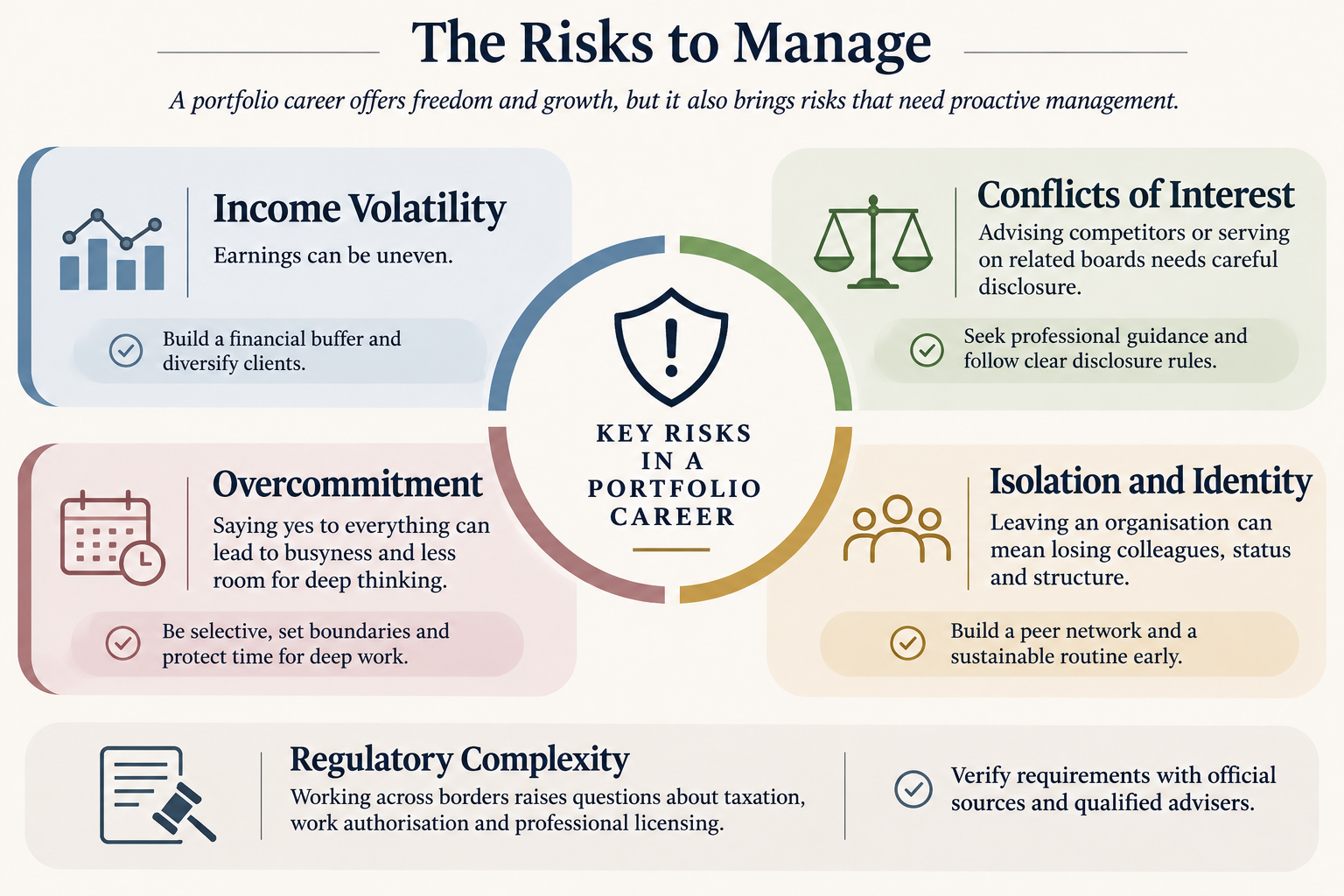
Honest planning means acknowledging the downsides.
- Income volatility. Earnings can be uneven. Hold a financial buffer and diversify clients.
Conflicts of interest. Advising competitors or sitting on boards in related sectors requires careful disclosure and, often, professional guidance. - Overcommitment. Saying yes to everything is the most common error. Portfolio professionals who are always busy often lack the space for deep thinking. Our guide to deep work for executives offers frameworks for protecting focus.
- Isolation and identity. Leaving an organisation removes colleagues, status and structure. Build a peer network and a routine before you need them. The relationship between technology, work and wellbeing is examined in our piece on digital wellness.
- Regulatory complexity. Working across borders raises questions about taxation, work authorisation and professional licensing. Verify requirements with official sources and qualified advisers.
What Organisations Should Learn
The portfolio trend also challenges employers. Experienced talent that once stayed for decades may now offer fractional or project-based expertise instead. Organisations that adapt can access senior capability they could not otherwise afford. That requires clearer scopes of work, faster onboarding and a willingness to treat external experts as genuine partners rather than temporary outsiders. Those that insist on full-time exclusivity may find their talent pool narrowing.
Design It, Do Not Drift Into It
A portfolio career is not simply a job search with extra steps. It is an act of design. The professionals who succeed define their priorities, choose their strands deliberately, protect their time and keep learning. Done well, it offers autonomy, variety and meaning at a stage when many leaders want all three. Done carelessly, it becomes several jobs with none of the security. Treat it with the planning you would give any major strategic decision.
Frequently Asked Questions
What is a portfolio career?
It is a working life built from several concurrent roles or income sources, such as advisory work, a board seat, teaching and a small venture, instead of a single full-time job. Charles Handy popularised the idea in 1989.
What are the four strands of a portfolio?
Core (reliable income), Craft (your specialist expertise sold to several clients), Contribution (boards, mentoring, teaching) and Curiosity (experiments that may become tomorrow's core).
Is a portfolio career financially riskier?
It can be, because earnings may be uneven. Hold a financial buffer, diversify clients and take qualified financial advice. More income sources can add resilience, but only if the portfolio is built carefully.
How should I price my work as an independent?
Price by the value you create and the scarcity of your expertise. Remember that a former salary included benefits and paid leave you must now fund yourself, and allow for unbilled time on sales and administration.